Driving in Rain UK: 4-Second Gap Wet-Weather Rule
Rain doubles UK stopping distances and cuts tyre grip by 30 to 50 percent, so a 4-second gap is the wet-weather minimum. The first ten minutes after a dry spell are the worst, when oil and rubber slick the surface.
How rain changes the physics
On wet tarmac, your tyres lose roughly 30 to 50 percent of their dry grip. Stopping distances roughly double. The 23-metre stopping distance at 30 mph in dry conditions becomes about 46 metres in the wet. The 96-metre stopping distance at 70 mph becomes around 192 metres in heavy rain. Apply the two-second rule and double it: a four-second gap to the car in front is the wet-weather minimum.
The first ten minutes of rain after a dry spell are the worst. Oil, rubber dust, and dirt sit on the road surface. The first rain mixes with these into a slick film before being washed away. If you have been driving on dry roads and rain starts, ease off your speed for the first half hour and treat every junction with extra care.
Headlights and visibility
In any rain heavy enough to obscure visibility, headlights must be on. This is not optional under Highway Code rule 226. Daytime running lights alone are not sufficient because they only light the front of the car; they do not put a red light on the back, which is what other drivers need to see you. Dipped beam is the right choice. Full beam in rain reflects off the water and dazzles you back.
Fog lights are a separate question. They should only come on if visibility drops below 100 metres, which is roughly the length of a football pitch. In ordinary rain, leave them off. In heavy spray on a motorway behind a lorry, rear fog lights can help, but switch them off the moment you have a clear gap behind you.
Aquaplaning: what it is and how to recover
Aquaplaning happens when standing water builds up in front of your tyres faster than they can clear it. The tyres lose contact with the road surface and ride on top of the water. You feel it in the steering as a sudden lightness, and the engine note often rises because the wheels are spinning slightly faster.
Recovery is counter-intuitive but simple. Do not brake. Do not steer. Lift off the accelerator gently and hold the wheel straight. The car will reconnect with the road surface within a second or two as it slows down. Braking or steering during aquaplaning makes it dramatically worse, often causing the car to spin the moment grip returns.
Prevention is better than cure. Maintain tyre pressures (under-inflated tyres aquaplane more easily). Keep tread depth above the legal 1.6 mm; the rubber industry recommends 3 mm for safe wet performance. Avoid driving through standing water at speed, particularly in the outside lane on motorways where water collects in the central reservation channel.
Spray from lorries and motorway rain
Heavy rain on a motorway with lorries produces spray that can reduce visibility to almost zero for seconds at a time. The sequence to handle this is: see the lorry, build a four-second gap (six is better), commit to your overtake, pass decisively, return to lane one. The dangerous moment is sitting alongside a lorry in spray for any length of time, because you cannot see the lane lines or the road ahead.
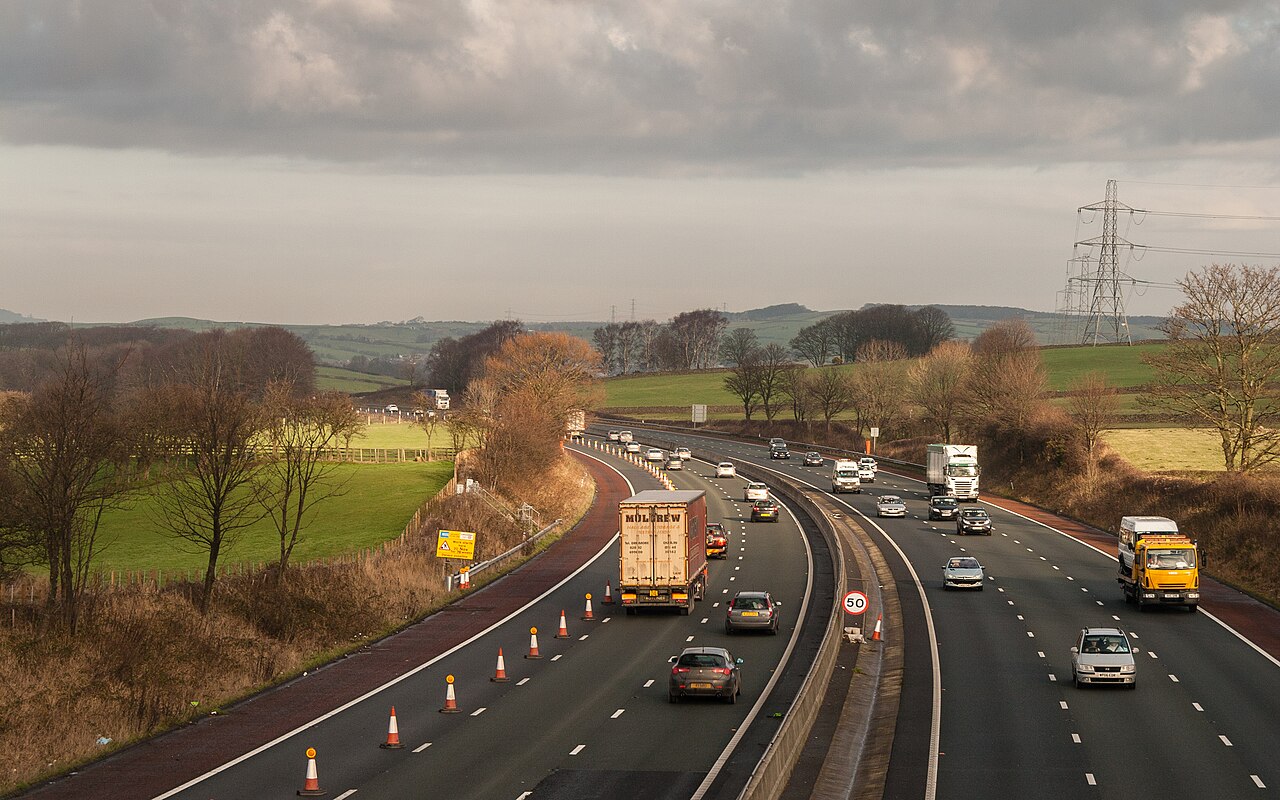
Variable speed limits on smart motorways often drop to 50 mph in heavy rain. These are legally enforceable and average-speed cameras will be running. Treat them as the right speed for the conditions, not as an arbitrary annoyance.
Standing water, fords, and floods
Driving through standing water of unknown depth is one of the most expensive mistakes a UK driver can make. Modern engines are vulnerable to water ingress through the air intake, which causes "hydrolocking" and usually a written-off engine. As a rule of thumb, if the water is more than a third of the way up your tyres, do not drive through it.
If you must cross shallow standing water, do it slowly and steadily in a low gear with the engine revving (this keeps water out of the exhaust). Test your brakes immediately afterwards by gentle application; brake discs can be slick from immersion. If the water is moving (a flooded ford or street), do not enter. As little as 30 cm of moving water can carry a car away.
Pedestrians, cyclists and being seen
- Splashing pedestrians: legal offence under the Road Traffic Act 1988, fine up to £5000 in serious cases
- Cyclists in rain: take a wider berth than usual, they may swerve to avoid potholes hidden by puddles
- Crossings: pedestrians may rush to cross to escape the rain, watch for unpredictable movements
- Children: school run in heavy rain is high-risk because hoods and umbrellas reduce their peripheral vision
Splashing a pedestrian is taken seriously by UK police. Several drivers a year are fined for deliberately driving through puddles next to footpaths. Even an accidental splash can be a public-order offence if it shows a lack of care. Slow down for puddles near pavements.
Putting it together
The summary of UK rain driving is: lights on, gap doubled, speed down, eyes scanning further ahead. The most common wet-weather collisions on UK roads are rear-end shunts (gap too small), single-vehicle losses of control (speed too high for grip), and side-swipes from drivers misjudging spray on motorways. All three are preventable with the same set of habits.
For more on related conditions, the snow and ice guide covers freezing-rain and surface ice, and the fog driving guide covers low visibility specifically. The test conditions overview explains how UK test centres handle rain on test day.
Sources and further reading
The figures, fees, and procedures referenced in this article are verifiable on the official gov.uk pages below. PassRates.uk is built on the Driver and Vehicle Standards Agency’s open data, published under the Open Government Licence.
What is the pass rate at your test centre?
Search by centre name, town or postcode to see the latest DVSA figure.
Frequently asked questions
What is the safe stopping distance in heavy rain?
Roughly double the dry stopping distance. At 70 mph, that is about 192 metres. The practical version is the four-second rule: leave four seconds between you and the car ahead.
What do I do if my car aquaplanes?
Lift off the accelerator gently and hold the steering wheel straight. Do not brake or steer. The car will reconnect with the road surface as it slows.
Are headlights legally required in rain?
Yes, in any rain that reduces visibility (Highway Code rule 226). Daytime running lights alone are not sufficient because they do not light the rear of the car.
When should I use fog lights in rain?
Only if visibility drops below 100 metres. In ordinary rain, leave them off. Switch them off as soon as visibility improves.
Is it illegal to splash pedestrians?
Yes. Driving without due care and attention so as to splash a pedestrian can result in a fixed penalty notice and, in serious cases, a fine of up to £5000.
How deep is too deep for standing water?
A third of the way up your tyres is the maximum for most modern cars. Beyond that, water can enter the engine air intake and cause hydrolocking, which usually writes off the engine.
Every candidate behind these numbers passed a theory test first. Nationally 44.8% of attempts clear it.
Lorries, buses, motorcycles, trams and how to share the road with them safely. All 14 DVSA topics are free to practise, with no sign up. See the theory pass rate by centre or the full practice hub.
Related guides
- Weather and visibilityNight driving (UK learners)Read guide
- Weather and visibilitySnow and Ice DrivingRead guide
- Weather and visibilityDriving in FogRead guide
- Weather and visibilityDriving in Strong WindsRead guide
- Road typesFirst Time on the MotorwayRead guide
- Road typesDual Carriageway DrivingRead guide
Written by Vikas Dulgunde, the software engineer and driving enthusiast behind PassRates.uk. The figures come straight from the DVSA open dataset; see the methodology.
Source DVSA, Open Government Licence v3.0
Continue reading
UK snow and ice driving: tyre choice, gentle inputs, hill technique, the 10-second rule, and 6 mistakes that strand most British drivers each winter.
Night driving for UK learner drivers: Highway Code rules, route choices for unlit roads, dazzle handling, and what to expect about night driving on the UK practical test.