Highway Code Essentials: 80% of Theory Test Questions
Around 80 percent of theory test questions come straight from the Highway Code. Read it twice, learn the 2022 hierarchy and the stopping distances, and the multiple-choice section becomes routine.
Why the Highway Code matters
The DVSA writes theory test questions directly from the Highway Code, Know Your Traffic Signs, and the Driving Skills books. Of the three, the Highway Code is the dominant source. If you understand every rule in the Code, you have already covered around 80 percent of the theory test syllabus before you open a revision app. The theory test explained guide covers the wider exam structure.
The full Code is freely available on gov.uk in HTML form, with the print edition costing under three pounds. Apps and revision packages have their place, but they are summaries of the Code. Working from the source is faster and more accurate.
The structure of the Code
The Highway Code is organised into 10 main sections plus annexes. Some sections are heavily examined, others barely come up. Understanding the weighting helps you spend revision time where it matters.
- Rules for pedestrians: light examined, but the recent priority changes are tested
- Rules for users of powered wheelchairs and mobility scooters: rarely examined
- Rules about animals: rarely examined
- Rules for cyclists: heavily examined since the 2022 hierarchy of road users update
- Rules for motorcyclists: light
- Rules for drivers and motorcyclists: heavily examined
- General rules, techniques and advice: very heavily examined, this is core territory
- Using the road: heavily examined, especially junction priority
- Road users requiring extra care: examined, including the new pedestrian priority
- Driving in adverse weather conditions: well examined
- Waiting and parking: light to moderate
- Motorways: heavily examined
- Breakdowns and incidents: examined, includes accident procedures
- Road works, level crossings and tramways: examined
- Light signals controlling traffic: heavily examined
- Signals to other road users: examined
- Traffic signs: very heavily examined, learn every category
- Road markings: very heavily examined
- Vehicle markings: light
The 2022 hierarchy of road users
The Code was updated in early 2022 to introduce a hierarchy of road users. This change has been heavily examined ever since because it is genuinely new material. The principle is that road users who can do the most harm have the greatest responsibility to reduce danger to others. That ranks pedestrians at the top of the hierarchy, then cyclists and horse riders, then motorcyclists, then car drivers, then larger vehicles.
The practical effect is in priority rules. At a junction, traffic turning into a side road must give way to pedestrians waiting to cross at that side road, as the pedestrian crossings guide and the junctions and priority guide explain. Drivers must not cut across cyclists going straight on at a junction. There is a recommended minimum overtaking distance for cyclists of 1.5 metres at speeds up to 30 mph. These specific rules come up reliably in theory tests.
Traffic signs and road markings
Around a quarter of theory test questions involve traffic signs, road markings, or signal recognition. The Highway Code covers the categories (warning, regulatory, informational, motorway). Know Your Traffic Signs goes deeper. For theory test purposes, the Code coverage is enough as long as you can recognise the shape and colour conventions.
- WarningHazard ahead, slow down and prepare for what is coming.
- ProhibitionNo entry, no parking, no waiting, no stopping.
- MandatoryCompulsory action: turn left, give priority, follow lane.
- InformationDirection signs, parking, services and facility info.
- StopMandatory full stop at the junction line.
- Give waySlow and yield to traffic crossing your path.
Triangular signs warn. Circular signs order (red ring forbids, blue circle commands). Rectangular signs inform. Yellow lozenge-shape signs are temporary. Brown signs point to tourist destinations. Most candidates lose marks on rare signs they have not encountered, so spend time on the less common ones. The traffic light priorities guide and the speed limits guide walk through the most heavily examined regulatory sets.
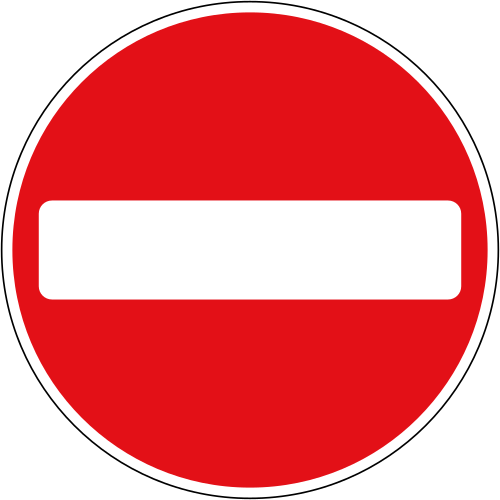 No entryNo entry for vehicular traffic. You must not drive past this sign.
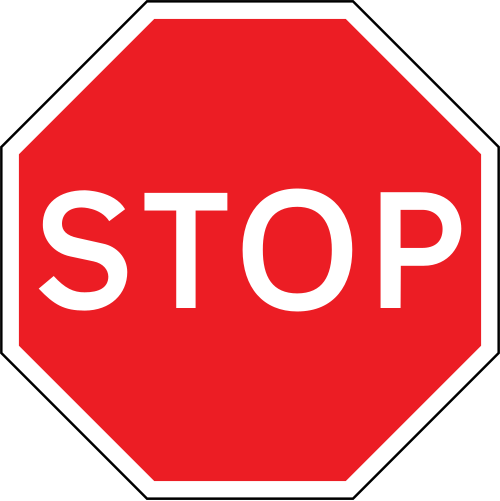 StopYou must come to a complete stop at the solid white line and give way before emerging.
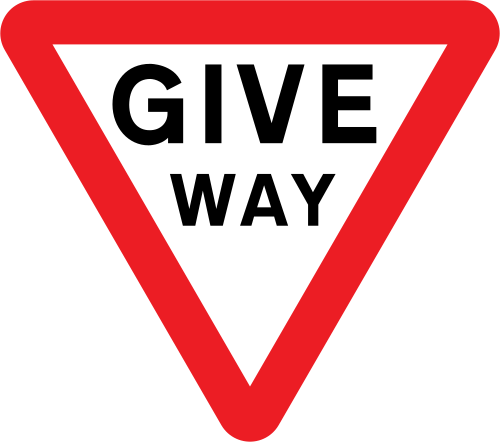 Give wayGive way to traffic on the major road. You do not have to stop if the road is clear.
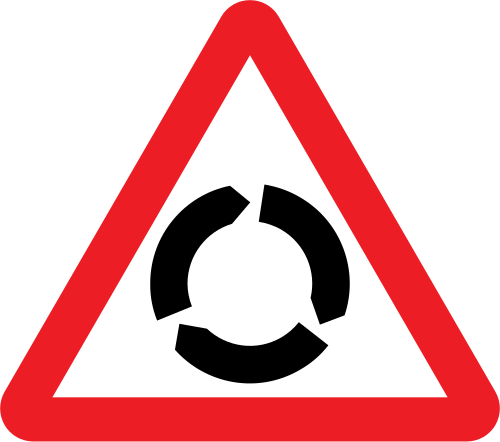 Roundabout aheadA roundabout is ahead. Be ready to give way to traffic from your right.
 National speed limitThe national speed limit applies from this point. For a car that is 60 mph on a single carriageway and 70 mph on a dual carriageway or motorway.
Stopping distances
Stopping distances are tested almost every sitting. The Highway Code numbers are based on dry conditions for an alert driver in a typical car, and the following distance and the two-second rule guide translates them into the gaps you keep on the road.
- 20 mph: 12 metres total stopping distance (3 thinking + 9 braking)
- 30 mph: 23 metres (6 thinking + 14 braking)
- 40 mph: 36 metres (9 thinking + 24 braking)
- 50 mph: 53 metres (12 thinking + 38 braking)
- 60 mph: 73 metres (15 thinking + 55 braking)
- 70 mph: 96 metres (18 thinking + 75 braking)
- Wet roads: double these distances. Icy roads: roughly ten times the dry distance
How to read the Code for the test
Two reads is the minimum. Once cover-to-cover at slow pace, taking notes on the rules that surprise you. A second read focused on the heavy-examined sections. Then use a revision app to test recall. The pattern matters. If you go straight to the app, you fill in your gaps with whatever the app authors decided to emphasise rather than what the DVSA actually examines.
A useful self-test: open the Code at random, cover the page with your hand, then list the rules on that page from memory. If you can do this for the heavy-examined sections, you are ready for the multiple-choice section. The full prep plan ties this into mock tests in the revision strategy guide.
Sources and further reading
The figures, fees, and procedures referenced in this article are verifiable on the official gov.uk pages below. PassRates.uk is built on the Driver and Vehicle Standards Agency’s open data, published under the Open Government Licence.
Could you answer these three?
Loading three practice questions…
Frequently asked questions
Do I need to buy the Highway Code?
No. The full Code is on gov.uk for free. The print version costs around three pounds and many learners prefer it for note-taking, but it is not required.
Is the Highway Code enough on its own?
It is the source for most questions, but you also need hazard perception practice (which the Code does not cover) and ideally Know Your Traffic Signs for the rarer signs. Mock tests are essential for self-testing.
Has the Highway Code changed recently?
Yes. A significant update in 2022 introduced the hierarchy of road users and changed pedestrian priority at junctions. These updates are heavily examined.
How much of the test comes from the Highway Code?
Around 80 percent of theory test questions are drawn directly from Highway Code rules. The rest come from Know Your Traffic Signs and the Driving Skills books.
Should I memorise stopping distances?
Yes. They appear in most theory test sittings. Learn the key speeds (30, 50, 70 mph) precisely and the others by approximate ratios.
Can I read the Code on my phone?
Yes. The gov.uk version is fully mobile-friendly and free. Many learners find it easier to read in short bursts on phone than in a book.
Related guides
- Revision and practiceTheory Revision StrategyRead guide
- Revision and practiceTheory Mock TestsRead guide
- Revision and practiceSigns That Give OrdersRead guide
- Revision and practiceMultiple Choice TipsRead guide
- Understanding the testTheory Test Pass RatesRead guide
- Understanding the testHazard Perception TestRead guide
Written by Vikas Dulgunde, the software engineer and driving enthusiast behind PassRates.uk. The figures come straight from the DVSA open dataset; see the methodology.
Source DVSA, Open Government Licence v3.0
Continue reading
Six-week theory test revision plan: 30 to 60 hours total, 30 to 50 mock tests, hazard practice from week 3, and the 47 plus out of 50 booking trigger.
UK hazard perception test 2026: 14 clips, pass mark 44/75. How scoring windows work, the double clip trap, over-clicking penalty, and a 4-week practice plan.