UK Junction Priority Rules
Priority decides who goes first at every UK junction. Most junctions have signs or road markings that tell you. The unmarked ones rely on a default rule that catches out drivers who have forgotten it.
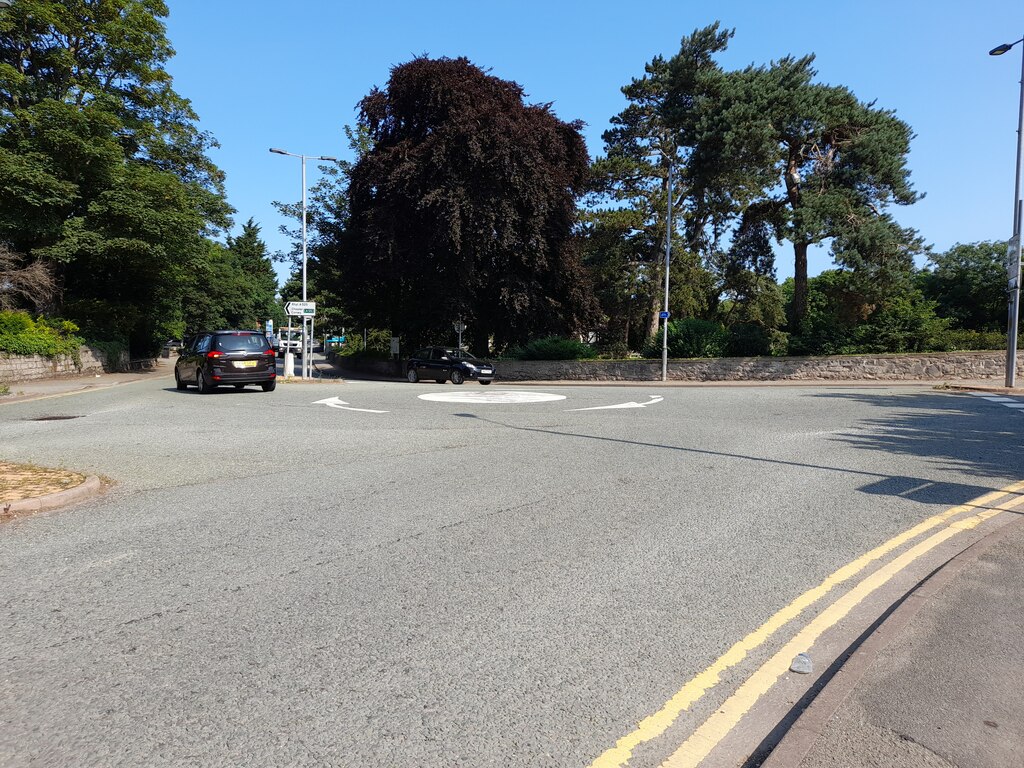
The four types of UK junction
UK junctions fall into four broad categories:
- T-junctions: a minor road meets a major road, usually with give way or stop markings
- Crossroads: two roads cross at a single intersection
- Y-junctions: similar to a T but with the minor road approaching at an acute angle
- Staggered junctions: two T-junctions facing each other across a major road
Each can be controlled (with traffic lights, give way signs, or stop signs) or uncontrolled (no signs or markings). The priority rules differ depending on which category and whether it is controlled.
- T-junctionMinor road gives way at the line, major road has priority.
- CrossroadsOften unmarked. Default rule: give way to traffic from the right.
- Mini roundaboutTreat the white painted spot as a roundabout, give way to the right.
- Standard roundaboutGive way to traffic already on the roundabout.
Give way signs and markings
A give way sign is an inverted red and white triangle. Where one is present, supported by a broken white double line on the road, you must give way to traffic on the major road. You do not need to stop if the major road is clear, but you must be able to stop if it is not.
In practice, "give way" means slow to a speed where you can stop, look both ways properly, and only proceed when the gap is yours. The gap belongs to you when you can complete your manoeuvre without forcing any other vehicle to slow down or change course. If a vehicle on the major road would have to brake for your move, you do not have priority. The Highway Code essentials guide sets out the underlying give way logic in plain English.
Stop signs and markings
A stop sign is a red octagon. Where one is present, supported by a solid white double line on the road, you must come to a complete halt at the line, regardless of whether the major road is clear. Only after stopping may you assess the gap and proceed.
A common test fault is rolling through a stop line at three or four miles per hour without coming to a genuine stop. This is a serious fault. Examiners watch for the wheels to actually stop turning. A complete stop with a brief pause (one or two seconds) is the correct response.
Stop signs are less common than give way signs in the UK; they are placed only where visibility is too poor to allow a moving give-way assessment. If you see a stop sign, the implication is that you cannot see far enough down the major road to gauge a gap while moving.
| Give way | Stop | |
|---|---|---|
| Sign shape | Inverted red triangle | Red octagon |
| Road marking | Broken double white line | Solid double white line |
| Action required | Slow + assess + go if clear | Complete halt at the line, every time |
| Stop if road is clear? | No, may proceed if safe | Yes, mandatory full stop |
| Typical placement | Most UK side-road junctions | Junctions with poor visibility only |
| Test fault if violated | Often a serious fault | Always a serious fault |
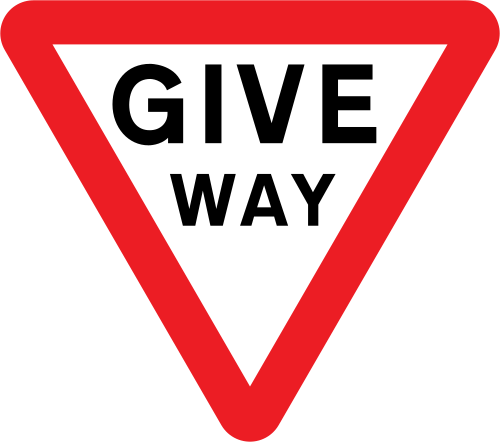 Give wayGive way to traffic on the major road. You do not have to stop if the road is clear.
 StopYou must come to a complete stop at the solid white line and give way before emerging.
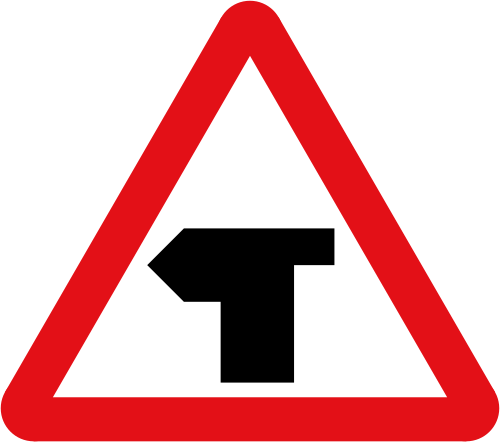 T-junction aheadT-junction ahead. The road you are on ends and you must turn left or right.
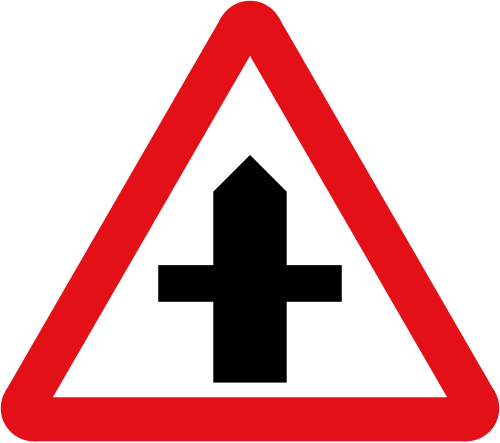 Crossroads aheadCrossroads ahead, where traffic may cross or join from both sides.
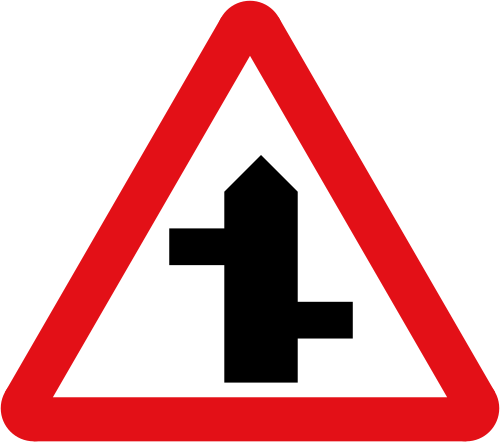 Staggered junctionStaggered junction ahead, with side roads on each side that do not line up.
Uncontrolled junctions
When two roads meet without signs, traffic lights, or give way markings, the default rule applies: give way to traffic from your right. This is the same rule as roundabouts. The driver on the right has priority; the driver on the left waits.
Uncontrolled junctions are common in residential areas, particularly older estates and rural villages. They are also common in cities like Manchester, Liverpool, and Birmingham where Victorian street grids meet at four-way intersections without modern signal control.
In practice, uncontrolled junctions involve eye contact and judgement. If you and the driver on your right reach the junction at roughly the same time, they have priority. If you arrived clearly first and they are well back, you may proceed with caution. The principle is that the give-way rule resolves the ambiguous case; in clear cases, sensible behaviour and eye contact handle it. The crossroads guide walks through the same logic at four-way intersections.
Turning right across oncoming traffic
A right turn from a major road into a minor road requires giving way to oncoming traffic. The right-turner waits at the centre of the major road, indicating, until a safe gap appears in the oncoming flow. This is the most common cause of right-turn faults on UK tests.
The waiting position matters. You position your car just before the centre line of the road, near the centre, with the wheels straight. Wheels straight is essential because if you are hit from behind, you do not get pushed into oncoming traffic. Turning the wheels in advance is a serious fault. The traffic light priorities guide covers right-turn filters that change this picture at signal-controlled junctions.
Two right-turners meeting at a crossroads
When two cars are turning right across each other at a crossroads, two passing methods exist:
- Offside to offside (turning around each other, both vehicles passing on their right): preferred where road space allows
- Nearside to nearside (passing in front of each other, vehicles passing on their left): used when the junction is angled or markings indicate it
The offside-to-offside method is safer because each driver can see oncoming traffic clearly. Examiners do not require a specific method but watch for evidence that the candidate has thought it through. Eye contact with the other right-turner usually resolves which method is being used.
Approach to a junction
The standard approach to any junction follows the mirror, signal, manoeuvre routine. Mirror, signal early, position correctly (left for a left turn, towards the centre for a right turn), reduce speed, look. The look phase is critical: examiners watch for active head movement, not just eye flicks. A genuine look right, then left, then right again at a junction is the right pattern.
Speed on approach should match the visibility. If the major road has good visibility 100 metres in each direction, you can approach faster and use the give-way assessment while moving. If the visibility is poor (parked cars blocking the view, a hedge, a wall), slow more and prepare to come to a near-stop.
- 01Mirror
Centre then door mirror in the direction of the turn. Examiners want to see the head turn, not just the eyes flick.
- 02Signal
Early enough that following drivers can react, late enough that you do not confuse a side-road driver between you and your turn.
- 03Position
Towards the centre line for a right turn, kerbside for a left. Wheels straight if waiting in the middle of the road for a right.
- 04Speed
Match the visibility. Good 100m view = approach gear and ride the give-way assessment. Blind corner = down to first or second, near walking pace.
- 05Look
Right, left, right again with a deliberate head turn. Only commit when the gap is yours without forcing oncoming traffic to brake.
Common junction faults
- Pulling out into traffic with priority (often a fail)
- Stopping unnecessarily at a give way when a clear gap was available
- Rolling through a stop line without a complete halt
- Failing to look properly (eye flicks instead of head movement)
- Turning the steering wheel while waiting to turn right (could be pushed into oncoming traffic)
- Cutting the corner on a right turn into a minor road
- Wide overshooting on a left turn into a minor road
- Misreading priority at uncontrolled junctions and not giving way to the right
“Junction observation is the single most common serious-fault category on the UK car test, year after year. Master the look-right-look-left-look-right routine and you have addressed the biggest failure mode.”
Junctions in different UK cities
London routes have the highest density of complex junctions. Inner London centres regularly feature signal-controlled crossroads, hooked junctions, and gyratories within a single test. Manchester, Birmingham, and Glasgow have similar urban-arterial densities. Smaller centres and rural routes have fewer but generally simpler junctions, which is one factor in their generally higher pass rates.
For a wider view of how junction handling integrates into the rest of the test, the main pass guide covers the structural advice. The faults explained guide shows how junction faults are graded against other categories.
Sources and further reading
The figures, fees, and procedures referenced in this article are verifiable on the official gov.uk pages below. PassRates.uk is built on the Driver and Vehicle Standards Agency’s open data, published under the Open Government Licence.
What is the pass rate at your test centre?
Search by centre name, town or postcode to see the latest DVSA figure.
Frequently asked questions
What does a give way sign mean?
You must give way to traffic on the major road. You do not have to stop if the road is clear, but you must be able to. The gap is yours only when proceeding does not force any other vehicle to slow or change course.
Do I have to come to a complete stop at a stop sign?
Yes. A stop sign requires a full halt, even if the road is clear. Rolling through is a serious fault.
What is the rule at an unmarked junction?
Give way to traffic from your right. This applies whenever no signs, signals, or markings dictate priority.
Should I turn the wheels while waiting to turn right?
No. Keep the wheels straight while waiting at the centre of the road. If you are hit from behind, this prevents you being pushed into oncoming traffic. Turning the wheels in advance is a serious fault.
How do two cars turning right at a crossroads pass each other?
Either offside to offside (passing each other on the right, around each other) or nearside to nearside (passing on the left, in front of each other). Offside to offside is generally safer. Eye contact resolves which is being used.
Can I proceed at a give way if I have to slow down to do it?
Slowing down to manage the manoeuvre is fine. Forcing oncoming traffic to slow for you is not. The gap is yours when proceeding does not affect any other vehicle on the major road.
Every candidate behind these numbers passed a theory test first. Nationally 44.8% of attempts clear it.
Observation, anticipation, concentration and avoiding distractions at the wheel. All 14 DVSA topics are free to practise, with no sign up. See the theory pass rate by centre or the full practice hub.
Related guides
- Junctions and priorityCrossroadsRead guide
- Junctions and priorityBox JunctionsRead guide
- Junctions and priorityMastering RoundaboutsRead guide
- Junctions and priorityMulti-Lane RoundaboutsRead guide
- Speed and following distanceUK Speed LimitsRead guide
- Speed and following distanceTwo-Second RuleRead guide
Written by Vikas Dulgunde, the software engineer and driving enthusiast behind PassRates.uk. The figures come straight from the DVSA open dataset; see the methodology.
Source DVSA, Open Government Licence v3.0
Continue reading
UK lane discipline on dual carriageways, motorways, multi-lane junctions and bus lanes, plus the 7 faults examiners flag for middle-lane hogging and late changes.
UK yellow line parking rules: single and double yellow lines, kerb dashes for loading, time restrictions, and 4 ways they catch out learners on test routes.