Traffic Signs That Give Orders: Red Circles, Blue Circles and What Each One Means
Traffic signs that give orders are always circular. A red ring on a white background prohibits something: no entry, no overtaking, a speed limit, no waiting. A solid blue circle requires a positive action: turn left, keep left, ahead only, mini-roundabout. Shape identifies the category; colour identifies the type of order.

- ProhibitionRed ring on white: you must not. Speed limits, no entry, no overtaking, no waiting.
- MandatorySolid blue circle: you must. Turn left, keep left, ahead only, mini-roundabout.
- WarningRed triangle on white: hazard ahead. Alerts you to prepare, not an order.
- InformationRectangles give directions and information. Not orders.
- StopThe only octagon on UK roads. Mandatory full stop at the junction line.
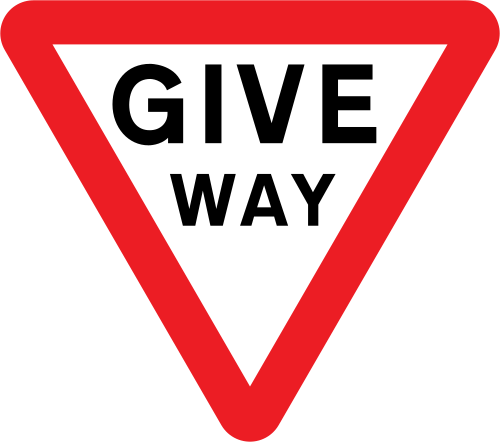
- Give wayInverted triangle: yield to traffic on the major road. You may proceed when clear.
How do you identify traffic signs that give orders?
Shape is the identification key. Signs that give orders are circular. That rule comes from the Highway Code and from the DfT publication Know Your Traffic Signs. If a sign is circular, it is giving you an order, not a warning and not information. Within the circular category, colour separates the two families: red means prohibition, blue means mandatory instruction.
Two shapes break the pattern for safety reasons. The stop sign is an octagon rather than a circle so that it remains recognisable even when obscured by snow or approached at an angle. The give-way sign is an inverted triangle. Both give orders despite not being circular. The theory test may ask about circular signs as a category, and it may also ask specifically about stop or give way, so you need all three identification rules.
Red circle signs: prohibitions (you must not)
A red ring on a white background prohibits. The white background with a red border tells you that the action shown, or the number displayed, is forbidden on that stretch of road. The most common red ring signs are speed limit circles: a number inside a red ring, such as 30, 40 or 50. Others in the family include no overtaking, no U-turn, no left turn, no right turn, no motor vehicles, no cycling, no waiting, and no stopping.
The no entry sign looks slightly different from the rest of the family. It is a solid red disc, not a white circle with a red border, with a white horizontal bar across the centre. The solid disc treatment communicates "closed" rather than "restricted", and it appears at the exit end of one-way streets and at the entrance to areas where through traffic is banned. The no entry sign is one of the most frequently tested signs in the DVSA theory test.
The national speed limit sign also belongs to the red circle family, though it shows a diagonal black stripe rather than a number. Where that sign is displayed, the posted numerical limit has been lifted and you revert to the national limit for the road type: 60 mph on single carriageways, 70 mph on dual carriageways and motorways (lower for lorries, buses and vehicles towing trailers). The speed limits guide covers national and posted limits in full.
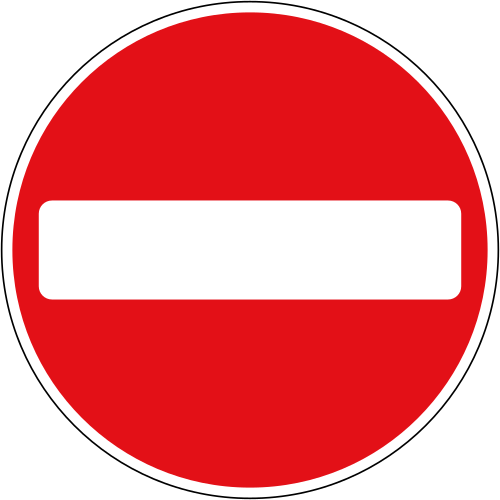 No entryNo entry for vehicular traffic. You must not drive past this sign.
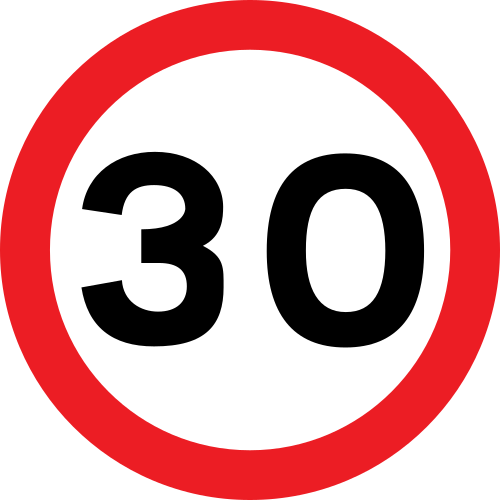 Speed limitA number inside a red ring sets the maximum speed for that stretch.
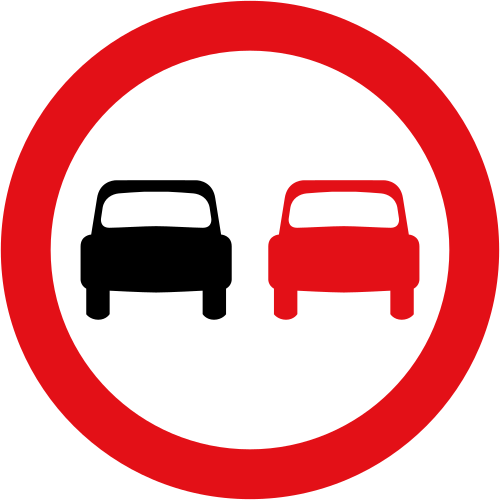 No overtakingNo overtaking. You must not overtake the vehicle in front until the restriction ends.
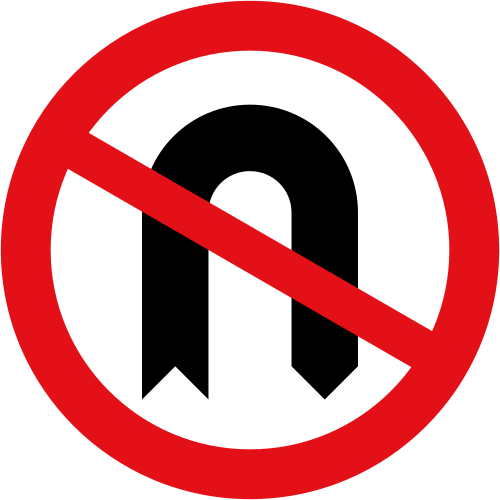 No U-turnsNo U-turns. You must not turn round to go back the way you came at this point.
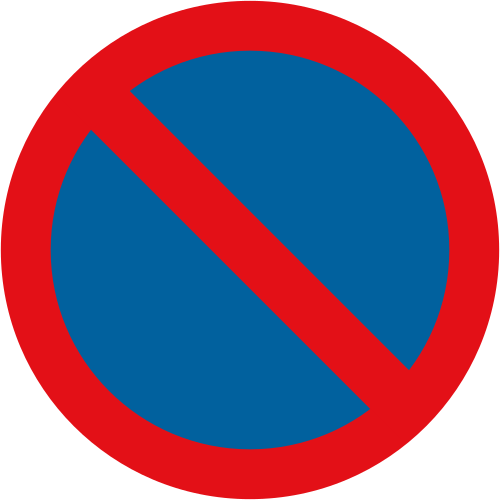 No waitingNo waiting. You may stop briefly to set down or pick up passengers or to load, but you must not wait or park.
 National speed limitLifts the posted limit to the national default for that road type.
Blue circle signs: mandatory instructions (you must)
Solid blue circles give positive instructions. They tell you what you must do, not what you are forbidden from doing. Common mandatory blue circle signs include turn left ahead, turn right ahead, keep left, keep right, ahead only, pass either side, mini-roundabout, and minimum speed limit. You will also see route designations for cycles and segregated paths displayed on blue circles or blue rectangles.
Turn left ahead and keep left are the two blue circle signs most often confused with each other in the theory test. Turn left ahead has an arrow that curves to the left and applies where a left turn is approaching. Keep left has a downward arrow with a left offset and applies to keep-left bollards, central refuges and traffic islands. Both are mandatory orders: ignoring either during a practical test results in a serious fault.
The mini-roundabout sign is a solid blue circle showing a small circular arrow. It signals that a mini-roundabout junction is ahead and applies the standard roundabout priority rule: give way to traffic already on the roundabout from the right. Treating a mini-roundabout as a normal crossroads without checking for circulating traffic is one of the more common serious faults on urban test routes.
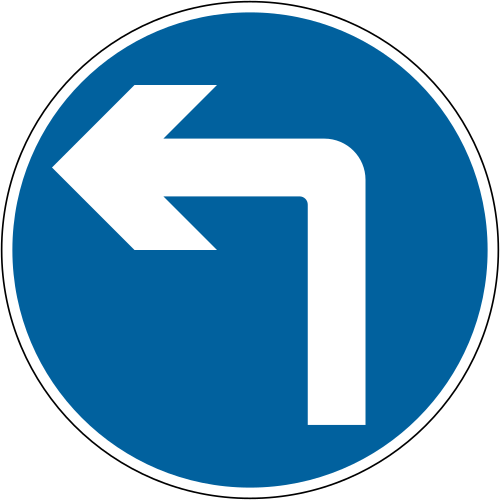 Turn left aheadTurn left ahead. This is a mandatory instruction, not a suggestion.
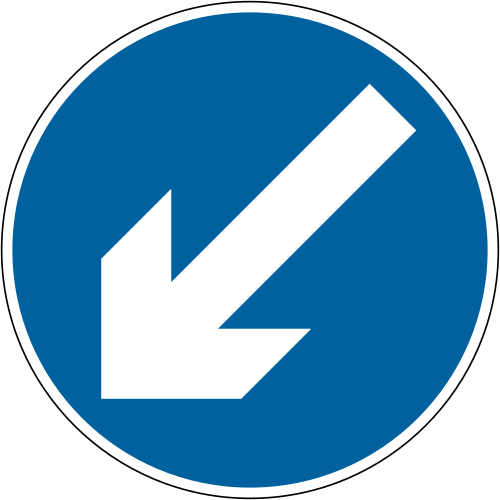 Keep leftKeep left. You must pass to the left of the sign.
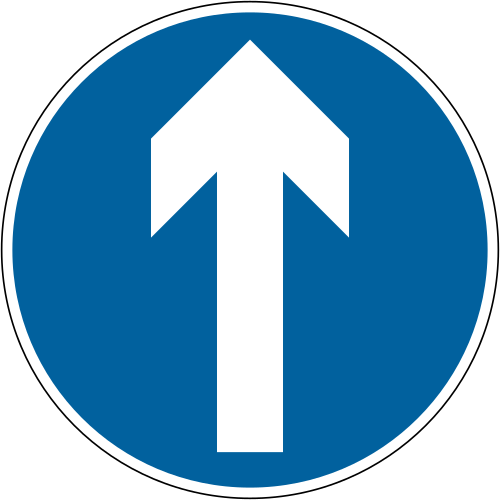 Ahead onlyProceed straight ahead only. Turning is not permitted here.
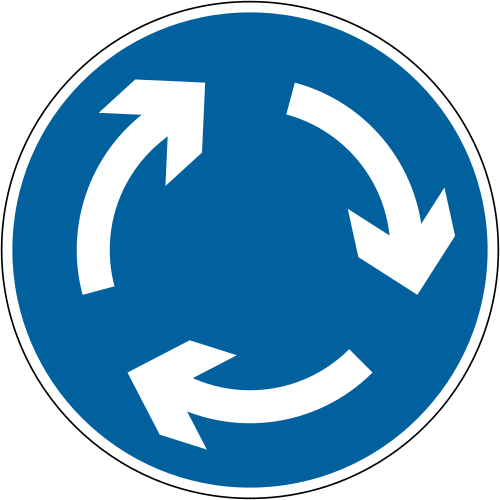 Mini-roundaboutA mini-roundabout ahead. Give way to traffic from your right and pass round the central markings.
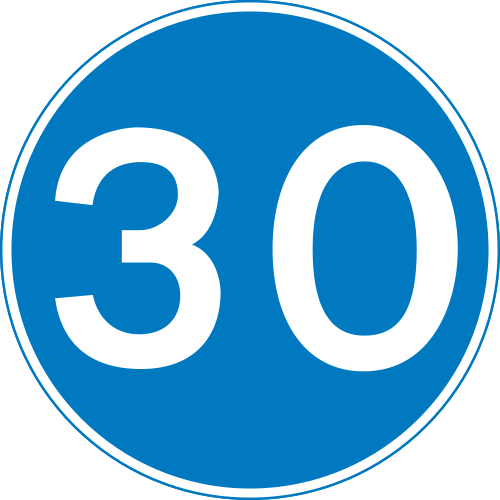 Minimum speedA minimum speed requirement on specific roads, rare but tested.
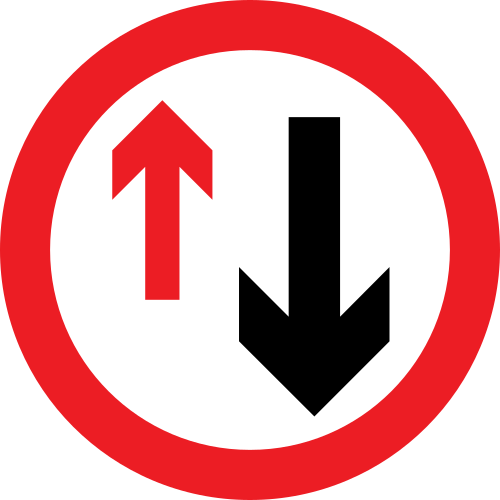 Give priority to oncomingYou must give way to approaching vehicles on a narrow road.
Stop and give-way: ordering signs with unique shapes
Two ordering signs use distinctive shapes rather than circles. Both still give mandatory orders.
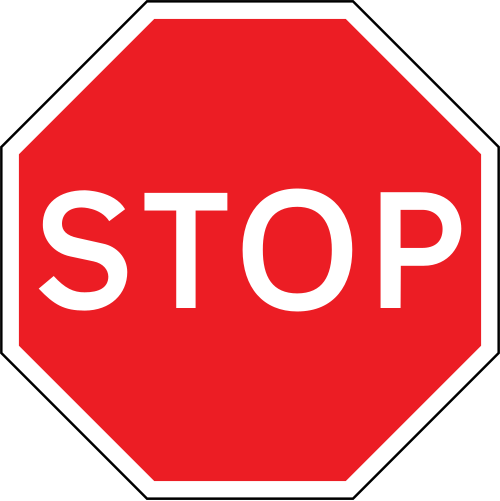
The stop sign is a red octagon with the word STOP in white. It is the only octagonal road sign in the UK. The shape was chosen so that the sign remains identifiable at acute angles and when partly obscured by snow, vandalism or overgrown hedges. At a stop sign you must bring the vehicle to a complete standstill at the junction line, even when the road appears clear. The Highway Code (rule 172) is explicit: give way to traffic on the road you are entering. Slowing down without stopping is a serious fault on a driving test.
The give-way sign is an inverted triangle with a red border on a white background, sometimes accompanied by a "GIVE WAY" road marking painted on the carriageway. At a give-way junction you must yield priority to traffic on the major road. Unlike stop, you do not need to come to a complete stop if the road is clear and you can assess it safely at slow speed. The examiner watches for an effective observation -- looking both ways and into the junction approach -- before the candidate emerges. A slow roll without proper observation is consistently in the top ten causes of serious practical test failures.
Signs that give orders versus warning signs and information signs
The most common confusion on theory test sign questions is between ordering signs and warning signs. Warning signs are triangular with a red border on a white background. They alert you to a hazard ahead, such as a bend, a crossroads, a school, or a level crossing, but they do not tell you what to do in response. A junction warning triangle tells you a junction is ahead; the give-way sign at the junction tells you to yield. The two can appear close together on the same approach.
Information signs are typically rectangular. Blue rectangles carry motorway direction information. Green rectangles carry primary route directions. White rectangles carry local directions. Brown rectangles carry tourist destination information. Rectangular signs guide and inform. None of them issue orders, though some rectangular signs clarify the scope of an order nearby (such as plates showing "except buses" or "6:30am to 10pm").
Temporary signs are yellow with black text or symbols. They override permanent signing during roadworks. A temporary 50 mph limit displayed on a yellow board overrides the normal posted limit for the duration of the works. Temporary signs appear in the theory test and on test routes: examiners can direct candidates through active roadworks zones where temporary speed limits apply.
How ordering signs appear in the theory test
The DVSA draws theory test questions about signs from Know Your Traffic Signs (DfT, updated 2019) and from the Highway Code. Sign identification questions appear in the 50-question multiple-choice section. A question may show an image of a sign and ask for its meaning, or describe a situation and ask which sign a driver should expect to see. Some questions ask a category question without showing an image: "what shape are signs that give orders?" The correct answer is always circular, with the stop and give-way shapes as noted exceptions.
Common theory test question patterns for ordering signs include: what does a blue circle sign mean? What does a red ring sign mean? Which sign means no entry? What is the difference between no waiting and no stopping? At which junction sign must you make a complete stop even when the road is clear? Knowing the shape and colour rules lets you answer the category questions immediately, then use the specific sign knowledge to answer image-based questions.
Ordering signs on your practical driving test route
Every practical test route includes the full range of ordering signs. Speed limit circles are the most frequent: a 30 mph circle typically appears at the boundary of a built-up area and at key junctions along the route. If the route passes through a 20 mph zone, a 20 mph circle will be signed at the boundary. The examiner notes whether the candidate observes the posted limit throughout the test, not just at the sign itself.
Give-way signs appear at virtually every junction on a test route. The examiner watches for a full assessment of the junction before the candidate emerges, even when the road appears clear. Candidates sometimes look but do not effectively observe, particularly at junctions with restricted visibility or where the first observation is taken too early in the approach. The driving test faults explained guide covers how junction observation is assessed.
Turn left ahead or turn right ahead signs appear at complex junctions or lane-choice points where the road layout could be ambiguous. Compliance with a blue circle turn sign is mandatory: ignoring it is a serious fault, not a minor. Examiners sometimes include these junctions to test whether candidates read and act on road signs independently, rather than relying on verbal directions from the examiner. The theory test to practical timing guide explains how sign knowledge built for the theory test transfers to the practical.
Sources and further reading
The figures, fees, and procedures referenced in this article are verifiable on the official gov.uk pages below. PassRates.uk is built on the Driver and Vehicle Standards Agency’s open data, published under the Open Government Licence.
Could you answer these three?
Loading three practice questions…
Frequently asked questions
How can you identify traffic signs that give orders?
Signs that give orders are circular. A red ring on a white background means prohibition (you must not do the action shown). A solid blue circle means mandatory instruction (you must do the action shown). Two exceptions use unique shapes: the stop sign is a red octagon, and the give-way sign is an inverted red-border triangle.
What is the difference between a red circle sign and a blue circle sign?
A red ring sign prohibits an action or sets a restriction, such as a speed limit or a no-entry ban. A blue circle sign requires a positive action, such as turning left, keeping left, or complying with a mini-roundabout instruction. Red restricts; blue commands.
Does the give-way sign give an order?
Yes. The give-way sign is an ordering sign despite not being circular. It is an inverted triangle with a red border, and it requires you to yield priority to traffic on the major road. You do not need to stop if the road is clearly safe, but you must give way to any approaching vehicle before emerging.
Does the stop sign give an order?
Yes. The stop sign is a red octagon with STOP in white text and gives a mandatory order to bring the vehicle to a full standstill at the junction line. You must stop even when the road appears clear. Slowing down without stopping is a serious fault on the driving test.
What shape are signs that give orders?
Circular, as the general rule. Red ring on white for prohibitions, solid blue for mandatory instructions. The stop sign (octagon) and give-way sign (inverted triangle) are the two exceptions that also give orders but use unique shapes for recognition at speed or in poor conditions.
What are the three main types of UK road signs?
The three main types are: signs that give orders (circular, plus the stop octagon and give-way triangle), warning signs (red-border triangles that alert to hazards), and information signs (rectangles that provide directions and guidance). Knowing which category a sign belongs to tells you immediately whether it is an instruction, a warning, or information.
Related guides
- Revision and practiceTheory Revision StrategyRead guide
- Revision and practiceTheory Mock TestsRead guide
- Revision and practiceHighway Code EssentialsRead guide
- Revision and practiceMultiple Choice TipsRead guide
- Understanding the testTheory Test Pass RatesRead guide
- Understanding the testHazard Perception TestRead guide
Written by Vikas and the PassRates.uk team. Vikas is the software engineer and driving enthusiast who started the site. The figures come straight from the DVSA open dataset; see the methodology.
Source DVSA, Open Government Licence v3.0
Continue reading
The UK driving test backlog is running at 11.1 weeks nationally in July 2026, with Scotland averaging 15.6 weeks and some centres above 30 weeks. Find out what is causing the wait, which regions are worst affected, and what options young drivers have while they wait.
Only 21,811 candidates passed the UK practical driving test with zero faults in 2024-25, which is 2.4% of all passes and 1.2% of all tests. What counts as a fault, whether aiming for zero faults changes how you drive, and which centres see the most clean sheets.