Northampton Driving Test Centre Pass Rate 2024-25
Northampton driving test centre returned a 50.4% pass rate in 2024-25 on 12,825 practical car tests, placing it 1.7 percentage points above the national average of 48.7%. With over 12,000 tests annually, Northampton is one of the larger DVSA centres in the East Midlands, and its 2024-25 figure represents the highest pass rate recorded at the centre since 2016-17 after a dip to 44.8% in 2019-20.
- Pass rate 2024-25
- 50.4%on 12,825 tests at Northampton
- vs UK average
- +1.7ppnational average 48.7%, 2024-25
- First-time pass rate
- 50.8%on 6,143 first-attempt candidates
- Gender gap
- 0.7ppmen 50.7% vs women 50.0%, 2024-25
The 2024-25 result in context
At 50.4%, roughly one in two candidates leaves Northampton with a pass certificate. That is 1.7 percentage points above the national average of 48.7%, placing the centre in the upper half of the national ranking but not among the top tier. With 12,825 tests in 2024-25, Northampton is a high-volume centre, and the sample size gives the 50.4% figure considerable statistical reliability: the 95% confidence interval is approximately plus or minus 0.9 percentage points.
The first-time pass rate at Northampton in 2024-25 is 50.8%, based on 6,143 first-attempt tests with 3,123 passing. This is 0.4 percentage points above the overall pass rate of 50.4%, a very small margin. At most centres the overall figure sits above the first-time rate because retakers perform better on average than first-timers. The near-identical figures at Northampton suggest a broadly balanced candidate mix without a strongly skewed retaker population.
Northampton against nearby East Midlands centres
Northampton at 50.4% in 2024-25 sits above all of its nearby neighbours. Wellingborough, the closest centre at 10.0 miles, returned 55.1% on 1,477 tests, which is higher than Northampton but on a much smaller sample. Kettering at 12.4 miles came in at 46.0% on 8,489 tests. Rugby at 17.9 miles also returned 46.0% on 7,174 tests, and Bletchley at 18.1 miles recorded 45.7% on 9,783 tests. Northampton at 50.4% is the highest-performing of the four large-volume centres in its immediate area.
Wellingborough outperforms Northampton by 4.7 percentage points, but its test volume of 1,477 is less than 12% of Northampton's. The higher pass rate at smaller local centres like Wellingborough often reflects a quieter local road network rather than the same candidate pool as the main town centre. Candidates in Northampton itself will typically test at Northampton rather than travelling to Wellingborough, which is served by a smaller centre with more limited slot availability.
Ten-year pass rate history at Northampton: 2015-16 to 2024-25
The DVSA data for Northampton covers ten years from 2015-16 to 2024-25, excluding the pandemic year. Over that period the pass rate has fluctuated by 8 percentage points, from a high of 52.8% in 2016-17 to a low of 44.8% in 2019-20. The 2019-20 low is notable because the national average was also suppressed in that year, and Northampton's gap to the national average narrowed to near zero. Since then the centre has recovered steadily, with 2024-25 at 50.4% representing the strongest result since the 2016-17 peak.
The declining trend from 2016-17 to 2019-20 coincided with a period of significant volume growth: tests conducted at Northampton rose from 8,537 in 2016-17 to 9,659 in 2019-20. Larger volumes tend to include more retakers and candidates with fewer prepared hours, which can suppress the headline pass rate. The recovery from 2021-22 onwards, again alongside growing test volumes (from 9,732 in 2021-22 to 12,825 in 2024-25), shows that the improvement is genuine rather than a volume-driven statistical effect.
Male and female pass rates at Northampton
Male candidates at Northampton passed at 50.7% in 2024-25, based on 7,290 tests with 3,696 passing. Female candidates passed at 50.0% on 5,535 tests with 2,768 passing. The gender gap of 0.7 percentage points in favour of male candidates is significantly narrower than the national figure of 1.9 percentage points (men 49.5%, women 47.6% nationally). Both male and female candidates at Northampton slightly outperform their respective national averages, and the near-symmetry of the two figures suggests that the Northampton road environment does not differentially advantage or disadvantage either group.
| Male | Female | |
|---|---|---|
| Northampton pass rate | 50.7% | 50.0% |
| National average | 49.5% | 47.6% |
| Northampton vs national | +1.2pp | +2.4pp |
| Tests conducted (Northampton) | 7,290 | 5,535 |
The narrow gender gap at Northampton is a consistent feature. In 2022-23 male candidates passed at 48.8% and female candidates at 46.4%, a gap of 2.4 percentage points. In 2023-24 male candidates returned 50.4% and female candidates 47.9%, a gap of 2.5 percentage points. The compression of that gap to 0.7 percentage points in 2024-25 is a more notable improvement for female candidates than the overall headline figure might suggest.
What the Northampton test route covers
The DVSA does not publish official route maps, and examiners vary routes. Northampton is a large town in the East Midlands with a mix of older town-centre streets, post-war estates and newer development around the ring road. Based on the road network, practical tests from Northampton are likely to include:
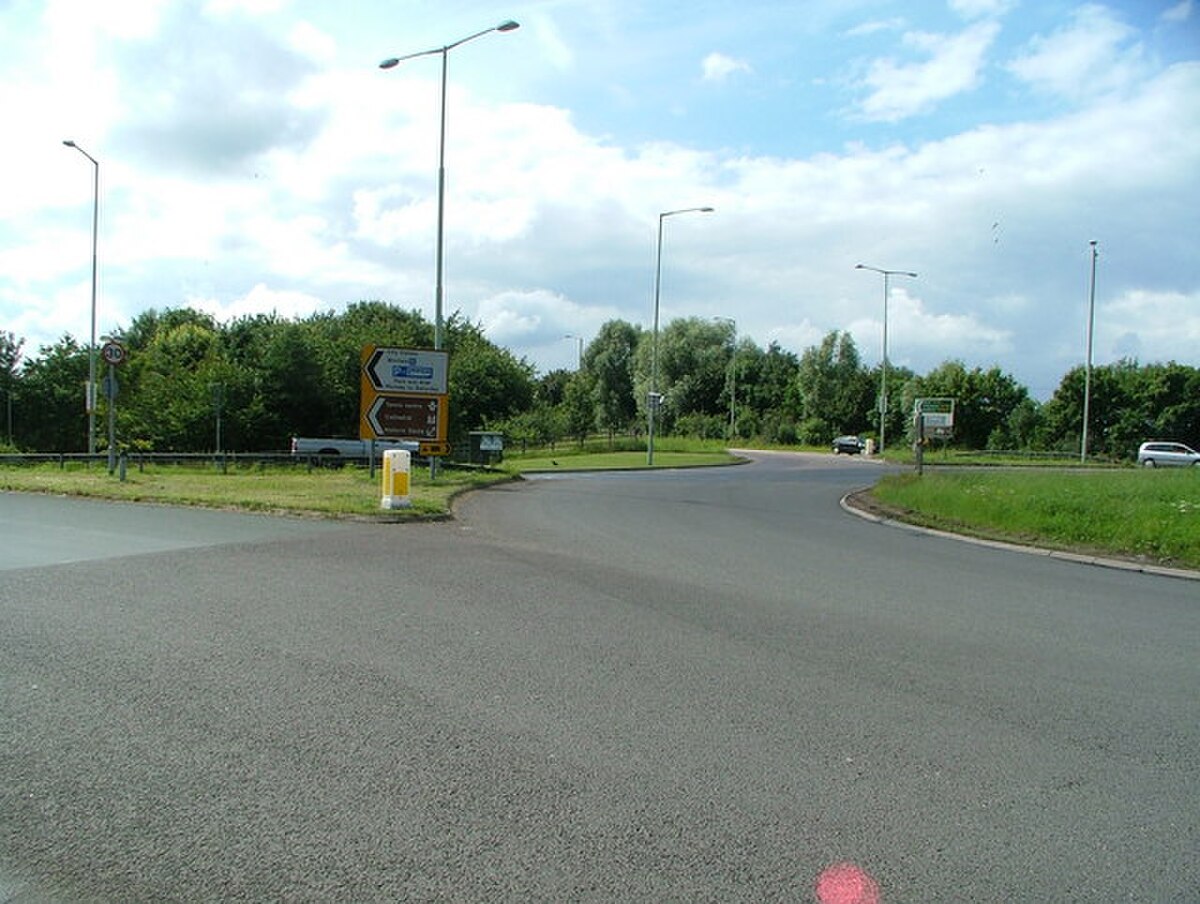
- The Northampton ring road and its roundabouts: the town is served by a series of roundabouts linking arterial roads. Lane selection and confident entry at these roundabouts are a consistent assessment point. Multi-lane roundabouts with gyratory systems appear in some Northampton routes.
- Suburban residential streets in the Kingsthorpe, Abington and Weston Favell areas: on-street parking, give-way junctions, pedestrian crossings and residential side-street observation feature throughout.
- A-road sections on the A45, A43 and A508: these roads carry commuter and commercial traffic at national speed limit or 50 mph. Safe lane changing, following distance, and speed management in varying conditions are assessed on these routes.
- Dual carriageway sections: some Northampton routes include brief dual carriageway sections on the A45 or similar roads. Joining from a slip road, maintaining appropriate speed, and signalling correctly before exiting are assessed when these sections are included.
- Independent driving via sat-nav: the 20-minute independent section covers Northampton roads without examiner instruction. The town layout includes several ring-road junctions and retail park accesses that can require confident route decisions under moderate traffic pressure.
Preparing for your test at Northampton
A 50.4% pass rate means that almost one in two candidates leaves Northampton without a pass certificate. The DVSA marking standard is identical at every centre in Great Britain, and Northampton's road mix of residential streets, ring-road roundabouts and A-road sections covers a broad range of skills. Preparation targeted at the specific roads and junction types around the centre is the most effective investment of final lesson time.
- 01Practise the ring road roundabouts in lesson time
The Northampton ring road roundabouts and their lane choices are the most frequently cited pressure point for candidates at this centre. Work through each major roundabout on the ring road system with your instructor, practising correct lane selection from approach, confident entry timing, and correct exit signal and positioning until the sequence is automatic.
- 02Cover A45 and A43 sections at test times
The A45 and A43 carry heavy traffic with variable speed limits and frequent junction accesses. Practise maintaining appropriate following distance at 50 mph and 60 mph, and joining from slip roads. Candidates who spend all their lesson time on 30 mph residential streets can find the speed management demands on faster roads catching them off guard during the test.
- 03Build residential street observation habits
Northampton residential areas involve on-street parking, parked delivery vehicles reducing forward visibility, and junctions from side streets. Develop consistent observation before turning across traffic and before passing stationary vehicles, particularly in Kingsthorpe and Abington where these features are dense.
- 04Practise dual carriageway joining and lane changes
If your test includes a dual carriageway section, the examiner will assess the join from the slip road and your lane discipline at speed. Practise building to appropriate speed before joining the main carriageway, mirror checks before lane changes, and signalling correctly before exiting. Hesitant joining on a dual carriageway is a common fault at centres with this route element.
- 05Complete a full mock test in the Northampton area
A mock test conducted by your instructor on the actual roads around the centre is the most accurate preparation available. Ask for a fault-by-fault debrief at the end and allocate remaining lesson time to the specific fault categories identified rather than general driving. A targeted final lesson is more useful than a repeat of what you can already do well.
Booking and what to expect on test day
Bookings for the DVSA practical test at Northampton are made through the DVSA online booking service on gov.uk using your provisional driving licence number and your theory test pass certificate number. With over 12,000 tests per year, Northampton carries a significant test volume, and slot availability is generally better than at smaller local centres. Cancellations return to the booking system throughout the day, so checking regularly can surface earlier slots if demand in your area is high.
The practical test at Northampton follows the standard DVSA format: eyesight check, one vehicle safety question, approximately 40 minutes of driving including the independent driving section and one standard manoeuvre (bay parking, parallel parking or pulling up on the right). The emergency stop is carried out on roughly one in every seven tests. Passing requires no more than 15 minor faults and zero serious or dangerous faults.
“Northampton returned 50.4% in 2024-25 on 12,825 tests, the highest figure recorded at the centre since 2016-17 and a 5.6-percentage-point recovery from the 2019-20 low of 44.8%.”
Sources and further reading
The figures, fees, and procedures referenced in this article are verifiable on the official gov.uk pages below. PassRates.uk is built on the Driver and Vehicle Standards Agency’s open data, published under the Open Government Licence.
What is the pass rate at your test centre?
Search by centre name, town or postcode to see the latest DVSA figure.
Frequently asked questions
What is the pass rate at Northampton driving test centre?
Northampton driving test centre recorded a 50.4% pass rate in 2024-25, based on 12,825 practical car tests. The national average in 2024-25 is 48.7%, placing Northampton 1.7 percentage points above the UK figure. The 2024-25 result is the highest pass rate recorded at the centre since 2016-17.
Is Northampton a good driving test centre?
By published pass rate, Northampton is slightly above the national average at 50.4% in 2024-25 compared with 48.7% nationally. It is above all of its large-volume nearby neighbours: Kettering and Rugby both returned 46.0%, and Bletchley 45.7%. Wellingborough returned 55.1% but on a much smaller sample of 1,477 tests.
How does Northampton compare to nearby test centres?
Among the centres near Northampton in 2024-25: Wellingborough returned 55.1% (1,477 tests), Kettering 46.0% (8,489 tests), Rugby 46.0% (7,174 tests), and Bletchley 45.7% (9,783 tests). Northampton at 50.4% is the best-performing of the four large-volume centres in its immediate area.
What is the first-time pass rate at Northampton?
The first-time pass rate at Northampton in 2024-25 is 50.8%, based on 6,143 candidates. This is 0.4 percentage points above the overall pass rate of 50.4%, a very small margin, suggesting a broadly balanced mix of first-time and retake candidates at this centre.
What is the gender pass rate at Northampton?
Male candidates passed at 50.7% at Northampton in 2024-25 based on 7,290 tests, and female candidates at 50.0% based on 5,535 tests, a gender gap of 0.7 percentage points. The national gender gap in 2024-25 is 1.9 percentage points (men 49.5%, women 47.6%). The unusually narrow gap at Northampton indicates that both male and female candidates perform similarly relative to each other at this centre.
How has the Northampton pass rate changed over time?
Northampton's recorded pass rate peaked at 52.8% in 2016-17 before declining to a low of 44.8% in 2019-20 as test volumes grew. Since 2021-22 the pass rate has recovered steadily: 47.8% in 2021-22, 47.7% in 2022-23, 49.2% in 2023-24, and 50.4% in 2024-25. The 2024-25 figure is the highest since 2016-17.
Where is Northampton driving test centre located?
Northampton driving test centre is located in Northampton, Northamptonshire, in the East Midlands. It serves candidates from Northampton and the surrounding area. Bookings are made through the DVSA booking service on gov.uk using your provisional licence number and theory test pass certificate number.
Related guides
Written by Vikas and the PassRates.uk team. Vikas is the software engineer and driving enthusiast who started the site. The figures come straight from the DVSA open dataset; see the methodology.
Source DVSA, Open Government Licence v3.0
Continue reading
Luton driving test centre returned a 40.1% pass rate in 2024-25 on 8,304 tests, 8.6 percentage points below the national average. Pass rate history from 2007-08, gender breakdown, nearby centre comparison and preparation advice for candidates in Bedfordshire.
Kendal (Oxenholme Road) driving test centre recorded a 64.8% pass rate in 2024-25, making it one of the two highest-ranked centres in England with at least 1,000 tests. Full history from 2015-16, gender breakdown, nearby Cumbria comparisons and preparation advice for this rural market-town centre.