The California DMV test, and how to pass it
California DMV states that you need 80 percent to pass the Class C knowledge test, and its Provisional Licensing fact sheet lets under-18s miss no more than 8 questions, but it does not publish the number of questions on any current page. The widely quoted 36 questions for adults and 46 for under-18s come from DMV research reports published in December 2006 and April 2008, the most recent official statements of those counts.
Source: California DMV, Learner's Permits, checked September 25, 2026. California DMV.
What the format is, and who says so
| Questions asked | 36California DMV Research and Development Branch report RSS-06-221 (December 2006), checked September 25, 2026For applicants 18 and over. Applicants under 18 sat a different form with 46 questions. No current DMV consumer page publishes either count: both come from a 2006 DMV research report, restated in an April 2008 one (RSS-08-226), which is why we name the source rather than stating the number bare. |
| Right answers needed | 30California DMV Research and Development Branch report RSS-06-221 (December 2006), checked September 25, 2026Six errors allowed for adults on the 36 question form; eight errors allowed for under-18s on the 46 question form. The under-18 limit is still in print: DMV's Provisional Licensing fact sheet (FFDL 19, revised July 2019) says a provisional applicant may miss no more than 8 questions. |
| Pass mark as a percentage | 80% published, though 30 of 36 is 83.3%California DMV, Learner's Permits, checked September 25, 2026DMV states 80 percent, but the documented error allowances work out at 83.3 percent for adults and 82.6 percent for under-18s. The two do not reconcile, so treat 80 percent as a floor and aim well above it. |
| Learner permit age | 15 years and 6 months with driver education, or over 17 years and 6 months without it (no drive test until 18)Vehicle Code s. 12509(a); California DMV, Learner's Permits, checked September 25, 2026 |
| Supervised hours | 50 hours, of which at least 10 must be at nightCalifornia Driver's Handbook (DL 600); Vehicle Code s. 12814.6, checked September 25, 2026Under-18 applicants only. The supervisor is a California-licensed driver 25 or over, except that a parent, spouse, guardian or licensed or certified driving instructor can be any age. Plus 6 hours of professional training and a 6 month permit hold. Adults have no supervised hours requirement. |
| Retakes | Three attempts per application, then you must reapplyCalifornia Driver's Handbook (DL 600), the testing process, checked September 25, 2026Applicants under 18 must also wait seven days before retaking a failed knowledge test, not counting the day of the failure. DMV's Provisional Licensing fact sheet (FFDL 19, revised July 2019) gives the same wait and lets a provisional applicant miss no more than 8 questions. |
Where California goes its own way
California defines lane splitting in its vehicle code (CVC 21658.1), and it applies a universal helmet law to every rider and passenger at every age. It sets four separate alcohol thresholds rather than one, including 0.01 for anyone on DUI probation and 0.01 for drivers under 21. Minimum liability insurance rose to 30/60/15 on January 1, 2025. Daylighting rules now bar parking within 20 feet of the approach side of any crosswalk, marked or not, or 15 feet where a curb extension is present. Drivers under 18 may not use a phone while driving, hands-free included, except in an emergency, and on a two-lane highway where passing is unsafe, a slow driver must pull over once five vehicles have lined up behind them. The painted curb colors carry five specific legal meanings, which the test does ask about.
| Alcohol limits | 0.08 adult, 0.01 under 21, 0.01 on DUI probation |
| Helmet | Universal, every rider and passenger, every age |
| Lane splitting | Defined in statute, CVC 21658.1 |
| Minimum insurance | 30/60/15 since January 1, 2025 |
| Parking | No parking within 20 feet before a crosswalk, 15 at a curb extension |
The California paper here carries 27 questions on rules of that kind, alongside 98 drawn from the material that reads the same in every state, federal sign shapes and right of way included.
What is the path from a learner permit to an unrestricted Class C license?
California splits that path by age. Under 18 you are in the Brady-Jared Teen Driver Safety Act program (California Vehicle Code section 12814.6): instruction permit, a 6-month hold, driver education plus driver training, 50 hours of supervised practice, a behind-the-wheel test, then a license marked provisional. Apply at 18 or older and the education, training, hold, and supervised-hour rules drop away. You still need the knowledge test, a vision screen, and a drive test if you have never been licensed.
- 15 years and 6 monthsInstruction permit
Finish driver education (or enroll in an integrated program), have a parent or guardian sign the application (both, if custody is shared), pay the $46 fee, and pass vision and the knowledge test. CVC 12509(a). DMV's Driver Training Schools page says the permit becomes valid only once a professional instructor signs it after at least one hour of behind-the-wheel training.
- After that first hourPermit becomes valid
Practice only with a California-licensed driver whose privilege is not on probation: your parent, guardian, or spouse or a licensed or certified driving instructor at any age, or anyone else who is 25 or older (CVC 12814.6(a)(1)). You may not drive alone, including to a DMV office for the drive test.
- 16, and 6 months heldEligible for the drive test
The 6 months count from the day the permit was issued (Teen Driver Tips). You also need proof of both driver education and driver training, plus the signature on the permit certifying 50 hours of practice, 10 of them at night. Book at dmv.ca.gov/make-an-appointment.
- First 12 months of the licenseProvisional restrictions
No driving 11 p.m. to 5 a.m., and no passengers under 20, unless a licensed parent or guardian, a licensed driver 25 or older, or a licensed or certified driving instructor is with you. Separate from that clock: anyone under 18 is banned from using a phone while driving, hands-free included (CVC 23124).
- 18th birthdayPhone ban ends
CVC 23124 stops applying. CVC 12814.6(b) counts the night and passenger rules only as 12 months from the issue date, while DMV's Parent-Teen Training Guide (DL 603) describes them as lasting the first year or until you turn 18. A points restriction, suspension, or probation runs its full term even past 18 (CVC 12814.6(g); Fast Facts 19).
The application and the $46 fee are good for 12 months from the day you apply, and DMV's Teen Driver Roadmap says the permit is good for up to one year from that same date. CVC 12509(c) sets an outer limit of 24 months from the application date on driving with a permit issued under 12509(a), but DMV's own pages work to the 12-month figure. If the application runs out before you have held the permit for 6 months, DMV's FAQ says you reapply at a DMV office and keep credit for the months already held. Bring both the expired permit and the new one to the drive test.
Which driver education and training route do I take?
Under 18 you must complete both driver education (the classroom, home-study, or internet course) and driver training (professional behind-the-wheel hours) before the drive test. CVC 12814.6(a)(3) names the legal routes, and outside an integrated program you may not start training until education is finished (CVC 12814.6(a)(3)(D)). DMV-licensed schools and some high schools offer both. Adults 18 and over are not required to take either course.
| Route | Driver education | Behind-the-wheel training | What it unlocks |
|---|---|---|---|
| Public or private high school | At least 2.5 semester periods of classroom driver education (Education Code 51851) | Education Code 51852 Plan One is 6 hours on-street in a dual-control car plus 6 hours of observation. Plans Two to Five cut the on-street minimum to 3 hours and add simulator, range, or tested hours. A private school student still needs 6 on-street hours (51852(h)). | Permit after education. Drive test after education, training, the 6-month hold, and the 50-hour signature. |
| DMV-licensed driving school, separate courses | 30 hours of classroom, home study, or internet instruction, not counting breaks or meals (DMV Driver Training Schools page) | At least 6 hours with a professional instructor, no more than 2 hours in one day. Time spent watching another student does not count. | Same as above. The instructor signs the permit after at least one hour of training, which is when the permit becomes valid for practice. |
| Integrated program at a licensed school | 30 classroom hours plus 6 behind-the-wheel hours in segmented modules (CVC 12814.6(a)(3)(B)) | Built into the same program, so training starts before education is finished | A Certificate of Enrollment in the integrated program can stand in for a completion certificate at the permit counter. |
| Over 17 years and 6 months, no certificates | Not required for the permit (CVC 12509(a)(5); DMV instruction permits FAQ) | Not required for the permit | Permit only, and no drive test until 18. Fast Facts 19 names finishing both courses as the other route, but the 6-month hold already carries anyone who applied after 17 and a half past their 18th birthday. |
| 18 or over | Not required | Not required | Knowledge test, vision, $46, then practice with a California-licensed driver 18 or older. No 6-month hold and no 50-hour log. |
Hours and certificate rules from CVC 12814.6, Education Code 51851 and 51852, Fast Facts 19, and the DMV Driver Training Schools page. Driving-school tuition is set by each school; DMV does not publish those prices.
Fast Facts 19 and handbook Section 2 both say a minor's instruction permit cannot be used until behind-the-wheel training begins and the instructor validates it, and the Driver Training Schools page puts that signature after at least one hour of training. Completing education and passing the knowledge test gets you the card. Until the instructor signs, you may not practice with a parent either. The 6-month hold, though, counts from the day the card was issued.
How is the behind-the-wheel test booked, and what fails it outright?
Schedule it at dmv.ca.gov/make-an-appointment or by calling 1-800-777-0133 during business hours. DMV does not publish how long a slot takes to appear. Minors must wait 14 days after a failed drive test, not counting the day of the failure (handbook Section 3; CVC 12814.6(a)(5) says not less than two weeks, and the Teen Driver Roadmap says 15 days without saying whether the day of the failure counts). A behind-the-wheel retest is $9 on the licensing fees page and the Teen Driver Roadmap, though DMV's driver's licenses page still says $7. Three failed drive tests end the application: you reapply and pay the fees again (Fast Facts 19).
- 1Pre-drive safety check
You locate and demonstrate the controls. A mechanical failure on items 1 to 8 or 15 to 17 (driver window, windshield, mirrors, turn signals, brake lights, tires, foot brake, horn, passenger door, glove box, seat belts), or a parking brake that will not set, gets the test rescheduled rather than failed. Being unable to locate or demonstrate 4 or more of items 9 to 14 (parking brake, arm signals, wipers, defroster, flashers, headlights) is marked unsatisfactory, which is a fail.
- 2Driving Performance Evaluation
You drive a scored route: parking lot, backing three vehicle lengths within 3 feet of the curb, intersections, turns, residential and business stretches, and lane changes. The sample Driving Performance Evaluation score sheet (DL 32, Rev. 4/2021) passes you only with no more than 3 pre-drive errors on items 9 to 14, no mark in the Critical Driving Error section, and no more than 15 errors on the scored maneuvers.
- 3Rules that apply on the route
Only the examiner rides with you (training, service animals, and certain law enforcement cases excepted). Interpreters may help on the pre-drive check, not on the drive. Automated parallel parking, lane-departure assists, and adaptive cruise are not allowed. Backup cameras and blind-spot monitors may be used but do not replace a head check. Recording devices must be off or blocked.
- Your instruction permit
Instructor signature and, if you are under 18, the parent or guardian signature that certifies the 50 hours.
- A licensed companion
California-licensed, 18 or older, or 25 or older if you are a minor. You may not drive there alone on a permit.
- A safe, registered, insured vehicle
Current registration, proof of insurance, and working seat belts for you and the examiner. A rental is allowed only if your name is on the contract and the contract does not exclude drive tests.
- No spare donut tire
Handbook Section 3: a donut spare is not allowed on the drive test. Each tire needs at least 1/32 inch of tread.
Handbook Section 3, Teen Driver Tips, and the Pre-Drive Checklist.
- One mark in the Critical Driving Error section fails the test, whatever the rest of the DL 32 sheet shows. The DPE criteria page lists the categories: examiner intervention (including a loud "Stop," or 3 attempts to back), striking an object or driving over a curb, disobeying a sign or signal, disobeying safety personnel or a school bus with red lights, a dangerous maneuver, driving 10 mph over the limit or 10 mph under it without a reason, not using wipers, defroster, or headlights when conditions call for them, and a lane violation.
- A rolling stop counts as a critical error: going through a stop sign, a flashing red, or a right turn on red faster than a brisk walk (4 mph).
- Driving more than 200 feet in a bike lane or a two-way center left-turn lane is a lane violation, which is also a critical error on the DPE criteria page.
Left turn from a two-way center left-turn lane
Oncoming through traffic, and any vehicle already in the center lane yields.
California's DPE criteria want you in that center lane only within 200 feet of the turn, wheels straight while you wait, and not cutting off anyone already in the lane. Stay in it past 200 feet and it is a critical lane violation.
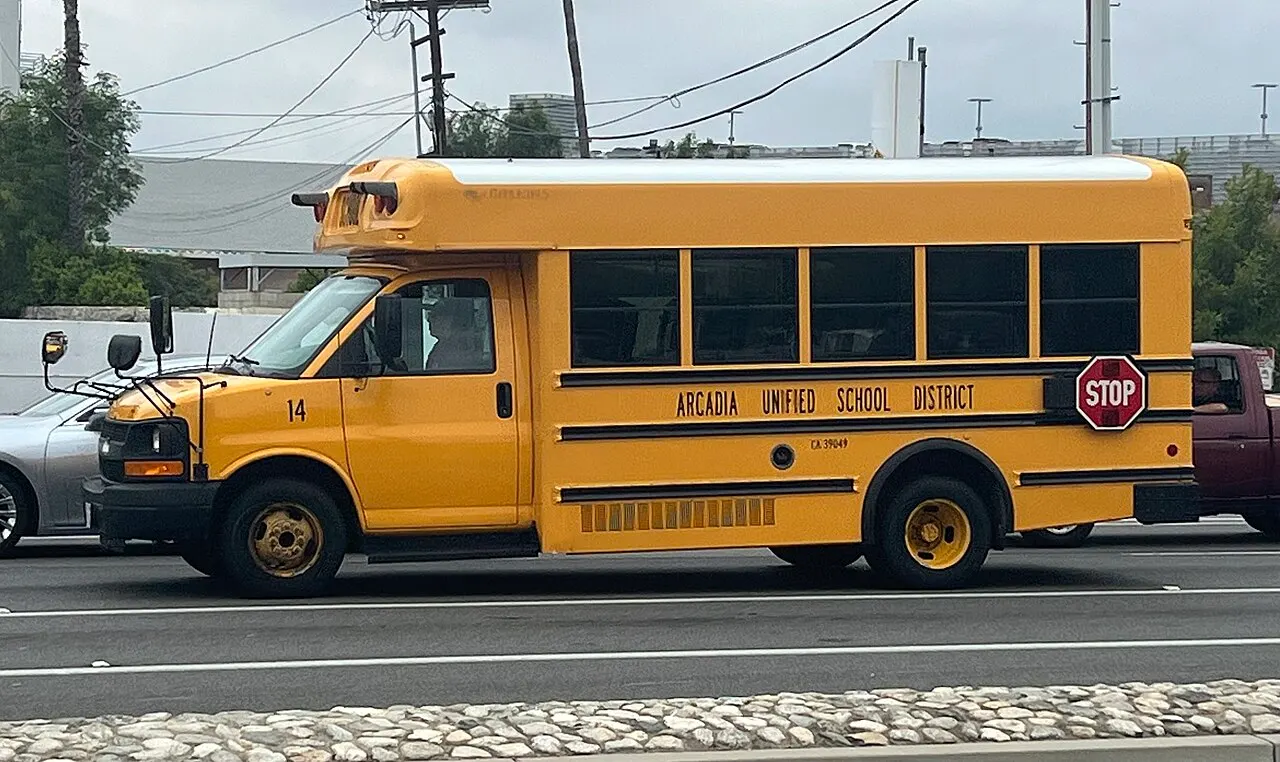
Passing a school bus with flashing red lights is a critical driving error on the DPE criteria page. CVC 22454 makes you stop from either direction and stay stopped until the red lights and any stop arm switch off. The only exception is a bus on the other roadway of a divided highway, or of a highway with two or more lanes in each direction.
What restrictions apply to a new or teen driver?
The night and passenger rules in CVC 12814.6(b) count 12 months from the day the provisional license is issued, and CVC 12814.6(k) puts that original issue date on the face of the card, so that is the date to count from. They do not apply at the permit stage, because a permit never allows unsupervised driving in the first place. A conviction for breaking them carries no violation point (CVC 12814.6(f)), but the court still has to impose a penalty.
- The exceptions in CVC 12814.6(b)(2) let you drive between 11 p.m. and 5 a.m., or carry an immediate family member, without a supervising adult, and, unless you are an emancipated minor, only when other reasonable transportation is inadequate. They do not open the car to friends under 20. Each needs a signed note carried with you: a physician for medical need, the principal, dean, or their designee for school, the employer for work, a parent or guardian for a family member's need. An emancipated minor needs no note (Fast Facts 19).
- Penalty for breaking the night or passenger rule: the court must impose either 8 to 16 hours of community service or a fine of not more than $35 for a first offense, and 16 to 24 hours or not more than $50 after that (CVC 12814.6(e)). An officer may not stop you solely to check these restrictions (CVC 12814.6(c)).
- Points still matter. Two or more violation points in 12 months add a 30-day restriction to driving with a licensed parent, spouse, guardian, or other licensed driver 25 or older. Three or more points in 12 months bring a 6-month suspension and a 1-year probation. Those terms keep running even after you turn 18 (CVC 12814.6(g); Fast Facts 19).
- Phone: under 18 you may not use a phone or other wireless device while driving, hands-free included, except for emergency purposes (CVC 23124). That ban is not part of the 12-month clock; it runs to your 18th birthday.
Local laws can add their own limits on night driving on top of the state rule; Fast Facts 19 flags that without listing any. Check the city you actually drive in. DMV does not publish a statewide table of local curfews.
Priya Raman, from permit to provisional license
- 1Priya was born March 4, 2010. She finished a 30-hour internet driver education course at a DMV-licensed school in August 2025, before she was old enough to apply.
- 2She turned 15 years and 6 months on September 4, 2025. Her parents share custody, so both signed her application. On September 8, 2025 she paid the $46 Class C application fee, passed vision and the knowledge test, and was issued an instruction permit. That card was not yet valid for practice.
- 3On September 15, 2025 she completed her first professional behind-the-wheel lesson, and the instructor signed the permit. From then on she could practice with her mother, who is 42 and holds a California license that is not on probation.
- 4She finished the remaining professional hours by October 24, 2025, never more than 2 hours in one day, for 6 in total. She logged 50 hours with her mother, 11 of them after dark, and her mother signed the permit on March 10, 2026.
- 5Her 6-month hold counted from the issue date, September 8, 2025, not the day the instructor signed, so it ended March 8, 2026. She had turned 16 on March 4, 2026. She booked the drive test online, brought her mother, registration, and insurance, and passed the DPE on March 18, 2026 with no critical errors.
Outcome. Priya's provisional license was issued March 18, 2026, and that date is printed on the card. The 11 p.m. to 5 a.m. rule and the under-20 passenger rule apply until March 18, 2027. The phone ban, hands-free included, lasts until her 18th birthday on March 4, 2028. While her license is provisional she also may not drive for pay or drive a vehicle that needs a commercial Class A, B, or C license (handbook Section 2).
Which handbook sections the exam draws on
These are the sections of the California Driver's Handbook (DL 600), 2025 edition that the knowledge exam is drawn from, in the handbook’s own order.
- Licenses and permits. Instruction permits, provisional restrictions, curfews and the testing process.
- Laws and rules of the road. Turning on red, speed limits, HOV lanes and the five-vehicle rule.
- Safe driving. Headlights, phones, child restraints and California conditions.
- Alcohol and drugs. The four separate BAC thresholds and what each one applies to.
- Insurance and collisions. Minimum cover, SR 1 reporting and financial responsibility.
- Parking. Curb colors, daylighting, and parking on a grade.
- Sharing the road. Lane splitting, helmets, cyclists and school buses.
Source: California Driver's Handbook (DL 600), 2025 edition. Read the official handbook.
Common questions
How many questions does the California permit test have?
The California Class C knowledge exam runs to 36 questions, and 30 of them have to be right. For applicants 18 and over. Applicants under 18 sat a different form with 46 questions. No current DMV consumer page publishes either count: both come from a 2006 DMV research report, restated in an April 2008 one (RSS-08-226), which is why we name the source rather than stating the number bare.
How old do you have to be to get a learner permit in California?
15 years and 6 months with driver education, or over 17 years and 6 months without it (no drive test until 18).
How many supervised driving hours does California require?
50 hours, of which at least 10 must be at night. Under-18 applicants only. The supervisor is a California-licensed driver 25 or over, except that a parent, spouse, guardian or licensed or certified driving instructor can be any age. Plus 6 hours of professional training and a 6 month permit hold. Adults have no supervised hours requirement.
How many times can you retake the California permit test?
Three attempts per application, then you must reapply. Applicants under 18 must also wait seven days before retaking a failed knowledge test, not counting the day of the failure. DMV's Provisional Licensing fact sheet (FFDL 19, revised July 2019) gives the same wait and lets a provisional applicant miss no more than 8 questions.
Can I skip driver education if I am 17 and a half?
If you are over 17 years and 6 months but still under 18, California DMV may issue an instruction permit without driver education or driver training certificates (CVC 12509(a)(5) and the instruction permits FAQ). You still cannot take the behind-the-wheel test until you turn 18. Because a minor must also hold the permit for 6 months, anyone applying after 17 and a half reaches 18 before the hold ends, so the courses would not get you licensed any sooner. The $46 application stays valid for 12 months from the day you apply.
How do I book the behind-the-wheel drive test?
Use dmv.ca.gov/make-an-appointment or call 1-800-777-0133 during business hours. If you are under 18 you must be at least 16, have held a California or out-of-state instruction permit for at least 6 months, and have both education and training certificates plus the 50-hour signature on the permit. DMV does not publish how long a slot takes to open. A minor must bring a licensed companion who is 25 or older; an adult needs one who is 18 or older.
What if my vehicle fails the pre-drive check?
If items 1 through 8 or 15 through 17 fail (driver window, windshield, mirrors, turn signals, brake lights, tires, foot brake, horn, passenger door, glove box, seat belts), or the parking brake will not set, the examiner reschedules. That is a mechanical postponement, not a fail. If you cannot locate or demonstrate 4 or more of items 9 through 14, the test is marked unsatisfactory, which is a fail. A failed drive test costs $9 to retake on the licensing fees page; DMV does not say whether a mechanical postponement counts as an attempt or carries that fee.
When do the 11 p.m. and passenger rules end?
CVC 12814.6(b)(1) bars driving between 11 p.m. and 5 a.m. and carrying passengers under 20 for the first 12 months after the provisional license is issued, unless a licensed parent or guardian, a licensed driver 25 or older, or a licensed or certified driving instructor is with you. The card shows the original issue date, so count 12 months from that. Signed notes cover medical, school, work, and immediate family needs, and an emancipated minor needs no note. The statute sets only the 12-month count; DMV's Parent-Teen Training Guide (DL 603) says the night and passenger limits last the first year or until you turn 18. The phone ban is a different statute and lasts until 18.
Can I use a phone with a hands-free set while I am under 18?
No. CVC 23124 bans a driver under 18 from using a wireless telephone or electronic communications device while driving, even if it has a hands-free set. The statute exempts use for emergency purposes, such as a call to police, a health care provider, a fire department, or another emergency service, and Fast Facts 19 adds that the ban does not cover driving on private property. The base fine is $20 for a first offense and $50 after that. An officer may not stop you solely to check this section.
How much is the Class C application, and how long is it good?
The DMV licensing fees page lists $46 for an original Class C application, checked September 2026. That fee is not refundable, and the application is valid for 12 months. It covers three knowledge test attempts and three drive test attempts; after three failures of either you must reapply (handbook Section 3; driver's licenses page), and Fast Facts 19 says three failed drive tests also mean paying all applicable fees again. A behind-the-wheel retest is $9. Driving-school tuition is set by each school; DMV does not publish those prices.
What else do people ask about the California permit test?
- How many questions can you miss on the California permit test?
- What happens if you fail the permit test in California?
- What to bring for the California permit test if you are under 18
- What to bring for the California permit test if you are 18 or over
- Can you take the permit test online in California?
- California supervised driving hours, and whether the log is turned in
No page on moving from another state. California DMV's driver's license page tells an applicant 18 or older with a valid license from another state to pass the knowledge test, with three attempts at each required test before the application lapses, and it is taken at a DMV office: the at-home route that opened to people moving to California in September 2023 closed to new driver's license applicants on January 3, 2025. What DMV leaves open is the under-18 case. Its Provisional Licensing fact sheet (FFDL 19) says the drive test for a minor with an out-of-state license is normally waived but that proof of driver education and training may be required, without saying when.
Sources
- California DMV, instruction and learner permits
- California DMV, Teen Driver Roadmap
- California DMV, Driver's Licenses (applying under 18)
- California Driver's Handbook, Section 2: Getting an Instruction Permit and Driver's License
- California Driver's Handbook, Section 3: The Testing Process
- California DMV, Driver Training Schools
- California DMV, licensing fees
- California DMV, make an appointment
- California DMV, Pre-Drive Checklist (Safety Criteria)
- California DMV, Driving Performance Evaluation (DPE) scoring criteria
- California DMV, DMV Driving Test (DPE / SDPE / ADPE)
- California DMV, Driving Performance Evaluation score sheet sample (DL 32, Rev. 4/2021)
- California DMV, Fast Facts 19: Provisional Licensing (FFDL 19, Rev. 7/2019)
- California DMV, Teen Driver Tips
- California DMV, Parent-Teen Training Guide (DL 603, Rev. 7/2019)
- California Vehicle Code section 12814.6 (Brady-Jared Teen Driver Safety Act)
- California Vehicle Code section 12509 (instruction permits)
- California Vehicle Code section 23124 (wireless device, drivers under 18)
- California Vehicle Code section 21658.1 (lane splitting defined)
- California Vehicle Code section 21656 (slow vehicle turnouts on two-lane highways)
- California Vehicle Code section 22500(n) (no parking on the approach side of a crosswalk)
- California Vehicle Code section 22454 (stopping for a school bus)
- California Education Code section 51851 (driver education course)
- California Education Code section 51852 (driver training laboratory plans)
Other states: all US permit practice tests.
Sources: California Department of Motor Vehicles; California Driver's Handbook (DL 600), 2025 edition. Checked September 25, 2026. Original practice questions, never the examination questions themselves. California DMV does not run this site and does not endorse it.