CDL practice tests, one federal bank
Commercial licensing is federal, so these three papers are the same questions whichever state you license in. 49 CFR Part 383 sets what you have to know and fixes the pass mark at 80 percent.
CDL general knowledge
FL30 questions, 24 right clears the federal 80 percent bar. Everyone takes this one, whatever class you are after.
CDL air brakes
FL25 questions, 20 right clears the federal 80 percent bar. Skip it and an air brake restriction goes on the license.
CDL combination vehicles
FL25 questions, 20 right clears the federal 80 percent bar. Required for Class A, which is most tractor-trailer work.
The pass mark is 49 CFR 383.135(a)(1). Paper lengths are ours: the regulation fixes the mark, not how many questions go on the paper.
Why one bank covers every state
A state issues the license, charges for it and books the appointment. It does not write the syllabus: 49 CFR Part 383 sets the knowledge a commercial applicant has to demonstrate, 383.135(a)(1) fixes the pass mark, and the book agencies hand out is the AAMVA model Commercial Driver’s License Manual rather than one of their own drafting. Car permit rules run the other way, which is why every car paper here carries a layer written from that state’s own statutes and these three do not.
| State | Car pass mark, set by the state | CDL pass mark, set federally |
|---|---|---|
| FloridaFLHSMV | 80%FLHSMV, Class E Knowledge Exam and Driving Skills Test, checked September 9, 2026 | 80%49 CFR 383.135(a)(1) |
| TexasTxDPS | 70%Texas Driver Handbook DL-7 (rev. January 2026), Chapter 1; 37 TAC s. 15.52, checked September 9, 2026 | 80%49 CFR 383.135(a)(1) |
| CaliforniaCalifornia DMV | 80%California DMV, Learner's Permits, checked September 25, 2026 | 80%49 CFR 383.135(a)(1) |
| New YorkNew York DMV | 70%New York State Driver's Manual (MV-21), Chapter 1: Driver Licenses, checked September 25, 2026 | 80%49 CFR 383.135(a)(1) |
The car figures come from the state and do not have to agree with each other. The commercial column cannot vary.
What each paper decides
- General knowledge. The first paper for every applicant, whatever the eventual class or endorsement looks like.
- Air brakes. Fail or skip it and an air brake restriction goes on the license, forbidding any vehicle whose braking system runs on air. Nothing here is rounded for readability either: the low air pressure warning has to activate before pressure falls below 60 psi, under 49 CFR 393.51.
- Combination vehicles. Required for Class A. Rearward amplification, off-tracking, and the coupling sequence down to the glad hands and the tractor protection valve.
Which parts of 49 CFR these questions cite
Under every answer sits the regulation, or the piece of FMCSA guidance, the question was built from, so the federal claim on this page can be checked rather than taken on trust. Four parts of Title 49 do most of the work.
- Part 383, commercial driver standards. The 80 percent pass mark at 383.135(a)(1), the definition of a commercial motor vehicle at 383.5, the 0.04 alcohol threshold at 383.51 and the duty to report a conviction to your employer at 383.31.
- Part 392, driving a commercial vehicle. Cargo checks at 392.9, railroad crossings at 392.10, warning devices after stopping at 392.22 and the alcohol rules at 392.5.
- Part 393, parts and accessories. The low pressure warning at 393.51, brake adjustment at 393.47 and air tank draining at 393.50.
- Part 396, inspection and maintenance. The post-trip report at 396.11, and the out-of-service conditions that mean a vehicle does not move at all.
Title 49 carries no copyright and the model manual very much does, so every question here was drafted from the regulation text. No paragraph of that manual has been reworded into one.
Which knowledge tests do you pass before a state issues the CLP?
A commercial learner's permit is a separate document from the CDL (49 CFR 383.25(b)). Carried with a valid driver's license from the same state, it lets you drive that class of commercial vehicle for behind-the-wheel training while a CDL holder with the right group and endorsements rides with you (383.5 and 383.25(a)). You must be at least 18 and pass the general knowledge test for the vehicle group you plan to drive (383.71(a)(1) and (a)(2)).
Part 383 lists what each test covers: 20 general areas in 383.111(a), 7 air brake areas in 383.111(b), and 3 combination vehicle areas in 383.111(c). States build the tests from an FMCSA-approved question pool, and a quarter of the questions on each new version must be new (383.133(b)(1) and (b)(2)(ii)). The question count comes from that approved test system, not from the regulation text (383.133(b)(2)(iv)). A test may be given on paper, orally, or on a computer, and in a foreign language, but never through an interpreter (383.133(b)(3)).
| Test | Who takes it | Under 80 percent |
|---|---|---|
| General knowledge | Every applicant, 383.71(a)(2) | No CLP |
| Air brakes | Drivers of air brake vehicles, 383.111(b) | A CLP or CDL may still issue, with restriction L (383.135(a)(2)) |
| Combination | Drivers of combination vehicles, 383.111(c) | No Group A CLP or CDL (383.135(a)(3)) |
| P, S, or N | Only if that endorsement goes on the CLP, 383.71(a)(8) | That endorsement stays off the permit (383.25(a)(5)) |
A failed test is retaken on a different version of it (383.133(b)(4)).
Group A is a combination with a gross combination weight rating of 26,001 pounds or more, where the towed unit is rated over 10,000 pounds. Group B is a single vehicle rated 26,001 pounds or more, towing no more than 10,000 pounds. Group C is anything outside A and B that is designed for 16 or more people, including the driver, or that carries hazardous materials as 383.5 defines them (383.91(a)). For the skills test, the rating decides the group, not what the vehicle weighs that day (383.133(c)(3)). A pass in Group A lets you drive B and C, and a pass in B lets you drive C, if you hold the needed endorsements (383.91(c)).
How does New York handle CDL testing?
New York requires you to hold a New York Class D, E, or non-CDL C license before you apply. NY DMV gives CDL knowledge tests only at its offices, in English, Spanish, Chinese, or Russian. The HazMat test is in English only. Each knowledge test needs 80 percent to pass, and each question offers three choices. NY DMV does not publish the General (Core) Knowledge question count. Failed tests have no fixed retake limit, but a District Director, Office Manager, County Clerk, or Office Supervisor decides whether you may retake one.
New York's $10 CDL application fee covers knowledge and endorsement tests taken at the same time. Another required test not taken and passed at the initial application costs $5; the road test costs $40. You must be at least 21 for an H or X endorsement or to drive interstate (New York Vehicle and Traffic Law 502(2)(a)). New York also has a metal-coil endorsement (501(2)(b)(ix)). NY DMV's CDL manual says it is needed to carry metal coils that weigh 5,000 pounds or more, individually or bundled (CDL-10 section 3.4.5).
What can you drive with the CLP?
Unless it is a passenger vehicle, the supervising CDL holder sits in the front seat next to you. In a passenger vehicle they sit directly behind you or in the first row behind you, and in every case they keep you under observation and direct supervision (383.25(a)(1)). The permit must state that it is invalid without the underlying license from the same state (383.153(b)(2)(i)). You may not drive a vehicle carrying hazardous materials as 383.5 defines them (383.25(a)(6)).
- P, passenger: no riders beyond a short list
Federal or state auditors and inspectors, test examiners, other trainees, and the supervising CDL holder. P on a CLP is class specific (383.25(a)(5)(i)).
- S, school bus: the same short list
No passengers other than the ones P allows (383.25(a)(5)(ii)).
- N, tank: empty only
Never a tank that held hazardous materials unless it has been purged (383.25(a)(5)(iii)). A tank vehicle has tanks rated over 119 gallons each and 1,000 gallons or more in total. An empty storage tank not designed for transport, temporarily attached to a flatbed trailer, does not count (383.5).
- No H, no T, and so no X
All other federal endorsements are prohibited on a CLP (383.25(a)(5)(iv) and 383.93(a)(2)). Doubles and triples need T (383.93(b)(1)), so the permit gives no route to towing them.
How long before you can take the skills test?
You are not eligible for the CDL skills test in the first 14 days after the state first issues the CLP (383.25(e)). The count runs from initial issuance, so a renewal does not reset it. A CLP can be valid for no more than 1 year from that first date without retaking the general and endorsement knowledge tests (383.25(c)).
A CLP must come before a first CDL, and before any upgrade that needs a skills test (383.25(d)). The skills test runs in a fixed order: pre-trip inspection, basic vehicle control, then on-road driving, and failing one segment ends the test there (383.133(c)(6)). Passed segments count only while the first CLP lasts. Once the permit is renewed, all 3 are taken again (383.133(c)(6)(ii)). A state may use a simulator in skills testing but never in place of the on-street test (383.113(e)). Disobeying traffic laws or causing a crash during the test is an automatic failure (383.135(b)(2)). The passing scores sit in the examiner manual that 383.131(b) refers to, and Part 383 sets no test fee.
- Issue dayCLP
Valid only with the same-state license and a supervising CDL holder on board.
- Days 1 to 14No skills test yet
Training can start. The skills test cannot (383.25(e)).
- Day 15 onSkills test
Pre-trip, basic control, on-road, in that order. For a first Class A or B, your training must already be on record (383.73(b)(11)).
- 1 yearRetake or stop
Past 1 year from first issue, the knowledge tests must be taken again (383.25(c)).
Holding a CLP at 18 does not settle who may hire you. Part 391, the federal qualification rule for people who drive for motor carriers, sets a minimum age of 21 in 391.11(b)(1), apart from the limited exemptions in its subpart G.
Who has to finish entry-level driver training?
Since February 7, 2022, entry-level training has to come from a provider listed on FMCSA's Training Provider Registry (380.600 and 380.609). Theory plus range and public-road driving must be finished before the skills test for a first Class A or B, or an upgrade to A or B. A Class B holder working toward Class A may take the Theory Instruction Upgrade Curriculum in place of the standard theory (Appendix A). A first P or S needs its course before that skills test. A first H needs the Appendix E course before the knowledge test, and H has no behind-the-wheel portion (380.715(b) covers Appendices A through D only). The state may not give a Class A, Class B, P, or S skills test until it confirms your training electronically (383.73(b)(11)).
| Situation | What Part 380 requires |
|---|---|
| First Class A or B, or an upgrade to A or B | Theory, range, and public road, before the skills test (380.609(a)) |
| Class B holder moving to Class A | The upgrade theory curriculum may replace the standard theory. Range and public-road training still apply (Appendix A) |
| First P or S | That endorsement's course, before the skills test (380.609(b)) |
| First H | Appendix E theory, before the knowledge test (380.609(b)) |
| Class A, B, P, S, or H issued before Feb 7, 2022 | Nothing further for that credential (380.603(b)) |
| CLP issued before Feb 7, 2022 | Nothing further if the CDL comes before that CLP or its renewal expires (380.603(c)(1)) |
Except for H, the theory and behind-the-wheel portions must be finished within 1 year of completing the first one (380.603(c)(3)). Outside this subpart: drivers excepted under 383.3(c), (d), and (h), restricted CDLs under 383.3(e) through (g), military drivers who meet 383.77, and anyone removing a restriction under 383.135(b)(7) (380.603(a)).
No curriculum sets a minimum number of hours. Appendix A says so for Class A theory and for behind-the-wheel range and public-road training, and the Class B, passenger, school bus, and hazardous materials appendices say the same. The instructor still has to cover every topic, the theory assessment needs an overall 80 percent (380.715(a)), and a simulator cannot stand in for range or public-road training (Appendix A). Both behind-the-wheel portions come from the same provider, though theory may come from another (380.707(c)). By midnight of the second business day after you finish, the provider must report the training through the registry, including your behind-the-wheel clock hours (380.717).
When do doubles need more than the T test?
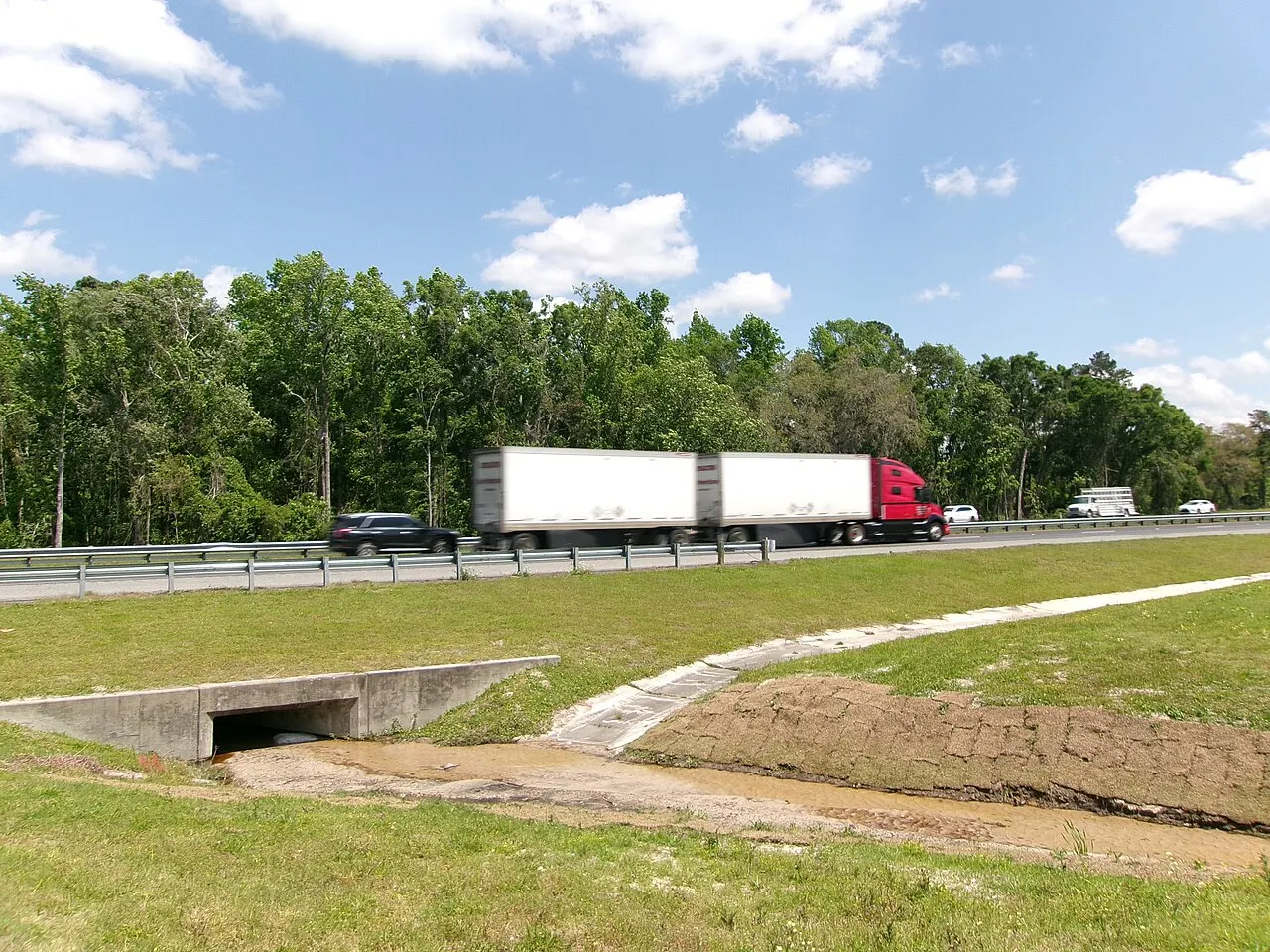
T is a knowledge test only (383.93(c)(1)). A longer combination vehicle is a truck-tractor with 2 or more trailers running on the Interstate System at a gross vehicle weight over 80,000 pounds (380.105), and driving one requires an LCV Driver Training Certificate first (380.107). The only way around that, the grandfather rule in 380.111, was open only in the year after June 1, 2004. To enter LCV Doubles training you need, for the 6 months before you apply, a Class A CDL with T, an employer's written statement that you drove a Group A vehicle for them, and a record that meets its conditions, such as no suspension of your CDL and at most 1 serious traffic violation in a CMV (380.203(a)). The course ends with its own knowledge test at 80 percent and a skills test given by a qualified LCV instructor (380.109). Part 380 sets no tuition.
Which code does the skills-test truck put on the license?
| Code | You may not drive | Why it is there |
|---|---|---|
| L | A CMV with any type of air brakes | Air brake knowledge under 80 percent, or a skills test in a vehicle without air brakes (383.95(a)) |
| Z | A CMV with brakes working fully on air | Skills test in a vehicle with air over hydraulic brakes (383.95(b)) |
| E | A CMV with a manual transmission | Skills test with an automatic. Only a driver-operated clutch counts as manual, so a semi-automatic counts as automatic (383.5 and 383.95(c)) |
| O | A fifth-wheel tractor-trailer that needs Group A | Group A skills test with a pintle hook or other non-fifth-wheel connection (383.95(d)) |
Air brakes here include any system working fully or partly on air (383.95(a)(2)). Z, E, and O apply to anyone whose skills test is on or after July 8, 2015. Holders tested earlier are not retested for them (383.153(g)).
Removing Z, E, or an L that came from the skills vehicle does not require the complete skills test again. The state may give a modified test in a vehicle with that equipment (383.135(b)(7)). Removing L or Z also takes the air brake pre-trip inspection and a passed air brake knowledge test. Removing O means all 3 skills segments again, in a representative tractor-trailer (383.135(b)(8)). A (b)(7) removal does not trigger entry-level training (380.603(a)(4)). Read the letters carefully: on both documents N is the tank endorsement and also the restriction for no Class A and B passenger vehicle, and on a CLP, P and X are also restrictions, for no passengers in a bus and no cargo in a tank (383.153(a) and (b)).
What has to happen before H goes on the CDL?
- 1Not on a CLP
H cannot be printed on the permit (383.93(a)(2)), and a permit holder may not drive a vehicle carrying hazardous materials (383.25(a)(6)).
- 2Training, if this is your first H
Since February 7, 2022, the Appendix E course from a registry provider comes before the knowledge test (383.71(b)(11) and (e)(5)).
- 3Knowledge test at 80 percent
The code is H, or X when you also hold N (383.153(a)(9)). Keeping H at renewal means passing the test again (383.71(d)(3)).
- 4TSA clearance, or a valid TWIC
The state cannot issue, renew, upgrade, or transfer H unless TSA has found you do not pose a security risk warranting denial, or you hold a valid TWIC (383.141(b)).
- 5Fingerprints and fees
You submit fingerprints and the information in 1572.9 when you apply for or renew H (1572.11(c)(1)). The state or a TSA agent collects the fees with the application. TSA publishes its threat assessment fee as a Federal Register notice, not in the CFR, and the state may add its own fees (1572.403 and 1572.405).
Part 1572 lists some convictions as permanent disqualifiers, including espionage, a federal crime of terrorism, improper transportation of a hazardous material, an explosives felony, and murder (1572.103(a)). Others, such as robbery, arson, and distributing a controlled substance, bar you if the conviction falls within 7 years of the application, or if your release from incarceration for that crime falls within 5 years of it (1572.103(b)). TSA may grant a waiver for the interim offenses and for most permanent ones, including the hazardous materials, explosives, and murder offenses, if it finds you do not pose a security threat. Espionage, sedition, treason, and terrorism under 1572.103(a)(1) through (a)(4) are outside the waiver rule (1515.7(a) and (b)). A pending warrant or indictment for a listed felony disqualifies you until it is released or dismissed (1572.103(c)). Applicants must be U.S. nationals or hold a status listed in 1572.105, such as lawful permanent resident, refugee, or asylee. States must require H to be renewed at least every 5 years, and must warn you at least 60 days before it expires, advising you to file as soon as possible and no later than 30 days before (383.141(c) and (d)).
What does one Class A application look like?
Maya Ortiz, 24, CLP issued Monday, March 2, 2026
- 1March 2: she holds a non-commercial license from the same state and passes general knowledge, combination, and air brakes at 80 percent or better. The Class A CLP issues that day. At 24 she is past both the permit age of 18 and the 21 in 391.11(b)(1).
- 2Her training truck is Group A by rating: a combination rated 26,001 pounds or more with a trailer rated over 10,000, full air brakes, a manual transmission, and a fifth wheel. Her supervisor holds a Class A CDL with no restriction that bars this truck and sits in the front seat beside her. No placarded load and no second trailer.
- 3Range and road lessons start only after the CLP, which the provider must verify (380.707(a)). On Wednesday, March 11, she completes Class A theory with an overall score of at least 80 percent, plus range and public-road training with the same provider. The provider must report it, with her behind-the-wheel clock hours, by midnight on Friday, March 13, the second business day.
- 4She is ineligible for the skills test from the moment the CLP issues through Monday, March 16, the 14th day after issue. On Friday, March 20, with her training confirmed electronically, she passes pre-trip, basic control, and on-road driving in that truck, in that order.
Outcome. She passed air brakes and tested in a truck with full air brakes, a manual transmission, and a fifth wheel, so none of L, Z, E, or O applies and the state can issue a Class A CDL without them. Doubles still need the separate T knowledge test. Had she waited instead, her CLP could not have run past March 2, 2027 without new knowledge tests. Part 383 sets no fee and prints no numeric skills score. The scores are in the examiner manual that 383.131(b) refers to.
Common questions
Is the CDL knowledge test the same in every state?
The knowledge is. 49 CFR Part 383 sets what a commercial applicant has to demonstrate and fixes the pass mark at 80 percent, and the book behind the exam is the AAMVA model Commercial Driver’s License Manual, which most agencies reprint with only their own front matter changed. Your state decides the price, the paperwork and how long you wait for an appointment. It does not decide the syllabus.
What score do you need to pass a CDL knowledge test?
Eighty percent, set by federal regulation at 49 CFR 383.135(a)(1), which requires an applicant to answer at least 80 percent of the questions correctly. A state runs its own fees and scheduling, but it may not pass someone below that mark.
What happens if you fail the air brakes test?
An air brake restriction goes onto the license, forbidding you from operating any vehicle whose brakes run on air. Nearly every tractor unit qualifies, so the restriction closes the work off rather than narrowing it, which is why almost every applicant takes air brakes right after general knowledge.
Which vehicles need a CDL?
Under the federal definition at 49 CFR 383.5, a commercial motor vehicle is one with a gross combination or vehicle weight rating of 26,001 lb or more, or designed to carry 16 or more people including the driver, or carrying hazardous materials in quantities requiring placards.
Does New York say how long its CDL General Knowledge test is?
NY DMV does not publish the General (Core) Knowledge question count. Its CDL manual says each knowledge question has three answer choices and each knowledge test requires 80 percent to pass. The tests are taken at a DMV office.
Does New York require a separate CDL endorsement for metal coils?
Yes. New York Vehicle and Traffic Law 501(2)(b)(ix) requires a metal-coil endorsement, and NY DMV's CDL manual (section 3.4.5) says it applies to metal coils that weigh 5,000 pounds or more, individually or bundled. This is a New York-specific endorsement.
How long must you hold a CLP before the skills test?
You are not eligible during the first 14 days after the state first issues the CLP (49 CFR 383.25(e)). The count starts at initial issuance, so renewing does not restart it. The permit cannot stay valid more than 1 year from that first date unless you retake the general knowledge test and any endorsement knowledge tests (383.25(c)). If you pass some skills segments and then renew the permit, all 3 segments must be taken again (383.133(c)(6)(ii)). Federal rules do not set how far out a state books appointments.
Can a state put a hazardous materials endorsement on a CLP?
No. The only endorsements a CLP may carry are passenger (P), school bus (S), and tank (N) (49 CFR 383.93(a)(2)). A permit holder also may not drive a vehicle carrying hazardous materials as 383.5 defines them (383.25(a)(6)). H, and the X code for tank plus hazardous materials, go on the CDL only after TSA clears you or you show a valid TWIC (383.141(b)).
Does entry-level driver training require a minimum number of hours?
No. Appendix A to Part 380 sets no minimum instruction hours for Class A theory or for behind-the-wheel range and public-road training, and the Class B, passenger, school bus, and hazardous materials appendices say the same. The instructor must still cover every topic, you need an overall 80 percent on the theory assessment (380.715(a)), and the provider reports the clock hours you actually spent behind the wheel (380.717(c)).
What is the difference between restriction L and restriction Z?
L bars a CMV with any type of air brakes. It follows an air brake knowledge score under 80 percent or a skills test in a vehicle without air brakes (383.95(a) and 383.135(a)(2)). Z bars brakes that work fully on air and follows a skills test in a vehicle with air over hydraulic brakes (383.95(b)). To remove a skills-test L or a Z, you perform the air brake pre-trip inspection, pass the air brake knowledge test, and pass a skills test that the state may limit to the brakes (383.135(b)(7)).
When do double trailers need more than a T endorsement?
T is a knowledge test for doubles and triples, and it cannot go on a CLP (383.93(c)(1) and 383.93(a)(2)). A truck-tractor with 2 or more trailers on the Interstate System at over 80,000 pounds gross is a longer combination vehicle, and its driver also needs an LCV Driver Training Certificate (380.105 and 380.107). LCV Doubles training requires a Class A CDL with T and 6 months of Group A driving for an employer immediately before you apply (380.203(a)).
If you held a Class A CDL before February 7, 2022, do you need entry-level training to keep it?
Not for that Class A. A Class A or B CDL, or a P, S, or H endorsement, issued before February 7, 2022 needs no subpart F training for that credential (380.603(b)). You would need training only to add P, S, or H for the first time (380.609(b)). A CLP issued before that date is also exempt if the CDL comes before the CLP or its renewal expires (380.603(c)(1)).
Sources
- NY DMV, get a commercial driver license (eligibility, testing, languages, and fees)
- NY DMV, Commercial Driver's License Manual CDL-10, section 1 (knowledge tests and retakes)
- NY DMV, Commercial Driver's License Manual CDL-10, section 3 (metal-coil endorsement)
- New York Vehicle and Traffic Law 501, license classes and metal-coil endorsement
- New York Vehicle and Traffic Law 502, license applications (age 21 for H, X, or interstate CDLs)
- 49 CFR 383.5, definitions (CLP, CMV groups, tank vehicle, hazardous materials, manual transmission)
- 49 CFR 383.25, commercial learner's permit
- 49 CFR 383.71, driver application procedures, including the February 7, 2022 training rule
- 49 CFR 383.73, state procedures, including electronic training verification before the skills test
- 49 CFR 383.91, commercial motor vehicle groups
- 49 CFR 383.93, endorsements
- 49 CFR 383.95, restrictions
- 49 CFR 383.111, required knowledge (general, air brakes, combination)
- 49 CFR 383.113, required skills and the simulator rule
- 49 CFR 383.133, test methods (question pool, versions, segment order)
- 49 CFR 383.135, passing knowledge and skills tests
- 49 CFR 383.141, hazardous materials endorsement and the TSA threat assessment
- 49 CFR 383.153, endorsement and restriction codes on the CLP and CDL
- 49 CFR 380.105, longer combination vehicle definition
- 49 CFR 380.107, LCV training requirement
- 49 CFR 380.109, LCV knowledge and skills testing
- 49 CFR 380.111, LCV grandfather rule
- 49 CFR 380.203, LCV Doubles prerequisites
- 49 CFR 380.600, entry-level driver training compliance date
- 49 CFR 380.603, entry-level driver training applicability
- 49 CFR 380.609, who must complete entry-level driver training
- 49 CFR 380.707, training provider duties (CLP check, same provider for both behind-the-wheel portions)
- 49 CFR 380.715, theory assessment at 80 percent
- 49 CFR 380.717, training certification deadline
- Appendix A to 49 CFR Part 380, Class A curriculum, upgrade theory, and the no-minimum-hours rule
- 49 CFR Part 380, including Appendices B through E (Class B, passenger, school bus, hazardous materials)
- 49 CFR 391.11, general qualifications of drivers, including age 21
- 49 CFR 1572.5, standards for the HME security threat assessment
- 49 CFR 1572.11, HME applicant fingerprints and information
- 49 CFR 1572.103, disqualifying criminal offenses (7 years from conviction or 5 years from release)
- TSA, disqualifying offenses and other factors, linked from its hazmat endorsement page
- 49 CFR 1515.7, waivers of disqualifying criminal offenses for HME applicants
- 49 CFR 1572.105, immigration status for an HME threat assessment
- 49 CFR 1572.403, HME fee collection by states
- 49 CFR 1572.405, HME fee collection by TSA agents
Car and motorcycle tests: all US practice tests by state. How this material is written and checked: who writes this.
Sources: 49 CFR Parts 383, 392, 393 and 396; Federal Motor Carrier Safety Administration guidance; Florida Department of Highway Safety and Motor Vehicles; Texas Department of Public Safety, Driver License Division; California Department of Motor Vehicles; New York State Department of Motor Vehicles. Original practice questions, not the official examination questions, and not affiliated with or endorsed by the FMCSA or any state licensing agency.