Right of way rules, one diagram at a time
Every rule here is a picture: the amber car owes the yield, the green one goes. Work through the diagrams, then answer a few in place at the bottom.
Almost no traffic law grants right of way. Read the statutes behind the questions and you find a list of drivers who must yield, never a driver who wins. So one car in every diagram is amber, and that duty is yours until taking the gap would cause a crash.
People on foot, and on bikes
These come first because almost nothing excuses them. Paint does not create the crossing, and a horn does not clear it.
Someone in the crossing
The driver yields.
At an intersection the crossing exists in law whether or not anyone painted it.
Pulling out of a driveway
The driver leaving the driveway yields.
The duty runs to everyone on the road, and to anyone on the sidewalk first.
- A white cane or a guide dog carries absolute right of way in every state. No horn: sound is what they navigate by. (Uniform Vehicle Code, blind pedestrian right of way)
- A cyclist going straight in a bike lane keeps priority over a car turning right across it. That crash is the right hook. (Uniform Vehicle Code, turning across a bicycle lane)
- Stop for a school bus on red flashers, arm out, until the lights go off and not until you judge the children clear. (Uniform Vehicle Code, overtaking school buses)
- On a right turn on red the stop and the yield are two duties, not one. Leaving a driveway is heavier again. (Uniform Vehicle Code, pedestrians right of way in crosswalks; entering roadway from private drive; Florida Statutes s. 316.075)
Turning and joining traffic
A green light settles your conflict with cross traffic and nothing else. Anything you take from a moving stream is a gap that stream gave you.
Turning left across traffic
The turning driver yields.
A green with no arrow makes the turn legal and leaves the conflict with you.
Your road ends at another
The driver whose road ends yields.
The through road keeps priority both ways, sign or no sign.
- The turn owes every oncoming lane and the crossing it lands in. A wave from the lane that stopped changes neither. (Uniform Vehicle Code, vehicle turning left; pedestrians right of way in crosswalks)
- Florida, Texas, California, New York each allow a left on a steady red, one-way onto one-way, after a complete stop unless a sign forbids it. New York City is the exception: no turn on red there at all unless a sign allows one. (Florida Statutes s. 316.075; Transportation Code s. 544.007(d); California Vehicle Code s. 21453(b); New York Vehicle and Traffic Law s. 1111(d)(2))
- Joining a lane that already has traffic, you yield, so the ramp is for speed and not for stopping. Never pass where you cannot see far enough to finish and return: crests, curves, intersections, railroad crossings. Right lanes travel, left lane passes. (Uniform Vehicle Code, entering controlled access highways; overtaking and passing; limitations on overtaking; driving on right side of roadway)
- Siren behind you: clear the intersection, then pull right and stop. A vehicle already stopped at the roadside is the other duty, slow and move over. (Uniform Vehicle Code, operation on approach of emergency vehicles; Move Over laws, adopted in every state; California AB 390, effective January 1, 2026)
- An unsigned T is not an uncontrolled intersection: your road ends, so you wait. The double solid lines beside a carpool lane hold the merge until a marked opening. (Uniform Vehicle Code, right of way at T-intersections; California Vehicle Code s. 21655.8)
At intersections
Nothing here ranks drivers by size, speed or courtesy. The junction decides, and where it cannot, the order people arrived does.
Four-way stop, arriving together
The driver with a vehicle on their right yields.
Arrival order settles most four-way stops. When two arrive together it is the driver on the left who yields, which is the same rule stated from the other side.
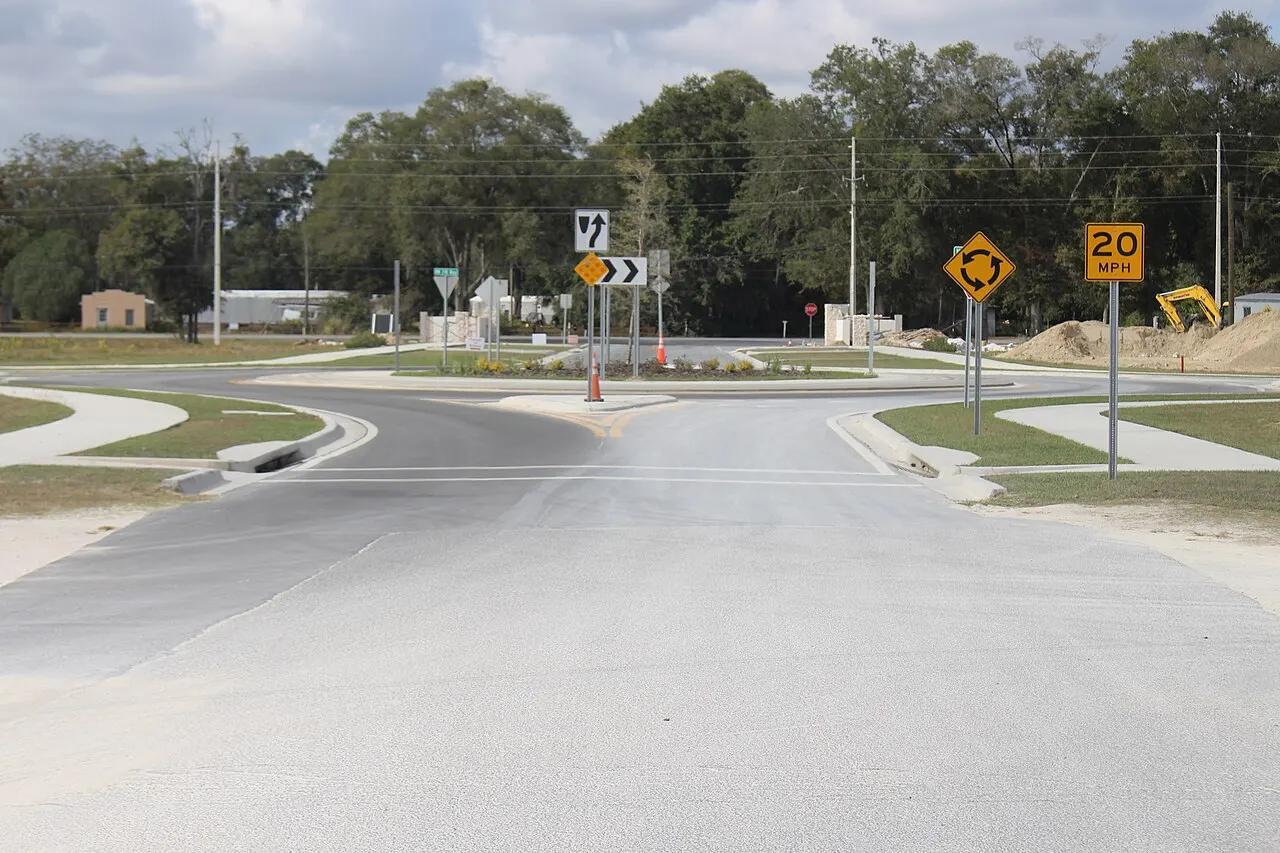
Entering a roundabout
The driver at the entry yields.
Traffic already in the circle keeps priority, and US circles turn counterclockwise.
- Only a genuine tie reaches the tiebreak: the vehicle on the right goes, straight ahead beats turning. The car on the right, not the car turning right. (Uniform Vehicle Code, stop intersections)
- A flashing red is a stop sign in full, and a signal showing no indication at all is treated the same way. (Uniform Vehicle Code, traffic control signal indications; inoperative traffic signals; Transportation Code s. 544.007(i))
- Uncontrolled and arriving together, the driver on the left yields. Uncontrolled means no sign and no signal, not no duty. (Uniform Vehicle Code, right of way at intersections)
- Signal your exit right, and never stop inside the circle to let a waiting driver in. (Federal MUTCD, 11th Edition (FHWA))
What each state sets for itself
The duties above are structural. What a state sets is the numbers: how far you slow, what divider cancels the school bus stop, how much room a cyclist is owed.
Florida
- Oncoming traffic is released from the school bus stop only on a divided highway with an unpaved space of at least 5 feet, a raised median, or a physical barrier. Paint does not count. (Florida Statutes s. 316.172)
- Stop-arm cameras: the registered owner takes a $200 civil penalty. (Florida Statutes s. 316.173)
- Move Over covers a stopped disabled vehicle showing hazard lights, flares or emergency signage, or with someone visibly present, not only emergency vehicles. (Florida Statutes s. 316.126, as expanded January 1, 2024)
- At least 25 Class E questions must cover bicycle and pedestrian safety. (Florida Statutes s. 322.12(3)(a)3.)
Drill these in the Florida statute questions, or start at the Florida hub.
Texas
- Undivided road, both directions stop for a school bus on red flashers. A first offense costs $500 to $1,250. (Transportation Code s. 545.066)
- Move Over: change lanes, or slow to 20 mph under the limit. Tow trucks, highway maintenance and utility vehicles count, not only police. (Transportation Code s. 545.157)
Drill these in the Texas statute questions, or start at the Texas hub.
California
- No parking within 20 feet of a crosswalk, marked or unmarked, or 15 feet at a curb extension. (California Vehicle Code s. 22500)
- Both directions stop for a school bus flashing red and stay stopped until the red lights stop flashing. Only traffic on the other roadway of a divided highway, or of a road with 2 or more lanes each way, may keep going. (California Vehicle Code s. 22454(a) and (b))
- Pass a bicycle with three feet of clearance, and change lanes where there is a lane to use. (California Vehicle Code s. 21760)
- A slow driver on a two-lane highway turns off once five vehicles are lined up behind. (California Vehicle Code s. 21656)
Drill these in the California statute questions, or start at the California hub.
New York
- Stop for a school bus showing red lights whether you meet it or follow it, on a divided highway too, at least 20 feet back, until it moves or its driver or a police officer waves you on. (New York Vehicle and Traffic Law s. 1174(a); New York State DMV, School Bus Safety)
- Passing a stopped school bus costs 8 points for violations from February 16, 2026, up from 5. (New York State DMV, The New York State Driver Point System and its notice of updated point values)
- Move Over covers amber-lit hazard vehicles such as tow trucks, and on parkways and controlled-access highways any vehicle stopped on the shoulder. Leave the lane beside it when that is safe. (New York Vehicle and Traffic Law s. 1144-a)
- With no working signal, slow or stop for a pedestrian in a crosswalk, marked or not, and never pass a car stopped at a crosswalk to let someone cross. (New York Vehicle and Traffic Law s. 1151)
- Pass a bicycle on the left at a safe distance until you are clear of it. The statute writes no figure in feet. (New York Vehicle and Traffic Law s. 1122-a)
Drill these in the New York statute questions, or start at the New York hub.
Try a few, right here
Pick an answer to see the rule behind it. Nothing is scored or saved.
A flashing red traffic signal means:
A flashing yellow traffic signal means:
Two vehicles reach an uncontrolled intersection at the same time. Who goes first?
At a four-way stop, who has priority?
You are turning left at a green light with no arrow. You must:
An emergency vehicle approaches with lights and siren. You should:
When is a crosswalk real if nobody painted it?
Florida Statutes s. 316.003(17) and Texas Transportation Code s. 541.302(2) give a crosswalk two routes into existence. At an intersection, it is the stretch of roadway between the lines of the sidewalks on opposite sides of the highway, carried across and measured from the curbs, or from the edges of the traversable roadway where there are no curbs. Separately, any part of a roadway marked for crossing with lines or other surface markings is a crosswalk, at an intersection or anywhere else. California Vehicle Code s. 275 carries the sidewalk lines across only where the roads meet at approximately right angles, never from an alley across a street, and it says there is no crosswalk where local authorities have posted signs indicating no crossing. The Florida and Texas definitions have no such sign exception.
Who counts as a pedestrian differs too. Florida s. 316.003(57) says any person afoot, and s. 316.2065(9) gives a person riding a bicycle or other human-powered vehicle across the road along a crosswalk the rights and duties of a pedestrian. Subsection (10) then has that rider yield to people on foot and give an audible signal before passing them. Texas s. 541.001 defines a pedestrian as a person on foot and, effective September 1, 2025, adds a sidewalk user: someone lawfully riding a bicycle, motor-assisted scooter, electric personal assistive mobility device, skateboard, roller skates, or a similar device on a sidewalk. Under s. 552.0035 you stop and yield to that rider in a crosswalk with no working signal, on the same half-of-the-road test as s. 552.003, and a rider who approaches or enters the crosswalk faster than 8 mph is prima facie going too fast. California s. 467 counts anyone afoot or on a human-powered conveyance other than a bicycle, so a skateboarder is a pedestrian there and a cyclist is not.
| Question | Florida | Texas | California | New York |
|---|---|---|---|---|
| No signal, person in the crosswalk | Yield, slowing or stopping if needed, when they are on your half or close enough from the other half to be in danger. s. 316.130(7)(c) | Stop and yield on the same half-of-the-road test. s. 552.003(a) | Yield in any marked crosswalk or unmarked one at an intersection, and slow down as needed. s. 21950(a), (c) | Yield, slowing or stopping if needed, to anyone in a crosswalk on the roadway you are using. No half-of-the-road test. s. 1151(a) |
| Car ahead already stopped for them | You may not pass it from behind. s. 316.130(9) | You may not pass it from behind. s. 552.003(c) | You may not pass it from behind. s. 21951 | You may not pass it from behind, at a marked or unmarked crosswalk. s. 1151(c) |
| Between 2 intersections with working signals | Pedestrians cross only in a marked crosswalk. s. 316.130(11) | Same limit, s. 552.005(b). On Walk, drivers stop and yield, s. 552.002(b). A green turn arrow alone does not let a pedestrian start across, s. 552.001(b) | Pedestrians cross only in a crosswalk. The section does not say it must be marked. s. 21955(a) | Section 1152 sets no such limit. Anyone crossing outside a crosswalk must yield to vehicles, and crossing an intersection diagonally needs an official traffic-control device that allows it. s. 1152(a), (c) |
Florida, Texas and California sources give no distance in feet for so close as to be in danger or for an immediate hazard. New York's s. 1151(a) applies where signals are not in place or not working. New York: Vehicle and Traffic Law ss. 1151 and 1152.
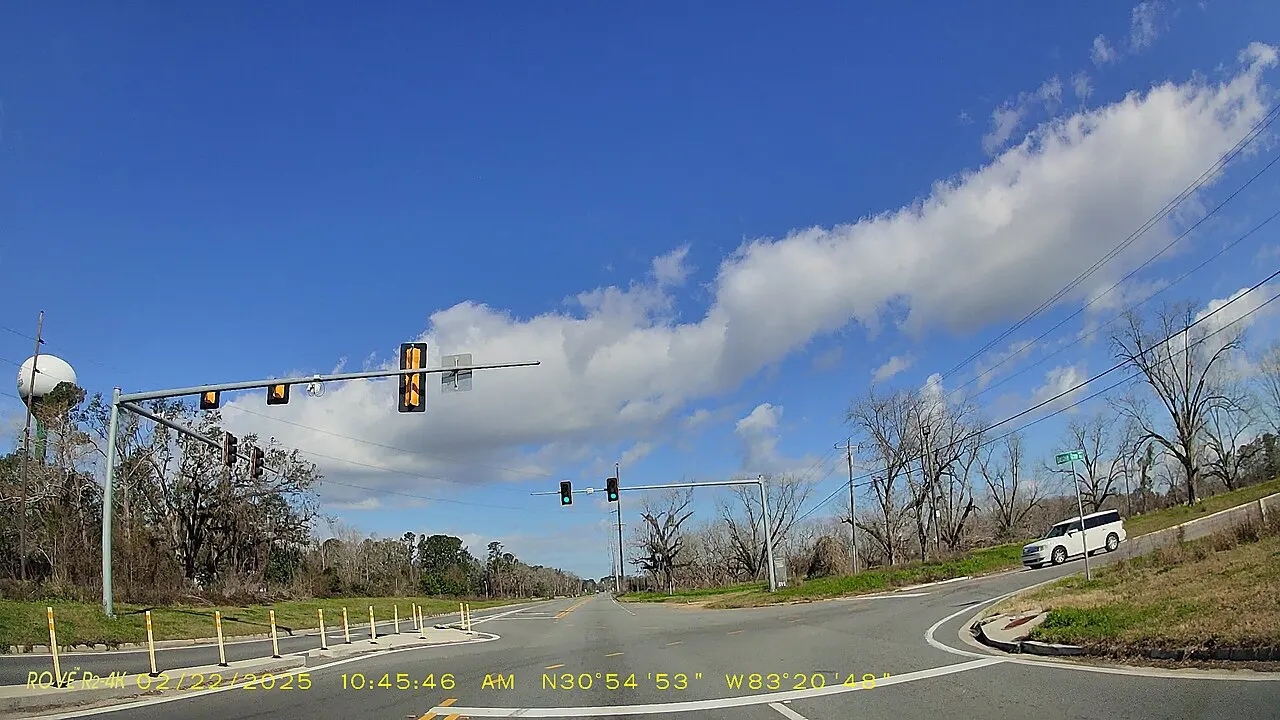
- Do not count on a person waiting for you. Florida s. 316.130(8) and Texas s. 552.003(b) bar stepping off a curb into the path of a vehicle too close to stop and yield, and California s. 21950(b) bars it when the vehicle is so close it is an immediate hazard. California also bars stopping or delaying traffic in a crosswalk without need.
- Away from a marked crosswalk, and away from an unmarked one at an intersection, the pedestrian yields. Florida s. 316.130(10) says to all vehicles on the roadway and Texas s. 552.005(a) to a vehicle on the highway. California s. 21954 limits it to vehicles so near they are an immediate hazard, and keeps the driver duty of due care.
- Where a pedestrian tunnel or overhead crossing is provided and a person crosses at road level anyway, Florida s. 316.130(7)(c) and Texas s. 552.005(a) put the yield on the pedestrian. Where there is no sidewalk, Florida s. 316.130(4) says walk on the left shoulder facing traffic when practicable, and Texas s. 552.006(b) says walk on the left facing traffic unless that side is obstructed or unsafe.
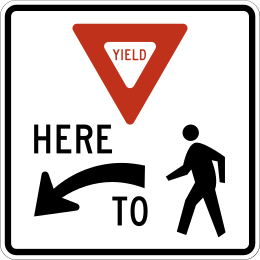
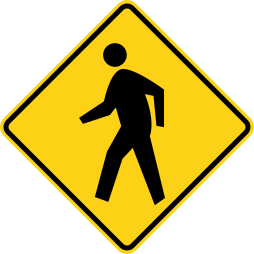

Florida s. 316.172, Texas s. 545.066, and California s. 22454 do not mention the School Bus Stop Ahead sign. The duty to stop comes from the signals on the bus, whether or not this warning is posted. New York uses the bus's red signals too (New York State Driver's Manual, Chapter 6).
Who stops for a school bus on two lanes, and who is released on a divided road?
New York keeps the stop in place even when a divided highway separates you from the bus. The New York State Driver's Manual (MV-21), Chapter 6 says to stop at least 20 feet from a school bus showing flashing red lights, from either direction. Wait until the bus moves or its driver or a traffic officer signals you onward. The rule also applies on multi-lane and divided highways, in front of a school, and in school parking lots. Yellow flashers mean prepare to stop; red flashers mean the bus is loading or unloading.
On an undivided road with 1 lane each way, all 4 states stop traffic in both directions. They differ on what counts as a divided road, on what ends the stop, and on the penalty. Florida s. 316.172 classes a violation as a moving violation and leaves the dollar amounts to s. 318.18(5).
| Point | Florida s. 316.172 | Texas s. 545.066 | California s. 22454 | New York, Chapter 6 |
|---|---|---|---|---|
| Two-lane road, stop signal out | Come to a full stop while the bus is stopped, and do not pass until the stop signal is withdrawn. | Stop before reaching the bus when it is operating the visual signal required by s. 547.701. Applies from either direction. | Stop immediately before passing when the flashing red light and the stop arm, if the bus has one, are visible from front or rear. | Stop at least 20 feet from a school bus with red lights flashing, from either direction. |
| Opposite direction may keep going | Only on a divided highway with an unpaved space of at least 5 feet, a raised median, or a physical barrier. | Only for a bus on a different roadway, set apart by a space vehicles may not use, a physical barrier, or a dividing section built to impede traffic, or, on a controlled-access highway, a bus stopped in a loading zone where pedestrians may not cross. A left turn lane alone does not count. | On a divided highway, or a multiple-lane highway of 2 or more lanes each way, when the bus is on the other roadway. No divider width is set. | Opposite traffic must stop too, including on a divided highway. |
| You may move again | When the stop signal is withdrawn. A wave from the driver is not listed. | When the bus moves, the bus driver signals you on, or the visual signal stops. | When the flashing red light and the stop arm, if the bus has one, stop operating. | When the bus moves or the driver or a traffic officer signals you to go. |
| Fines and other figures | $200 for failing to stop and $400 for passing on the side children enter and exit, s. 318.18(5)(a) and (b), plus $65 more on either one under s. 318.18(5)(c)2. A second offense within 5 years brings a suspension of 180 days to 1 year, or 360 days to 2 years on the door side. When a school bus camera under s. 316.173 catches the door-side pass, the penalty is a minimum of $200 and the add-on is $25. When possible, the bus does not stop where the view is blocked for 200 feet either way. | First offense $500 to $1,250. A second or later offense within 5 years is $1,000 to $2,000, and on a second or later conviction the court may suspend the license for up to 6 months. | First conviction $150 to $250, second $500 to $1,000, s. 22454.5. A third within 3 years of 2 or more others is a 1-year suspension. The rule also applies on roadways on private property. | DMV's School Bus Safety page lists operator fines of $250 to $400 for a first conviction, $600 to $750 for a second within 3 years, and $750 to $1,500 for a third or later conviction within 3 years. Vehicle and Traffic Law s. 1174-a separately lets local camera programs fine the owner $250, then $275, then $300 for repeats within 18 months. |
Florida s. 316.172(1)(b) makes passing a stopped bus on the side children enter and exit its own violation. Section 318.18(5)(b) sets it at $400, twice the $200 for failing to stop, before the $65 that s. 318.18(5)(c)2. adds to each, and s. 318.19 requires the driver to appear at a hearing. A door-side pass caught by a school bus camera under s. 316.173 is a minimum of $200 instead. Texas s. 545.066 and California s. 22454 do not treat the door side separately.
Andre Hale meets a stopped bus on a two-lane Florida road
- 1Tuesday, September 8, 2026, 7:15 a.m. Andre Hale is driving west on a road with 1 lane each way, posted at 45 mph. The only separation is a painted center line: no raised median, no barrier, no unpaved gap.
- 2A school bus facing east has stopped in the eastbound lane with its stop signal out. Children are boarding on its right side, next to the eastbound shoulder. Andre is the oncoming driver, so he would pass the bus on its left side.
- 3Section 316.172(2) excuses opposite traffic only on a divided highway with an unpaved space of at least 5 feet, a raised median, or a physical barrier. Paint is none of those, so subsection (1)(a) applies and he stops.
- 4At 7:16 a.m. the driver withdraws the stop signal. That is the release subsection (1)(a) names, so Andre drives on.
Outcome. Had Andre kept going, he would have failed to stop under s. 316.172(1)(a), a $200 penalty under s. 318.18(5)(a) plus $65 under s. 318.18(5)(c)2. He would have passed the left side of the bus, not the door side, so the $400 penalty and the mandatory hearing would not apply. California would also stop him on this road, since 1 lane each way is not a multiple-lane highway under s. 22454(b).
What do you do for a moving emergency vehicle, and for one that is stopped?
A vehicle still moving is a different rule from Move Over. Florida s. 316.126(1)(a) applies when an authorized emergency vehicle on its way to an emergency is using a siren, exhaust whistle, or other adequate sound, or showing blue or red lights. Yield, pull as close as reasonable to the nearest curb, clear of any intersection, and stay stopped until it has passed unless an officer directs otherwise. Under s. 316.126(2), pedestrians on the road yield too. California s. 21806 applies when the vehicle is sounding a siren and shows at least 1 red lamp visible, in normal conditions, from 1,000 feet ahead of it. Drive to the right-hand edge or curb, clear of any intersection, and stay stopped until it passes. A driver in an exclusive or preferential lane leaves it once that can be done with reasonable safety, and pedestrians go to the nearest curb or place of safety. Texas s. 545.156 covers an authorized emergency vehicle using the audible and visual signals of ss. 547.305 and 547.702, medical examiner and justice of the peace vehicles using their visual signals, and a police vehicle using only a siren or only lights. Yield, get as close as possible to the right-hand edge or curb, clear of any intersection, and stay stopped until it passes. The Texas section sets no visibility distance.
Florida s. 316.126(1)(b) is the stopped-vehicle rule. On an interstate, or any highway with 2 or more lanes in your direction, leave the lane closest to the stopped vehicle as soon as it is safe. If that move cannot be made safely, the section sends you to its speed rule: 20 mph below the posted limit when the limit is 25 mph or more, or 5 mph when the limit is 20 mph or less, which it states for a two-lane road. The list goes beyond police and fire. It covers sanitation and utility service vehicles working at the roadside, a wrecker with amber lights doing a recovery or loading, road and bridge maintenance or construction vehicles showing warning lights without advance signs and channelizing devices, and a disabled motor vehicle that shows warning or hazard lights, uses flares or emergency signage, or has 1 or more people visibly present. A person standing beside a car with no lights on is enough.
| Point | Florida s. 316.126(1)(b) | Texas s. 545.157 | California s. 21809 | New York s. 1144-a |
|---|---|---|---|---|
| Multilane move | Leave the closest lane on an interstate or where 2 or more lanes travel your way. If that is not safe, slow down under the speed rule. | Either leave the closest lane where 2 or more lanes travel your way, or slow down under the speed rule, unless an officer directs otherwise. | Approach with due caution and move to a lane not next to the vehicle, if that is practicable and legal. | On a parkway or controlled-access highway, leave the lane that contains or sits next to the shoulder where the vehicle is stopped, if the move is otherwise legal. On any road, use due care to avoid hitting it. |
| Speed the section names | 20 mph below a posted limit of 25 or more, or 5 mph when the limit is 20 or less, on a two-lane road. | No faster than 20 mph below a posted limit of 25 or more, or 5 mph when the limit is under 25. | If the lane change is unsafe or impracticable, a reasonable and prudent speed for the conditions. No mph figure is given. | No mph figure. The duty is due care, and any lane change must still comply with the rest of the law, including traffic-control devices (s. 1110) and driving within marked lanes (s. 1128). |
| Penalty and coverage | Section 316.126 names no amount. Section 318.18(2)(d) sets the penalty at $30, and s. 316.126(6) still classes it as a moving violation. | First offense $500 to $1,250. Also covers tow trucks, TxDOT and contracted highway maintenance or construction vehicles, utility vehicles, stationary trash and recycling trucks, toll project vehicles, animal carcass removal vehicles, and parking citation vehicles, most only while using the signals the section names. | Infraction, fine of not more than $50. No duty if the vehicle is not next to the highway or is behind a protective physical barrier. Since January 1, 2026, any stationary vehicle with flashing hazard lights or a warning device such as cones, flares, or retroreflective devices counts. | Covers authorized emergency vehicles showing red, red and white, or blue emergency lights, hazard vehicles showing amber lights, a group that includes tow trucks and government snow plows, and vehicles showing a blue or green light. On parkways and controlled-access highways it also covers any motor vehicle parked, stopped or standing on the shoulder or in the road, s. 1144-a(d). The section itself names no fine. |
California s. 21809 was amended by Statutes of 2025, chapter 58 (AB 390), effective January 1, 2026. The $50 is the fine the section names. It does not list court assessments added on top. New York: Vehicle and Traffic Law s. 1144-a.
When is a turn on red allowed in New York?
New York City reverses New York State's usual right-turn-on-red rule. Across the rest of the state, a driver may turn right on steady red after stopping and yielding to traffic and pedestrians, unless a sign, signal, or pavement marking forbids it. In New York City, do not turn on red at all unless a posted sign permits it. Elsewhere, a left turn on red is limited to a one-way street onto another one-way street after a stop and yield. A red arrow prohibits a turn in its direction until it changes.
- 11 lane your way, speed limit 45 mph
45 is 25 or more, so s. 316.126(1)(b)2. takes 20 mph off the posted limit. 45 minus 20 is 25 mph while you pass the stopped vehicle.
- 2Same road, speed limit 20 mph
For a limit of 20 mph or less the section sets 5 mph. Do not subtract 20 from 20: that would be a full stop, which the statute does not require. Work from the Speed Limit sign, which MUTCD 11th Edition, Section 2B.21 says shows the limit set by law, ordinance, regulation, or an engineering study. Black on yellow is the warning sign color scheme (Section 2C.02), and a speed shown that way is advisory, like the Advisory Speed plaque in Section 2C.59.
- 32 lanes your way, lane change safe
Leave the closest lane. The speed cut is the fallback for when that move cannot be made safely, not a speed you must hold after you have moved over.
Common questions about right of way
A left turn lane sits between me and a stopped school bus in Texas. Do I still stop?
Yes. Section 545.066(f) treats a highway as having separate roadways only when a space vehicles may not use, a physical barrier, or a dividing section built to impede traffic stands between them, and it says a left turn lane alone does not make separate roadways. The only exceptions in subsection (b) are a bus on a different roadway, and, on a controlled-access highway, a bus stopped in a loading zone where pedestrians may not cross. Stop for the visual signal required by s. 547.701, then wait until the bus moves, the bus driver signals you on, or the signal stops.
California, 2 lanes each way, no median, bus stopped on the other side. Do I stop?
No. Section 22454(b) says a driver on a divided highway or a multiple-lane highway need not stop for a school bus on the other roadway, and it defines a multiple-lane highway as one with 2 or more lanes of travel in each direction. It sets no median or divider requirement. You still stop if the bus is on your side, and you wait until the flashing red light and the stop arm, if the bus has one, stop operating. Florida would not release you on paint alone: s. 316.172(2) needs an unpaved space of at least 5 feet, a raised median, or a physical barrier.
A disabled car sits on a Florida shoulder with a person beside it and no flashers. Move over?
Yes. Section 316.126(1)(b) gives a disabled motor vehicle 3 separate triggers: warning or hazard lights, flares or emergency signage, or 1 or more people visibly present. The third needs no lights. Where 2 or more lanes travel your way, leave the closest lane when that is safe. On a two-lane road, slow to 20 mph below a posted limit of 25 or more, or to 5 mph when the limit is 20 or less.
The person is still on the far half of an unsignalized crosswalk. Do I stop?
Not just because the crosswalk exists. Florida s. 316.130(7)(c) and Texas s. 552.003(a) start the duty when the person is on your half of the road, or is coming from the other half so closely as to be in danger, and neither gives that distance in feet. California s. 21950 has no half-of-the-road test: yield to a pedestrian crossing in the crosswalk and slow down as needed. A person who steps out too close for you to stop breaks their own rule, but you still owe due care under Florida s. 316.130(15), Texas s. 552.008, and California s. 21950(d).
Can a bus driver wave me past, or only the lights?
In Texas a signal from the bus driver is enough: s. 545.066(a) lets you go when the bus moves, the driver signals you to proceed, or the visual signal stops. Florida s. 316.172(1)(a) holds you until the stop signal is withdrawn, and California s. 22454(a) until the flashing red light and the stop arm, if the bus has one, stop operating. Neither lists a hand signal, so in those 2 states wait for the equipment.
Can I turn right on red in New York City?
Only where a posted sign permits it. New York State usually allows a right turn on steady red after a full stop and a yield, unless a sign, signal, or marking prohibits it. New York City reverses that default. A red arrow also prohibits turning in its direction until it changes.
Do I stop for a New York school bus on the far side of a divided highway?
Yes. New York requires traffic in both directions to stop for a school bus with flashing red lights, including across a divided highway. Stop at least 20 feet from the bus. You may proceed when the bus moves or its driver or a traffic officer signals you onward.
Sources
- Florida Statutes s. 316.003 (2026), definitions of crosswalk and pedestrian
- Florida Statutes s. 316.130 (2026), pedestrian traffic regulations
- Florida Statutes s. 316.2065 (2026), bicycle regulations, riders in crosswalks
- Florida Statutes s. 316.172 (2026), traffic to stop for a school bus
- Florida Statutes s. 316.126 (2026), emergency vehicles and Move Over
- Florida Statutes s. 318.18 (2026), amount of penalties, school bus and Move Over
- Florida Statutes s. 318.19 (2026), infractions requiring a mandatory hearing
- Texas Transportation Code chapter 541 (PDF), pedestrian, sidewalk user, and crosswalk
- Texas Transportation Code chapter 545 (PDF), school bus, approaching emergency vehicle, Move Over
- Texas Transportation Code chapter 552 (PDF), pedestrians and sidewalk users
- California Vehicle Code s. 275, crosswalk
- California Vehicle Code s. 467, pedestrian
- California Vehicle Code s. 21950, right of way at crosswalks
- California Vehicle Code s. 21951, vehicles stopped for pedestrians
- California Vehicle Code s. 21954, pedestrians outside crosswalks
- California Vehicle Code s. 21955, crossing between signalized intersections
- California Vehicle Code s. 22454, stopping for a school bus
- California Vehicle Code s. 22454.5, school bus fines and suspension
- California Driver's Handbook, Section 7 (continued), school buses
- California Vehicle Code s. 21806, approach of an authorized emergency vehicle
- California Vehicle Code s. 21809, Move Over, as amended effective January 1, 2026
- MUTCD 11th Edition, Chapter 2B (PDF), Section 2B.21 Speed Limit sign
- MUTCD 11th Edition, Chapter 2C (PDF), Sections 2C.02 and 2C.59, warning signs and advisory speed plaque
- New York State Department of Motor Vehicles, School Bus Safety
- New York State Department of Motor Vehicles, New York State Driver's Manual (MV-21), Chapter 4: Traffic Control
- New York State Department of Motor Vehicles, New York State Driver's Manual (MV-21), Chapter 5: Intersections and Turns
- New York State Department of Motor Vehicles, New York State Driver's Manual (MV-21), Chapter 6: Passing
- New York Vehicle and Traffic Law s. 1111, traffic-control signal indications
- New York Vehicle and Traffic Law s. 1144-a, approaching stopped emergency, hazard and other vehicles
- New York Vehicle and Traffic Law s. 1151, pedestrians' right of way in crosswalks
- New York Vehicle and Traffic Law s. 1152, crossing at other than crosswalks
- New York Vehicle and Traffic Law s. 1174-a, owner liability for an operator's failure to stop for a school bus
Sources: Federal Highway Administration (MUTCD, 11th Edition); Uniform Vehicle Code; Florida Department of Highway Safety and Motor Vehicles; Texas Department of Public Safety, Driver License Division; California Department of Motor Vehicles; New York State Department of Motor Vehicles. Checked September 10, 2026, and the New York rules September 25, 2026. Original practice questions, not the official examination questions, and not affiliated with or endorsed by any state licensing agency.