The motorcycle test is two tests wearing one name
Half of it is riding technique, which is the same physics in every state. Half is licensing law, which changes at a state line, so each paper below pairs the shared riding questions with that state's own rules.
Florida
FL25 questions, 20 to pass, drawn from 25 shared riding questions and 30 on Florida law.
Texas
TX25 questions, 18 to pass, drawn from 25 shared riding questions and 24 on Texas law.
California
CA25 questions, 20 to pass, drawn from 25 shared riding questions and 27 on California law.
New York
NY20 questions, 14 to pass, drawn from 25 shared riding questions and 36 on New York law.
More states are being added. All DMV practice tests.
What an endorsement changes about the test
Riding legally usually means an endorsement rather than a second license: one more letter on the card already in your wallet. Because it is an addition, the exam behind it assumes the road rules are already in you and asks only about balancing on two wheels with the controls split across both hands and both feet.
Why the riding half is the same everywhere
Braking pitches weight onto the front tire in Tampa and in Sacramento alike, because that is what a spinning wheel does rather than what a statute says. So states do not write it down separately: motorcycle knowledge tests are built on the Motorcycle Safety Foundation curriculum and the MSF-derived state rider handbooks, which are substantially the same document state to state.
- Controls and braking (5 questions). Using both brakes, clutch and throttle control, and stopping in a straight line.
- Cornering and turning (4 questions). Slow, look, press, roll, counter-steering and choosing a line.
- Lane position and visibility (6 questions). Where to ride in the lane, making sure drivers register you, and keeping an escape route.
- Hazards and surfaces (5 questions). Gravel, rain, grooves, animals, and riding at night.
- Gear and rider condition (5 questions). Protective equipment, carrying passengers and loads, alcohol and fatigue.
Which rule each shared question rests on
| Source behind the answer | Questions |
|---|---|
| Motorcycle Safety Foundation rider curriculum, as adopted in state rider handbooks | 22 |
| NHTSA motorcycle crash causation data; MSF curriculum | 1 |
| NHTSA motorcycle safety data; FMVSS 218 | 1 |
| NHTSA motorcycle safety data | 1 |
Each answer prints its own source line when you take the test, and none of these questions reuses handbook prose.
The half that does not travel
Must you wear a helmet? In California the helmet law is universal, every rider and passenger, every age. In Florida it is optional over 21 with at least $10,000 in medical benefits; eye protection still required, and that over-21 exception lifts the helmet only, not the operator's eye protection. Same rider, same machine, two correct answers, which is why the shared set holds no rule that varies by state. California also defines lane splitting in its vehicle code, at CVC 21658.1.
In New York the helmet rule has no age or insurance exception for any rider or passenger either. What differs there is the card: riders hold a class of their own, Class M or the junior Class MJ, rather than an endorsement on a car license, and a Basic Rider Course card issued in New York can stand in for the road test within two years of the course.
Permit ages and learner engine size limits are state figures too, so they sit in the state sections below with the statute or agency page behind each, such as the 250 cubic centimeter limit on a restricted Texas Class M from 15 under section 521.224.
Pass marks and what each state publishes
| State | Helmet rule on record | Motorcycle question count | Our paper |
|---|---|---|---|
| FloridaFL | Optional over 21 with at least $10,000 in medical benefits; eye protection still required | None we can citeFLHSMV publishes a count for the Class E car exam only. | 25 questions, pass with 2080 percent, per FLHSMV, Class E Knowledge Exam and Driving Skills Test, checked September 9, 2026 |
| TexasTX | No sourced helmet rule, so this page states none. | None we can citeTxDPS publishes no count for the car exam either. | 25 questions, pass with 1870 percent, per Texas Driver Handbook DL-7 (rev. January 2026), Chapter 1; 37 TAC s. 15.52, checked September 9, 2026 |
| CaliforniaCA | Universal, every rider and passenger, every age | None we can citeCalifornia DMV publishes no current count for the car exam either; the counts that circulate there come from an older agency research report. | 25 questions, pass with 2080 percent, per California DMV, Learner's Permits, checked September 25, 2026 |
| New YorkNY | Required for every rider and passenger, no age or insurance exception | 20 questions, 14 to passAt least 2 of the 4 road sign questions must be right too. New York State DMV, Get a Motorcycle Learner Permit and License, checked September 25, 2026 | 20 questions, pass with 14New York DMV's own Class M format, marked on the overall count only. |
Texas is the clean case: its handbook sets 70 percent for any knowledge exam rather than for the car exam alone, so that figure on a motorcycle paper is the state's own wording. Florida's 80 percent comes from a figure published for the Class E exam, where 40 correct out of 50 works out at exactly that, and carrying it across is our decision. California is the awkward one: its 80 percent is carried across from the Class C exam the same way, and even there the DMV figure does not reconcile with the documented error allowances, which come to 83.3 percent for adults and 82.6 percent under 18. Treat it as a floor. New York needs no carrying across: DMV's motorcycle permit page gives Class M its own 20 questions and 14 to pass, so that paper runs at DMV's figures. It cannot apply the road sign condition, because the shared riding questions carry no drawn signs, so read its result as the overall count only.Everywhere else the 25 question length is ours, and the time allowance on every motorcycle paper is ours, because no agency here publishes a limit.
What do Florida, Texas, California, and New York print on the card?
Florida puts motorcycles on a license rather than in a class of their own. Section 322.57(1)(g) gives a rider who passes the motorcycle knowledge and skills tests an endorsement if they already hold a license for another vehicle, and a Class E license restricted to motorcycle use only if they do not. FLHSMV says the endorsement goes on at least a valid Class E. A motorcycle-only applicant skips the car road test under section 322.12(5)(a). Section 322.21 prices each endorsement at $7 and an original motorcycle-only license at $48, and renewal of that license is also $48.
Texas has Class M, which section 521.084 defines as a license to operate a motorcycle. Section 521.122(b) also lets the department add a motorcycle authorization to a driver's license once the holder meets every Class M requirement, and section 521.148 names Class A, B, and C as the licenses that can carry it. DPS prints those as Class AM, BM, or CM. A course limited to three-wheeled motorcycles produces a Class M restricted to them, under section 521.148. California has two classes. DMV says Class M1 covers any two-wheeled motorcycle plus everything in Class M2, and Class M2 covers a motorized bicycle, a moped, or a bicycle with an attached motor.
New York gives motorcycles a class of their own: Class M, or Class MJ for a junior rider. After passing the motorcycle road test, a driver who already holds a New York license waits at least 7 days, then pays $12.50 to add the class at an office. A qualifying rider course can waive the road test. Mopeds are sorted separately as limited use motorcycles: a Class A moped, over 30 and up to 40 mph, needs a Class M or MJ license or permit, while Class B and Class C mopeds, at 30 mph or less, can be ridden on a license of any class. Permit restrictions still apply.
Who has to finish a rider course first?
Florida section 322.12(5)(a) adds a separate motorcycle exam, knowledge plus a riding demonstration, and requires every first-time applicant to show a safety course under section 322.0255 before being licensed to ride. A failed motorcycle knowledge exam costs $5 to retake and a failed skills exam $10, below the general $10 and $20 retest fees in subsection (1). Subsection (5)(b) lets the department skip the office exam when the course certificate shows a similar test of knowledge and skill. Section 322.0255 sets the course at 12 hours or more, at least 6 of them on the motorcycle, and caps the registration fee at $20, refunded when you finish. It sets no other price. FLHSMV adds that a course pass must become an endorsement within one year, or the course is taken again. Section 322.0255(7) still carries a narrower rule, in force since January 1, 1989, for first-time applicants under 21.
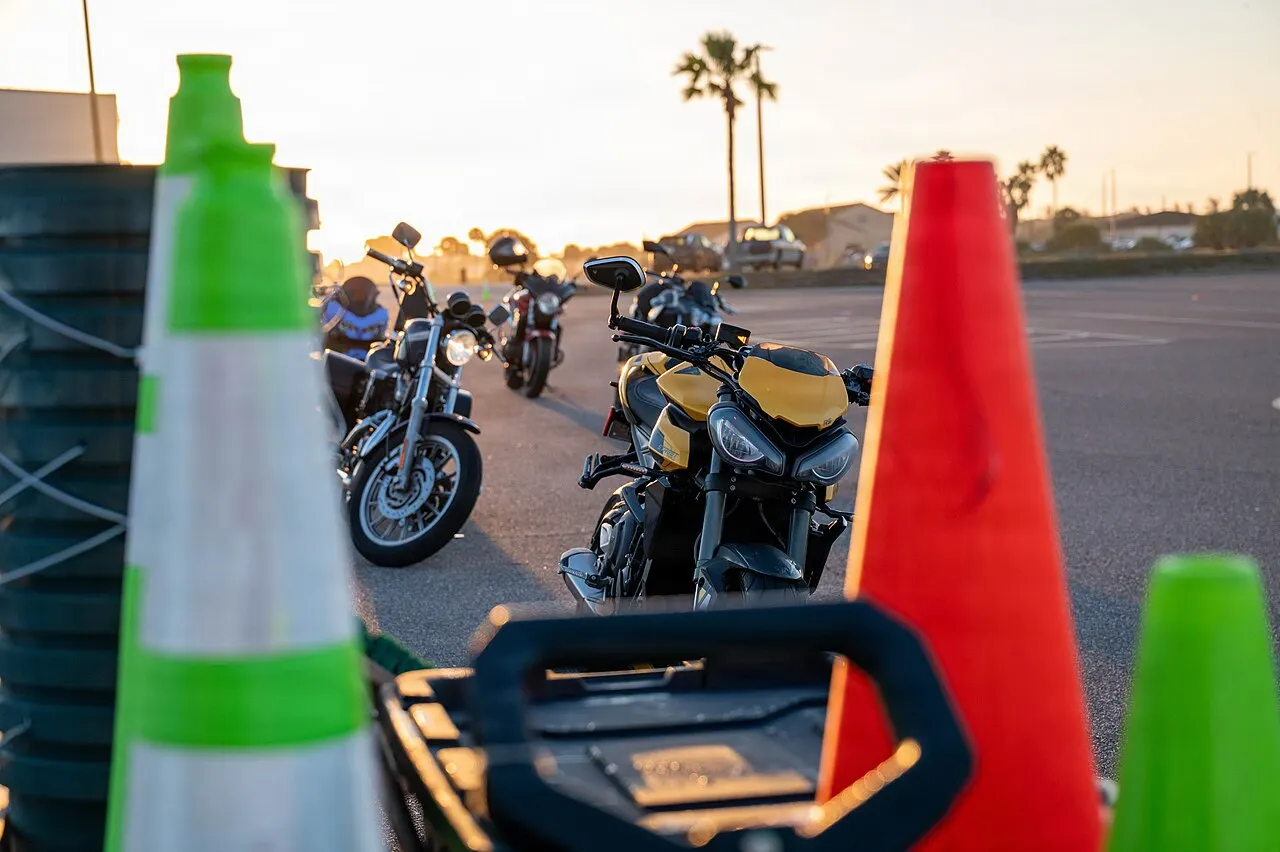
Texas section 521.148 requires a course approved under Chapter 662 for an original Class M or for a Class A, B, or C license that carries motorcycle authorization, and bars the department from issuing either without it. The section does not apply to someone who already holds a valid license from another state that authorizes a motorcycle. Chapter 662 leaves the curriculum to rules of the Texas Commission of Licensing and Regulation and prints no course length or student price. DPS says the course certificate lets it waive the motorcycle knowledge test and stays valid for 24 months, and that an adult with a valid, unrestricted Class A, B, or C plus the course may have the skills test waived too. Anyone who does take the road test brings a motorcycle and, under section 521.166, a passenger vehicle and a licensed driver to carry the examiner.
California splits the course by age in Vehicle Code section 12509.5. From 15 years and 6 months until 18, the permit needs a Class C license or the driver education and training in section 12814.6, the motorcyclist safety program that starts at section 2930, and the motorcycle written exam. From 18 until 21, the course and the written exam are enough. At 21 and older the statute asks only for the written exam. DMV says the course is the California Motorcyclist Safety Program, administered by the California Highway Patrol, and that its Certificate of Completion of Motorcycle Training (DL 389) waives the DMV skills test within 12 months of the date it was issued. At 21 and older the course is a choice: DMV accepts either the course or its own riding test.
Section 12509.5 requires the motorcycle written exam at every age, course or not. The DL 389 stands in for the riding test only, and DMV says a rider under 21 who uses it may still be asked for an observation test.
Can you ride on a permit before that license?
Florida's learner license, open at 15 under sections 322.05 and 322.1615, requires a licensed driver 21 or older in the closest seat to the right, and daylight driving only for the first 3 months, then until 10 p.m. Section 322.1615 gives no motorcycle exception to that seat rule, and FLHSMV says no one under 16 may operate or be licensed to operate a motorcycle or moped on Florida roads. The permit that does name motorcycles is the 90-day temporary instruction permit in section 322.07, for someone 18 or older who would qualify for Class E except for lack of instruction. Its right-seat supervisor is not required while the holder operates a motorcycle or moped, and the course in section 322.12(5)(a) is still required before the license. For a motorcycle-only license, FLHSMV sets a minimum age of 16 and, under 18, a learner license held for one year with no traffic convictions.
Texas DPS lists a motorcycle learner license marked with a J restriction: the holder practices only while a licensed motorcycle operator 21 or older stays in sight. DPS prints no minimum holding period for it and lists a $16 fee under 18. Separately, section 521.224 lets a rider from 15 until 18 hold a restricted Class M limited to 250 cubic centimeters, after an approved course and a parent or guardian signing the application under section 521.145. The statute lifts the engine limit on the 16th birthday without a second course, and DPS says the holder removes it by passing a skills test at 16. California section 12509.5 requires a motorcycle instruction permit before you operate a two-wheel motorcycle, motor-driven cycle, motorized bicycle, moped, or bicycle with an attached motor, and before an M1 or M2 is issued. Riders under 21 hold it at least 6 months. The code sets no holding period at 21 and older, and DMV's license page says people over 21 do not need a permit before applying. The permit lasts no more than 24 months from the application date.
- 15 yr 6 moEarliest permit
Class C or driver education, the safety program, and the written exam. From 18 to 21, the Class C or driver-education piece drops off.
- While it lastsThree limits
No riding in darkness, no freeway with full control of access and no crossings at grade, and no passenger except a licensed driving-school instructor or a qualified instructor under Education Code section 41907.
- 6 monthsThen M1 or M2
Minimum hold before the license. The permit itself can run 24 months from the application date.
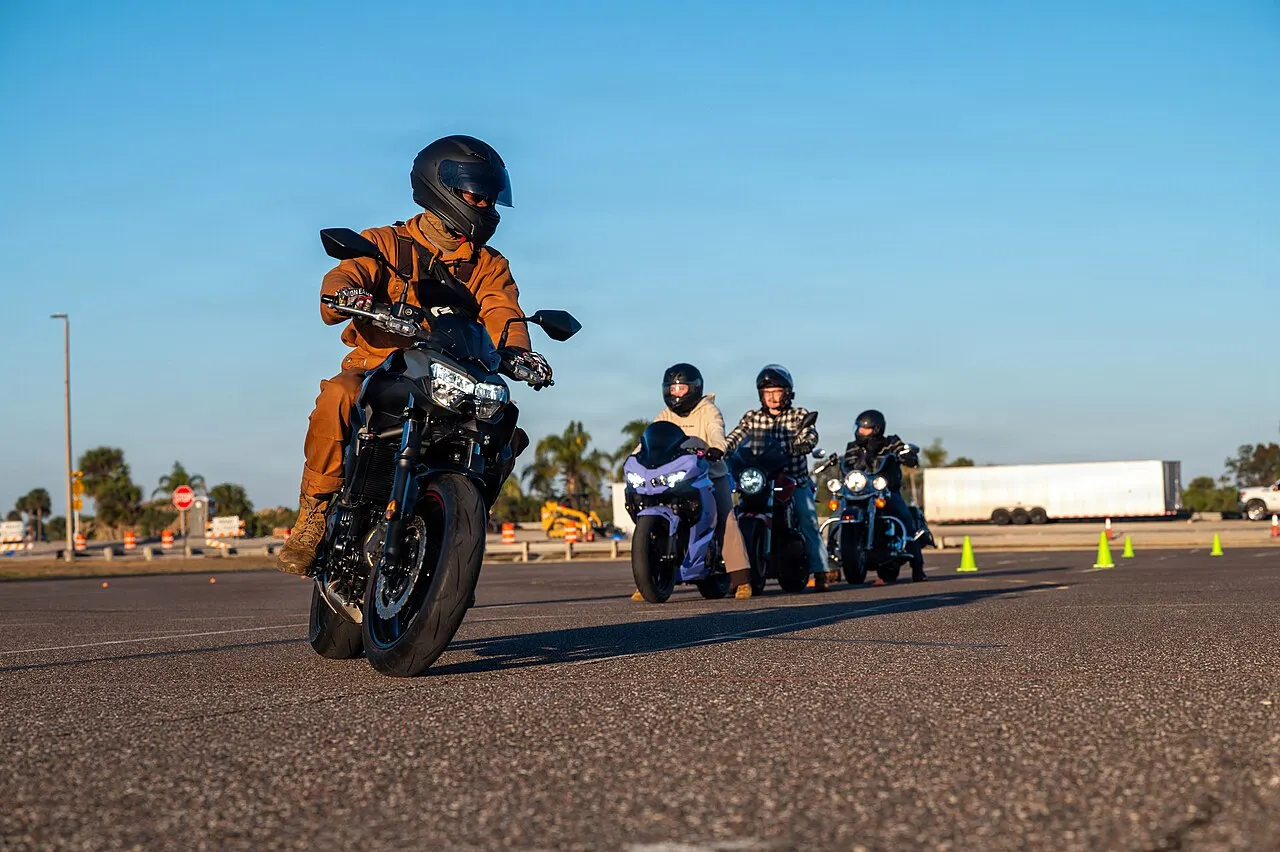
What does each helmet statute require?
Florida section 316.211(1) bars operating or riding on a motorcycle without fastened headgear that meets Federal Motor Vehicle Safety Standard 218. Subsection (2) is separate: the operator wears an eye-protective device of a type the department approves. Under subsection (3)(b), a person over 21 may skip the helmet, not the eye protection, with a policy paying at least $10,000 in medical benefits for crash injuries while operating or riding on a motorcycle. Subsection (3)(a) lifts both rules inside an enclosed cab, and for a rider 16 or older on a machine of 50 cubic centimeters or less, or rated at no more than 2 brake horsepower, that cannot go faster than 30 miles per hour on level ground. A violation is a noncriminal traffic infraction, punished as a nonmoving violation. A motorcycle registered to someone under 21 must carry a license plate unique in design and color.
Texas section 661.003 makes it an offense to operate or ride as a passenger on a motorcycle on a public street or highway without headgear meeting the department's standards, and a separate offense to carry a passenger who is not wearing it. The exception covers only a person 21 or older who has finished a Chapter 662 course or is covered by a health insurance plan paying medical benefits for collision injuries. The statute sets no dollar minimum for that plan. Section 661.002 lets the department adopt American National Standards Institute standards and does not name Standard 218. Section 661.004 lets an officer stop a rider to inspect headgear, but section 661.003(c-1) bars a stop made only to check the course or the insurance. The fine is $10 to $50.
California section 27803 requires the driver and every passenger on a motorcycle, motor-driven cycle, or motorized bicycle on a highway to wear a helmet meeting section 27802. Wearing means fastened with the straps and sized to fit without excessive side-to-side or up-and-down movement. Section 27802 requires the department's helmet standards to include Federal Motor Vehicle Safety Standard No. 218. There is no age cutoff and no insurance substitute. The one exception is a fully enclosed three-wheeler at least 7 feet long, at least 4 feet wide, and 900 pounds or more unladen that meets the code and the federal standards.
New York Vehicle and Traffic Law s. 381(6) makes it unlawful to operate or ride on a motorcycle without a helmet meeting Federal Motor Vehicle Safety Standard 218, and it writes in no age or insurance exception. Subsection (7) requires the operator to wear goggles or a face shield. DMV's Motorcycle Operator's Manual sets that eye protection at the ANSI Z87.1 standard and says a windshield does not replace it, and adds that the headlight and rear light stay on whenever the motorcycle is on the road.
| Rule | Florida | Texas | California | New York |
|---|---|---|---|---|
| Card | Endorsement, or Class E limited to motorcycles | Class M, or authorization on A, B, or C | Class M1 or M2 | Class M, or Class MJ for a junior rider |
| Course | Every first-time applicant. Another state's endorsement transfers without it, but Alabama's also needs a Motorcycle Safety Foundation course card | Every original issue, unless another state already authorized you | Required under 21. Optional at 21 and older | A BRC or BRC2 License/Waiver card issued by the New York State Motorcycle Safety Foundation can waive the road test for a rider age 16 or older with a valid New York Class A, B, C, D, DJ, or E license and an M or MJ permit, if presented within two years of the course |
| Permit | 90-day permit at 18 or older, no supervisor on a motorcycle. No riding under 16 | J-restricted learner license, licensed rider 21 or older in sight. Restricted Class M at 15, 250 cubic centimeters or less | Required before you ride. Six months under 21. No hold in the code at 21 and older | Supervisor 21 or older with a valid motorcycle license, within one-quarter mile and in sight. No passenger but the supervisor |
| Helmet off | Over 21, and at least $10,000 in crash medical benefits. Eye protection stays | 21 or older, plus a Chapter 662 course or a health plan. No dollar floor written in | No age or insurance exception | No age or insurance exception, and eye protection even with a windshield |
| Written test | Retest $5 knowledge, $10 skills. The course certificate can replace the office exam | The course lets DPS waive it. Three tries per application | Pass at 80 percent. Three tries | 20 questions, 14 to pass, with at least 2 of the 4 road sign questions right |
Florida: sections 316.211, 322.07, 322.12, 322.21, 322.57, and the FLHSMV endorsement page. Texas: sections 521.148, 521.161, 521.224, 661.003, and the DPS motorcycle license page. California: Vehicle Code sections 12509.5 and 27803, and the DMV motorcycle pages. New York: Vehicle and Traffic Law s. 381, the DMV motorcycle permit and license page, the Motorcycle Operator's Manual, and the learner permit restrictions page.
What changes when the passenger is under 21?
Maya Torres in Austin on September 8, 2026
- 1Maya is 22, holds a valid, unrestricted Texas Class C, and has never held a motorcycle license anywhere. She finishes a Chapter 662 course that day. Section 521.148 bars DPS from adding motorcycle authorization without that proof, and DPS says the course lets it waive her knowledge test and, with her Class C, her skills test.
- 2She is 21 or older, so the finished course is one helmet exception under section 661.003(c). If an officer stops her and she shows the certificate, the same subsection bars a citation. The other exception, a health plan, has no minimum amount in the statute.
- 3Her brother Andre, born June 2, 2007, turned 19 that June. The exception belongs to the person who would wear the headgear, and he is under 21, so Maya's course does nothing for his helmet.
- 4If he rides bare-headed, he commits the passenger offense in subsection (a) and Maya commits the separate offense in subsection (b) of carrying him. Each carries a fine of $10 to $50.
Outcome. The same ride in Florida: Maya, over 21, may go without a helmet only with at least $10,000 in crash medical benefits, and as the operator she still needs approved eye protection. Andre, at 19, needs Standard 218 headgear whatever the policy. In California both wear a fastened, fitted helmet, since age and insurance open no exception there.
- 1Pass the written exam
Section 12509.5 requires it for the permit. DMV sets the passing score at 80 percent and allows three attempts. A third failure on the same test ends the application. Office knowledge tests are not given after 4:30 p.m.
- 2Book the riding test
DMV gives no driving test without an appointment, made online or at 1-800-777-0133. Bring proof of financial responsibility. A failed riding test means a new appointment on another day and a $7 retest fee, and a third failure ends the application. The license page states no amount for the application fee.
- 3What they score
A pre-trip inspection, riding in different track paths, slow riding, and gear shifting. An applicant with no other driver's license may also need an observation test. Passing brings a temporary license valid for 60 days, and the application and fee stay valid for 12 months.
Common questions
Is a motorcycle license separate from a car license?
Not for a car driver in Florida or Texas. Florida adds a motorcycle endorsement to the existing license under section 322.57(1)(g), and Texas adds a motorcycle authorization that DPS prints as Class AM, BM, or CM. A rider with no other license gets a motorcycle-only one instead: a Class E restricted to motorcycle use in Florida, or a Class M in Texas. California issues its own Class M1 and M2, and DMV's motorcycle page allows for an applicant who holds no other license. Whether a state grants an added letter or a distinct class is itself one of the rules that varies, so it sits in that state layer rather than the shared set. New York is a distinct-class state: riders hold Class M, or Class MJ as a junior, and a licensed car driver adds it by amending the license after the motorcycle road test.
Are motorcycle knowledge questions the same in every state?
The riding technique half is. Braking, counter-steering, lane position, surface hazards and protective gear come from the Motorcycle Safety Foundation curriculum as adopted in state rider handbooks, so the 25 shared questions here hold wherever you sit the test. The licensing half is not: helmet and endorsement rules are state law and change at a border.
How many questions are on the motorcycle knowledge test?
New York publishes one: 20 questions with 14 to pass, at least 2 of the 4 road sign questions among them, the same as its car test, and our New York paper runs at that length and pass mark. No other state covered here publishes a motorcycle question count we can cite. California DMV publishes no current count for any class. Where a published count exists in those states it is for the car knowledge exam and nothing else. Our motorcycle paper there runs 25 questions, and that length is ours rather than any agency's.
Do I have to wear a helmet?
It depends on the state. California: universal, every rider and passenger, every age. New York: required for every rider and passenger, no age or insurance exception, and the operator wears eye protection even behind a windshield. Florida: optional over 21 with at least $10,000 in medical benefits; eye protection still required, and that over-21 exception lifts the helmet only, not the operator's eye protection. One question, two correct answers, which is why it is not in the shared bank.
If I already ride legally in another state, do I take the course again?
Usually not in Texas or Florida. Texas section 521.148(d) says the course rule does not apply to someone holding a valid license from another state that authorizes a motorcycle, and DPS may waive the skills test for an adult 18 or older transferring a valid, unrestricted motorcycle license from another state or a Canadian province. FLHSMV says it honors another state's motorcycle endorsement without the course, except that an Alabama endorsement needs a Motorcycle Safety Foundation Basic RiderCourse completion card with it. California lets a visitor over 18 ride on a valid home motorcycle license and gives a new resident 10 days to get a California motorcycle license. DMV's page does not say whether the course is waived for that new resident.
Does the California course let me skip the written test?
No. Vehicle Code section 12509.5 requires the motorcycle written exam at every age, including riders who finished the safety program. DMV says the DL 389 waives the skills test only, and only within 12 months of the date it was issued. The passing score is 80 percent, and riders under 21 still hold the permit at least 6 months before an M1 or M2.
Can a 15-year-old get a full-size motorcycle license in Texas?
No. DPS says applicants under 16 are subject to an engine size restriction. Section 521.224 offers a restricted Class M from 15 until 18, for a motorcycle of 250 cubic centimeters or less, after an approved course and a parent or guardian signature under section 521.145. The statute lifts that limit on the 16th birthday without a second course, and DPS says the holder does it by passing a skills test at 16. DPS also requires every applicant under 18 to pass a skills test and to show the classroom part of driver education, which the motorcycle page still puts at 32 hours while the DPS teen learner page now gives 24 on the block method. Section 521.161 allows three tries at each part of the exam per application.
What does Texas charge to add a motorcycle?
DPS lists $16 to add a motorcycle to an existing license, $48 for a new Texas license with a motorcycle, $33 for a new Class M alone, and $44 to renew either, each including a $1 administrative fee that is not charged by mail. Behind those, section 521.421 sets $15 for the added motorcycle application in subsection (f), $11 extra on a Class A, B, or C license that carries the authorization in subsection (g), and $43 for renewal in subsection (b).
How long does a California motorcycle instruction permit last, and what is banned?
Section 12509.5(d) makes the permit valid for no more than 24 months from the application date. Anyone who got it under 21 holds it at least 6 months before an M1 or M2. On the permit you may not ride in darkness, use a freeway with full control of access and no crossings at grade, or carry a passenger other than a licensed driving-school instructor or a qualified instructor under Education Code section 41907.
What does Florida charge for the endorsement, and what does the course cost?
Section 322.21 sets each endorsement at $7. An original license restricted to motorcycle use only is $48, and renewing it or a Class E license is also $48, plus a $15 delinquent fee when the renewal comes within 12 months after the license expired. Section 322.0255 caps the course registration fee at $20, refunded if you finish, and sets no other course price.
Sources
- Florida Statutes s. 316.211 (2026), motorcycle helmet and eye protection
- Florida Statutes s. 322.0255 (2026), course hours and the registration-fee cap
- Florida Statutes s. 322.05 (2026), no license under 16 except a learner license
- Florida Statutes s. 322.07 (2026), 90-day instruction permit
- Florida Statutes s. 322.12 (2026), motorcycle exam, retest fees, out-of-state waiver, and the first-time course
- Florida Statutes s. 322.21 (2026), license, endorsement, and delinquent renewal fees
- Florida Statutes s. 322.57 (2026), endorsement versus a motorcycle-only Class E
- Florida Statutes s. 322.1615 (2026), learner license supervision and hours
- FLHSMV, Motorcycle Rider Education and Endorsements (reciprocity, one-year course window, motorcycle-only license at 16)
- Texas Transportation Code chapter 521, including ss. 521.084, 521.122, 521.145, 521.148, 521.161, 521.166, 521.224, and 521.421
- Texas Transportation Code chapter 661, headgear standards, the helmet offense, and headgear stops
- Texas Transportation Code chapter 662, motorcycle operator training and curriculum rules
- Texas DPS, Motorcycle License (course waivers, skills test, J and I restrictions)
- Texas DPS, Driver License Fees
- Texas DPS, Texas learner license as a teen (6 classroom hours concurrent, 24 block)
- California Vehicle Code s. 12509.5, motorcycle instruction permit
- California Vehicle Code s. 27802, helmet standard
- California Vehicle Code s. 27803, who must wear a helmet
- California Vehicle Code s. 21658.1, lane splitting defined
- California DMV, Motorcycle Licenses
- California DMV, Instruction and Learner's Permits (motorcycle permit and 80 percent passing score)
- New York Vehicle and Traffic Law s. 381, Motorcycle equipment (helmet in subdivision 6, eye protection in subdivision 7)
- New York State DMV, Get a Motorcycle Learner Permit and License (20 questions, 14 to pass, 2 of 4 signs, road test waiver, $12.50 amendment)
- New York State DMV, Motorcycle Manual: Motorcycle Licenses Ownership, Special Rules (ANSI Z87.1 eye protection, lights on)
- New York State DMV, Learner Permit Restrictions (motorcycle supervisor within one-quarter mile)
- New York State DMV, Register a Limited Use Motorcycle (Moped) (classes A, B, and C)
Sources: Florida Department of Highway Safety and Motor Vehicles; Texas Department of Public Safety, Driver License Division; California Department of Motor Vehicles; New York State Department of Motor Vehicles; Motorcycle Safety Foundation rider curriculum, as adopted in state rider handbooks; NHTSA motorcycle crash causation data; MSF curriculum; NHTSA motorcycle safety data; FMVSS 218; NHTSA motorcycle safety data. Checked September 25, 2026. Original practice questions, not the official examination questions, and not affiliated with or endorsed by any state licensing agency.