What does the Road Work Ahead sign mean?
The Road Work Ahead sign (MUTCD W20-1) is a work zone sign under the federal Manual on Uniform Traffic Control Devices, the national standard the states build from. Crews and equipment are at work somewhere on the road past this sign, and the layout you meet may no longer match the markings under your wheels.
Source: MUTCD 11th Edition, Part 6, Table 6H-1, checked 2026-09-09.
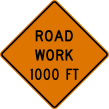
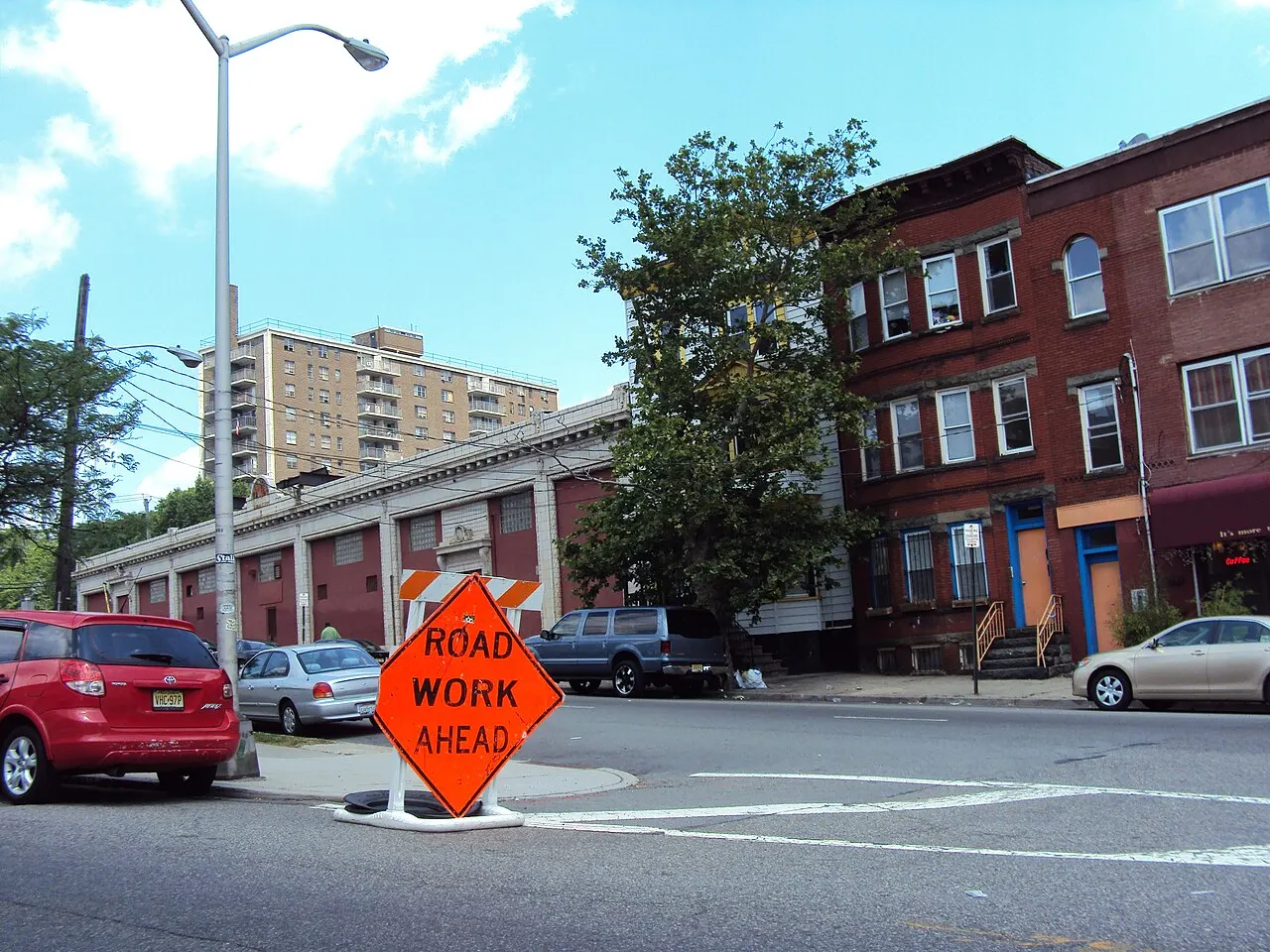
What shape and color is the Road Work Ahead sign?
| MUTCD code | W20-1 |
|---|---|
| Group | Work zone signs |
| Shape | Diamond |
| Color | Orange background, black legend and border |
What a diamond means. A warning. It tells you what the road does next and obliges you to do nothing in particular, which is the distinction test writers probe most often.
What orange means. Temporary traffic control. A work zone, and usually a higher fine.
Work zone signs. Orange is temporary by definition, used only while traffic is being routed around a job. The shapes repeat from the permanent set; what changes is the color and, in most states, the size of the fine.
How far ahead of the work is this sign placed?
Section 6H.03 places W20-1 on the road where the work is, ahead of the work space or any detour. The legend may say STREET instead of ROAD, and the distance line may read XX FEET, XX MILES, or AHEAD. Section 6H.02 says that where two or more advance signs are used, ROAD WORK AHEAD should be the first one drivers meet, and the sign nearest the work should be about 100 feet out on a low-speed city street and 1,000 feet or more on a freeway. Section 6B.04 puts the nearest sign on an urban street at 4 to 8 times the speed limit in feet, allows a single sign as close as 100 feet on a low-speed residential street, and puts the first sign on a rural highway at 8 to 12 times the limit, 440 to 660 feet at 55 mph.
| Road | A, then B, then C |
|---|---|
| Urban, low speed | 100, 100, 100 feet |
| Urban, high speed | 350, 350, 350 feet |
| Rural | 500, 500, 500 feet |
| Expressway or freeway | 1,000, then 1,500, then 2,640 feet |
A runs from the transition or point of restriction back to the nearest sign. B and C are the next two gaps upstream. The highway agency decides which urban roads count as low speed. MUTCD Table 6B-1.
Added up, a three-sign series puts ROAD WORK AHEAD about 300 feet before the restriction on a low-speed city street and about 5,140 feet, just under a mile, on a freeway. Section 6B.04 calls these distances approximate and says to lengthen or shorten them for the site. The sign may also be left out. Typical Application 1 allows that when the work space is behind a barrier, more than 24 inches behind the curb, or 15 feet or more from the edge of any roadway. Typical Application 10, a flagger lane closure on a two-lane road, lets short-duration work, up to 1 hour in one spot under Section 6N.01, drop both this sign and END ROAD WORK.
What do you change when you see it?
- 1Expect a layout that may not match the paint
Section 6A.01 says work zones present constantly changing conditions that drivers do not expect. This sign does not say whether a lane ends or the work is only on the shoulder.
- 2Slow before the cones
On a low-speed street like the one in the Newark photo, Table 6B-1 spaces signs about 100 feet apart.
- 3Do not change lanes yet
A shoulder job and a lane closure use different signs later. Swerving here invents a restriction.
Andre in Newark, posted 25 mph
- 1On September 18, 2026 at 8:40 a.m. Andre is driving at the posted 25 mph. ROAD WORK AHEAD stands on a portable frame at the corner, as in the photo. He sees no cones yet.
- 2He eases off and stays in his lane. About 100 feet on, cones close the parking lane only.
Outcome. At 25 mph, Section 6B.04 puts the nearest sign 100 to 200 feet from the work, so cones at about 100 feet were no surprise. Holding his lane was right, because the restriction never took his through lane.
When does Florida double the speeding fine?
Section 318.18(3)(e) doubles the paragraph (b) fine only in a posted construction zone whose signs show the speed limit and say fines double, and only while construction workers are present or operating equipment on or right beside the road. Paragraph (b) makes 1 to 5 mph over a warning, so there is no dollar amount to double. The other bands, ordinary then doubled: 6 to 9 mph over is $25 then $50, 10 to 14 is $100 then $200, 15 to 19 is $150 then $300, 20 to 29 is $175 then $350, and 30 or more is $250 then $500.
In New York, this orange advance sign gives you time to adjust before the work, but it does not set a speed limit. Read the speed signs as you approach and keep to the limit posted for the zone. New York DMV assigns 8 points for work-zone speeding. That consequence makes it especially important to slow before the first cones instead of waiting until the lane narrows.
- Reading the diamond as "your lane is closed." A later sign names the lane.
- Doubling a Florida fine because the panel is orange. The posting must also show the limit and the double-fine notice, and workers must be present or running equipment.
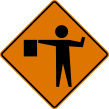
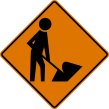

This diamond is general. A lane closure, a flagger, or workers on foot are later signs.
What is the Road Work Ahead sign often mistaken for?
Yellow warning signs generally. Orange means temporary traffic control, and MUTCD Section 6H.02 requires it for TTC warning signs. W20-1 is normally the first advance sign in a work zone.
What does the permit test ask about the Road Work Ahead sign?
These 2 questions are from the practice bank, with the answer marked.
An orange sign of this shape tells you:
- A.A permanent hazard is ahead
- B.You are entering a temporary work zone(correct answer)
- C.A detour is mandatory
- D.The road surface has changed
Source: MUTCD W20-1
What does an orange sign or work-zone marking mean?
- A.A recreational area
- B.Roadwork or a temporary traffic control zone(correct answer)
- C.A hospital route
- D.A scenic byway
Why: Orange is reserved for construction and maintenance. Fines are commonly increased in these zones and workers may be close to live lanes.
Source: Federal MUTCD, 11th Edition (FHWA)
Questions drivers ask about the Road Work Ahead sign
I see the sign and no cones. Should I change lanes?
Not from this sign alone. Section 6H.03 treats it as a general warning of obstructions or restrictions and places it ahead of the work space or any detour. The sign that names a closed lane comes later. On a low-speed street the next sign or device can be about 100 feet away, so ease off and hold your lane until a later sign or the cones show which lane is actually going away.
How far before freeway work should it stand?
Table 6B-1 spaces freeway advance signs at 1,000 feet, then 1,500, then 2,640. Section 6H.02 puts the sign nearest the work 1,000 feet or more out and says ROAD WORK AHEAD should be the first you reach, so in a three-sign series it stands about 5,140 feet out. Section 6B.04 says those distances are approximate and can be lengthened or shortened for the site.
A 10-minute patch has no ROAD WORK AHEAD sign. Is that allowed?
It can be. Section 6N.01 defines short-duration work as work that stays in one spot for up to 1 hour. Typical Application 10 lets a flagger lane closure on a two-lane road omit this sign and END ROAD WORK for short-duration work. Typical Application 1 allows the omission when work is behind a barrier, more than 24 inches behind the curb, or 15 feet or more from the roadway edge, and for short or mobile work beyond the shoulder a vehicle with activated warning lights can replace all the signs.
Does the orange sign alone double a Florida speeding fine?
No. Section 318.18(3)(e) doubles the paragraph (b) fine only when the posting includes the limit and a notice that fines double, and only when construction workers are present or operating equipment on or beside the road. Fifteen to 19 mph over is $150, or $300 when those conditions are met. One to 5 mph over is a warning, and the statute prints no doubled dollar amount for it.
Sources
- MUTCD 11th Edition, Part 6, Table 6H-1
- MUTCD 11th Edition (December 2023), Part 6, Sections 6A.01, 6B.04, 6H.02, 6H.03, and 6N.01, Table 6B-1, Typical Applications 1 and 10
- Florida Statutes section 318.18 (2025), construction-zone speeding fines
- New York State DMV, The New York State Driver Point System
What are the other work zone signs?
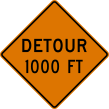
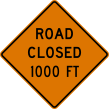
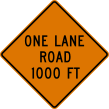


All 9 work zone signs on one page, or every US road sign by shape and color.
Test yourself on this sign and the rest of the set with a road signs practice test for Florida, Texas, California or New York.
The artwork is the federal design itself, which the manual dedicates to the public domain in MUTCD 11th Edition, Part 1, Section 1D.06, checked 2026-09-09. The Interstate Shield, the 511 pictograph and the National Scenic Byway graphic are named exceptions and are not reproduced anywhere on this site.
Source: Manual on Uniform Traffic Control Devices, 11th Edition. Not affiliated with or endorsed by the Federal Highway Administration or any state agency.