What do the General Service signs (Gas, Food, Lodging, Telephone) mean?
The General Service signs (Gas, Food, Lodging, Telephone) (MUTCD D9-7, D9-8, D9-9, D9-1) are guide signs under the federal Manual on Uniform Traffic Control Devices, the national standard the states build from. They name which of the road-user services, fuel, a meal, a bed for the night, a phone, can be reached from the interchange coming up.
Source: MUTCD 11th Edition (FHWA), checked 2026-09-09.
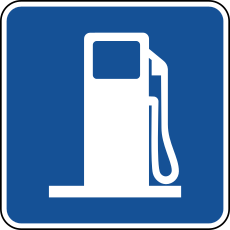
What shape and color are the General Service signs (Gas, Food, Lodging, Telephone)?
| MUTCD code | D9-7, D9-8, D9-9, D9-1 |
|---|---|
| Group | Guide and service signs |
| Shape | Square or rectangular symbol panels |
| Color | Blue background, white symbols, legend and border |
What blue means. Motorist services: rest areas, hospitals, fuel, food and lodging.
Guide and service signs. Direction, services, recreation: three colors doing three jobs, and not one of them carrying a duty. Work out which job the color does and most questions in this group answer themselves.
When is a gas, food, lodging, or phone symbol even posted?
Section 2I.02 of the MUTCD 11th Edition (December 2023) starts from the point that on conventional roads, gas, food, and lodging are usually within sight at fairly frequent intervals, so special signs are usually unnecessary. In urban areas it says General Service signs are usually not needed except for hospitals, law enforcement assistance, tourist information centers, and camping. The option to post them is for places where services are infrequent and found only on an intersecting highway or crossroad.
The legend and border are white on blue. A General Service sign at an intersection shall carry a directional message. Symbols and words shall not be mixed on the same sign. The codes on this page are Telephone D9-1, Gas D9-7, Food D9-8, and Lodging D9-9.
Section 2I.02 sets no operating hours for gas, food, lodging, or telephone on a conventional road. It asks each State that uses these signs to set a statewide policy with criteria for when services count as available. Hours do appear for other symbols: the hospital sign is limited to facilities open 24 hours a day, 7 days a week, the pharmacy sign to a 24 hour pharmacy within 3 miles of an interchange on the Federal-aid system, and EV charging to DC fast chargers in continuous operation at least 16 hours a day, 7 days a week. For freeways and expressways, Section 2I.03 suggests state criteria count gas only where it operates at least 16 hours a day, 7 days a week.
Why does Inglis say 35 miles?
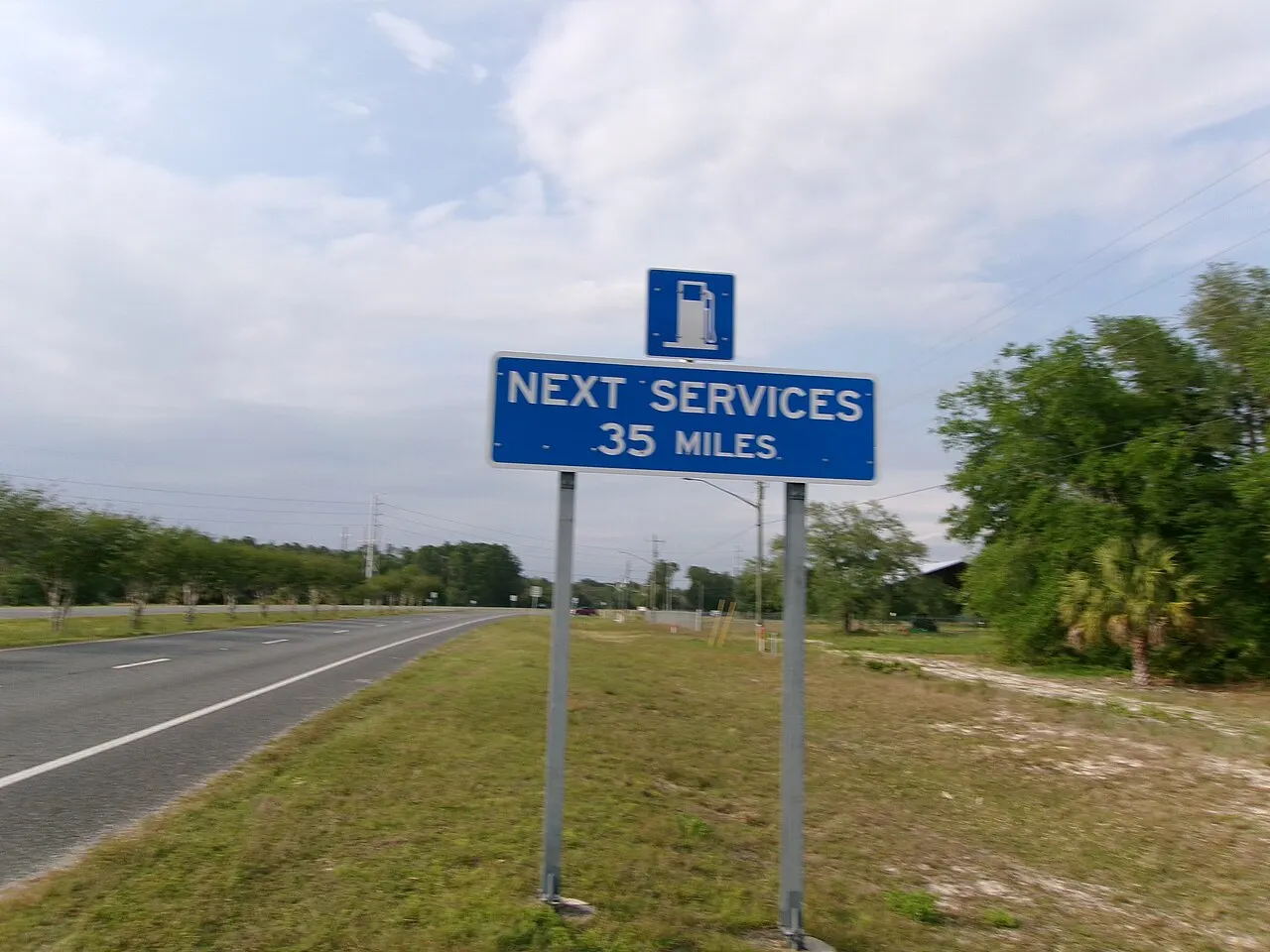
Paragraph 16 of Section 2I.02 allows a Next Services Advance plaque (D9-17P) under a General Service sign when the next point with services is 10 miles or more away. On a freeway or expressway, Section 2I.03 uses "greater than 10 miles" and puts the plaque under the Exit Direction sign. Table 2I-1 sizes the plaque at 72 by 24 inches on a conventional road and 114 by 30 on a freeway or expressway.
The Inglis assembly stands beside northbound US 19 and US 98, and the photo shows no interchange, so the conventional-road paragraph is the one that fits. A small gas-pump symbol sits above a wide panel reading NEXT SERVICES 35 MILES. Thirty-five is well past the 10 mile threshold. The symbol and the words are on two separate panels, which is how the assembly keeps symbols and words off the same sign.
Table 2I-1 sizes these symbol signs at 24 by 24 inches on a conventional road and 30 by 30 on a freeway or expressway. On freeways, Section 2I.03 caps a General Service sign at six services and says the space for a service that is not present should be left blank for one that may come later.
What should you do with a 35 mile panel?
- 1Read 35 as a gap, not a menu
Paragraph 16 measures to the next point where services are available. The plaque does not list which services wait there, so do not count on food or a motel at mile 35.
- 2Treat 35 as a distance, not a brand
The plaque names no company, price, or exit number. Panels with business logos are Specific Service signs, covered in Chapter 2J.
- 3Decide before the gap, not in the middle of it
A stretch of 10 miles or more without services is the reason the plaque exists. If your range is anywhere near 35 miles, buy fuel before you start it.
- 4A freeway ramp is a second sign
Section 2I.03 repeats the signing, smaller and with arrows, where the exit ramp of a single-exit interchange meets the crossroad, when the services cannot be seen from the ramp. Inglis is not that ramp.
Paragraph 05 of Section 2I.02 says a State that elects to use General Service signs should set a statewide policy or warrant, with criteria for the availability of services, and local agencies should follow it. The 35 on the Inglis plaque is a distance, not a statute, a fine, or a promise about hours.
Denise, northbound at Inglis, about 40 miles of fuel left
- 1The pump symbol sits over NEXT SERVICES 35 MILES. Her gauge suggests about 40 miles of range. The 40 is her figure, not something on the sign.
- 2If the first services are at mile 35 and include fuel, she arrives with about 5 miles to spare. The plaque does not promise that fuel is what she will find there, or that it will be open.
Outcome. A 5 mile margin with no guarantee is too thin, so she buys fuel before starting the 35 miles. With 30 miles of range, the same plaque would tell her plainly that she cannot make it without stopping first.
Which test traps attach the wrong rule?
- "Gas signs are only for stations open 24 hours." The 24 hour rules in Section 2I.02 belong to the hospital and pharmacy signs. For freeway signing, Section 2I.03 suggests 16 hours a day for gas, as a guideline for state policy, not a 24 hour Standard.
- "The words NEXT SERVICES under a symbol break the rule against mixing symbols and words." They cannot mix on one sign. A D9-17P plaque under a separate symbol sign is the option in paragraph 16.
- "The 3 mile limit applies to gas." The 3 miles in Section 2I.02 is for a 24 hour pharmacy near an interchange on the Federal-aid system. Section 2I.02 sets no such mileage cap for gas.
- "35 miles means the next exit." This panel has a distance and no exit number. On routes with exit numbering, Section 2I.03 says the freeway General Service sign should include the exit number.
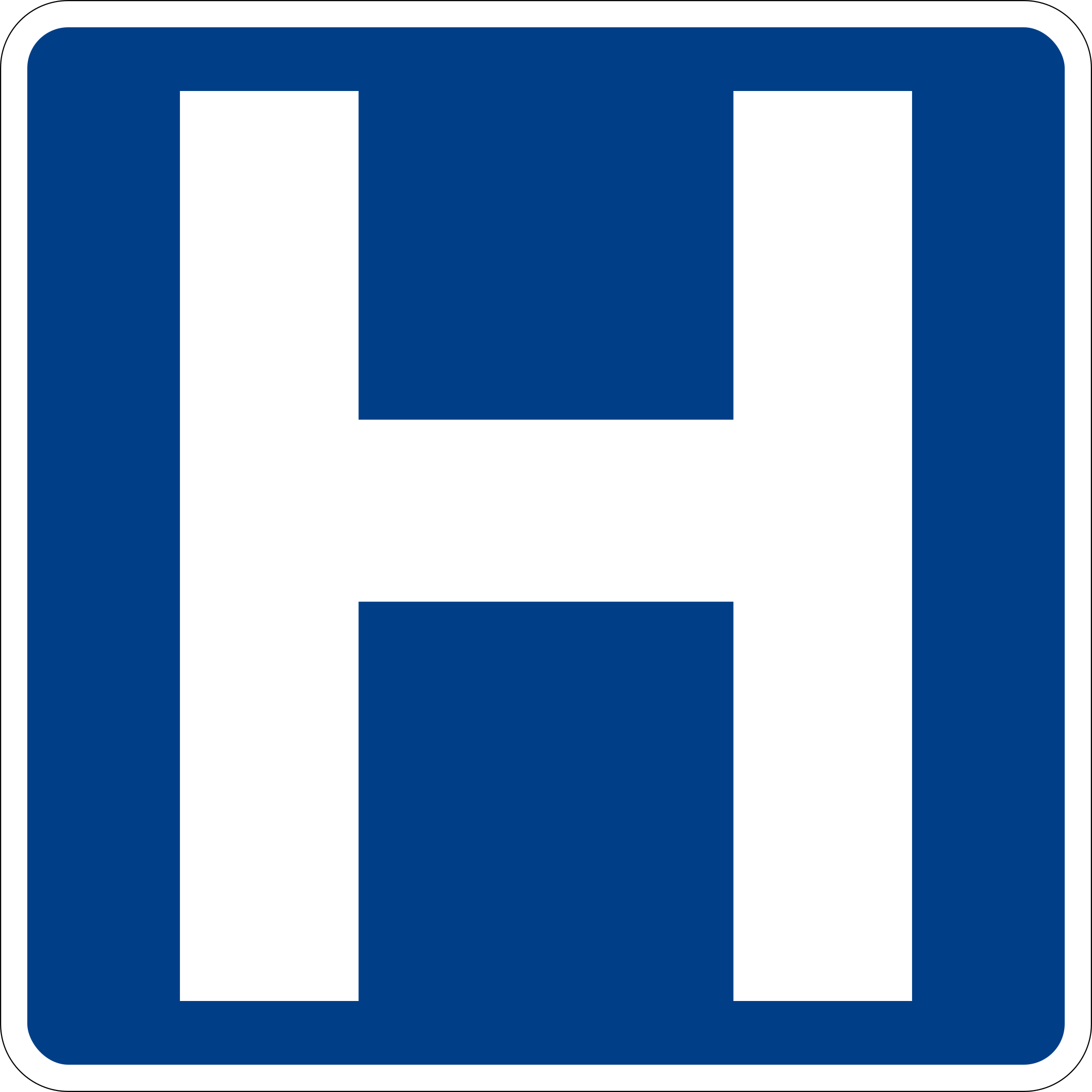
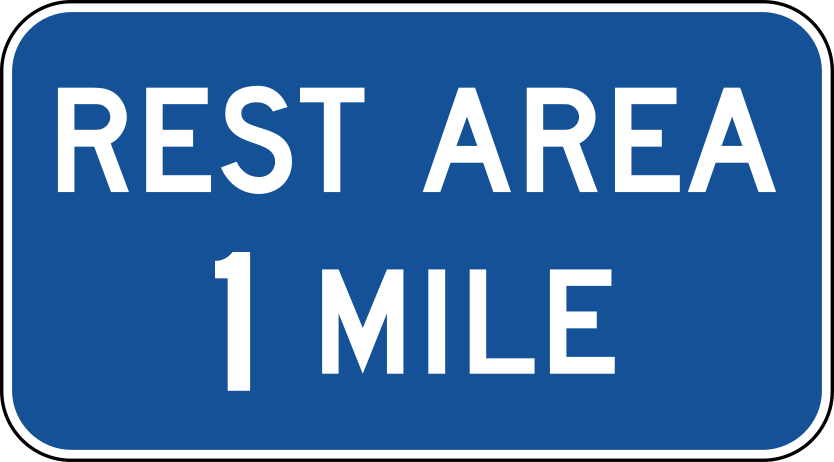
The Hospital sign is limited to facilities open 24 hours a day, 7 days a week. Rest Area needs parking and restrooms. Brown recreational and cultural interest signs point to places like parks, not to fuel.
What are the General Service signs (Gas, Food, Lodging, Telephone) often mistaken for?
Specific Service or logo signs under MUTCD Chapter 2J, which carry real business logos. Those logos are trademarks and are expressly outside the MUTCD public-domain clause, which is why none is reproduced here.
What does the permit test ask about the General Service signs (Gas, Food, Lodging, Telephone)?
This question is from the practice bank, with the answer marked.
A blue sign on a highway generally indicates:
- A.A warning
- B.Where to find gas, food or lodging(correct answer)
- C.A speed limit
- D.A recreational site
Why: Blue is the services color. Brown marks recreation and cultural sites, green gives directions and distances.
Source: Federal MUTCD, 11th Edition (FHWA)
Questions drivers ask about the General Service signs (Gas, Food, Lodging, Telephone)
Does NEXT SERVICES 35 MILES mean fuel, food, and a motel are all 35 miles away?
Not necessarily. Paragraph 16 of Section 2I.02 measures to the next point at which services are available, and the plaque does not say which services are there. At Inglis it sits under a gas symbol, so the fair reading is that you should not expect services on this route for 35 miles. Food, lodging, and a phone each have their own symbol, and none of them is on this post.
Is the plaque required once the gap hits 10 miles?
No. Paragraph 16 says the D9-17P plaque may be installed below the General Service sign when the next services are 10 miles or more away. "May" is an option. On freeways and expressways the matching option in Section 2I.03 is for a gap greater than 10 miles, with the plaque under the Exit Direction sign. Inglis at 35 miles qualifies. A 9 mile gap does not meet the 10 mile test.
How do I know the station is open when I get there?
From this sign, you do not. Section 2I.02 sets no daily hours for D9-7, D9-8, D9-9, or D9-1 on a conventional road and leaves availability criteria to each State's policy. The 24 hour rules in that section cover hospitals and the pharmacy sign, and the 16 hour rule covers EV charging. For freeway signing, Section 2I.03 suggests states count gas only where it operates at least 16 hours a day, 7 days a week. The sign lists no price or brand either.
I am on a freeway and the services sign has an exit number. Do I still get a sign on the ramp?
Section 2I.03 says General Service signs are generally not appropriate at major interchanges and in urban areas. Where they are used and the services cannot be seen from the ramp of a single-exit interchange, the signing shall be repeated in a smaller size where the exit ramp meets the crossroad, with arrows. No more than six services go on one sign, and the space for a service that is not present should be left blank.
Is a pay phone still what D9-1 promises?
The manual names the symbol Telephone, code D9-1, 24 by 24 inches on a conventional road. Section 2I.02 does not say the phone is free, indoors, or within a set distance of the road. For freeway signing, Section 2I.03 suggests states count a public telephone only if it operates continuously, 7 days a week. If the next services are 10 miles or more away, the same D9-17P plaque may go under a telephone symbol. The Inglis post shows a pump, not a phone.
Sources
- MUTCD 11th Edition (FHWA)
- MUTCD 11th Edition (December 2023), Chapters 2H through 2N, Sections 2I.02 and 2I.03, Table 2I-1, Chapters 2J and 2M
What are the other guide and service signs?



All 11 guide and service signs on one page, or every US road sign by shape and color.
Test yourself on this sign and the rest of the set with a road signs practice test for Florida, Texas, California or New York.
The artwork is the federal design itself, which the manual dedicates to the public domain in MUTCD 11th Edition, Part 1, Section 1D.06, checked 2026-09-09. The Interstate Shield, the 511 pictograph and the National Scenic Byway graphic are named exceptions and are not reproduced anywhere on this site.
Source: Manual on Uniform Traffic Control Devices, 11th Edition. Not affiliated with or endorsed by the Federal Highway Administration or any state agency.