What does the Curve sign mean?
The Curve sign (MUTCD W1-2) is a warning sign under the federal Manual on Uniform Traffic Control Devices, the national standard the states build from. A gradual bend rather than a corner. Settle the speed before the entry and hold it, since braking part way around is what puts a car onto the shoulder.
Source: MUTCD 11th Edition, Chapter 2C, Table 2C-1, checked 2026-09-09.
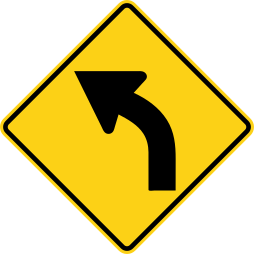
What shape and color is the Curve sign?
| MUTCD code | W1-2 |
|---|---|
| Group | Warning signs |
| Shape | Diamond |
| Color | Yellow background, black symbol and border |
What a diamond means. A warning. It tells you what the road does next and obliges you to do nothing in particular, which is the distinction test writers probe most often.
What yellow means. General warning of a permanent condition ahead.
Warning signs. A diamond reports a condition and orders nothing. What you do about it is left to you, and that gap between a report and an order is what test writers keep probing.
Why did the agency use the curve arrow here?
Section 2C.07 sets the default. If Table 2C-4 says a horizontal alignment sign is required, recommended, or allowed, the sign ahead of the curve shall be a Curve sign unless another sign in that section is recommended or allowed instead. The Turn sign should replace it when the advisory speed is 30 mph or less. Above that, the curve arrow is the sign the standard names.
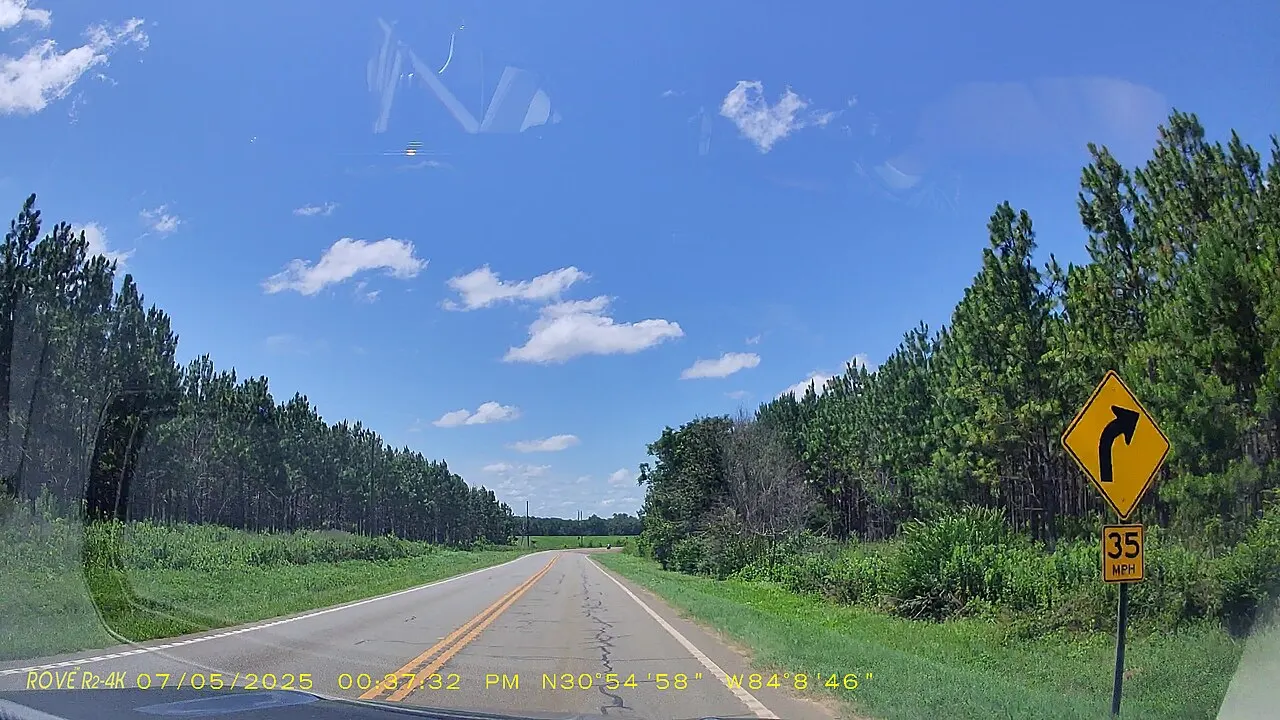
The Grady County photo shows that pairing: a curve arrow over a 35 MPH plaque. Thirty-five is above the Turn threshold, so the curve symbol matches Section 2C.07. The plaque is a separate decision under Table 2C-6, based on how far 35 sits below the approach speed.
How far before the bend should the sign stand?
Section 2C.04 points agencies to Table 2C-3 and says its distances can be adjusted for roadway features, other signs, and visibility. Condition B is the set of columns for slowing down to get through a curve or turn. Those distances already subtract 250 feet of legibility distance, which the table footnote calls appropriate for an alignment symbol sign. They are the distance from the sign to the start of the condition, not the distance at which you can first read the sign.
What else gets installed when the speed drop is large?
Chart A of Table 2C-4 decides whether any device is needed, from roadway type and daily traffic. A freeway or expressway is "Required" at every volume. An arterial or collector with pavement markings is optional under 1,000 vehicles a day, recommended from 1,000 to 3,999, and required above 3,999. Without pavement markings, the same road becomes required from 3,000 a day. Roads that are not freeways, expressways, arterials, or collectors are optional at every volume. Section 2C.06 lets devices be omitted when the approach speed limit is 20 mph or less, and on urban streets with an AADT of 1,000 or less.
| Differential | What goes out on the road |
|---|---|
| 5 mph | Pavement markings, or the advance alignment sign, on a paved road. The advance sign on an unpaved road. |
| 10 mph | Advance horizontal alignment warning sign |
| 15 mph | Delineators and the advance warning sign |
| 20 mph or more | Chevrons and the advance warning sign |
MUTCD Table 2C-4, Chart B. The differential is the curve advisory against the posted limit, the statutory limit, or the 85th percentile approach speed. Section 2C.06 lets a One-Direction Large Arrow replace or supplement delineators or chevrons where the site limits how many can be seen or installed.
What do you do between the sign and the bend?
- 1Finish the speed change on the straight
Condition B in Table 2C-3 is built on a 2.5 second perception-response time and a deceleration of 10 feet per second squared, then shortened by the 250-foot reading distance. That math assumes you slow before the curve, not halfway around it.
- 2Match the plaque by the time the roadway bends
If a W13-1P is mounted under the curve arrow, that figure is the study speed for the bend in free-flow conditions. Arrive at it as the curve begins.
- 3Hold a steady speed through the bend
A late brake is a steering problem as well as a speed problem. The sign gave its warning upstream so the tires are not asked to slow and turn hard at once.
- 4Watch for chevrons if the differential is 20 mph or more
Chart B puts chevrons with the advance sign at that gap. Table 2C-5 sets their spacing, and its note says the radius and speed pairs in it should not be used to determine the advisory speed.
Jordan, a Florida state road posted 55, advisory 40, April 18, 2026
- 1The road is an arterial with a center line carrying 4,500 vehicles a day, so Chart A of Table 2C-4 requires devices for the curve.
- 2The differential is 15 mph, so Table 2C-6 requires the advisory plaque and Chart B calls for delineators plus the advance warning sign.
- 3Forty is above 30, so Section 2C.07 keeps the advance sign as a Curve sign rather than a Turn sign.
- 4Table 2C-3 suggests about 125 feet from that sign to the curve on a 55 mph approach slowing to 40.
- 5Jordan is at 55 when the symbol becomes readable and brakes only after the roadway has started to bend.
- 6Section 316.183(4)(b) tells every Florida driver to drive at an appropriately reduced speed when approaching and going around a curve, consistent with the reasonable-speed rule in subsection (1).
Outcome. Braking inside the bend is what the sign placement was meant to prevent. The 55 sign was still the legal maximum, but section 316.183(4)(b) required a reduced speed for the curve, and the plaque showed 40 as the study speed for it.
Can you turn around near a New York curve?
A Curve warning sign tells you the road bends ahead, but it does not by itself ban a U-turn. In New York, the New York State Driver's Manual (MV-21), Chapter 5, forbids a U-turn near a curve when other drivers cannot see you from 500 feet away. If the bend hides approaching traffic, continue to a place with a clear view instead of using the curve approach to turn around.
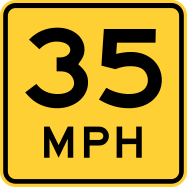

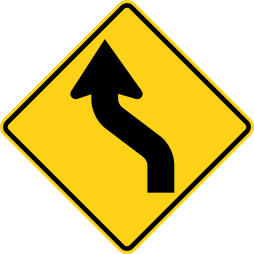
Chevrons are the 20 mph-or-more treatment along the curve. A Reverse Curve sign should replace two Curve signs when the bends turn opposite ways and the tangent between them is under 600 feet.
What is the Curve sign often mistaken for?
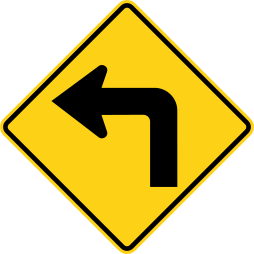
Turn (W1-1), which is the sharper version of the same idea.
|  |
|---|---|
| GroupWarning signs | GroupWarning signs |
| ShapeDiamond | ShapeDiamond |
| ColorYellow background, black symbol and border | ColorYellow background, black symbol and border |
| What it meansA gradual bend rather than a corner. | What it meansThe alignment breaks sharply, close to a right angle. |
Which signs get mistaken for the Curve sign?
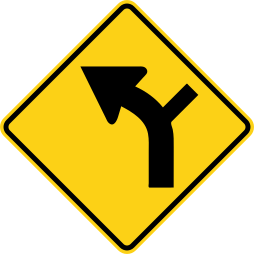 Combination Horizontal Alignment / IntersectionW1-10
A plain Curve sign (W1-2). Candidates miss the short stub arm representing the side road.
What does the permit test ask about the Curve sign?
This question is from the practice bank, with the answer marked.
A yellow sign showing a curved arrow with a posted number means:
- A.A mandatory maximum speed limit
- B.An advisory safe speed for the curve(correct answer)
- C.A distance to the next exit
- D.A weight limit for the bridge
Why: The number on a warning sign is advisory: the recommended speed to take the feature safely in good conditions. The legal limit remains the posted regulatory limit.
Source: Federal MUTCD, 11th Edition (FHWA)
Questions drivers ask about the Curve sign
The plaque says 35 and the speed limit sign said 55. Which one do I obey?
Both, for different reasons. The white sign is the legal maximum for the road. The yellow plaque is the engineering study speed for this bend, and on a 20 mph gap Chart B also calls for chevrons. Florida section 316.183(4)(b) separately requires a reduced speed going around a curve. The curve sign does not repeal the posted limit, and the posted limit does not make 55 a safe entry speed.
Why is the sign so close to the curve that I have little time after I pass it?
On a 55 mph road, Table 2C-3 lists 125 feet from the sign to the curve when the advisory is 40 mph, and 200 feet when it is 30. Those figures already assume you could read the symbol about 250 feet before you reached the post. If you wait until the sign is beside you, you have spent the reading distance and only the short remainder is left.
Does every bend get a curve sign?
No. Chart A of Table 2C-4 leaves low-volume roads optional, and Section 2C.06 allows devices to be omitted when the approach speed limit is 20 mph or less, and on urban streets at or under 1,000 vehicles a day. A freeway is in the required row at every volume. A missing sign is not a statement that the bend has no advisory speed.
Can the same curve use a turn sign in one direction and a curve sign in the other?
The choice follows the advisory speed of that approach, not a single label for the whole bend. Section 2C.07 says a Turn sign should be used when that advisory is 30 mph or less and a Curve sign otherwise. Two directions can have different approach speeds and different advisories, and the manual does not forbid that result.
Sources
- MUTCD 11th Edition, Chapter 2C, Table 2C-1
- MUTCD 11th Edition, December 2023, Sections 2C.04, 2C.06, 2C.07, and 2C.08, Tables 2C-3, 2C-4, 2C-5, and 2C-6
- Florida Statutes section 316.183 (2025), reduced speed going around a curve
- New York State Driver's Manual (MV-21), Chapter 5, Intersections and Turns
What are the other warning signs?
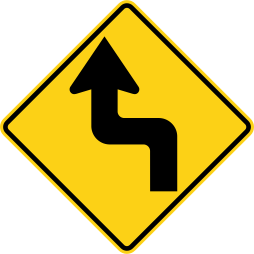
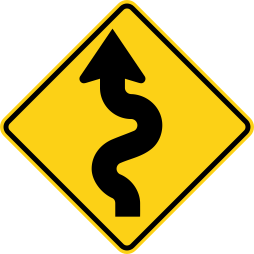


All 55 warning signs on one page, or every US road sign by shape and color.
Test yourself on this sign and the rest of the set with a road signs practice test for Florida, Texas, California or New York.
The artwork is the federal design itself, which the manual dedicates to the public domain in MUTCD 11th Edition, Part 1, Section 1D.06, checked 2026-09-09. The Interstate Shield, the 511 pictograph and the National Scenic Byway graphic are named exceptions and are not reproduced anywhere on this site.
Source: Manual on Uniform Traffic Control Devices, 11th Edition. Not affiliated with or endorsed by the Federal Highway Administration or any state agency.