What does the T Intersection sign mean?
The T Intersection sign (MUTCD W2-3) is a warning sign under the federal Manual on Uniform Traffic Control Devices, the national standard the states build from. The road you are on ends ahead at a T intersection; you must turn left or right.
Source: MUTCD 11th Edition, Chapter 2C, Table 2C-1, checked 2026-09-09.

What shape and color is the T Intersection sign?
| MUTCD code | W2-3 |
|---|---|
| Group | Warning signs |
| Shape | Diamond |
| Color | Yellow background, black symbol and border |
What a diamond means. A warning. It tells you what the road does next and obliges you to do nothing in particular, which is the distinction test writers probe most often.
What yellow means. General warning of a permanent condition ahead.
Warning signs. A diamond reports a condition and orders nothing. What you do about it is left to you, and that gap between a report and an order is what test writers keep probing.
Where does the T warning stand, and which code does the manual use?
MUTCD 11th Edition, Section 2C.41 lists the intersection warnings by code: Cross Road is W2-1, Side Road is W2-2, W2-3 or W2-3a, T-Intersection is W2-4, and Y-Intersection is W2-5. The T symbol is for a road that meets another road and does not continue. In Figure 2C-10, W2-3 is a side road joining at an angle, not the T.
Most intersection warnings should not be posted on an approach that already has a STOP sign, a YIELD sign, or a signal. Paragraph 07 of Section 2C.41 excepts the T-Intersection sign (and the Circular Intersection sign) from that limit, so a stem that is already controlled can still carry the T warning. The symbol should still match the layout: a bar across the top, no road continuing ahead.
The diamond is the advance warning. What faces you at the end of the stem is different. Section 2C.43 says a Two-Direction Large Arrow (W1-7), if used, shall be installed on the far side of the T in line with traffic on the stem. Section 2C.08 says Chevron Alignment signs shall not be put there to show that a through movement is impossible, because that is the job of a Two-Direction or One-Direction Large Arrow. You meet the arrow at the junction and the W2-4 before it.
What do you do on the stem?
- 1Get your speed down early
You cannot continue. If a stop is likely, Table 2C-3 Condition B to 0 mph is 250 feet at 35 mph and 305 feet at 40 mph, and note 3 names Intersection Warning signs among the typical signs for that column.
- 2Pick left or right and set up the turn
California Vehicle Code s. 22100: make both the approach and the right turn as close as practicable to the right-hand curb or edge. For a left, approach as close as practicable to the left-hand edge of the extreme left-hand lane lawfully available, and leave the intersection in a lane lawfully available for your new direction.
- 3Yield to the road that continues
California Vehicle Code s. 21800(b)(1): when two vehicles enter at the same time, the driver on the left yields to the driver on the immediate right, except that a driver on a terminating highway yields to any vehicle on the continuing highway. A T stem is a terminating highway under the definition in (b)(2).
- 4Obey a stop sign, yield sign or signal if one is there
Section 21800(e) says the section does not apply where an official signal or a yield sign controls the intersection, or where stop signs control it from fewer than all directions. The warning does not cancel those devices.
Stem of a T meeting a through road
The driver on the terminating stem yields.
California Vehicle Code s. 21800(b) defines a terminating highway as one that meets, but does not continue beyond, an intersection with a highway that does continue, and makes that driver yield to vehicles on the continuing highway. Florida Statutes s. 316.121 has no terminating-highway clause. It uses first to enter, then left yields to right, plus road-type rules for state-maintained and unpaved roads.
On a New York stem, the T sign tells you to prepare for a left or right turn because the road does not continue. The New York State Driver's Manual (MV-21), Chapter 5 requires a turn signal or hand signal at least 100 feet before the turn. Choose your direction early enough to give that warning before the intersection. Any STOP, YIELD, or signal at the junction still controls when you may enter.
How does Luis turn off a 35 mph stem in California?
Luis, northbound stem, through road running east and west
- 1Luis is driving north at 35 mph on a two-lane road that ends at a county highway. W2-4 is the advance symbol Section 2C.41 assigns to that layout. In this example nothing else controls the junction: no signal, no stop sign, no yield sign.
- 2Condition B to a stop at 35 mph is 250 feet in Table 2C-3. He slows as soon as he reads the sign, so the stop or the turn is not a last-second move.
- 3An eastbound car on the through road, coming from his left, reaches the junction at the same moment he does. Under the ordinary tie rule that driver, being on his left, would yield to him. Vehicle Code s. 21800(b)(1) reverses it: Luis is on the terminating highway, so he yields.
- 4Once the car has passed, he turns right as close as practicable to the right-hand edge, s. 22100(a). If a large arrow is posted on the far side, it is the Section 2C.43 sign, not a row of chevrons.
Outcome. He ends up heading east on the through road behind the car that had the right of way. He never aimed at the far roadside as if the stem continued.
What do permit questions get wrong here?
| If you arrive with cross traffic | California Vehicle Code s. 21800 | Florida Statutes s. 316.121 |
|---|---|---|
| You are on the stem, they are on the road that continues | You yield, because your highway terminates | No terminating-highway clause. Subsection (3) still makes you yield if the through road is state-maintained and nothing controls your approach |
| Nobody has entered yet, and you arrive together | Left yields to the immediate right, except the terminating-highway rule | Left yields to the right |
| A yield sign or a signal faces you | Section 21800 does not apply | Subsection (5): the rules are modified at through highways and as stated elsewhere in the chapter |
Florida Statutes s. 316.151 tells you where to position a right or left turn once you go. It does not decide who goes first.
- Answering that you can go straight if you creep forward. The stem does not continue past the junction.
- Calling the advance diamond the place where you stop. Any stop, if signed, is at the intersection. The diamond can be hundreds of feet earlier.
- Using a side-road code. A single road joining from one side is W2-2, W2-3 or W2-3a. The T, in Section 2C.41, is W2-4.
- Putting chevrons on the far side to say the road ends. Section 2C.08 forbids that use. A large arrow does that job.
What is the T Intersection sign often mistaken for?
Dead End (W14-1) and the Two-Direction Large Arrow (W1-7). At a T you can still go somewhere; at a dead end you cannot.
| 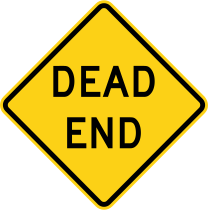 | 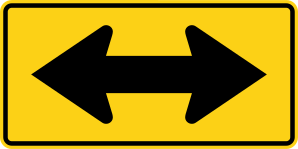 |
|---|---|---|
| GroupWarning signs | GroupWarning signs | GroupWarning signs |
| ShapeDiamond | ShapeDiamond | ShapeHorizontal rectangle |
| ColorYellow background, black symbol and border | ColorYellow background, black legend and border | ColorYellow background, black double arrow and border |
| What it meansThe road you are on ends ahead at a T intersection; you must turn left or right. | What it meansThis road stops at a barrier or a wall and nothing continues past it. | What it meansThe road you are approaching runs both left and right from here. |
What does the permit test ask about the T Intersection sign?
These 2 questions are from the practice bank, with the answer marked.
This sign means:
- A.A side road joins from the right
- B.The road you are on ends ahead and you must turn(correct answer)
- C.A divided highway begins
- D.Traffic from both directions merges
Source: MUTCD W2-3
Your street runs out where it meets a larger road at a T-intersection. You must:
- A.Yield to whatever is already on the through road(correct answer)
- B.Proceed, as the through road yields to you
- C.Stop only if a sign tells you to
- D.Sound the horn and merge
Why: The street that terminates gives up priority to the one that carries on. That holds whether or not a stop sign is posted.
Source: Uniform Vehicle Code, right of way at T-intersections
Questions drivers ask about the T Intersection sign
Can the T warning be used if the stem already has a stop sign?
Yes. Section 2C.41 says ordinary intersection warnings should not be used on an approach controlled by a STOP sign, a YIELD sign, or a signal, then excepts the T-Intersection sign and the Circular Intersection sign. The STOP sign still controls the stop. The yellow symbol only tells you the road does not continue.
Does Florida have California's terminating-highway rule?
No. Florida Statutes s. 316.121 has you yield to a vehicle that has already entered from another highway, and if two vehicles enter together the driver on the left yields to the driver on the right. It never uses the words terminating highway. It does add road-type rules: with no control device, a driver entering a state-maintained road yields to all traffic on it, and so does a driver coming off an unpaved road onto a paved county or city road. California Vehicle Code s. 21800(b)(2) defines a terminating highway as one that does not continue past the intersection.
How close to the junction is the warning supposed to be?
Section 2C.04 offers Table 2C-3 as the aid for placing warning signs, and note 3 lists Intersection Warning signs among the typical signs for its potential-stop column. That column is 250 feet at 35 mph and 360 feet at 45 mph. Section 2C.04 says to apply the distances with engineering judgment, so they are a guideline, not a surveyed distance for any particular road.
What sign is on the far side, facing the stem?
Not a row of curve chevrons. Section 2C.08 prohibits Chevron Alignment signs on the far side of a T facing stem traffic, because showing that a through movement is impossible is the job of a Two-Direction or One-Direction Large Arrow. Section 2C.43 places the Two-Direction Large Arrow, if used, on the far side in line with the stem. W2-4 is the warning before you get there.
Sources
- MUTCD 11th Edition, Chapter 2C, Table 2C-1
- MUTCD 11th Edition (December 2023), Chapter 2C, Sections 2C.04, 2C.08, 2C.41 and 2C.43, Figure 2C-10 and Table 2C-3
- California Vehicle Code s. 21800, right of way at intersections
- California Vehicle Code s. 22100, turning
- Florida Statutes s. 316.121, vehicles approaching or entering intersections (2026)
- Florida Statutes s. 316.151, required position and method of turning at intersections (2026)
- New York State Driver's Manual (MV-21), Chapter 5: Intersections and Turns
What are the other warning signs?

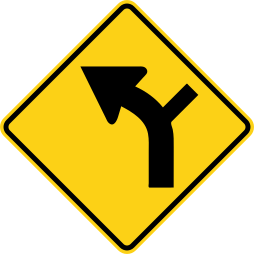
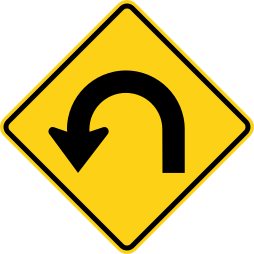




All 55 warning signs on one page, or every US road sign by shape and color.
Test yourself on this sign and the rest of the set with a road signs practice test for Florida, Texas, California or New York.
The artwork is the federal design itself, which the manual dedicates to the public domain in MUTCD 11th Edition, Part 1, Section 1D.06, checked 2026-09-09. The Interstate Shield, the 511 pictograph and the National Scenic Byway graphic are named exceptions and are not reproduced anywhere on this site.
Source: Manual on Uniform Traffic Control Devices, 11th Edition. Not affiliated with or endorsed by the Federal Highway Administration or any state agency.