What does the Signal Ahead sign mean?
The Signal Ahead sign (MUTCD W3-3) is a warning sign under the federal Manual on Uniform Traffic Control Devices, the national standard the states build from. There is a signal head past the crest or the bend, sited where drivers reach it with little time to react. Cover the brake.
Source: MUTCD 11th Edition, Chapter 2C, Table 2C-1, checked 2026-09-09.
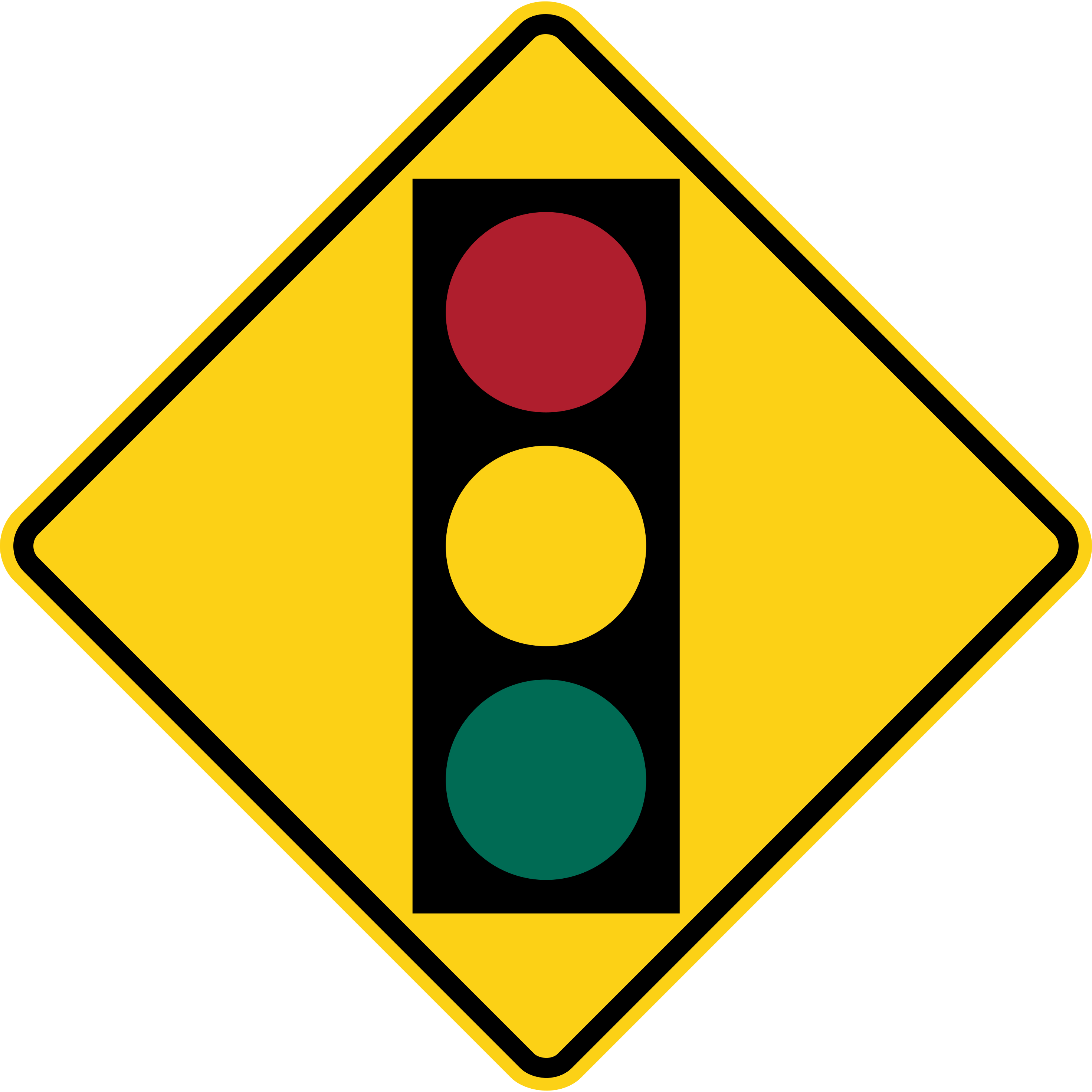
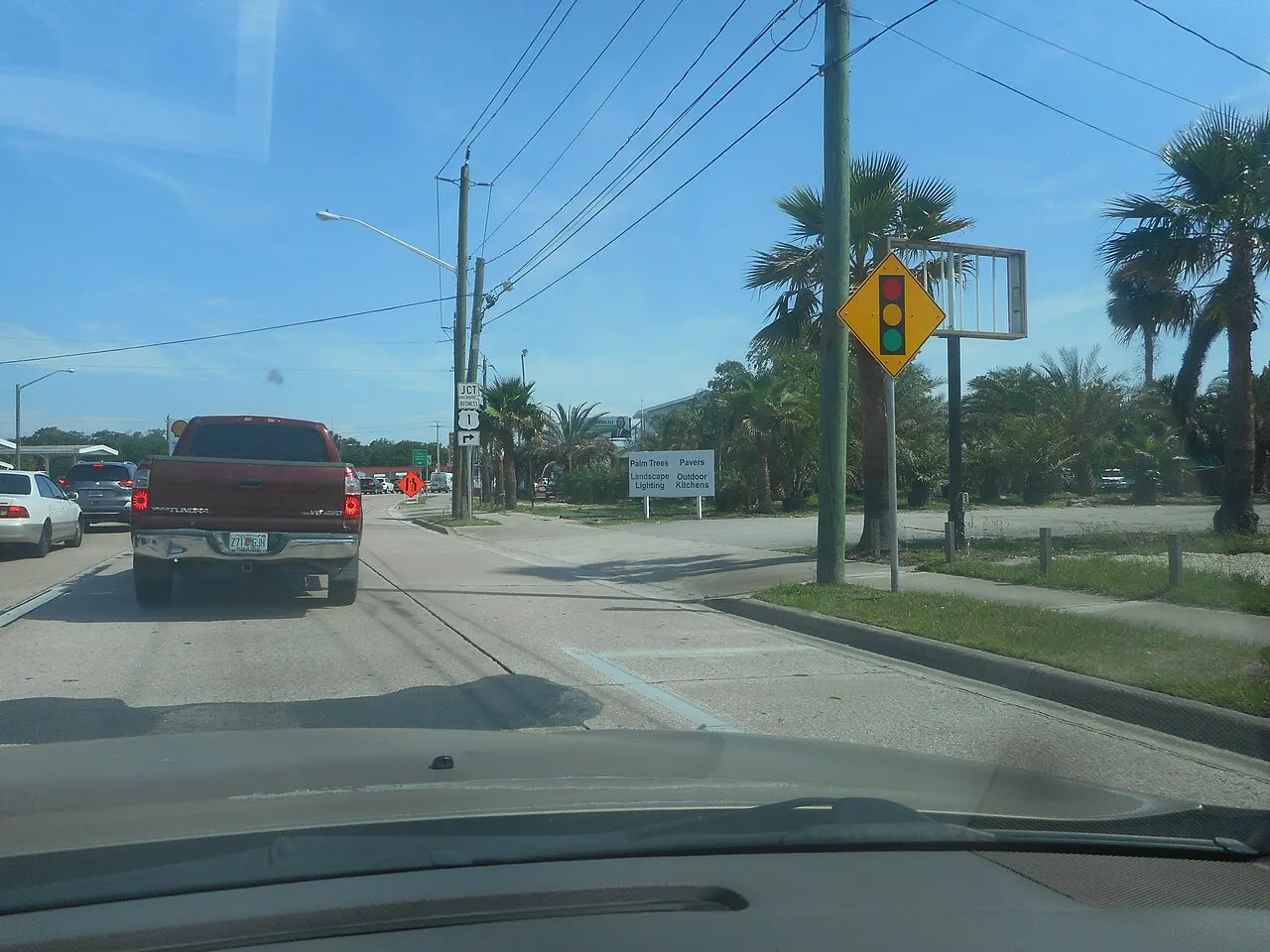
What shape and color is the Signal Ahead sign?
| MUTCD code | W3-3 |
|---|---|
| Group | Warning signs |
| Shape | Diamond |
| Color | Yellow background, black border, signal symbol with red, yellow and green |
What a diamond means. A warning. It tells you what the road does next and obliges you to do nothing in particular, which is the distinction test writers probe most often.
What yellow means. General warning of a permanent condition ahead.
Warning signs. A diamond reports a condition and orders nothing. What you do about it is left to you, and that gap between a report and an order is what test writers keep probing.
When must a Signal Ahead sign go up?
Section 2C.35 requires a Signal Ahead sign (W3-3) when the signal is not visible for a sufficient distance for you to respond. For a signal, that distance is not a guess. The same paragraph says the visibility test is a continuous view of at least two signal faces for the distance in Table 4D-2. Section 4D.06, which is guidance, says those two primary faces should be continuously visible from at least that far in advance of the stop line, unless a physical obstruction prevents it or another signal already sits inside that distance. If you do not have that view, 4D.06 says a sign (Section 2C.35) should be installed.
| 85th-percentile speed | Table 4D-2, see at least two signal faces | Table 2C-3, potential-stop column for the warning sign |
|---|---|---|
| 35 mph | 325 feet | 250 feet |
| 45 mph | 460 feet | 360 feet |
| 55 mph | 625 feet | 495 feet |
Table 4D-2 is how far away you should be able to see the signal, measured to the stop line. Its note says the figures are stopping sight distance plus an assumed line of stopped vehicles for cycle lengths of 60 to 75 seconds. Table 2C-3 is the guideline for where a potential-stop warning sign is placed. They are not the same number.
Table 4D-2 runs from 175 feet at an 85th-percentile speed of 20 mph to 715 feet at 60 mph, with no row above 60. Section 2C.35 allows a Warning Beacon, or yellow LEDs in the border, on this sign. Its guidance adds that when a Warning Beacon is interconnected with the signal, or with detection of backed-up traffic, the BE PREPARED TO STOP sign should carry a WHEN FLASHING plaque. Table 2C-1 sizes W3-3 at 30 by 30 inches on a conventional road and 48 by 48 on an expressway or freeway. Section 2C.03 sets 36 by 36 as the minimum for a diamond warning sign facing a multi-lane conventional road posted above 35 mph, except a duplicate sign on the left side, which may use the single-lane size.
What is the Be Prepared to Stop sign doing here?
W3-4 is optional and warns of stopped traffic caused by a signal. When it is used before a signal, it shall be added to Signal Ahead and placed downstream of it, not instead of it. Table 2C-1 lists it at 36 by 36 inches on a conventional road, against 30 by 30 for W3-3. A ramp meter has its own signs, W3-7 and W3-8, in Section 2C.37.
What do you do when you see it?
- 1Cover the brake while the heads are still hidden
The sign exists because you do not yet have the Table 4D-2 view. On a 45 mph approach that view is 460 feet of continuous sight of two faces. If a bridge or a crest cuts that short, you are the driver the sign is for.
- 2Do not stop at the diamond
Florida Statutes 316.075(1)(c) puts the stop for a steady red signal before the near crosswalk, or before the intersection if there is no crosswalk, and you remain stopped until a green indication, apart from the turn-on-red exceptions in the same paragraph. The section does not mention W3-3 and does not move that stop back to the warning sign. A circular green lets you proceed, still yielding to vehicles and pedestrians lawfully in the intersection or an adjacent crosswalk.
- 3If a second yellow sign says BE PREPARED TO STOP, it is closer to the light
That is the downstream position Section 2C.35 requires. It warns that traffic may be stopped because of the signal. It is still not itself a red light.
Nora at 40 mph, heads hidden until 210 feet
- 1Nora drives at 40 mph toward a signal in Florida, on an approach where the 85th-percentile speed is also 40 mph. Table 4D-2 calls for a continuous view of at least two faces from 390 feet out, measured to the stop line. An overpass pier blocks the heads until she is 210 feet away.
- 2That is short of 390 feet, so Section 2C.35 requires Signal Ahead. She passes the diamond without stopping and is ready to brake.
- 3When the heads appear, they show a circular green. Florida Statutes 316.075(1)(a)1 lets her continue, yielding to any vehicle or pedestrian lawfully in the intersection or an adjacent crosswalk. Nothing is there. She goes through.
Outcome. The warning sign matched a real visibility gap (210 feet against a 390-foot table). It did not turn green into red. Had the indication been a steady red, her stop would have been before the near crosswalk, or before the intersection if there is none, under 316.075(1)(c), not back at the diamond.
W3-3 shows a symbol with red, yellow, and green lamps because a signal is ahead. It is silent on which lamp is lit. Section 2C.35 is about sight distance. The color you obey is the one on the signal faces once you can see them.
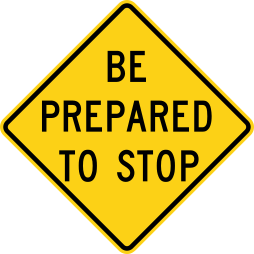

Be Prepared to Stop, if used before a signal, has to follow this sign and sit closer to the intersection. Stop Ahead uses the same diamond and a different symbol.
What is the Signal Ahead sign often mistaken for?
Be Prepared To Stop (W3-4), the word-message version usually paired with it, and Ramp Meter Ahead (W3-7).
| |
|---|---|
| GroupWarning signs | GroupWarning signs |
| ShapeDiamond | ShapeDiamond |
| ColorYellow background, black border, signal symbol with red, yellow and green | ColorYellow background, black legend and border |
| What it meansThere is a signal head past the crest or the bend, sited where drivers reach it with little time to react. | What it meansTraffic ahead may be stopped or stopping; slow now. |
What does the permit test ask about the Signal Ahead sign?
This question is from the practice bank, with the answer marked.
This sign warns that:
- A.A signal you cannot see yet controls the next intersection(correct answer)
- B.A police checkpoint is ahead
- C.The signal ahead is out of service
- D.You may turn on red ahead
Source: MUTCD W3-3
Questions drivers ask about the Signal Ahead sign
Does Signal Ahead mean the light is red or about to turn red?
No. Section 2C.35 installs W3-3 when you cannot see the signal soon enough, tested as a continuous view of at least two faces for the Table 4D-2 distance. The symbol includes all three colors because the device ahead is a signal, not because a particular color is showing. Florida Statutes 316.075 is what tells you to stop, and it does that for a steady red at the crosswalk or the intersection, not at the warning sign.
How far before the light should I be able to see it?
Table 4D-2 works from the 85th-percentile approach speed: 325 feet at 35 mph, 390 at 40, 460 at 45, 540 at 50, 625 at 55, and 715 at 60. Section 4D.06 says at least two signal faces should be continuously visible across that distance, measured to the stop line. The note builds the figures from stopping sight distance plus a line of stopped vehicles for cycles of 60 to 75 seconds. No speed above 60 mph is listed.
What is the difference between this sign and Be Prepared to Stop?
Signal Ahead is the sign Section 2C.35 requires when the heads are hidden. Be Prepared to Stop (W3-4) is optional and warns of stopped traffic caused by a signal. If W3-4 is used in advance of a signal, it shall be used in addition to Signal Ahead and shall be placed downstream of it, nearer the intersection. Table 2C-1 lists W3-4 at 36 by 36 inches on a conventional road and W3-3 at 30 by 30. One does not stand in for the other.
The light is green when I get there. Do I still stop?
Not because of this sign. Florida Statutes 316.075(1)(a)1 says vehicular traffic facing a circular green may proceed straight or turn unless a sign prohibits the turn, and shall yield to vehicles and pedestrians lawfully in the intersection or an adjacent crosswalk. The stop for a steady red is a different paragraph, (1)(c), and it is made before the crosswalk or the intersection. W3-3 gave you time to see which of those you have.
Sources
- MUTCD 11th Edition, Chapter 2C, Table 2C-1
- MUTCD 11th Edition (December 2023), Sections 2C.03, 2C.35, and 2C.37, and Tables 2C-1 and 2C-3
- MUTCD 11th Edition (December 2023), Section 4D.06 and Table 4D-2
- Florida Statutes 316.075 (2026)
What are the other warning signs?


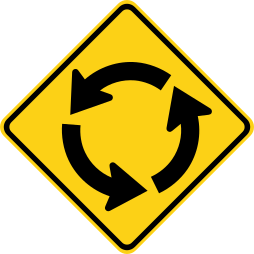

All 55 warning signs on one page, or every US road sign by shape and color.
Test yourself on this sign and the rest of the set with a road signs practice test for Florida, Texas, California or New York.
The artwork is the federal design itself, which the manual dedicates to the public domain in MUTCD 11th Edition, Part 1, Section 1D.06, checked 2026-09-09. The Interstate Shield, the 511 pictograph and the National Scenic Byway graphic are named exceptions and are not reproduced anywhere on this site.
Source: Manual on Uniform Traffic Control Devices, 11th Edition. Not affiliated with or endorsed by the Federal Highway Administration or any state agency.