What does the Stop Ahead sign mean?
The Stop Ahead sign (MUTCD W3-1) is a warning sign under the federal Manual on Uniform Traffic Control Devices, the national standard the states build from. There is an octagon beyond this point that a driver at speed will not pick out in time. Lose the speed here so the stop itself is unhurried.
Source: MUTCD 11th Edition, Chapter 2C, Table 2C-1, checked 2026-09-09.

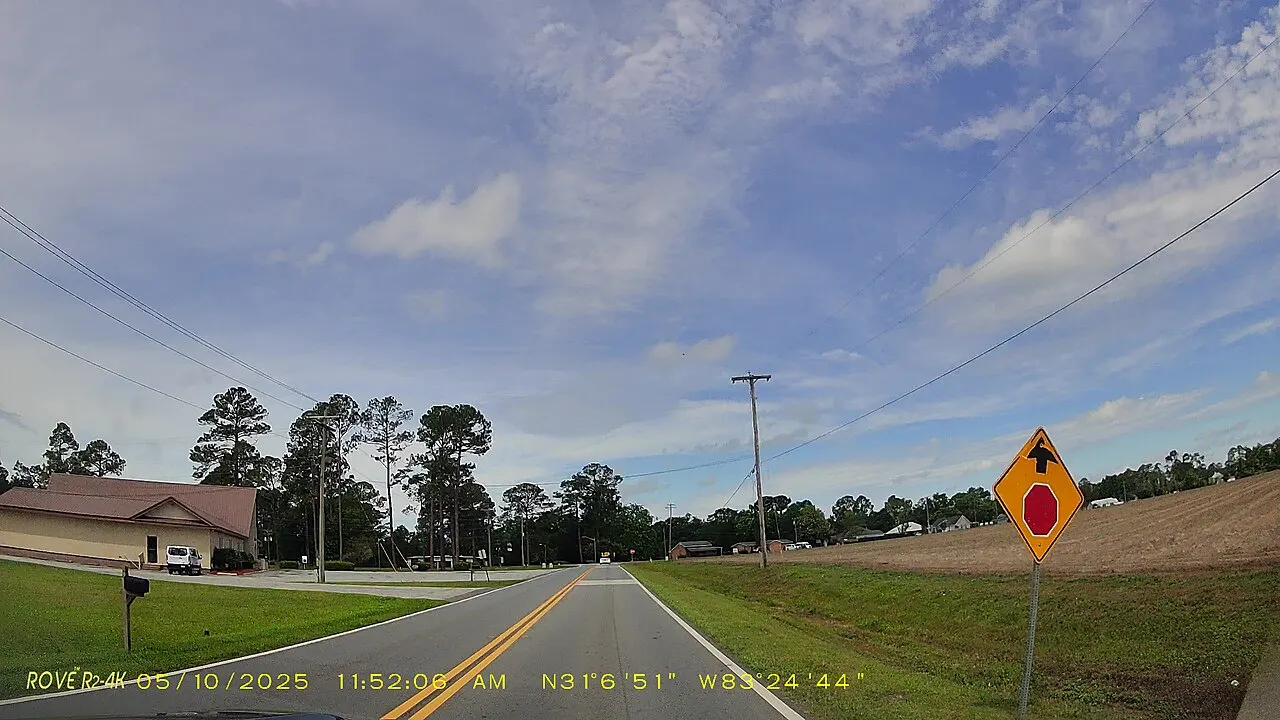
What shape and color is the Stop Ahead sign?
| MUTCD code | W3-1 |
|---|---|
| Group | Warning signs |
| Shape | Diamond |
| Color | Yellow background, black border, red octagon symbol |
What a diamond means. A warning. It tells you what the road does next and obliges you to do nothing in particular, which is the distinction test writers probe most often.
What yellow means. General warning of a permanent condition ahead.
Warning signs. A diamond reports a condition and orders nothing. What you do about it is left to you, and that gap between a report and an order is what test writers keep probing.
When is this yellow sign required?
Section 2C.35 is a standard. A Stop Ahead sign (W3-1) shall be installed on an approach to a stop sign that is not visible for a sufficient distance for the driver to respond. The measuring stick is Table 2C-3. Section 2B.18 repeats the duty from the other end: once the STOP sign is in its required place on the right and its visibility is still restricted, Stop Ahead shall go up in advance. Permanent obstructions include the roadway alignment, such as a curve or a crest, and structures. Parked vehicles and foliage are intermittent, and those get engineering judgment rather than an automatic sign.
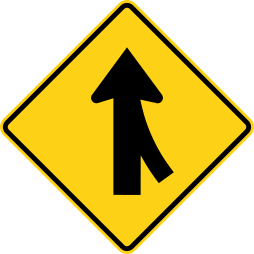
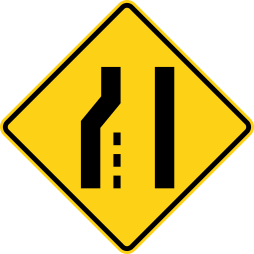
Footnote 3 of Table 2C-3 assigns Stop Ahead, Yield Ahead, Signal Ahead, and intersection warning signs to the potential-stop condition. That column is the Condition B distance for slowing all the way to a stop. The distances come from the 2018 AASHTO stopping sight distance: 2.5 seconds of perception-response time and a deceleration of 11.2 feet per second squared. They are not the longer Condition A column, which is for a speed cut plus a lane change in heavy traffic (Merge, Right Lane Ends) and uses a perception-response time of 14.0 to 14.5 seconds.
Paragraph 05 of Section 2C.35 also allows the sign for emphasis even when the stop sign is already visible. Section 2C.01 still says warning signs should be kept to a minimum, because extra warnings breed disrespect. Table 2C-1 sizes W3-1 at 30 by 30 inches on a conventional road and 48 by 48 inches on an expressway or freeway, with no oversized size listed. Section 2C.03 then sets 36 by 36 inches as the minimum for a diamond warning sign facing a multi-lane conventional road posted above 35 mph. The one exception is a duplicate sign added on the left side, which may use the single-lane size.
What do you do at the diamond?
- 1Do not stop at the yellow sign
W3-1 is a warning sign under Section 2C.35. California Vehicle Code 22450 and Florida Statutes 316.123 place the stop at the stop sign: the marked limit line (a stop line in Florida), otherwise the near crosswalk, otherwise the state's third point. Neither section names this diamond or tells you to stop where it stands.
- 2Lose speed over the distance the table is built for
The potential-stop column is the stopping sight distance for the posted or 85th-percentile speed: time to perceive, then braking to a stop. At 55 mph that figure is 495 feet. Slowing starts once you read the sign, not once you finally see the hidden octagon.
- 3Make the stop at the octagon's legal point
The red STOP sign still has its own rule. The diamond got you there slowly enough to use it. If a street-name plaque is added, that is Section 2C.65, identifying the cross street. It does not move the stopping point.
Helen at 55 mph, the octagon hidden until 220 feet
- 1Helen drives west at 55 mph on a rural two-lane road in Florida. A crest hides the STOP sign until she is 220 feet from it.
- 2Table 2C-3's potential-stop distance at 55 mph is 495 feet. She cannot see the sign for that distance, so Section 2C.35 requires Stop Ahead. The diamond stands at the table distance, about 495 feet before the stop.
- 3She keeps moving past the diamond and brakes toward the stop line at the intersection. Stopping beside the diamond would leave her sitting in the travel lane roughly 495 feet early, which Florida Statutes 316.123 does not require.
Outcome. The yellow sign reached her while she still had the stopping sight distance the table is built from (2.5 seconds to perceive, then 11.2 feet per second squared of braking). Without it, 220 feet of sight would have been well short of the 495 feet she needed. The legal stop happens at the stop line under Florida Statutes 316.123(2)(a).
Table 2C-1 lists Stop Ahead with Yield Ahead and Signal Ahead on one row, W3-1, W3-2, and W3-3, and Section 2C.02 makes warning signs yellow diamonds with a black legend and border. The small red octagon on W3-1 is a picture of the device ahead, not the device itself.
Answers that treat the warning as the command
- Stopping at W3-1. The stop statutes cited above attach to the stop sign.
- Using the Condition A distance (775 feet at 45 mph, 990 feet at 55 mph). Footnote 2 assigns that column to lane changes in heavy traffic, not to Stop Ahead.
- Assuming every stop sign has one of these a fixed distance ahead. The standard applies when visibility is too short. The sign is optional when visibility is already fine.
- Reading the sign as a yield. The embedded symbol is an octagon. Yield Ahead carries a triangle.
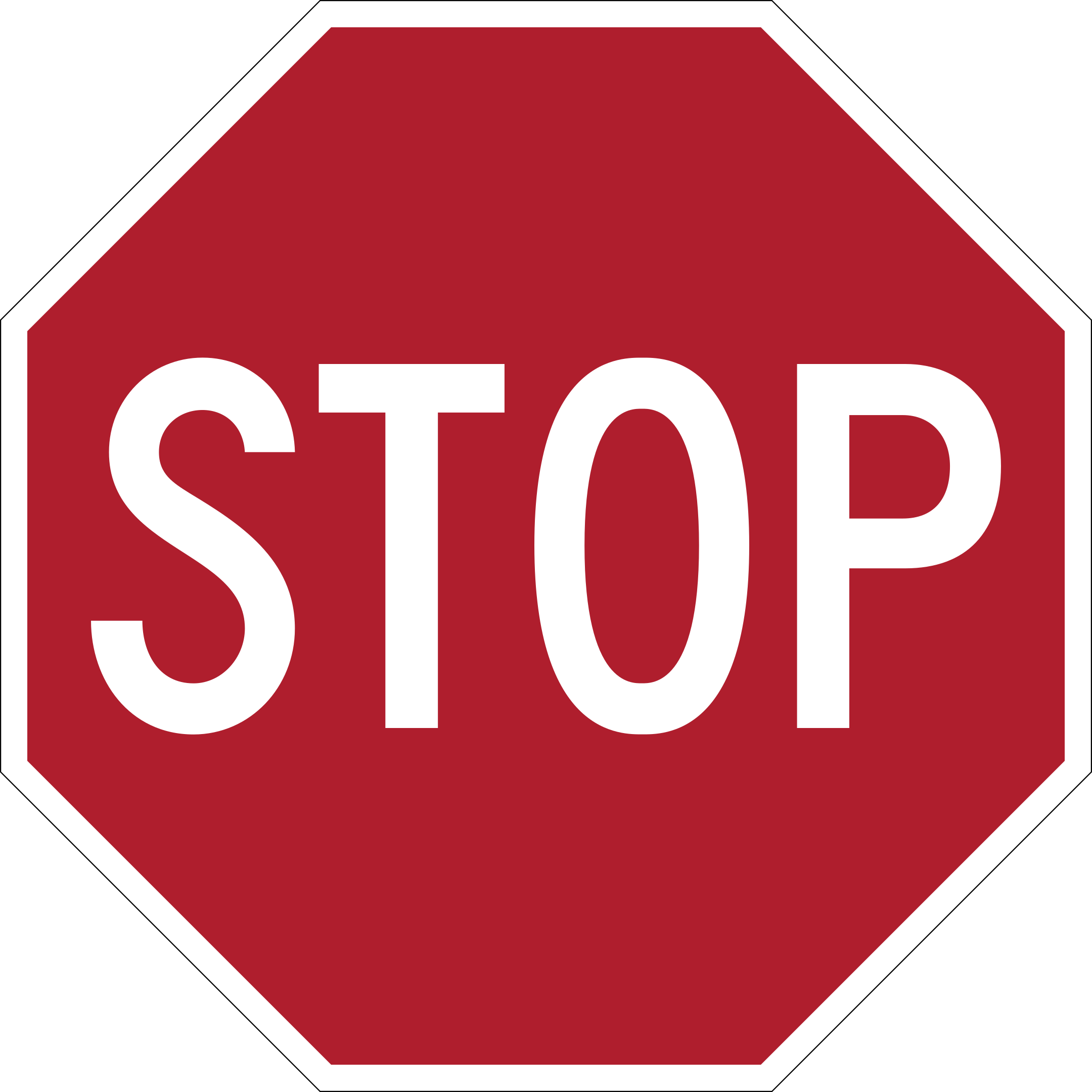

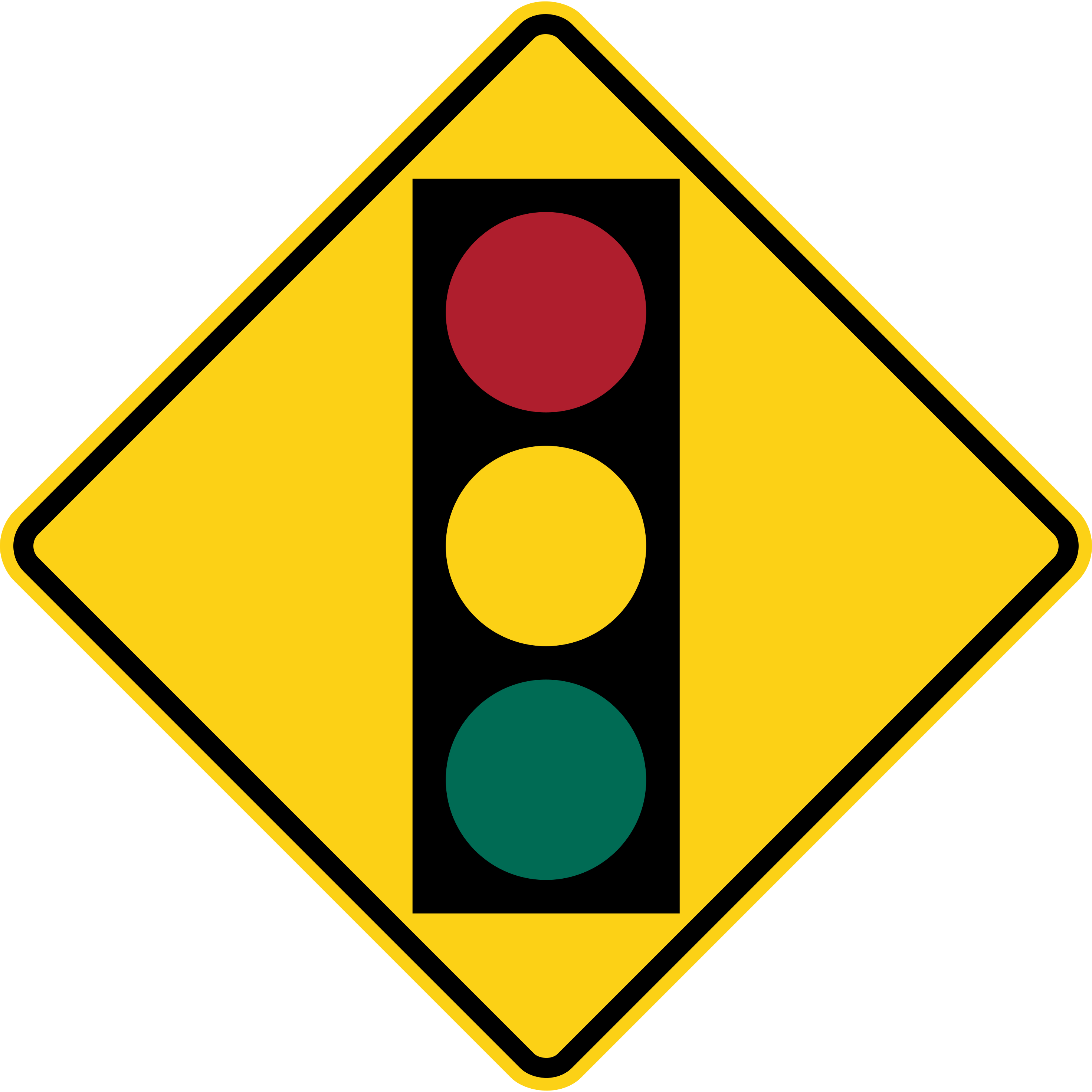
Same yellow diamond family. The symbol inside tells you which device is hidden: octagon, triangle, or signal.
What is the Stop Ahead sign often mistaken for?
The Stop sign itself (R1-1). Answering that you must stop at W3-1 is the single most common sign-test error. It contains a red octagon but it is a warning sign.
| |
|---|---|
| GroupWarning signs | GroupRegulatory signs |
| ShapeDiamond | ShapeOctagon |
| ColorYellow background, black border, red octagon symbol | ColorRed background, white legend and border |
| What it meansThere is an octagon beyond this point that a driver at speed will not pick out in time. | What it meansThe duty is a complete stop, wheels no longer turning, at whichever of these you reach first: a painted stop line, the near edge of the crosswalk, or the point where you can finally see along the cross street. |
Which signs get mistaken for the Stop Ahead sign?
- Yield AheadW3-2
The Yield sign itself (R1-2), and Stop Ahead (W3-1). The embedded symbol tells you which control is coming.
What does the permit test ask about the Stop Ahead sign?
This question is from the practice bank, with the answer marked.
This sign means:
- A.Stop where the sign stands
- B.There is a stop sign beyond your sight line, so start slowing now(correct answer)
- C.Traffic ahead is stopped
- D.Stopping is prohibited beyond this point
Source: MUTCD W3-1
Questions drivers ask about the Stop Ahead sign
Do I stop where the Stop Ahead sign stands?
No. Section 2C.35 makes W3-1 a warning that the stop sign is not visible soon enough. California Vehicle Code 22450 puts the stop at the limit line, otherwise the near crosswalk, otherwise the entrance to the intersecting roadway. Florida Statutes 316.123 uses the line, then the crosswalk, then the point closest to the cross street with a view of its approaching traffic. Neither section mentions the yellow diamond. You slow on the approach and stop at the stop sign.
How far before the stop sign should I expect it?
Table 2C-3 gives guidelines, not a single nationwide spacing. For the potential-stop column that footnote 3 assigns to Stop Ahead, the distance is 155 feet at 25 mph, 250 feet at 35 mph, 360 feet at 45 mph, 495 feet at 55 mph, and 645 feet at 65 mph. Those figures are stopping sight distance with 2.5 seconds to perceive and 11.2 feet per second squared of braking. Section 2C.04 says to apply them with engineering judgment and notes they can be adjusted for roadway features and other signs.
Can the sign be posted even when I can already see the stop sign?
Yes. Paragraph 05 of Section 2C.35 says an Advance Traffic Control sign may be used for extra emphasis even when the visibility distance to the stop sign is already satisfactory. That is an option, not the standard. The standard is the hidden sign. Section 2C.01 still says warning signs should be kept to a minimum, because unnecessary ones tend to breed disrespect for all signs.
The little octagon is red. Does that make the whole sign a stop sign?
No. W3-1 is in the warning series. Table 2C-1 lists it with Yield Ahead and Signal Ahead, sized 30 by 30 inches on a conventional road and 48 by 48 inches on an expressway or freeway, and Section 2C.03 raises it to at least 36 by 36 on a multi-lane conventional road posted above 35 mph. The red octagon is the symbol of the sign you have not reached. The duty to stop begins at that later sign, at the point the state statute names, not at the diamond.
Sources
- MUTCD 11th Edition, Chapter 2C, Table 2C-1
- MUTCD 11th Edition (December 2023), Sections 2C.01 through 2C.04, 2C.35, and 2C.65, and Tables 2C-1 and 2C-3
- MUTCD 11th Edition (December 2023), Section 2B.18
- California Vehicle Code 22450
- Florida Statutes 316.123 (2026)
What are the other warning signs?


All 55 warning signs on one page, or every US road sign by shape and color.
Test yourself on this sign and the rest of the set with a road signs practice test for Florida, Texas, California or New York.
The artwork is the federal design itself, which the manual dedicates to the public domain in MUTCD 11th Edition, Part 1, Section 1D.06, checked 2026-09-09. The Interstate Shield, the 511 pictograph and the National Scenic Byway graphic are named exceptions and are not reproduced anywhere on this site.
Source: Manual on Uniform Traffic Control Devices, 11th Edition. Not affiliated with or endorsed by the Federal Highway Administration or any state agency.