What does the Lane Ends sign mean?
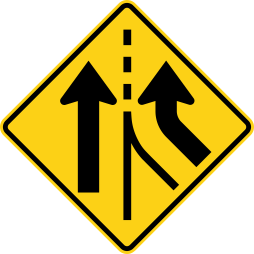
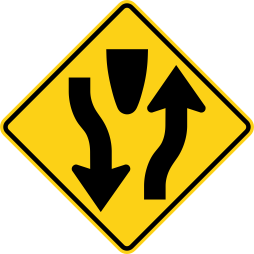
The Lane Ends sign (MUTCD W4-2) is a warning sign under the federal Manual on Uniform Traffic Control Devices, the national standard the states build from. One of the through lanes ends ahead and its traffic must move over.
Source: MUTCD 11th Edition, Chapter 2C, Table 2C-1, checked 2026-09-09.
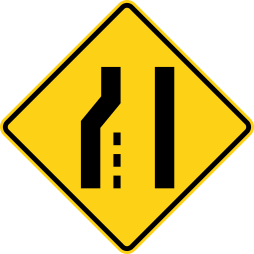
What shape and color is the Lane Ends sign?
| MUTCD code | W4-2 |
|---|---|
| Group | Warning signs |
| Shape | Diamond |
| Color | Yellow background, black symbol and border |
What a diamond means. A warning. It tells you what the road does next and obliges you to do nothing in particular, which is the distinction test writers probe most often.
What yellow means. General warning of a permanent condition ahead.
Warning signs. A diamond reports a condition and orders nothing. What you do about it is left to you, and that gap between a report and an order is what test writers keep probing.
Where is the lane-ends sign placed, and what is the order of the messages?
MUTCD 11th Edition, Section 2C.47 uses the Lane Ends symbol (W4-2) and the RIGHT (LEFT) LANE ENDS word sign (W9-1) to warn that the number of lanes in your direction is about to drop. The W4-2 should be installed at the advance placement distance in Table 2C-3. Note 2 of that table names Right Lane Ends, with Merge, as a typical Condition A sign: a place where you need extra time to change lanes in heavy traffic, with distances built from a 14.0 to 14.5 second perception-response time and a 180-foot legibility distance.
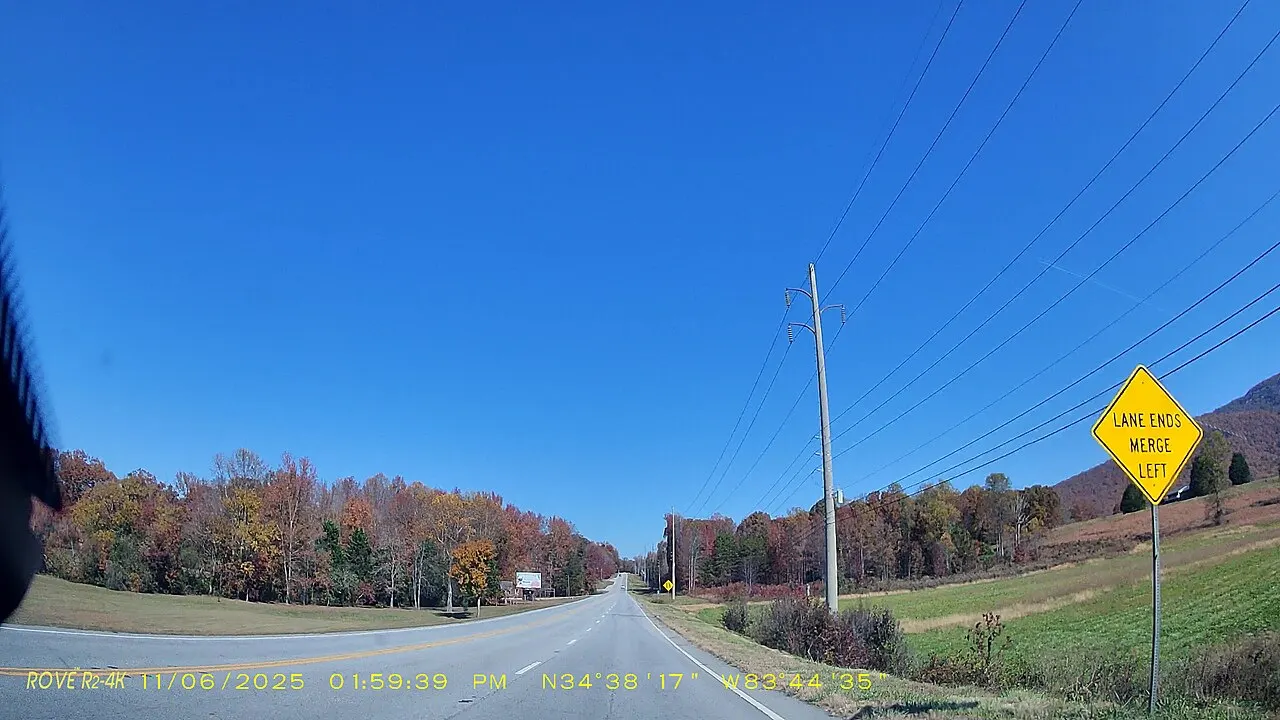
A W9-1 may be added farther upstream for extra warning, and if it is, a distance plaque (W16-2P or W16-3P series) should go under it. On a one-way street or a divided highway where the left lane is ending and the median is wide enough, both signs should face traffic from the left side or the median. The White County photo shows a third legend, LANE ENDS MERGE LEFT, which is not one of the two signs Section 2C.47 names. It tells drivers in the ending lane to move left, so the lane dropping there is the right-hand one.
- FarthestOptional W9-1
RIGHT LANE ENDS or LEFT LANE ENDS, with a distance plaque under it when it is used.
- Table 2C-3W4-2 symbol
At 55 mph, Condition A is 990 feet. At 65 mph it is 1,200 feet.
- AP/4Broken line stops
Section 3B.12 ends the broken white lane line one quarter of the way through the advance placement distance, counted from the sign end (Figure 3B-14 marks it AP/4). A dotted lane line may carry on from there to the taper.
- The taperPavement narrows
At 45 mph or more, taper length L equals W times S. Under 45 mph, L equals W times S squared, divided by 60.
What must the driver in the ending lane do?
- 1Identify your lane on the symbol
One of the two lanes on the sign stops. If you are in that lane, you have to be in the continuing lane before the taper runs out.
- 2Move only after the gap is actually there
California Vehicle Code s. 21658(a) forbids leaving a marked lane until the move can be made with reasonable safety. The warning does not let you push into the next lane.
- 3Do not expect the continuing lane to stop
Nothing in Section 2C.47 tells drivers who already have a lane through the narrow section to brake to a halt or to leave their lane.
- 4Watch the markings, not only the diamond
Section 3B.12 requires a no-passing zone in the direction of the convergence, except where that does not apply, such as one-way streets, expressways, and freeways, plus an edge line through the transition. At 45 mph or more, lane-reduction arrows should be on the pavement.
In New York, the ending lane gives you a reason to plan a lane change before the taper. The New York State Driver's Manual (MV-21), Chapter 5 says to signal a lane change at least 100 feet before making it. Start that signal while there is still room, then move into the continuing lane when a gap opens. A driver already in the continuing lane receives no direction to change lanes from W4-2.
How long is the taper when Helen is in the ending lane?
Helen, 55 mph, a 12-foot lane dropping on the right
- 1Helen is in the right lane of a California multi-lane highway posted at 55 mph, and a W4-2 is ahead. The 55 mph and the 12-foot offset are chosen so the arithmetic can be checked. They are not the posted speed or lane width on Georgia 75.
- 2Condition A in Table 2C-3 at 55 mph is 990 feet, so the symbol should be about that far before the taper.
- 3Section 3B.12: at 45 mph or more, L = W times S. A 12-foot offset at 55 mph gives a 660-foot taper, assuming the 85th-percentile speed is not above 55. The broken white lane line should stop a quarter of the way into the 990 feet, about 248 feet from the sign end, leaving about 742 feet in which a dotted lane line may be used.
- 4The left lane is clear beside her, so under California Vehicle Code s. 21658(a) she can move. If a car were there, she would wait for the next gap rather than straddle both lanes.
Outcome. She is in the continuing lane before the 660-foot taper. Section 3B.12 sets a minimum taper of 100 feet in urban areas and 200 feet in rural areas, so 660 feet clears both. The continuing lane was never told to stop.
Section 2C.47 Standard: W4-2 and W9-1 shall not be used in dropped lane situations. On conventional roads at intersections, where a through lane becomes a mandatory turn lane, the regulatory signs in Section 2B.28 shall be used instead. The same section also says Lane Ends signs should not be installed ahead of the downstream end of an acceleration lane.
Which wrong answers show up on the permit test?
- "Everyone must merge." Only the lane that is ending has to move. The other lane continues.
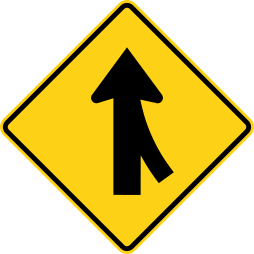
- "This is the same as a ramp merge." Section 2C.45 forbids using the Merge sign where lanes on a single roadway must merge because the pavement narrows. The duty is not shared the way a two-roadway join is.
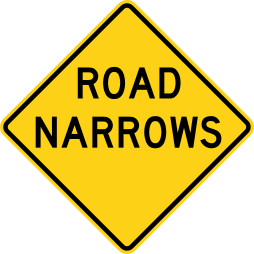
- "The road gets narrower but every lane remains." That is closer to ROAD NARROWS (W5-1), which Section 2C.17 uses where a two-lane road narrows so much that opposing vehicles cannot pass through together without slowing. Here the lane count falls.
- "Stop at the sign." Nothing in Section 2C.47 says to stop. One placement option it does give is putting W4-2 on the far side of an intersection when the lane ends too soon after it for the normal advance distance, with the W9-1 upstream.
Lane count drops, two roads share a lane, or the same lanes just get tighter.
What is the Lane Ends sign often mistaken for?
Merge (W4-1). Lane Ends puts the obligation on the lane that is disappearing.
| |
|---|---|
| GroupWarning signs | GroupWarning signs |
| ShapeDiamond | ShapeDiamond |
| ColorYellow background, black symbol and border | ColorYellow background, black symbol and border |
| What it meansOne of the through lanes ends ahead and its traffic must move over. | What it meansTwo traffic streams join ahead and drivers on both must adjust speed and position. |
Which signs get mistaken for the Lane Ends sign?
- Road NarrowsW5-1
Lane Ends (W4-2), which removes a lane, and Narrow Bridge (W5-2), which is a specific structure.
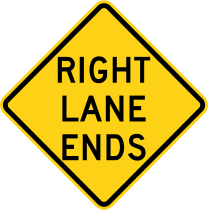 Right (Left) Lane EndsW9-1
The symbol version, Lane Ends (W4-2), and Lanes Merge (W9-4), where both lanes end and form a single new one.
What does the permit test ask about the Lane Ends sign?
This question is from the practice bank, with the answer marked.
This sign means:
- A.A lane is being added ahead
- B.Your lane ends ahead and you must merge(correct answer)
- C.The road narrows but all lanes continue
- D.A shoulder is closed ahead
Source: MUTCD W4-2
Questions drivers ask about the Lane Ends sign
Who has to move, the left lane or the right lane?
The lane that is ending. Section 2C.47 warns of a reduction in the number of lanes in your direction, and the symbol shows which lane stops. A LANE ENDS MERGE LEFT legend, like the one beside northbound Georgia 75 in White County, tells drivers in the ending lane to move left into the lane that continues. The continuing lane is not told to change lanes.
How far before the taper should the symbol be?
Section 2C.47 says the W4-2 should be at the Table 2C-3 advance placement distance. For Condition A, the column whose note names Right Lane Ends, that is 990 feet at 55 mph and 1,200 feet at 65 mph. If a W9-1 word sign is added farther ahead, a distance plaque should be mounted under it.
What if the lane ends just past an intersection?
Where the lane ends closer to the intersection than the Table 2C-3 distance, Section 2C.47 allows the W4-2 on the far side of the intersection. The W9-1 word sign should then be upstream of the intersection with the matching distance plaque. That is a placement exception, not a reason to stop in the intersection.
Does the through driver have to let me in?
California Vehicle Code s. 21658(a) puts the burden on the driver who is moving: you do not leave your lane until the move can be made with reasonable safety. It does not order the continuing lane to stop or to leave its lane. Section 3B.12 adds a taper, a no-passing zone where one applies, and lane-reduction arrows at 45 mph or more so the pinch is visible well before it arrives.
Sources
- MUTCD 11th Edition, Chapter 2C, Table 2C-1
- MUTCD 11th Edition (December 2023), Chapter 2C, Sections 2C.17, 2C.45 and 2C.47, Figure 2C-13 and Table 2C-3
- MUTCD 11th Edition (December 2023), Part 3, Section 3B.12 Lane-Reduction Transitions and Figure 3B-14
- MUTCD 11th Edition (December 2023), Chapter 2B, Section 2B.28 Mandatory Movement Lane Control Signs
- California Vehicle Code s. 21658, laned roadways
- New York State Driver's Manual (MV-21), Chapter 5: Intersections and Turns
What are the other warning signs?


All 55 warning signs on one page, or every US road sign by shape and color.
Test yourself on this sign and the rest of the set with a road signs practice test for Florida, Texas, California or New York.
The artwork is the federal design itself, which the manual dedicates to the public domain in MUTCD 11th Edition, Part 1, Section 1D.06, checked 2026-09-09. The Interstate Shield, the 511 pictograph and the National Scenic Byway graphic are named exceptions and are not reproduced anywhere on this site.
Source: Manual on Uniform Traffic Control Devices, 11th Edition. Not affiliated with or endorsed by the Federal Highway Administration or any state agency.