What does the Added Lane sign mean?
The Added Lane sign (MUTCD W4-3) is a warning sign under the federal Manual on Uniform Traffic Control Devices, the national standard the states build from. A whole extra lane opens on the entry side, so joining traffic has somewhere to go and nobody has to change lanes or yield.
Source: MUTCD 11th Edition, Chapter 2C, Table 2C-1, checked 2026-09-09.
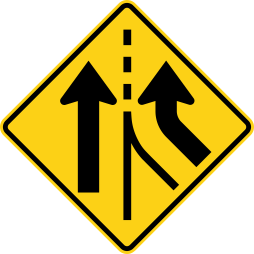
What shape and color is the Added Lane sign?
| MUTCD code | W4-3 |
|---|---|
| Group | Warning signs |
| Shape | Diamond |
| Color | Yellow background, black symbol and border |
What a diamond means. A warning. It tells you what the road does next and obliges you to do nothing in particular, which is the distinction test writers probe most often.
What yellow means. General warning of a permanent condition ahead.
Warning signs. A diamond reports a condition and orders nothing. What you do about it is left to you, and that gap between a report and an order is what test writers keep probing.
Where does the added-lane sign go, and why is merging the wrong verb?
MUTCD 11th Edition, Section 2C.46 says the Added Lane (W4-3) sign should be installed ahead of a point where two roadways converge and merging movements are not required. Where possible it should be placed so drivers on both roadways can see it. Where that is not possible, each roadway should get its own Added Lane sign.
On the major road the straight arrow is that road and the curved arrow is the entering roadway, turned to the side it joins from, and the sign should stand on that same side. Where the entering roadway curves before it meets a straight major road, Section 2C.46 calls for the Entering Roadway Added Lane (W4-6) version instead. Drawing B of Figure 2C-12 shows both in use.
Section 2C.46 gives no advance distance of its own. Section 2C.04 offers Table 2C-3 as the aid for placing any warning sign, but note 2 of that table names Merge and Right Lane Ends, not Added Lane, as the typical Condition A signs. Table 2C-1 sizes W4-3 at 36 by 36 inches on a conventional road and 48 by 48 inches on an expressway or freeway. Its 30 by 30 inch Minimum column is the size Section 2C.03 says to use on low-volume rural roads with operating speeds of 30 mph or less.
What should each driver do, and what is a false yield?
- 1If you are entering
The entering pavement continues as a lane of its own beside the through lanes. You do not have to squeeze into the lane next to you. Stay in your lane and bring your speed up to the flow beside you.
- 2If you are already on the main road
This sign does not put anyone into your lane. Moving over "to be polite" is a lane change you chose, not one the sign asks for.
- 3If you do change lanes later
Florida Statutes s. 316.089(1): on a roadway marked into lanes, keep as nearly as practicable within a single lane and do not move out of it until you have first ascertained that the move can be made with safety. That governs a later lane change. It is not a duty to move at the sign.
| Question | Added Lane, W4-3 | Merge, W4-1 |
|---|---|---|
| Do the lanes stay separate? | Yes. The entering roadway adds a lane | No. Two streams share one lane |
| Does the sign require a yield? | No | No. It is a warning; a yield needs a YIELD sign |
| Manual section | 2C.46, merging not required | 2C.45, lanes from two roadways become one |
Under Florida Statutes s. 316.089(1) the sign changes nothing about lane discipline: you stay in your lane until a move is safe.
How does Naomi handle an entrance that becomes its own lane?
Naomi on an entrance that keeps going
- 1Naomi is on a Florida freeway entrance at 50 mph with the through lanes on her left. Her entrance does not taper away. It keeps its full width and runs on as a lane of its own.
- 2She passes the Added Lane sign for her roadway. Section 2C.46 is written for exactly this: two roadways converge and no merge is required.
- 3A driver in the through right lane swings into the left lane as if Naomi needed the space. The sign did not ask for that, and under s. 316.089(1) it was a lane change that needed the same safety check as any other. Naomi simply stays in the added lane.
- 4A mile later she wants the lane to her left. Now s. 316.089(1) is the rule that matters: she moves only after she has ascertained that the move can be made with safety.
Outcome. At the sign both drivers could have kept the lanes they were in. The one who moved over made a lane change the road never required.
What do people mark on a permit question about this symbol?
- They pick "yield to freeway traffic." W4-3 carries no yield message. A yield answer belongs to a YIELD sign, or to a true merge where you need a gap.
- They pick "the through lane must move over." Section 2C.46 does not tell the major-road lane to clear out.
- They read the symbol as a lane ending. On W4-3 the entering arrow joins and both arrows carry on. On a Lane Ends symbol one of the lanes stops.
- They treat W4-6 as a different rule. It is the entering-roadway version in the same section, used where the entering roadway curves before it joins. The no-merge meaning is the same.
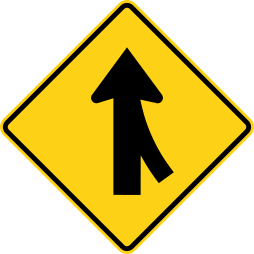
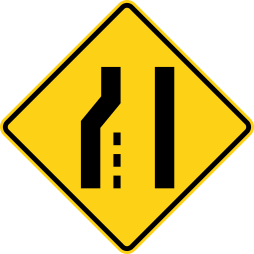
Look at whether the second path ends, joins and disappears, or joins and keeps going.
The enforceable piece, if you change lanes, is the general lane rule in Florida Statutes s. 316.089(1). The manual piece is the geometry test in Section 2C.46: if drivers must merge, this is the wrong sign, and Section 2C.45 says the Merge sign in turn should not be used where merging is not required.
What is the Added Lane sign often mistaken for?
Merge (W4-1). Candidates say they must yield; with an added lane there is nothing to yield to.
| |
|---|---|
| GroupWarning signs | GroupWarning signs |
| ShapeDiamond | ShapeDiamond |
| ColorYellow background, black symbol and border | ColorYellow background, black symbol and border |
| What it meansA whole extra lane opens on the entry side, so joining traffic has somewhere to go and nobody has to change lanes or yield. | What it meansTwo traffic streams join ahead and drivers on both must adjust speed and position. |
What does the permit test ask about the Added Lane sign?
This question is from the practice bank, with the answer marked.
This sign means:
- A.A lane is added, so joining traffic does not have to merge into yours(correct answer)
- B.Your lane ends ahead
- C.A passing lane is closing
- D.Traffic ahead is merging into a single lane
Source: MUTCD W4-3
Questions drivers ask about the Added Lane sign
Do I have to move left as soon as the new lane appears?
No. Section 2C.46 is for a convergence where merging movements are not required, so the entering driver has a lane to stay in. Florida Statutes s. 316.089(1) only comes into play if you later leave that lane: you stay in one lane until you have ascertained that a move can be made with safety. The sign is not an order to move over.
Should the through driver slow down to let the entering traffic in?
Not because of this sign. The through lane stays a through lane, and the entering traffic has its own lane to use. If the entrance later tapers and a Merge sign appears, the situation has changed and the two streams do have to share one lane.
Why would there be two of these signs at one join?
Section 2C.46 says the Added Lane sign should, where possible, be placed so drivers on both roadways can see it. If that is not possible, an Added Lane sign should go on the side of each roadway. On the major road the straight arrow is the major road and the curved arrow is the entrance.
Is an added lane the same thing as an acceleration lane that runs out?
No. Where the entering lane does not continue, the streams have to share one lane, which is Merge territory under Section 2C.45, and that section also allows a NO MERGE AREA plaque where there is no acceleration lane at all. Section 2C.47 adds that Lane Ends signs should not be installed ahead of the downstream end of an acceleration lane. An added lane keeps a full lane after the roadways meet.
Sources
- MUTCD 11th Edition, Chapter 2C, Table 2C-1
- MUTCD 11th Edition (December 2023), Chapter 2C, Sections 2C.03, 2C.04, 2C.45, 2C.46 and 2C.47, Figure 2C-12, Table 2C-1 and Table 2C-3
- Florida Statutes s. 316.089, driving on roadways laned for traffic (2026)
What are the other warning signs?

All 55 warning signs on one page, or every US road sign by shape and color.
Test yourself on this sign and the rest of the set with a road signs practice test for Florida, Texas, California or New York.
The artwork is the federal design itself, which the manual dedicates to the public domain in MUTCD 11th Edition, Part 1, Section 1D.06, checked 2026-09-09. The Interstate Shield, the 511 pictograph and the National Scenic Byway graphic are named exceptions and are not reproduced anywhere on this site.
Source: Manual on Uniform Traffic Control Devices, 11th Edition. Not affiliated with or endorsed by the Federal Highway Administration or any state agency.