What does the Divided Highway Ends sign mean?
The Divided Highway Ends sign (MUTCD W6-2) is a warning sign under the federal Manual on Uniform Traffic Control Devices, the national standard the states build from. The median ends ahead and you will be facing two-way traffic on a single roadway.
Source: MUTCD 11th Edition, Chapter 2C, Table 2C-1, checked 2026-09-09.
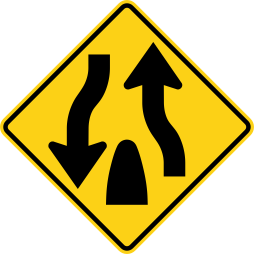
What shape and color is the Divided Highway Ends sign?
| MUTCD code | W6-2 |
|---|---|
| Group | Warning signs |
| Shape | Diamond |
| Color | Yellow background, black symbol and border |
What a diamond means. A warning. It tells you what the road does next and obliges you to do nothing in particular, which is the distinction test writers probe most often.
What yellow means. General warning of a permanent condition ahead.
Warning signs. A diamond reports a condition and orders nothing. What you do about it is left to you, and that gap between a report and an order is what test writers keep probing.
Where does this warning go, and where is it the wrong sign?
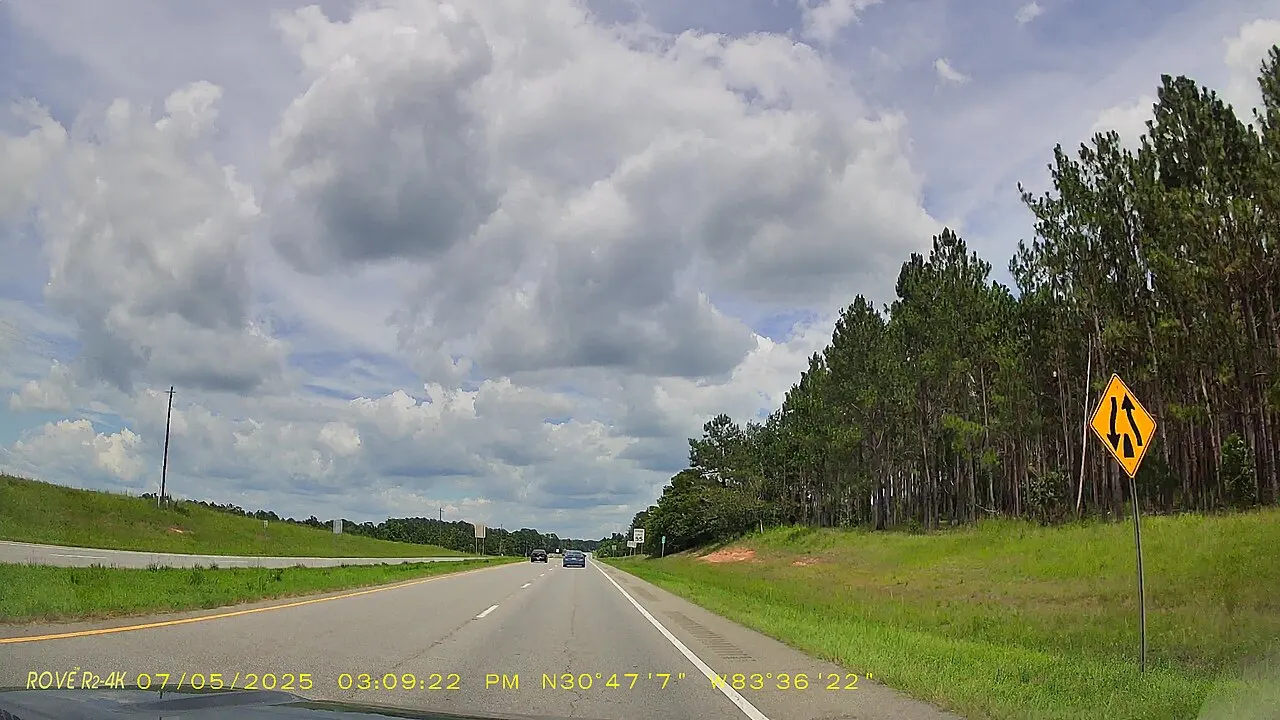
Section 2C.21 says this sign should be used in advance of the end of a physically divided section, not at an intersection or junction, to warn of two-way traffic ahead. It adds that Two-Way Traffic (W6-3) should be used to give notice of the change to a two-lane, two-way road. The Brooks County photo still shows the median and the far lanes, so the divided section has not ended at that post.
A median that only opens at a cross street is not the end of a divided highway, and the manual does not use this sign there. On that nose, Section 2C.20 bars the related Divided Highway (W6-1) sign from replacing a Keep Right sign.
What does Texas law stop doing when the grass runs out?
| While a divider separates the roadways | After that divider ends | |
|---|---|---|
| Which pavement you use | The right-hand roadway, unless a traffic-control device or an officer directs otherwise | The separator is gone, so the right-roadway sentence no longer describes two roadways |
| Crossing the grass or the barrier | Not allowed, except through an opening in the barrier or dividing space, or at a crossover or intersection a public authority established | There is no dividing space left to cross. Opposing traffic is now on the same roadway |
| What the sign is doing | Warning, in advance, that this condition is about to stop | You are past the condition the statute names. The center line, not a median, separates the directions |
Florida statute 316.090 matches this: right-hand roadway only, and no driving over, across, or within the dividing space except through an opening or at a crossover or intersection.
What do you do between the sign and the end of the median?
- 1Stay on the right-hand roadway while the median is still there
Texas 545.063(a) keeps you on that roadway. Do not use the grass to pass, even if a truck is holding the left lane of your side.
- 2Expect the far roadway to become the lane beside you
Section 2C.21 describes a warning of two-way traffic ahead, not notice that your side gains a lane. The traffic that was beyond the median will be facing you.
- 3Do not treat the taper as a passing lane
While any dividing space remains, 545.063(b) bars driving over, across, or in it except through an opening or at a crossover or intersection a public authority established. Once paint takes over, a pass to the left is a move into opposing traffic.
Ruth Adeyemi, Thursday, April 2, 2026, a divided Texas highway
- 1At 4:40 pm Ruth is eastbound on a divided Texas highway posted 65 mph. The sign is on the right, the grass median is still on her left, and westbound traffic is on the far pavement, the same layout the Brooks County photo shows on US 84.
- 2A truck is in the left lane of her roadway. She does not use the grass to get around it. Section 545.063(b) bars driving in the dividing space.
- 3The median tapers out. A car from the far roadway is now in the lane beside her, coming toward her. She stays right of the new center line.
Outcome. The sign warned her that the separate roadways in section 545.063 were about to end. She stayed off the grass, then treated the lane beside her as oncoming traffic.
Section 2C.21 limits this warning to the end of a divided section, not an intersection or junction. At a median opening for a side road, the device on the nose is Keep Right under Section 2B.39, and 545.063(b) still bars cutting across the divider anywhere except an opening, crossover, or intersection.
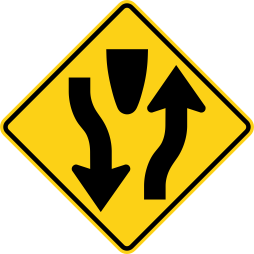
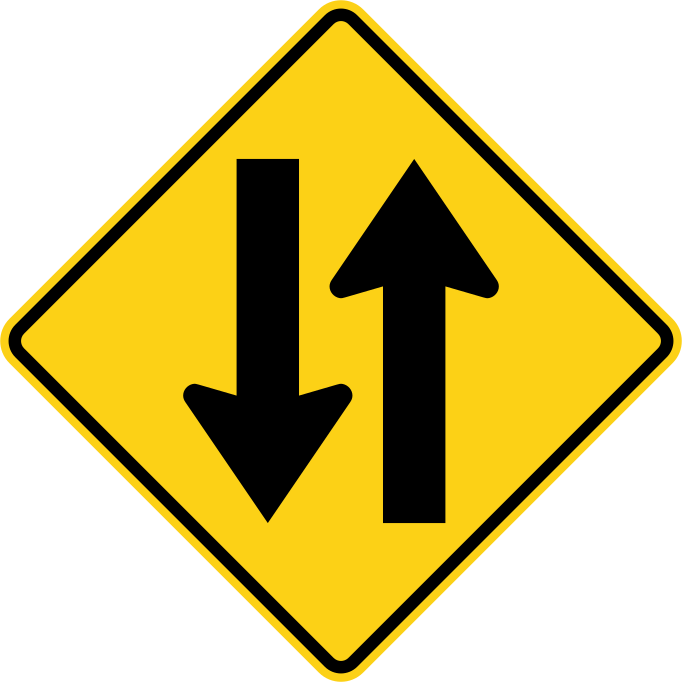
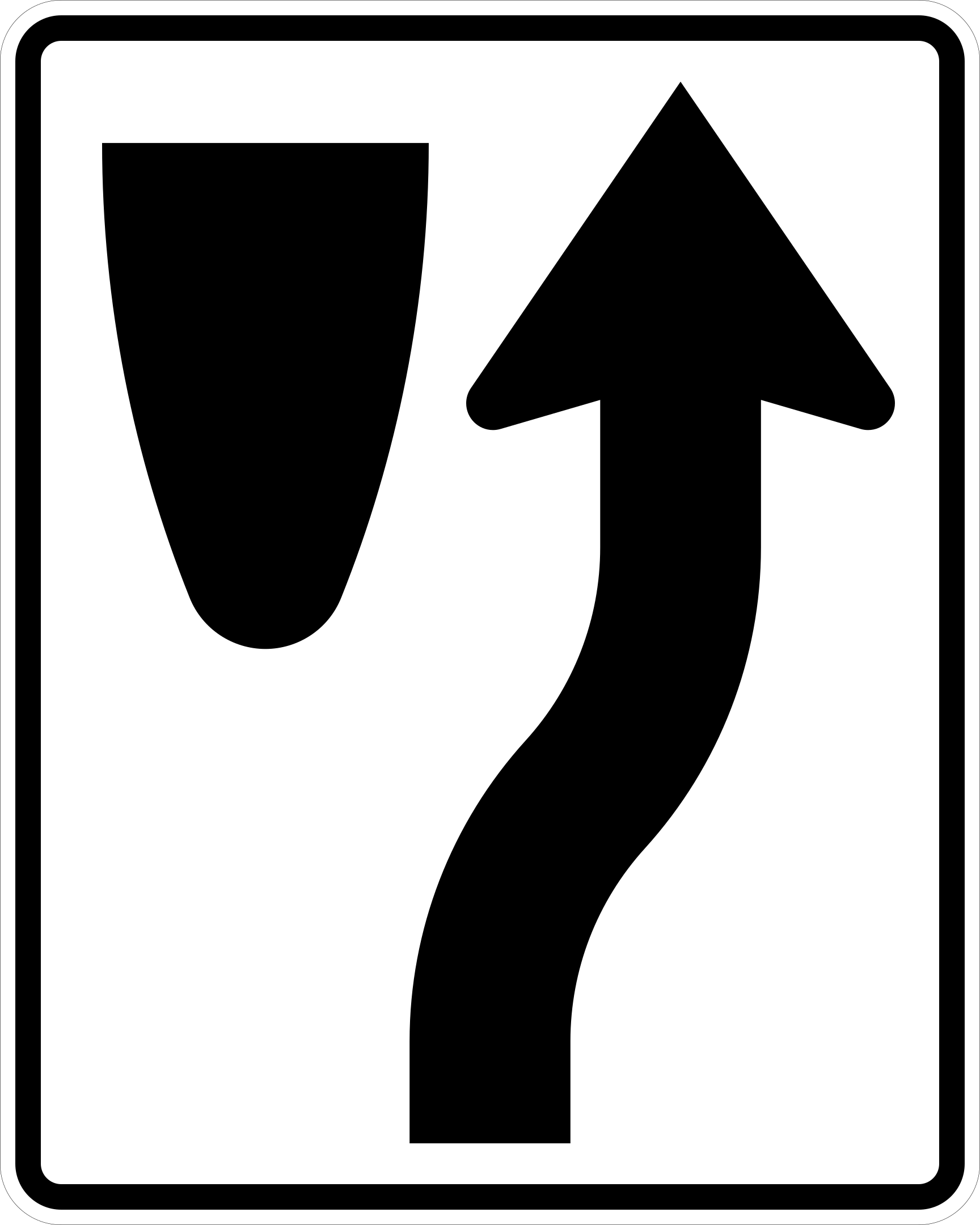
Divided Highway begins is the opposite warning, for where a median starts. Two-Way Traffic is the sign Section 2C.21 pairs with the change to a two-lane, two-way road. Keep Right is the regulatory sign for a median nose, where this diamond is not used.
What is the Divided Highway Ends sign often mistaken for?
Divided Highway begins (W6-1). This is the one that matters: after W6-2 there is oncoming traffic in the lane beside you.
| |
|---|---|
| GroupWarning signs | GroupWarning signs |
| ShapeDiamond | ShapeDiamond |
| ColorYellow background, black symbol and border | ColorYellow background, black symbol and border |
| What it meansThe median ends ahead and you will be facing two-way traffic on a single roadway. | What it meansFrom here the two directions run on their own pavement with a median between them. |
What does the permit test ask about the Divided Highway Ends sign?
This question is from the practice bank, with the answer marked.
This sign warns you that ahead:
- A.The road becomes one way
- B.The median ends and you will meet oncoming traffic on the same pavement(correct answer)
- C.The highway ends at an intersection
- D.The shoulder is no longer paved
Source: MUTCD W6-2
Questions drivers ask about the Divided Highway Ends sign
Can I cross the median to pass once I have seen this sign?
No. The sign warns that the divided section ends ahead. It does not open the median. Until the divider ends, Texas 545.063 keeps you on the right-hand roadway and out of the dividing space, except through an opening or at a crossover or intersection a public authority established. The taper still counts. Florida 316.090 has the same rule.
Does the sign mean a new lane is opening for me?
No. Section 2C.21 warns of two-way traffic ahead. Vehicles that were beyond the median meet you on the same pavement, facing you. Speeding up into a "new" lane puts you in that opposing stream. The symbol shows the end of the separation, not an added lane in your direction.
How far before the median ends should the sign stand?
Section 2C.21 says in advance and prints no distance. The Brooks County photo still shows the median beside the post and does not show how many feet remain. Section 2C.04 offers Table 2C-3 as a general aid, but none of its columns is written for W6-2, so the manual gives no footage for this sign.
What should I do at a median opening that is also a cross street?
Follow the Keep Right sign on the nose, not this diamond. Section 2C.21 keeps W6-2 to the end of a divided section, not an intersection, and Section 2C.20 bars the Divided Highway (W6-1) sign from replacing Keep Right on a median nose. Stay right of the nose. Texas 545.063(b) allows crossing only through an opening or at a crossover or intersection, not along a path you pick across the divider.
Sources
- MUTCD 11th Edition, Chapter 2C, Table 2C-1
- MUTCD 11th Edition (December 2023), Sections 2C.04, 2C.20, and 2C.21, Table 2C-3
- MUTCD 11th Edition (December 2023), Section 2B.39
- Texas Transportation Code section 545.063
- Florida Statutes section 316.090 (2025), Driving on divided highways
What are the other warning signs?
All 55 warning signs on one page, or every US road sign by shape and color.
Test yourself on this sign and the rest of the set with a road signs practice test for Florida, Texas, California or New York.
The artwork is the federal design itself, which the manual dedicates to the public domain in MUTCD 11th Edition, Part 1, Section 1D.06, checked 2026-09-09. The Interstate Shield, the 511 pictograph and the National Scenic Byway graphic are named exceptions and are not reproduced anywhere on this site.
Source: Manual on Uniform Traffic Control Devices, 11th Edition. Not affiliated with or endorsed by the Federal Highway Administration or any state agency.