What does the Slippery When Wet sign mean?
The Slippery When Wet sign (MUTCD W8-5) is a warning sign under the federal Manual on Uniform Traffic Control Devices, the national standard the states build from. Grip falls away sharply on this stretch once it is wet, so brake, steer and accelerate one at a time and none of them hard.
Source: MUTCD 11th Edition, Chapter 2C, Table 2C-1, checked 2026-09-09.
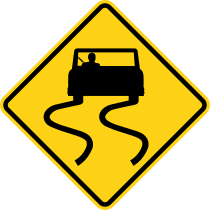
What shape and color is the Slippery When Wet sign?
| MUTCD code | W8-5 |
|---|---|
| Group | Warning signs |
| Shape | Diamond |
| Color | Yellow background, black car-and-skid-marks symbol and border |
What a diamond means. A warning. It tells you what the road does next and obliges you to do nothing in particular, which is the distinction test writers probe most often.
What yellow means. General warning of a permanent condition ahead.
Warning signs. A diamond reports a condition and orders nothing. What you do about it is left to you, and that gap between a report and an order is what test writers keep probing.
When can this sign go up, and what can be added under it?
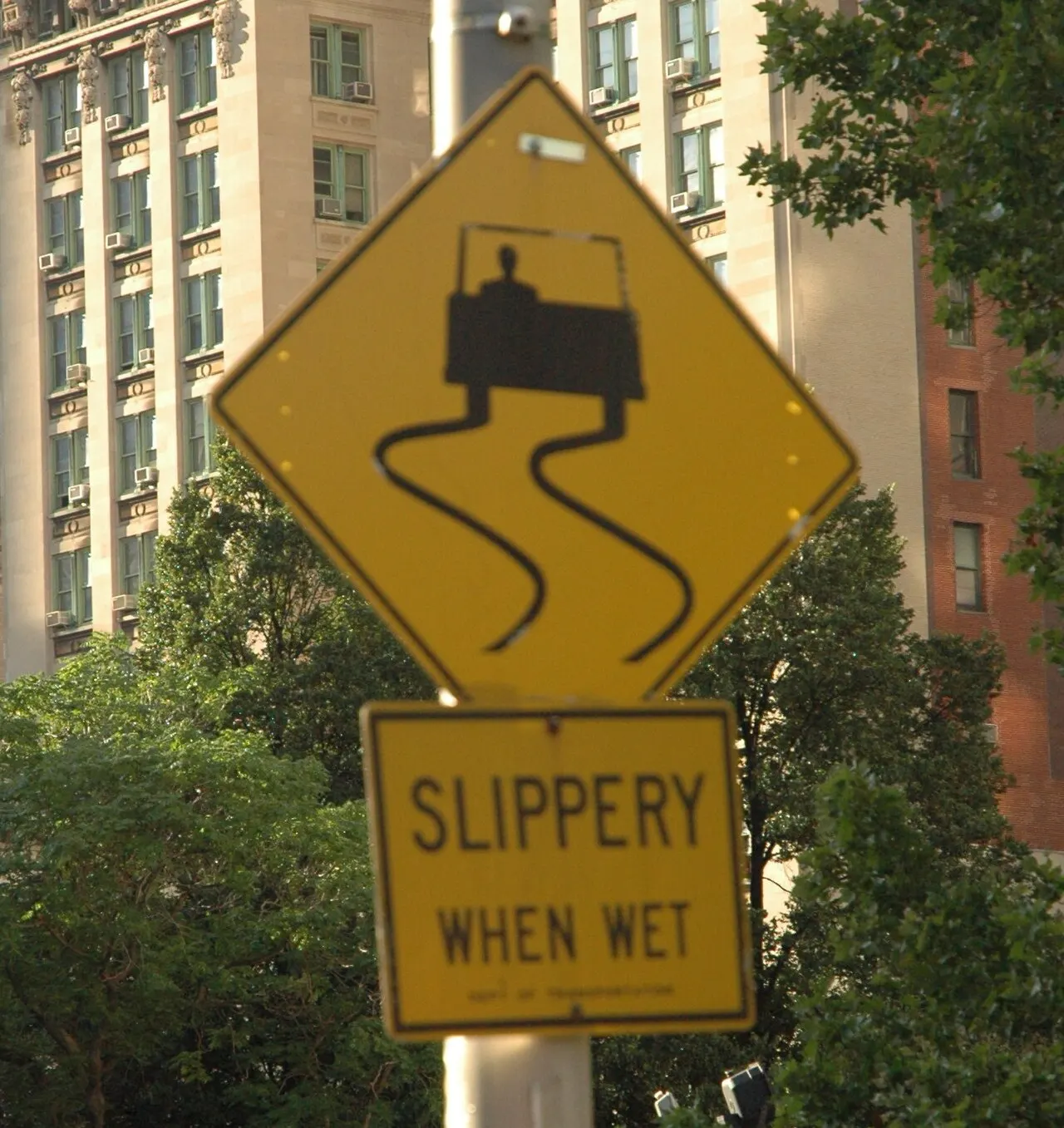
Section 2C.30 makes the Slippery When Wet sign optional, for unexpected slippery conditions. It is not automatic on every road that gets rain. The same paragraph allows a supplemental plaque to name the reason, and gives ICE, WHEN WET, STEEL DECK, and EXCESS OIL as examples. The Manhattan photograph shows the car-and-skid symbol with a SLIPPERY WHEN WET plaque under it, the "when wet" case spelled out in words.
- ICE names cold slickness anywhere, not only on a bridge. Bridge Ices Before Road is a separate sign, and it may be removed or covered in seasons when its message does not apply.
- WHEN WET says the trigger is water. The symbol already shows a skidding car.
- STEEL DECK is a metal riding surface. Section 2C.31 also allows a METAL BRIDGE DECK word sign aimed at motorcyclists, bicyclists, and other road users.
- EXCESS OIL is a surface film. The manual lists the legend and does not define how much oil counts.
- GROOVED PAVEMENT, TEXTURED PAVEMENT, and BRICK PAVEMENT are Section 2C.31 word signs, including for a grooved skid-resistance treatment on a curve. They are not this symbol.
Where along the slick stretch is the sign placed?
Paragraph 07 says surface condition signs should be placed in advance of the start of the affected section, with Table 2C-3 as the guide, and repeated at appropriate intervals where the condition continues. That table is built around lane changes, stops, and slowing to a listed advisory speed. A W8-5 with no advisory plaque has no single cell, and the MUTCD prints no separate distance for this sign. Adding a W13-1P selects a column, and that speed still has to come from a study.
Section 2C.31 says surface warnings such as this one can also help motorcyclists where the condition exists. A Motorcycle plaque may go with the grooved-pavement and metal-deck signs. The diamond is not limited to cars, and a rider is not told to wait for a different sign.
What do you change when you see it?
- 1Drop speed before the surface changes
The sign stands in advance of the affected section. The adjustment belongs on the approach. Waiting until the car is on the slick patch spends the warning.
- 2Do not invent a mph discount
No sentence in Section 2C.30 says "10 under the limit" or any other fixed cut. Unless an advisory plaque is also posted, the diamond gives no replacement number.
- 3Separate braking from a hard steering input
The symbol is a car already in a skid. Asking the same patch of wet pavement for a sharp steer and a hard stop at once is how that picture happens. Ease one input, then the next.
- 4Keep the reduction up for the whole signed stretch
Paragraph 07 calls for additional signs at intervals where the condition continues. A repeat sign means the slippery stretch has not ended, even if the next few hundred feet look dry.
What do New York, California, and Texas actually require?
New York section 1180(a) forbids a speed that is not reasonable and prudent for the actual and potential hazards then existing. Section 1180(e) requires an appropriately reduced speed when a special hazard exists by reason of weather or highway conditions. Neither names a mph cut for rain. California section 22350 writes the surface into the same duty: due regard for weather, visibility, traffic, and the surface and width of the highway, and never a speed that endangers people or property.
In New York, rain at this sign can also trigger a lighting duty. New York VTL 375(2)(a) requires headlights whenever the wipers are clearing rain, snow or sleet, even in daylight. Switch them on as you slow for the slick pavement. The New York State Driver's Manual (MV-21), Chapter 10, says parking lights and daytime running lights do not replace headlights. The yellow diamond gives no exception when the posted speed still feels comfortable.
Texas section 545.353 lets the Transportation Commission, after an engineering and traffic investigation, declare another speed for wet or inclement weather, meaning a roadway made unsafe by precipitation, including water, ice, and snow. A limit it declares takes effect when signs giving notice are erected. Under Section 2B.21 a legal limit is displayed on a Speed Limit sign, not on this diamond, so a lone W8-5 is not that second number.
Marco, a Manhattan avenue in rain, April 9, 2026
- 1He is holding the number on the white speed limit sign. The yellow diamond ahead matches the photograph: skid-mark symbol, SLIPPERY WHEN WET plaque.
- 2Section 2C.30 allows that plaque to state the reason. It does not replace the white number with a lower one.
- 3Rain is the kind of hazard section 1180(e) names: weather and highway conditions. The statute still does not say how many mph to take off.
- 4He waits until the car is on the wet section, then brakes and turns at the same time because a parked car narrows the lane.
Outcome. He was still "at the limit" on the white sign and already too fast for the surface the yellow sign marked. Nothing in Section 2C.30 or section 1180 turns this sign into a lower posted maximum, and section 1180(e) still required him to slow for it.
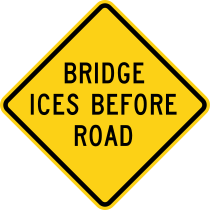
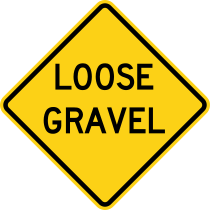
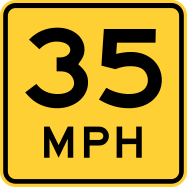
Bridge Ices Before Road may be covered out of season. Loose Gravel warns of material on the pavement. An advisory plaque is the only one of the three that prints a speed, and only after a study.
What is the Slippery When Wet sign often mistaken for?
Bridge Ices Before Road (W8-13), which is a specific cold-weather hazard, and Grooved Pavement (W8-15), which mainly affects motorcycles.
| |
|---|---|
| GroupWarning signs | GroupWarning signs |
| ShapeDiamond | ShapeDiamond |
| ColorYellow background, black car-and-skid-marks symbol and border | ColorYellow background, black legend and border |
| What it meansGrip falls away sharply on this stretch once it is wet, so brake, steer and accelerate one at a time and none of them hard. | What it meansThe bridge deck freezes earlier than the surrounding roadway because cold air passes underneath. |
What does the permit test ask about the Slippery When Wet sign?
These 2 questions are from the practice bank, with the answer marked.
This sign warns that the road ahead:
- A.Floods in heavy rain
- B.Loses grip when wet, so slow down before you need to brake(correct answer)
- C.Is under construction
- D.Has loose gravel
Source: MUTCD W8-5
The most slippery road conditions usually occur:
- A.After several hours of heavy rain
- B.In the first few minutes of rain after a dry spell(correct answer)
- C.Only when the temperature is below freezing
- D.During fog
Why: Oil and rubber build up on dry roads and float to the surface when rain first falls. Prolonged rain then washes it away, so the first few minutes are the worst.
Source: NHTSA wet weather driving guidance
Questions drivers ask about the Slippery When Wet sign
Does this sign lower the speed limit when the pavement is wet?
Not by a figure you can read off the diamond. Section 2C.30 contains no mph reduction. New York section 1180(e) and California section 22350 require a slower speed when weather or the surface makes the posted number unsafe, without stating the replacement. Texas can declare a separate wet-weather speed under section 545.353, effective when signs giving notice go up. Those are speed limit signs, not W8-5.
The road looks dry. Can I ignore the sign?
The sign is for unexpected slippery conditions, and the WHEN WET plaque ties this warning to water, so a dry surface is not the condition the plaque names. Other legends the manual gives, such as ICE, STEEL DECK, and EXCESS OIL, describe causes that do not need rain. The manual lets agencies cover Bridge Ices Before Road out of season, and it gives no such seasonal provision for this sign.
There is a second Slippery When Wet sign a short way later. Did I miss a new hazard?
Paragraph 07 says additional signs should be placed at appropriate intervals along a road where the condition exists. A repeat means the stretch is still slippery, not automatically a second and different problem. The manual does not set the interval in feet. If a new reason applies, the plaque is where that reason would be written.
I ride a motorcycle. Is there a different sign I should be looking for?
Section 2C.31 says Slippery When Wet, LOOSE GRAVEL, and ROUGH ROAD signs can also help riders when those conditions exist. Grooved, textured, or brick pavement, and a metal bridge deck, have their own word signs, and a Motorcycle plaque may be mounted with them. Those word signs are not a substitute you wait for before taking the diamond seriously.
Can the city add a yellow speed under this sign?
Yes, but only as an advisory plaque: set by an engineering study (outside an emergency or temporary condition), a multiple of 5 mph, and mounted under the warning sign. Section 2C.59 forbids installing that plaque alone. The number would be an advisory for the slippery condition, not a new white speed limit, and Section 2B.21 says not to use a Speed Limit sign for an advisory speed.
Sources
- MUTCD 11th Edition, Chapter 2C, Table 2C-1
- MUTCD 11th Edition, December 2023, Sections 2C.04, 2C.30, 2C.31, and 2C.59
- MUTCD 11th Edition, December 2023, Section 2B.21
- New York Vehicle and Traffic Law section 1180
- New York Vehicle and Traffic Law section 375, headlamps when windshield wipers are in use
- New York State Driver's Manual (MV-21), Chapter 10, Special Driving Conditions
- California Vehicle Code section 22350
- Texas Transportation Code section 545.353
What are the other warning signs?
All 55 warning signs on one page, or every US road sign by shape and color.
Test yourself on this sign and the rest of the set with a road signs practice test for Florida, Texas, California or New York.
The artwork is the federal design itself, which the manual dedicates to the public domain in MUTCD 11th Edition, Part 1, Section 1D.06, checked 2026-09-09. The Interstate Shield, the 511 pictograph and the National Scenic Byway graphic are named exceptions and are not reproduced anywhere on this site.
Source: Manual on Uniform Traffic Control Devices, 11th Edition. Not affiliated with or endorsed by the Federal Highway Administration or any state agency.