What does the Bicycle sign mean?
The Bicycle sign (MUTCD W11-1) is a warning sign under the federal Manual on Uniform Traffic Control Devices, the national standard the states build from. Watch for bicycles entering or crossing the roadway ahead.
Source: MUTCD 11th Edition, Chapter 2C, Table 2C-1, checked 2026-09-09.
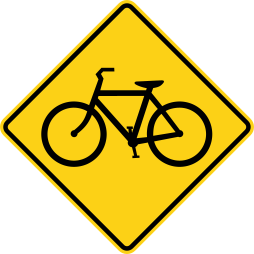
What shape and color is the Bicycle sign?
| MUTCD code | W11-1 |
|---|---|
| Group | Warning signs |
| Shape | Diamond |
| Color | Yellow or fluorescent yellow-green background, black symbol and border |
What a diamond means. A warning. It tells you what the road does next and obliges you to do nothing in particular, which is the distinction test writers probe most often.
What fluorescent yellow-green means. Pedestrian, bicycle and school warnings. Reserved so those warnings cannot be mistaken for an ordinary hazard.
Warning signs. A diamond reports a condition and orders nothing. What you do about it is left to you, and that gap between a report and an order is what test writers keep probing.
When is the bicycle diamond used, and what may be mounted under it?
W11-1 is a Vehicular Traffic Warning sign in Section 2C.54, not a pedestrian or animal sign. Paragraph 01 allows it where bicycles might enter the road unexpectedly, and paragraph 03 says to use it only where sight distance is restricted or the entry would be unexpected. If the activity is seasonal or temporary, paragraph 04 says remove or cover the sign when it is not happening. Paragraph 06 allows, but does not require, a fluorescent yellow-green background.
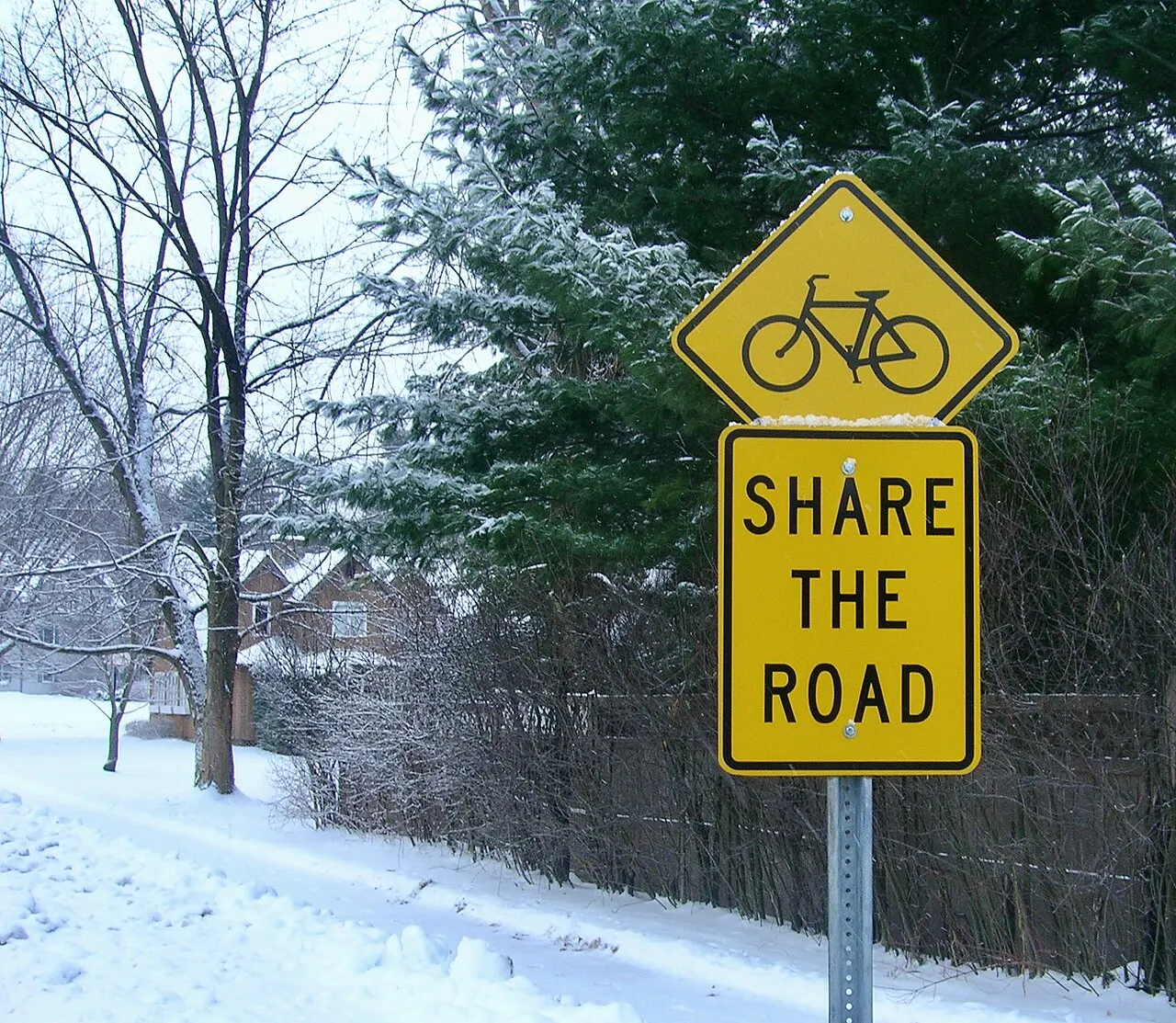
The South Burlington photograph shows SHARE THE ROAD under the diamond. That was the W16-1P legend in the 2009 edition (Section 2C.60). The 11th Edition's Section 2C.67 uses IN ROAD (W16-1P) and IN STREET (W16-1aP) to warn of slower traffic traveling along the highway. The plaque shall match the background of the sign above it, shall be mounted below that sign, and shall not stand alone. Paragraph 07 of 2C.54 lists AHEAD, XX FEET, NEXT XX MILES, IN STREET, and IN ROAD as plaque legends. At the crossing point, paragraph 09 says a post-mounted W11-1 shall carry the diagonal arrow. An overhead one shall not.
Paragraph 10 bars the assembly on an approach controlled by a STOP or YIELD sign, with two exceptions: a circular intersection whose crosswalk is at least 20 feet before the yield point, and a YIELD-controlled channelized right-turn lane at a signalized or stop-controlled intersection, with the same 20-foot gap.
What do you do, depending on what the rider is doing?
- 1AHEAD, a distance, or IN ROAD
Nobody has to be in front of you yet. IN ROAD means riders may be traveling along this road, not that the crosswalk is at the post.
- 2Arrow at a crossing
Cover the brake and yield if a rider is entering. Do not stop in an empty lane just because the diamond is there.
- 3A rider is ahead, going your way, in Florida
Section 316.083(2) requires a pass of not less than 3 feet, or you stay back until you can. Subsection (3) uses the same 3 feet for a bicycle lane. Subsection (4) says both rules do not apply in a separated bicycle lane.
- 4The same pass in California
Vehicle Code 21760(c) measures 3 feet from any part of your vehicle to any part of the bicycle or the rider. If another same-direction lane is available, change into it first when that is practicable and legal. If you cannot keep 3 feet, subdivision (d) says slow to a reasonable and prudent speed and pass only when it will not endanger the rider.
| Florida 316.083 | California 21760 | |
|---|---|---|
| Minimum gap | Not less than 3 feet. | 3 feet from any part of the vehicle to any part of the bicycle or rider. |
| If you cannot move over | Stay back until the 3-foot pass is safe. | Slow to a reasonable speed and pass only if it will not endanger the rider. |
| Another lane your way | No added lane-change duty. | Change lanes first if practicable and legal. |
| Fine in the statute | A moving violation under chapter 318. No dollar amount in 316.083. | $35, or $220 if a collision injures the rider and you violated the section. |
Neither statute is triggered by the diamond alone. Both apply when you overtake a bicycle going your way. Florida 316.083(4) drops the 3-foot rules in a separated bicycle lane. California 21760 does not say that.
What does Jordan Ellis do on a 45 mph two-lane road?
A rider in the lane, no room to the left
- 1On May 3, 2026, Jordan Ellis is westbound in Florida at 40 mph on a two-lane road posted 45, one lane each way, with oncoming cars. A W11-1 with an IN ROAD plaque is on the right.
- 2About 200 feet past it, a rider is in his lane going the same way at about 15 mph. The oncoming lane is occupied, so a 3-foot pass would put him into that car.
- 3Florida 316.083(2) says he stays back until he can pass at not less than 3 feet, so he slows to the rider's pace. Florida 316.085(1) lets him use the left side only when it is clear of oncoming traffic far enough ahead to finish the pass. When it is, he moves left, leaves more than 3 feet from his mirror to the rider, and returns only after he is clear.
Outcome. The diamond did not order a stop, and a wide-looking lane did not shrink the 3 feet. The sign was why he was looking early.
What do the wrong answers assume?
- "The diamond prohibits bicycles." The ban is the regulatory No Bicycles sign. W11-1 warns that bicycles may be here.
- "SHARE THE ROAD sets a speed." The Vermont plaque is the 2009 legend. IN ROAD and IN STREET in Section 2C.67 set no speed, and 2C.54 prints none for this sign.
- "Three feet is door to tire." California 21760(c) counts any part of the vehicle, so a mirror counts. Florida gives no looser measuring point.
- "Stop and wait until a bicycle appears." An empty road has nothing to yield to yet. Stopping in the lane for a warning sign is how a rear-end crash starts.
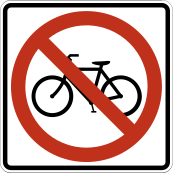
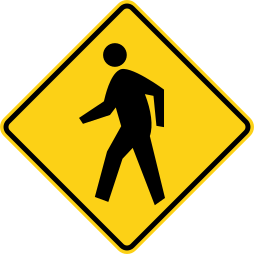
No Bicycles is a ban. The pedestrian diamond is a different section of the manual. Both diamonds may be yellow or fluorescent yellow-green.
What is the Bicycle sign often mistaken for?
No Bicycles (R5-6), which bans them. Note the 11th Edition dropped the SHARE THE ROAD legend from W16-1P, which now reads IN ROAD.
| |
|---|---|
| GroupWarning signs | GroupRegulatory signs |
| ShapeDiamond | ShapeSquare |
| ColorYellow or fluorescent yellow-green background, black symbol and border | ColorWhite background, red circle and slash over a black bicycle symbol |
| What it meansWatch for bicycles entering or crossing the roadway ahead. | What it meansRiding a bicycle past this point is prohibited, typically because the road carries speeds or a shoulder profile that leaves no room for one. |
What does the permit test ask about the Bicycle sign?
These 2 questions are from the practice bank, with the answer marked.
This sign means:
- A.A bike lane begins
- B.Cyclists may be in or crossing the roadway ahead(correct answer)
- C.Bicycles are prohibited ahead
- D.A bike path crosses under the road
Source: MUTCD W11-1
You want to pass a bicycle on a two-lane road but cannot give safe clearance. You should:
- A.Pass anyway, keeping as far left as possible
- B.Wait behind until it is safe to pass with proper clearance(correct answer)
- C.Sound the horn until they move over
- D.Pass on the right
Why: A bicycle is entitled to the lane. If you cannot give the clearance your state requires, commonly three feet, you wait. Squeezing past is what causes most car and bicycle collisions.
Source: State minimum passing distance laws; NHTSA bicycle safety guidance
Questions drivers ask about the Bicycle sign
Does this sign mean bicycles are not allowed on the road?
No. Section 2C.54 uses W11-1 to warn that bicycles may enter the roadway, or may be along it when an IN ROAD or IN STREET plaque is mounted below. A ban is a separate regulatory sign. If you treat the yellow diamond as a prohibition, you have reversed the message, and you will also miss the rider the sign was put there to mark.
The plaque says SHARE THE ROAD. Do I have to do something extra?
That wording is what the South Burlington photograph shows, and it was the W16-1P legend in the 2009 edition. Section 2C.67 of the 11th Edition specifies IN ROAD or IN STREET for a plaque warning of slower traffic traveling along the highway, mounted under the warning sign and never alone. Neither legend is a speed limit. When you do catch a rider going your way, Florida still requires a pass of not less than 3 feet, and California requires 3 feet as well.
Is the 3 feet measured from my door, or from the mirror?
California Vehicle Code 21760(c) says the gap is between any part of the motor vehicle and any part of the bicycle or its operator, so a side mirror counts. Florida Statutes 316.083(2) requires not less than 3 feet when the rider is in your lane and, if you cannot make that pass safely, requires you to stay back until you can. Subsection (3) requires not less than 3 feet when the rider is in a bicycle lane. Squeezing through at arm's length fails both states.
A rider is in a separated bicycle lane. Does Florida's 3-foot rule still apply?
Section 316.083(4) says the 3-foot rules in subsections (2) and (3) do not apply when the bicycle or other nonmotorized vehicle occupies a separated bicycle lane. That exception is narrow. A rider in an ordinary bicycle lane is still covered by subsection (3), and a rider in your travel lane is covered by subsection (2). The yellow diamond does not tell you which kind of lane is ahead. Look at the pavement.
Sources
- MUTCD 11th Edition, Chapter 2C, Table 2C-1
- MUTCD 11th Edition (December 2023), Section 2C.54, Vehicular Traffic Warning signs including W11-1
- MUTCD 11th Edition, Section 2C.67, IN ROAD and IN STREET plaques
- MUTCD 2009 Edition, Section 2C.60, SHARE THE ROAD plaque (W16-1P)
- Florida Statutes 316.083, overtaking a bicycle (2026)
- Florida Statutes 316.085, limits on passing on the left (2026)
- California Vehicle Code 21760, Three Feet for Safety Act
What are the other warning signs?
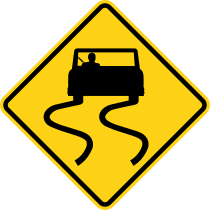
All 55 warning signs on one page, or every US road sign by shape and color.
Test yourself on this sign and the rest of the set with a road signs practice test for Florida, Texas, California or New York.
The artwork is the federal design itself, which the manual dedicates to the public domain in MUTCD 11th Edition, Part 1, Section 1D.06, checked 2026-09-09. The Interstate Shield, the 511 pictograph and the National Scenic Byway graphic are named exceptions and are not reproduced anywhere on this site.
Source: Manual on Uniform Traffic Control Devices, 11th Edition. Not affiliated with or endorsed by the Federal Highway Administration or any state agency.