What does the Low Shoulder sign mean?
The Low Shoulder sign (MUTCD W8-9) is a warning sign under the federal Manual on Uniform Traffic Control Devices, the national standard the states build from. The shoulder is lower than the traveled lane; leaving the pavement could pull the vehicle off.
Source: MUTCD 11th Edition, Chapter 2C, Table 2C-1, checked 2026-09-09.
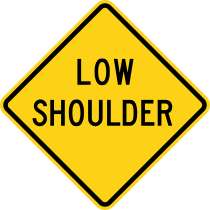
What shape and color is the Low Shoulder sign?
| MUTCD code | W8-9 |
|---|---|
| Group | Warning signs |
| Shape | Diamond |
| Color | Yellow background, black legend and border |
What a diamond means. A warning. It tells you what the road does next and obliges you to do nothing in particular, which is the distinction test writers probe most often.
What yellow means. General warning of a permanent condition ahead.
Warning signs. A diamond reports a condition and orders nothing. What you do about it is left to you, and that gap between a report and an order is what test writers keep probing.
Where does a Low Shoulder sign go, and what drop is it for?
Section 2C.29 of the MUTCD 11th Edition (December 2023) lists LOW SHOULDER (W8-9) as an option: the agency may post it and is not required to. The option covers a shoulder where the elevation difference between the shoulder and the travel lane is 3 inches or less. A deeper unprotected edge calls for a different sign.
Table 2C-1 sizes the diamond at 36 by 36 inches on a conventional road or an expressway and 48 by 48 on a freeway. The manual gives it no fixed distance. Table 2C-3 in Section 2C.04 lists advance distances by speed, but the note under that table says a warning about a condition not tied to one location, with SOFT SHOULDER as its example, can go wherever engineering judgment places it. Paragraph 07 of Section 2C.29 adds that shoulder signs should be repeated at appropriate intervals where the condition keeps going. No spacing in feet is published for those repeats.
W8-9 covers a difference of 3 inches or less. Where an unprotected drop beside the lane is deeper than 3 inches for a significant continuous length, Section 2C.29 says the Shoulder Drop Off symbol (W8-17) should be used instead.
What do you do with the wheels?
- 1Stay on the paved lane
The warning is about the strip beside the lane, not about the lane closing. Both right tires belong on the traveled surface.
- 2Do not pass on the grass
A slow car ahead is not a reason to put a wheel on a shoulder the sign has already called low or soft. Wait for a legal pass on the pavement.
- 3If a tire goes off, slow down first
Keep a firm grip, lift off the accelerator and brake lightly. The California Driver Handbook cautions that forcing the wheel back can put the car into the oncoming lane.
- 4Then ease back on
Once speed is down and the mirror shows no one close behind, steer back onto the pavement with a small, deliberate movement.
What does Florida law add when a pass would leave the pavement?
Florida is one state that writes this into its code. Florida Statutes section 316.084 (2025) allows passing on the right only when the vehicle ahead is turning or about to turn left, on a road with unobstructed pavement wide enough for two or more lines of moving traffic each way, or on a one-way road wide enough for two lines. Subsection (2) adds that the move must be safe and may never be made by driving off the pavement or main-traveled portion of the roadway. Subsection (3) makes a violation a noncriminal traffic infraction, punished as a moving violation. The statute never names this sign. The sign warns that the edge is poor; the statute is what makes an off-pavement pass unlawful in Florida even where the grass looks flat.
What happened on McMillan Road that morning?
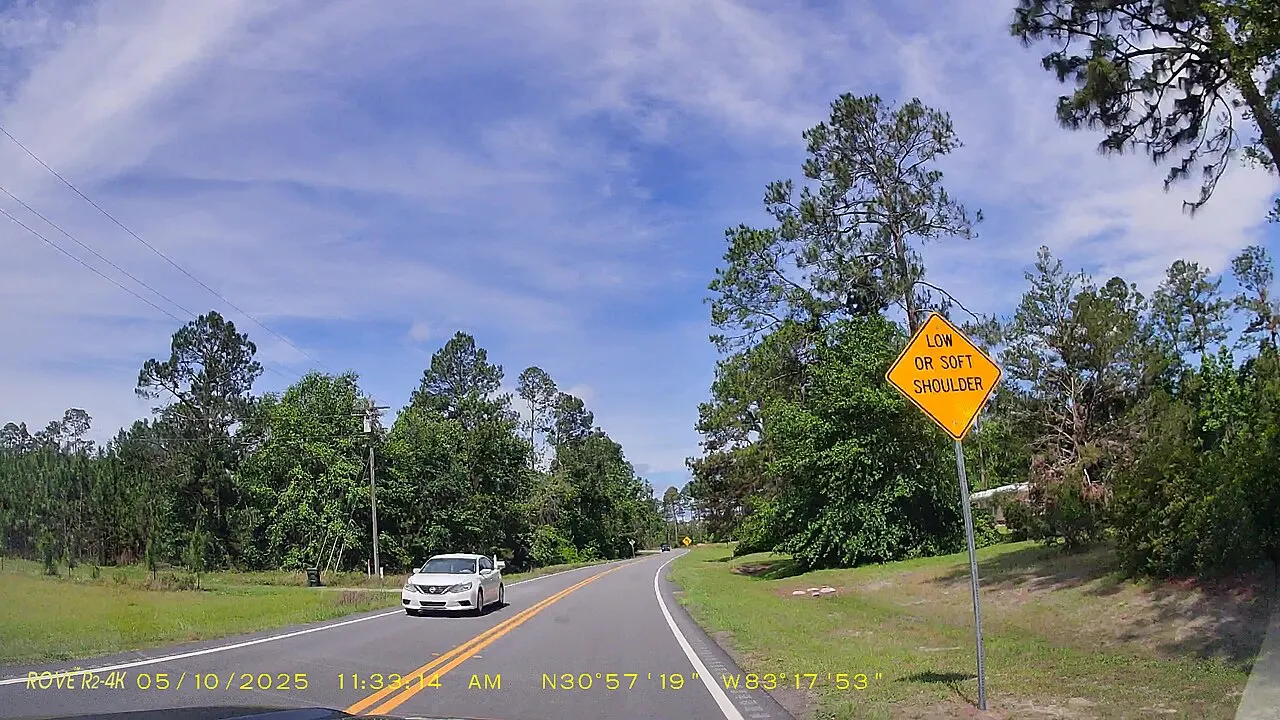
Jordan, westbound on McMillan Road, May 10, 2025
- 1At 11:33 a.m. the diamond on the right reads LOW OR SOFT SHOULDER. Section 2C.29 lists those as two separate signs, W8-9 and W8-4. This post puts both words on one diamond.
- 2The road is two lanes with a double yellow center line. A white sedan is coming the other way in the eastbound lane, so there is no room to drift left either.
- 3Past the white edge line on the right there is only a narrow strip of pavement, then grass. Jordan keeps the right tires inside the edge line instead of edging toward the grass to give the oncoming sedan extra room.
Outcome. Jordan passes the sign and the sedan with all four tires on the lane. The sign did not order a stop, a turn, or a lower speed. It told Jordan, before getting there, that the edge was the wrong place to put a tire.
Which permit-test answers sound right and are not?
- The sign does not close the road, and it does not mean the pavement is about to turn to gravel. That message is Pavement Ends (W8-3), a different diamond.
- No MUTCD number fixes how many feet before the low shoulder the sign must stand. An answer like "exactly 500 feet" borrows a figure from the Table 2C-3 speed chart, and that table's own note leaves a condition like this to engineering judgment.
- A combined LOW OR SOFT legend, as on McMillan Road, is not a separate code in Section 2C.29. The manual keeps the low edge (3 inches or less) and the soft shoulder as two signs.
- The sign is yellow and diamond-shaped because it warns. It does not decide who goes first at the next driveway.
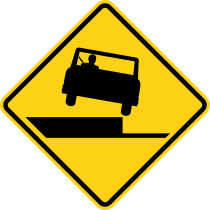
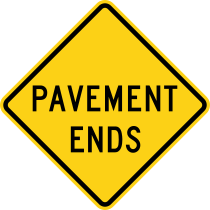
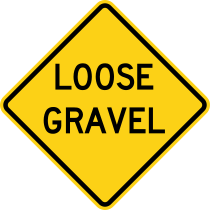
Shoulder Drop-Off is the edge deeper than 3 inches. Pavement Ends marks pavement changing to gravel or earth. Loose Gravel warns of loose gravel on the road surface itself.
What is the Low Shoulder sign often mistaken for?
Soft Shoulder (W8-4), where the shoulder is level but will not bear weight, and Shoulder Drop-Off (W8-17), which is the severe version.
| |
|---|---|
| GroupWarning signs | GroupWarning signs |
| ShapeDiamond | ShapeDiamond |
| ColorYellow background, black legend and border | ColorYellow background, black symbol and border |
| What it meansThe shoulder is lower than the traveled lane; leaving the pavement could pull the vehicle off. | What it meansThere is a significant vertical drop from the pavement edge to the shoulder. |
What does the permit test ask about the Low Shoulder sign?
This question is from the practice bank, with the answer marked.
Your vehicle begins to leave the pavement onto a soft shoulder. You should:
- A.Brake hard and steer back immediately
- B.Ease off the accelerator, keep straight, then steer back gently at lower speed(correct answer)
- C.Accelerate to climb back onto the road
- D.Steer sharply left at once
Why: Jerking the wheel back at speed is what turns a drop onto the shoulder into a rollover or a head-on. Slow first, then rejoin gently.
Source: NHTSA run-off-road recovery guidance
Questions drivers ask about the Low Shoulder sign
Can I ease onto the shoulder to let a faster car by?
Section 2C.29 does not speak to that. It only warns that the edge beside the lane is low or soft. Florida section 316.084 does not answer it either, because its off-pavement ban is aimed at the driver who passes on the right. What the sign does tell you is that the strip beside the lane is a poor place for a tire, so the safer choice is to hold your lane and let the other driver pass where passing is legal.
Does the sign tell me the drop is exactly 3 inches?
No. The manual uses 3 inches as the top of the range for this sign: a difference of 3 inches or less can carry W8-9. There is no plaque for the measured depth, and Section 2C.29 does not ask the agency to post the number of inches. An unprotected drop deeper than 3 inches for a significant continuous length gets the Shoulder Drop Off symbol instead.
Why does the Georgia photo say LOW OR SOFT SHOULDER?
The frame from westbound McMillan Road in Lowndes County shows both words on one yellow diamond. Section 2C.29 gives SOFT SHOULDER (W8-4) and LOW SHOULDER (W8-9) as separate options. Low has a number attached, a difference of 3 inches or less between the shoulder and the lane. Soft has none; the manual only says the sign may warn of a soft shoulder condition. On that road the post warns of both, and either one is a reason to keep your tires on the pavement.
If my tire drops off, should I brake hard and steer back right away?
No. The California Driver Handbook describes the opposite: get off the gas, slow with gentle braking while holding the wheel steady, and steer back only after you have slowed and checked behind you. It warns that yanking the wheel can put you into oncoming traffic. The sign does not print these steps. It warns you that the edge is low or soft before you reach it.
Sources
- MUTCD 11th Edition, Chapter 2C, Table 2C-1
- MUTCD 11th Edition (December 2023), Chapter 2C, Sections 2C.04, 2C.28, 2C.29 and 2C.30, Tables 2C-1 and 2C-3
- Florida Statutes section 316.084 (2025), When overtaking on the right is permitted
- California Driver Handbook, Section 8: Safe Driving (continued), Driving Off the Pavement
What are the other warning signs?
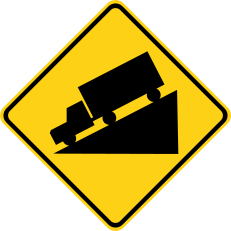
All 55 warning signs on one page, or every US road sign by shape and color.
Test yourself on this sign and the rest of the set with a road signs practice test for Florida, Texas, California or New York.
The artwork is the federal design itself, which the manual dedicates to the public domain in MUTCD 11th Edition, Part 1, Section 1D.06, checked 2026-09-09. The Interstate Shield, the 511 pictograph and the National Scenic Byway graphic are named exceptions and are not reproduced anywhere on this site.
Source: Manual on Uniform Traffic Control Devices, 11th Edition. Not affiliated with or endorsed by the Federal Highway Administration or any state agency.