What does the Bridge Ices Before Road sign mean?
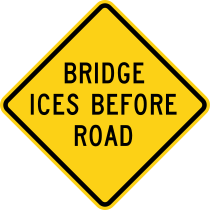
The Bridge Ices Before Road sign (MUTCD W8-13) is a warning sign under the federal Manual on Uniform Traffic Control Devices, the national standard the states build from. The bridge deck freezes earlier than the surrounding roadway because cold air passes underneath.
Source: MUTCD 11th Edition, Chapter 2C, Table 2C-1, checked 2026-09-09.
What shape and color is the Bridge Ices Before Road sign?
| MUTCD code | W8-13 |
|---|---|
| Group | Warning signs |
| Shape | Diamond |
| Color | Yellow background, black legend and border |
What a diamond means. A warning. It tells you what the road does next and obliges you to do nothing in particular, which is the distinction test writers probe most often.
What yellow means. General warning of a permanent condition ahead.
Warning signs. A diamond reports a condition and orders nothing. What you do about it is left to you, and that gap between a report and an order is what test writers keep probing.
When is this sign up, and when can it be covered?
Section 2C.30 allows W8-13 in advance of a bridge to warn of winter conditions. It is optional, and it may be removed or covered in seasons when the message does not apply. Covering is allowed, not required, so a sign still up in August is not a mistake. The same section places surface condition signs before the start of the affected section using Table 2C-3, with more signs at intervals if the condition continues, and Section 2C.04 lets those distances be adjusted. The manual assigns this legend no column of the table, so no single distance fits every bridge.
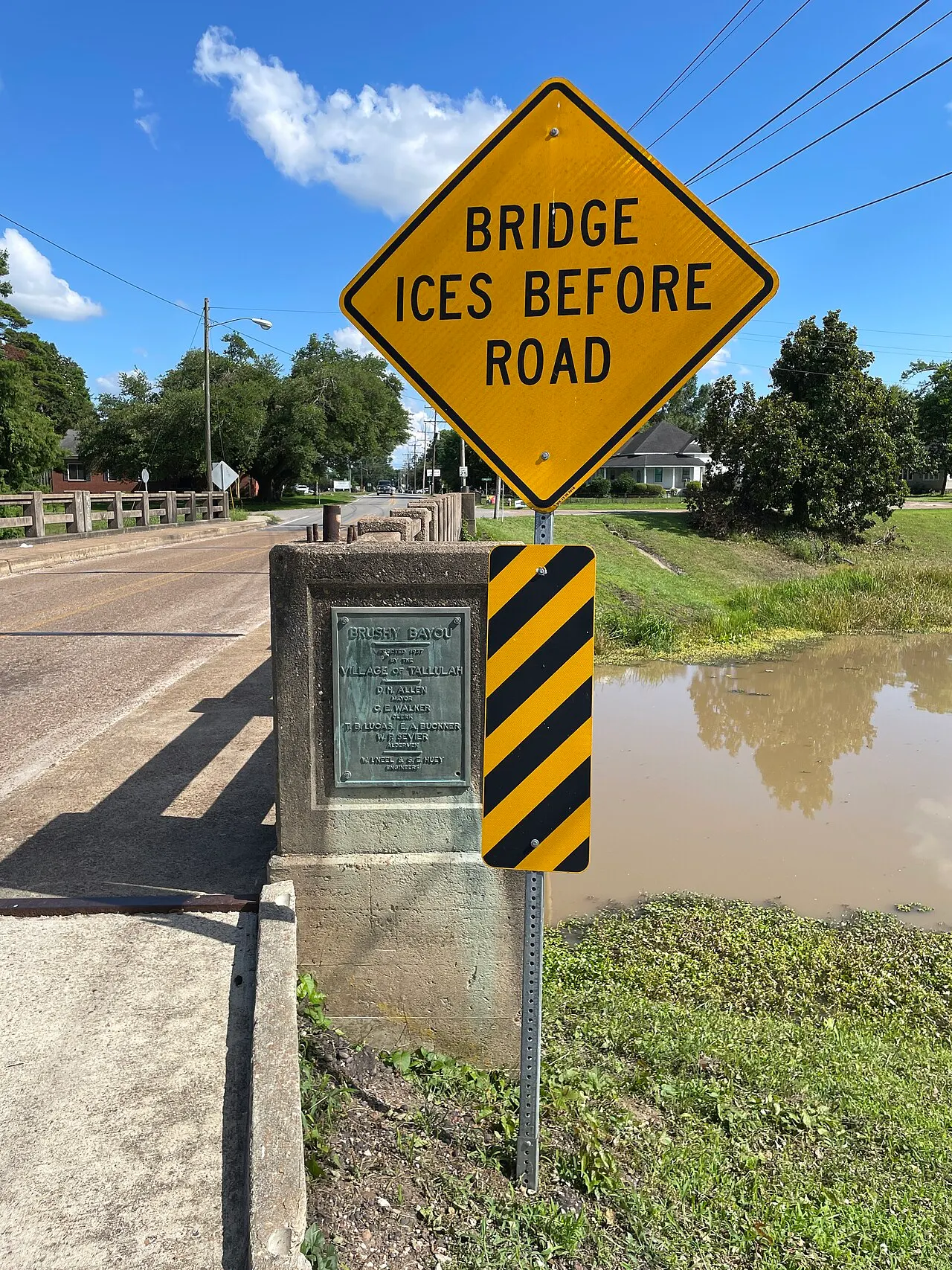
Section 2C.30 also lets Slippery When Wet carry a plaque reading ICE, WHEN WET, STEEL DECK, or EXCESS OIL. That plaque is not this legend, and the seasonal-cover sentence is written only for W8-13. The Tallulah photo also shows a striped object marker at the bridge. Object markers are separate devices under Sections 2C.70 through 2C.73, not part of the diamond.
What do you change before the deck?
- 1Slow on the approach
The sign is early so the speed change happens before the tires are on the span.
- 2Do not trust the dry road behind you
The legend itself says the deck ices first, so a dry approach tells you nothing about the span.
- 3Cross straight
A hard brake or a sharp steer on a thin film is the slide. Section 2C.30 prints no speed number.
| Legend | Section 2C.30 |
|---|---|
| BRIDGE ICES BEFORE ROAD | Optional, ahead of a bridge. May be covered out of season. |
| Slippery When Wet | Unexpected slipperiness. Not limited to bridges or to ice. |
| That sign plus an ICE plaque | Names ice. The cover-in-summer sentence is not written for the plaque. |
Camille, 34 degrees, Tallulah
- 1On January 19, 2026 at 6:50 a.m. Camille is at 55 mph. The air is 34 degrees Fahrenheit and the road she is on looks dry.
- 2The diamond is ahead of a short bridge, with a striped marker at the span, as in the photo. She keeps her speed and brakes only after the front tires are on the deck.
Outcome. She should have slowed before the abutment and then crossed straight. The sign had already said the deck can freeze while the road has not. No speed is printed on it.
Florida Section 316.185 says driving under the posted limit does not excuse the duty to slow further for weather or roadway conditions, as far as needed to avoid a collision. A violation is a noncriminal traffic infraction, punished as a moving violation. The section names no bridge, no sign, and no winter speed.
The sign exists because the deck can freeze before the road on either side does. Braking hard on the span is a late way to find out.
- "It counts only if you can see ice." The sign is for ice you cannot see from the approach.
- "Rain triggers it, same as Slippery When Wet." That is the other sign.
- "It sets a speed." Section 2C.30 has no number, and Section 316.185 adds none.
- "A sign still up in August must be a mistake." The manual allows covering it out of season but does not require it.
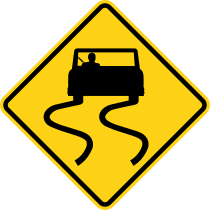
Slippery When Wet may add an ICE plaque. It is not limited to bridges.
What is the Bridge Ices Before Road sign often mistaken for?
Slippery When Wet (W8-5). This one is specifically about ice forming when the rest of the road is still clear.
| |
|---|---|
| GroupWarning signs | GroupWarning signs |
| ShapeDiamond | ShapeDiamond |
| ColorYellow background, black legend and border | ColorYellow background, black car-and-skid-marks symbol and border |
| What it meansThe bridge deck freezes earlier than the surrounding roadway because cold air passes underneath. | What it meansGrip falls away sharply on this stretch once it is wet, so brake, steer and accelerate one at a time and none of them hard. |
What does the permit test ask about the Bridge Ices Before Road sign?
This question is from the practice bank, with the answer marked.
Black ice is most likely to form:
- A.In the middle of a straight, open road
- B.On bridges, overpasses and shaded stretches(correct answer)
- C.Only where snow has been cleared
- D.On south-facing hills
Why: A bridge deck loses heat from above and below, so it freezes before the road either side of it. Shaded stretches stay frozen long after open road has thawed.
Source: FHWA road weather management guidance
Questions drivers ask about the Bridge Ices Before Road sign
The road looks dry. Do I still slow down?
Yes. The legend means the deck can be icy when the road you are on is not. Section 2C.30 puts the sign before the bridge so the slower speed happens on the approach. Florida Section 316.185 requires a further reduction for weather or road conditions even if you are already under the posted limit. Neither source prints a miles-per-hour figure for the deck.
Why is the sign gone in July and back in December?
Section 2C.30 says it may be removed or covered when the message is not relevant. A cover in midsummer is that option, not a broken post. An agency that leaves it up all year is also within the manual.
How far before the bridge should it stand?
Before the affected section, using Table 2C-3, with more signs at intervals if the condition continues. Section 2C.04 says the distances may be adjusted for the site. The manual assigns this legend to no single column and publishes no one distance for every bridge.
Is this the same as Slippery When Wet with an ICE plaque?
No. They are different signs in the same section. Slippery When Wet warns of unexpected slipperiness anywhere and can add a plaque such as ICE or STEEL DECK. This legend is only for bridges, and it is the one the manual lets agencies cover out of season. Florida Section 316.185, the general duty to slow for weather or road conditions, names neither sign.
Sources
- MUTCD 11th Edition, Chapter 2C, Table 2C-1
- MUTCD 11th Edition (December 2023), Chapter 2C, Sections 2C.04, 2C.30, and 2C.70 through 2C.73 and Table 2C-3
- Florida Statutes section 316.185 (2025), special hazards
What are the other warning signs?
All 55 warning signs on one page, or every US road sign by shape and color.
Test yourself on this sign and the rest of the set with a road signs practice test for Florida, Texas, California or New York.
The artwork is the federal design itself, which the manual dedicates to the public domain in MUTCD 11th Edition, Part 1, Section 1D.06, checked 2026-09-09. The Interstate Shield, the 511 pictograph and the National Scenic Byway graphic are named exceptions and are not reproduced anywhere on this site.
Source: Manual on Uniform Traffic Control Devices, 11th Edition. Not affiliated with or endorsed by the Federal Highway Administration or any state agency.