What does the Shoulder Drop-Off sign mean?
The Shoulder Drop-Off sign (MUTCD W8-17) is a warning sign under the federal Manual on Uniform Traffic Control Devices, the national standard the states build from. There is a significant vertical drop from the pavement edge to the shoulder.
Source: MUTCD 11th Edition, Chapter 2C, Table 2C-1, checked 2026-09-09.
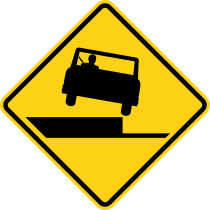
What shape and color is the Shoulder Drop-Off sign?
| MUTCD code | W8-17 |
|---|---|
| Group | Warning signs |
| Shape | Diamond |
| Color | Yellow background, black symbol and border |
What a diamond means. A warning. It tells you what the road does next and obliges you to do nothing in particular, which is the distinction test writers probe most often.
What yellow means. General warning of a permanent condition ahead.
Warning signs. A diamond reports a condition and orders nothing. What you do about it is left to you, and that gap between a report and an order is what test writers keep probing.
When is the symbol called for instead of a word sign?
Section 2C.29 of the MUTCD 11th Edition (December 2023) puts the Shoulder Drop Off sign (W8-17) under Guidance, a "should," where LOW SHOULDER is only a "may." It should be used where an unprotected shoulder drop-off next to the travel lane is more than 3 inches deep for a significant continuous length along the road. How long counts as significant is left to engineering judgment. The manual gives no minimum length in feet.
W8-17 is a symbol sign. The SHOULDER DROP-OFF word plaque (W8-17P) may be mounted under it and is optional. Table 2C-1 lists the diamond at 30 by 30 inches for a single-lane conventional road, 36 by 36 for a multi-lane conventional road or an expressway, and 48 by 48 on a freeway. Section 2C.03 makes 36 by 36 the minimum for a diamond facing traffic on a multi-lane conventional road where the posted speed limit is higher than 35 mph. Paragraph 07 says shoulder signs should be repeated at appropriate intervals where the condition continues. It gives no interval in feet.
| Sign | Condition beside the lane | Force of the rule | Legend |
|---|---|---|---|
| W8-9 Low Shoulder | Difference of 3 inches or less | Option (may) | Words |
| W8-17 Shoulder Drop Off | Unprotected drop over 3 inches, significant continuous length | Guidance (should) | Symbol, word plaque optional |
| W8-23 No Shoulder | No shoulder along a portion of the road | Option (may) | Words |
| W8-25 Shoulder Ends | Shoulder is ending | Option (may) | Words |
All four are in Section 2C.29, along with SOFT SHOULDER (W8-4). Only W8-17 is written as a "should," for a drop deeper than 3 inches.
What do you do if the right tire is already below the edge?
- 1Do not read it as a lane closure
Nothing in Section 2C.29 tells you to stop, turn around, or move into the opposing lane. The lane you are in is still yours.
- 2Keep a margin from the edge
Position the car so the right tires are not tracking right along the pavement edge. The hazard is the vertical face beside the lane, not a bump in the wheel path.
- 3If a tire drops, slow in a straight line
Hold the wheel steady, lift off the accelerator and brake gently. Do not try to climb straight back out at speed.
- 4Steer back only after slowing
Check behind you, then return to the lane with a controlled, modest steering input. The California Driver Handbook cautions that a hard pull on the wheel can put you in the path of oncoming traffic.
What does Texas allow on an improved shoulder?
Texas Transportation Code section 545.058(a) lets a driver use an improved shoulder to the right of the main traveled portion only when that is necessary and can be done safely, and only to stop, stand, or park; to accelerate before entering the main lane; to slow before a right turn; to pass a vehicle that is slowing, stopped, disabled, or about to turn left; to let a faster vehicle pass; as a traffic-control device permits or requires; or to avoid a collision. Section 545.057(b) bars passing on the right by leaving the main traveled portion except as 545.058 allows. Neither section mentions drop-offs. Whether a shoulder move "may be done safely" is the driver's call, and a signed drop deeper than 3 inches is strong evidence against it.
W8-17 is set out in Chapter 2C, among the ordinary warning signs in Part 2 of the manual. A yellow Shoulder Drop Off diamond can stand on an ordinary highway with no work going on.
How does the rule play out at 50 mph?
Elena, 50 mph, right tires near a 4 inch drop
- 1Elena is westbound on a two-lane Texas highway posted at 50 mph. For a long stretch the right pavement edge drops about 4 inches to the ground beside it, with nothing guarding it. That is more than 3 inches, so it is the W8-17 case. The 4 inches is this example's figure, not a measured site.
- 2A faster car closes from behind. Section 545.058 lists letting a faster vehicle pass as a reason to use an improved shoulder, but only if that is necessary and can be done safely. With a 4 inch drop at the pavement edge Elena decides it cannot, so she stays in her lane instead of drifting right to be polite.
- 3Her right tires are about 6 inches from the edge. She moves slightly left within her lane, still clear of the center line. No advisory speed plaque is posted, so the sign sets no lower number, and she stays at or under the 50 mph limit.
Outcome. She clears the stretch with both right tires on the pavement. If a tire had dropped, the next move would have been to slow in a straight line and then steer back with care, not a sharp turn of the wheel at 50 mph.
Which choices look familiar on a permit test?
- "The shoulder is soft" describes W8-4, which Section 2C.29 ties to no depth at all. W8-17 is about a vertical drop of more than 3 inches.
- "You must stop and back up" appears nowhere in Section 2C.29.
- "The plaque is required" is wrong. W8-17P may be added under the symbol. The symbol alone is the sign.
- "It is always 750 feet before the drop" invents a placement. Section 2C.29 asks for signs at appropriate intervals and gives no single distance.
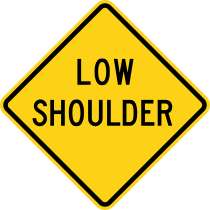
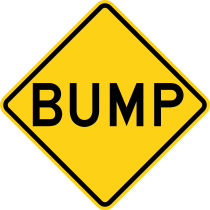
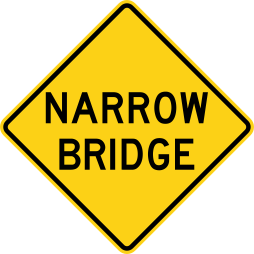
Low Shoulder is the word sign for a difference of 3 inches or less. Bump warns of a sharp rise in the road profile. Narrow Bridge is about the width of the structure, not the height of the edge.
What is the Shoulder Drop-Off sign often mistaken for?
Low Shoulder (W8-9). The recovery technique tested is the same: slow, do not jerk the wheel, re-enter gradually.
| |
|---|---|
| GroupWarning signs | GroupWarning signs |
| ShapeDiamond | ShapeDiamond |
| ColorYellow background, black symbol and border | ColorYellow background, black legend and border |
| What it meansThere is a significant vertical drop from the pavement edge to the shoulder. | What it meansThe shoulder is lower than the traveled lane; leaving the pavement could pull the vehicle off. |
What does the permit test ask about the Shoulder Drop-Off sign?
This question is from the practice bank, with the answer marked.
Your vehicle begins to leave the pavement onto a soft shoulder. You should:
- A.Brake hard and steer back immediately
- B.Ease off the accelerator, keep straight, then steer back gently at lower speed(correct answer)
- C.Accelerate to climb back onto the road
- D.Steer sharply left at once
Why: Jerking the wheel back at speed is what turns a drop onto the shoulder into a rollover or a head-on. Slow first, then rejoin gently.
Source: NHTSA run-off-road recovery guidance
Questions drivers ask about the Shoulder Drop-Off sign
Is 3 inches measured from the white line or from the dirt?
Section 2C.29 speaks of an unprotected shoulder drop-off adjacent to the travel lane that exceeds 3 inches in depth. It does not say to measure from the painted edge line, from the gravel, or from the ditch bottom. If the vertical face next to the lane you are driving in is deeper than 3 inches for a long stretch, the symbol is the sign the section says should be used.
Does the symbol set a lower speed?
No. W8-17 carries no number, and Section 2C.29 says nothing about speed. Section 2C.59 lets an agency add an Advisory Speed plaque (W13-1P) under an advance warning sign when a condition calls for one. If a plaque is there, that is the advisory figure. If not, the posted limit applies, and the right speed is one at which you can keep your tires off the edge.
Can I drive the shoulder in Texas if the symbol is up and I only want to let someone pass?
Section 545.058(a) lists letting a faster vehicle pass as one allowed reason to drive on an improved shoulder, but only when that is necessary and can be done safely. The statute does not mention drop-offs, so the safety call is yours, and a signed drop deeper than 3 inches weighs heavily against it. Section 545.057(b) separately bars passing on the right by leaving the main traveled portion unless 545.058 allows it.
What if the drop is deep but only a few feet long, at one driveway?
The "should" in Section 2C.29 is for a drop deeper than 3 inches over a significant continuous length, judged by the engineer. A short lip at one driveway is not what that sentence describes, and the manual gives no length in feet that triggers the sign. A short lip can still catch a tire, so whether a sign is posted and how you drive are separate questions.
Sources
- MUTCD 11th Edition, Chapter 2C, Table 2C-1
- MUTCD 11th Edition (December 2023), Chapter 2C, Sections 2C.03, 2C.26, 2C.29 and 2C.59, Table 2C-1
- Texas Transportation Code sections 545.057 and 545.058
- California Driver Handbook, Section 8: Safe Driving (continued), Driving Off the Pavement
What are the other warning signs?
All 55 warning signs on one page, or every US road sign by shape and color.
Test yourself on this sign and the rest of the set with a road signs practice test for Florida, Texas, California or New York.
The artwork is the federal design itself, which the manual dedicates to the public domain in MUTCD 11th Edition, Part 1, Section 1D.06, checked 2026-09-09. The Interstate Shield, the 511 pictograph and the National Scenic Byway graphic are named exceptions and are not reproduced anywhere on this site.
Source: Manual on Uniform Traffic Control Devices, 11th Edition. Not affiliated with or endorsed by the Federal Highway Administration or any state agency.