What does the Pedestrian sign mean?
The Pedestrian sign (MUTCD W11-2) is a warning sign under the federal Manual on Uniform Traffic Control Devices, the national standard the states build from. Expect pedestrians in the roadway at or close to this point, with no signal anywhere to hold you for them.
Source: MUTCD 11th Edition, Chapter 2C, Table 2C-1, checked 2026-09-09.
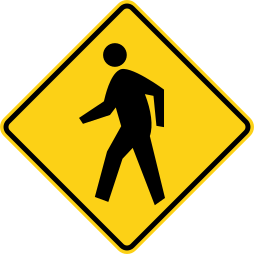
What shape and color is the Pedestrian sign?
| MUTCD code | W11-2 |
|---|---|
| Group | Warning signs |
| Shape | Diamond |
| Color | Yellow or fluorescent yellow-green background, black symbol and border |
What a diamond means. A warning. It tells you what the road does next and obliges you to do nothing in particular, which is the distinction test writers probe most often.
What fluorescent yellow-green means. Pedestrian, bicycle and school warnings. Reserved so those warnings cannot be mistaken for an ordinary hazard.
Warning signs. A diamond reports a condition and orders nothing. What you do about it is left to you, and that gap between a report and an order is what test writers keep probing.
How far before the people is the first diamond?
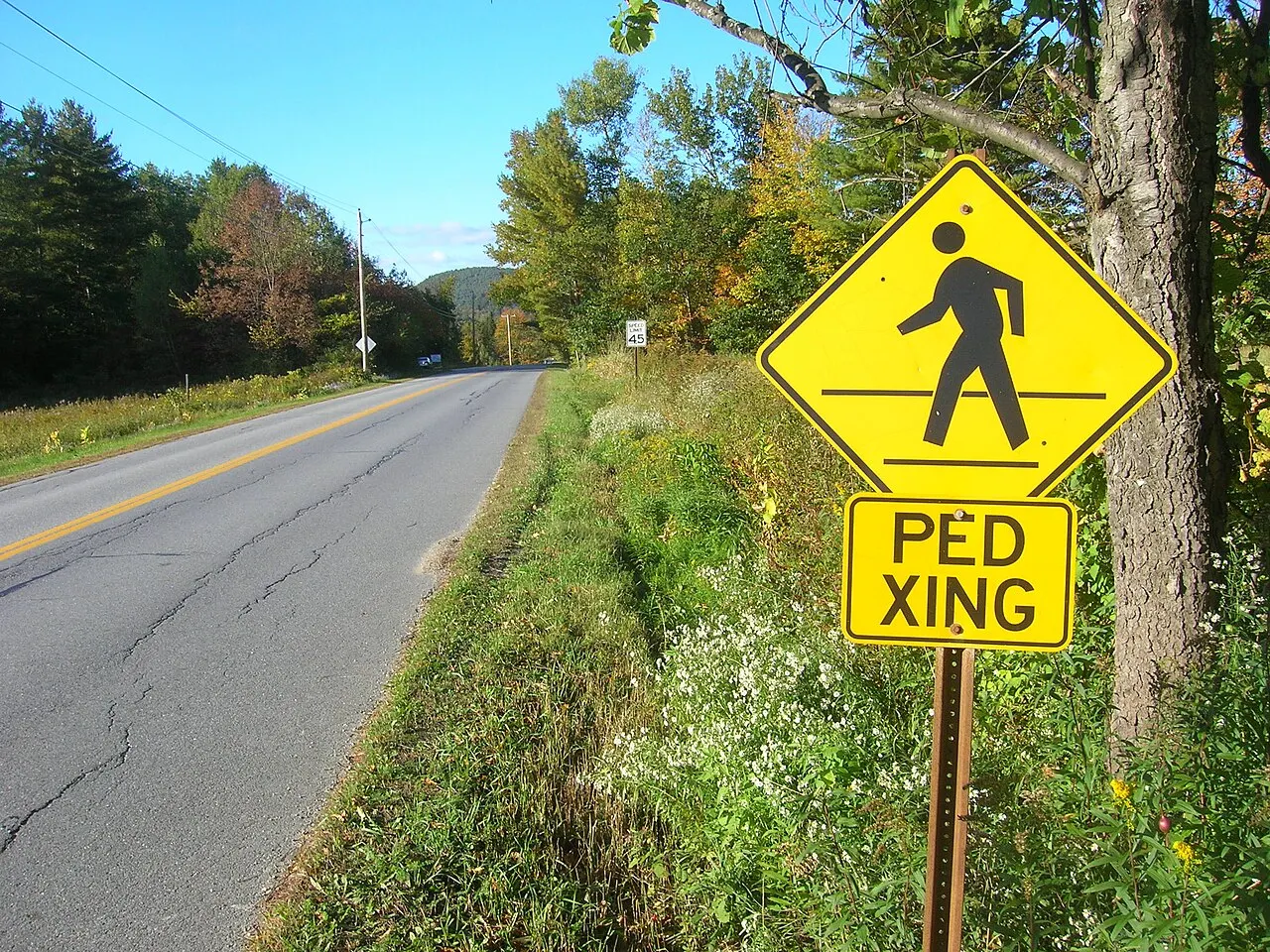
Section 2C.55 allows W11-2 where people may enter the road unexpectedly or share it, at one crossing or along a stretch. Paragraph 03 says that, used in advance of a crossing, it should carry AHEAD or a distance in feet. The Huntington photograph shows a PED XING plaque, which is neither of those legends.
Section 2C.04 points agencies to Table 2C-3, applied with engineering judgment. The table has no pedestrian row. The column below is its potential-stop column, and the table names Stop Ahead, Yield Ahead, Signal Ahead, and Intersection Warning signs as its typical uses. Which column fits a given crossing is the agency's call.
What is different when the arrow is pointing at the pavement?
- 1AHEAD, or a number of feet
You are not at the crossing. If the agency used the potential-stop column, 250 feet at 35 mph is just under 5 seconds. Cover the brake and look at both curbs.
- 2Diagonal arrow on a post at the crossing
Section 2C.55 paragraph 04 requires the W16-7P arrow under a post-mounted W11-2 at the crossing. Overhead, the arrow shall not be used. Look in the crosswalk now.
- 3No signal, and no sign that orders a stop
Florida Statutes 316.130(7)(c) says yield, by slowing or stopping, when the person is on your half or closing from the other half. California Vehicle Code 21950(a) says yield in any marked crosswalk, or an unmarked one at an intersection, and subsection (c) says reduce speed or take any other action needed.
- 4A regulatory sign orders the stop or the yield
That duty is not from this diamond. Section 2B.19 says a post-mounted W11-2 at the crosswalk shall not share a post with a Yield Here to Pedestrians sign.
- 5A vehicle ahead has already stopped
Florida Statutes 316.130(9) says you shall not pass a vehicle stopped at a marked crosswalk, or at an unmarked crosswalk at an intersection, to let a person cross.
A person in the crosswalk on your half of the road
The driver approaching that crosswalk yields.
With no signal running, Florida 316.130(7)(c) and California 21950 require the driver to yield to the person in the crosswalk.
What does Andre Wallace do when a woman steps out 200 feet ahead?
35 mph, no signal, marked crosswalk
- 1At 8:05 a.m. on April 9, 2026, Andre Wallace is southbound in Florida at 35 mph on a street posted 35. An advance W11-2 with AHEAD stands about 250 feet before a marked crosswalk, the Table 2C-3 potential-stop distance for 35 mph.
- 2He eases to 25 mph and covers the brake. At the crossing, the second diamond has the diagonal arrow. A woman steps from his curb into the crosswalk, on his half of the road, when he is about 200 feet away. No signal is running, and no regulatory sign orders a stop.
- 3At 25 mph, 200 feet is about 5.5 seconds, so he can stop short of the crosswalk, and he does. Section 316.130(7)(c) calls for that: slow down or stop if need be to yield. The driver behind may not pass him (316.130(9)). Once she is past his half and walking away from it, he goes. Had she still been on the sidewalk, not yet crossing, there would have been no one to yield to.
Outcome. The diamond told him where to look. Florida 316.130(7)(b), stop and remain stopped, applies only where signage indicates that stronger duty. This diamond does not.
Why do the tempting answers fail?
- "Always stop, even if the crosswalk is empty." Neither 2C.55 nor 316.130(7)(c) nor California 21950 requires a stop when nobody is crossing or close.
- "Wait until they reach the center of your lane." Florida already requires the yield when a person on the far half is close enough to be in danger.
- "They jumped out, so I had no duty." Florida 316.130(8) and California 21950(b) forbid leaving the curb into the path of a vehicle that is too close. Florida 316.130(15) and 21950(d) still require the driver to use due care. Speeding up to clear the crosswalk is the wrong answer.
- "This diamond bans the crossing." The ban is the red circle and slash. This diamond warns that people may be in the road.
Florida 316.130(7)(b), stop and remain stopped, applies at a crosswalk "where signage so indicates." W11-2 does not say that. A regulatory sign can: Section 2B.19 allows a Stop Here for Pedestrians sign only where the law requires a stop. With no signal and no such sign, the duty is to yield.
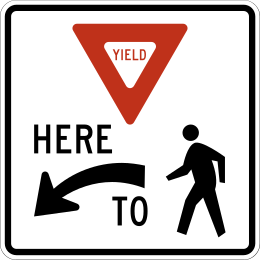
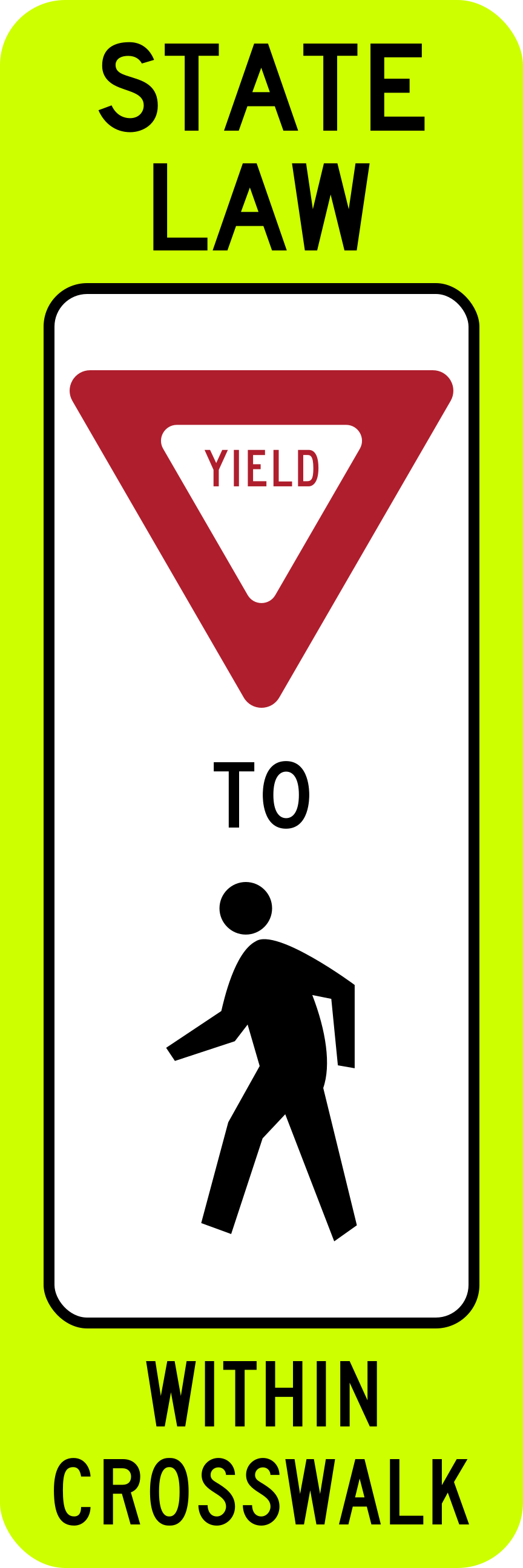
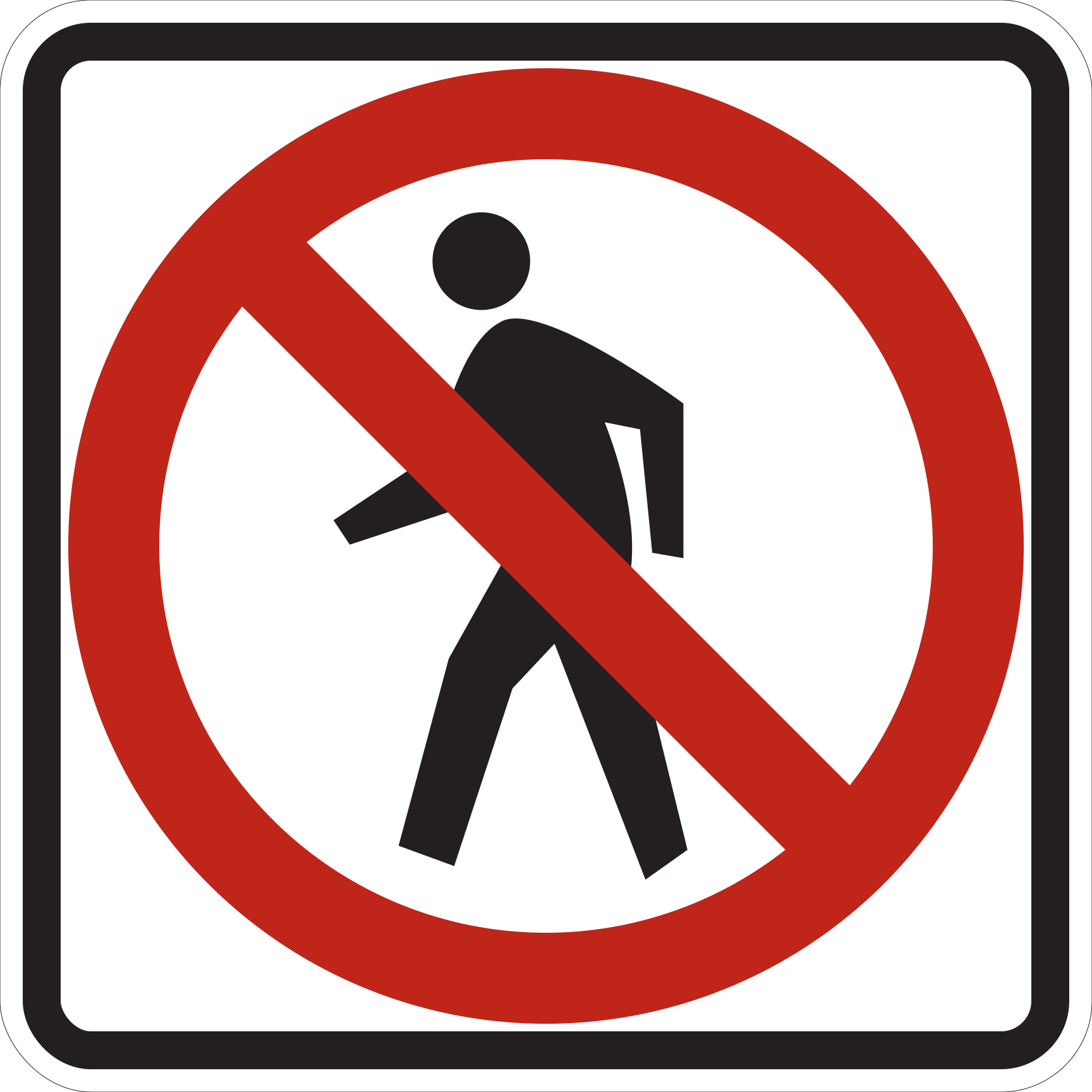
The first two are regulatory reminders for the crosswalk. The red circle and slash prohibits people from crossing there. None of the three is a substitute for the yellow warning diamond.
What is the Pedestrian sign often mistaken for?
The School sign (S1-1), which is a five-sided pentagon and always fluorescent yellow-green. W11-2 is a diamond and may be either color. Also No Pedestrian Crossing (R9-3), which has the same figure inside a red circle and slash.
|  | |
|---|---|---|
| GroupWarning signs | GroupSchool zone signs | GroupRegulatory signs |
| ShapeDiamond | ShapePentagon with the point up | ShapeSquare (symbol) or vertical rectangle (word message) |
| ColorYellow or fluorescent yellow-green background, black symbol and border | ColorFluorescent yellow-green background, black legend and border | ColorWhite background, red circle and slash over a black walking pedestrian |
| What it meansExpect pedestrians in the roadway at or close to this point, with no signal anywhere to hold you for them. | What it meansWarns that a school, school zone or school crossing is at or near this point. | What it meansCrossing on foot is prohibited here, so anyone walking has to carry on to the next legal crossing point. |
Which signs get mistaken for the Pedestrian sign?
- In-Street Pedestrian CrossingR1-6
The pedestrian warning sign (W11-2), which is a yellow or fluorescent yellow-green diamond and carries no legal duty of its own. R1-6 does.
What does the permit test ask about the Pedestrian sign?
This question is from the practice bank, with the answer marked.
A fluorescent yellow-green sign is used for:
- A.Roadwork
- B.Pedestrian, bicycle and school warnings(correct answer)
- C.Exit numbers
- D.Toll booths
Why: That distinctive yellow-green was introduced specifically for vulnerable road user warnings, so it stands apart from ordinary yellow warnings.
Source: Federal MUTCD, 11th Edition (FHWA)
Questions drivers ask about the Pedestrian sign
Does the yellow diamond mean I must stop even when nobody is there?
No. Section 2C.55 makes it a warning of people who may enter or share the road. Florida Statutes 316.130(7)(c) requires a yield, by slowing or stopping, when a person is on your half of an unsignalized crosswalk or is closing from the other half. California Vehicle Code 21950 requires a yield to a person who is crossing in a marked crosswalk, or in an unmarked crosswalk at an intersection. An empty crossing is not that moment.
The plaque says PED XING. Is the crossing at that post?
Not necessarily. The photograph from Huntington shows that plaque. Section 2C.55 says an advance pedestrian sign should carry AHEAD or a distance in feet, and a post-mounted sign placed at the crossing itself shall carry the diagonal downward arrow. Read the plaque. A distance or the word AHEAD means the crosswalk is still ahead of you. The arrow means you are at it.
Can I continue once the person has passed the middle of my lane?
Not automatically. Florida 316.130(7)(c) keeps the yield in place while the person is on your half, and also while they are approaching so closely from the opposite half as to be in danger. Clearing the center of your lane is not the test the statute uses. Wait until they are no longer on your half and no longer closing on it. Then go.
There is no diamond, but there is an unmarked crosswalk at an intersection. Do I still yield?
Yes, if the person is crossing there. California Vehicle Code 21950(a) covers an unmarked crosswalk at an intersection, not only a painted one, and it does not require this warning sign to be present. Florida 316.130(7)(c) likewise applies when signals are not in place or not operating. The diamond tells you to expect people. It is not what creates the crosswalk.
Sources
- MUTCD 11th Edition, Chapter 2C, Table 2C-1
- MUTCD 11th Edition (December 2023), Section 2C.04 and Table 2C-3, advance placement of warning signs
- MUTCD 11th Edition, Section 2C.55, Non-Vehicular Warning signs including W11-2
- MUTCD 11th Edition, Section 2B.19, Yield Here to and Stop Here for Pedestrians signs and the W11-2 post
- Florida Statutes 316.130, pedestrians (2026)
- California Vehicle Code 21950, pedestrian right-of-way at crosswalks
What are the other warning signs?
All 55 warning signs on one page, or every US road sign by shape and color.
Test yourself on this sign and the rest of the set with a road signs practice test for Florida, Texas, California or New York.
The artwork is the federal design itself, which the manual dedicates to the public domain in MUTCD 11th Edition, Part 1, Section 1D.06, checked 2026-09-09. The Interstate Shield, the 511 pictograph and the National Scenic Byway graphic are named exceptions and are not reproduced anywhere on this site.
Source: Manual on Uniform Traffic Control Devices, 11th Edition. Not affiliated with or endorsed by the Federal Highway Administration or any state agency.