What does the Deer Crossing sign mean?
The Deer Crossing sign (MUTCD W11-3) is a warning sign under the federal Manual on Uniform Traffic Control Devices, the national standard the states build from. A known route for deer and other large game across the pavement, busiest at first light and again at dusk. One animal in the road is usually followed by a second.
Source: MUTCD 11th Edition, Chapter 2C, Table 2C-1, checked 2026-09-09.
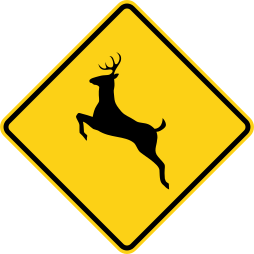
What shape and color is the Deer Crossing sign?
| MUTCD code | W11-3 |
|---|---|
| Group | Warning signs |
| Shape | Diamond |
| Color | Yellow background, black animal symbol and border |
What a diamond means. A warning. It tells you what the road does next and obliges you to do nothing in particular, which is the distinction test writers probe most often.
What yellow means. General warning of a permanent condition ahead.
Warning signs. A diamond reports a condition and orders nothing. What you do about it is left to you, and that gap between a report and an order is what test writers keep probing.
Why is there no distance and no arrow on this diamond?
W11-3 is a non-vehicular warning in Section 2C.55, for animals that may enter unexpectedly or share the road, at one spot or along a segment. The note under Table 2C-3 names Deer Crossing, with SOFT SHOULDER, as examples of warnings not tied to one location, which an agency places by engineering judgment. The table has no "deer at 45 mph" distance.
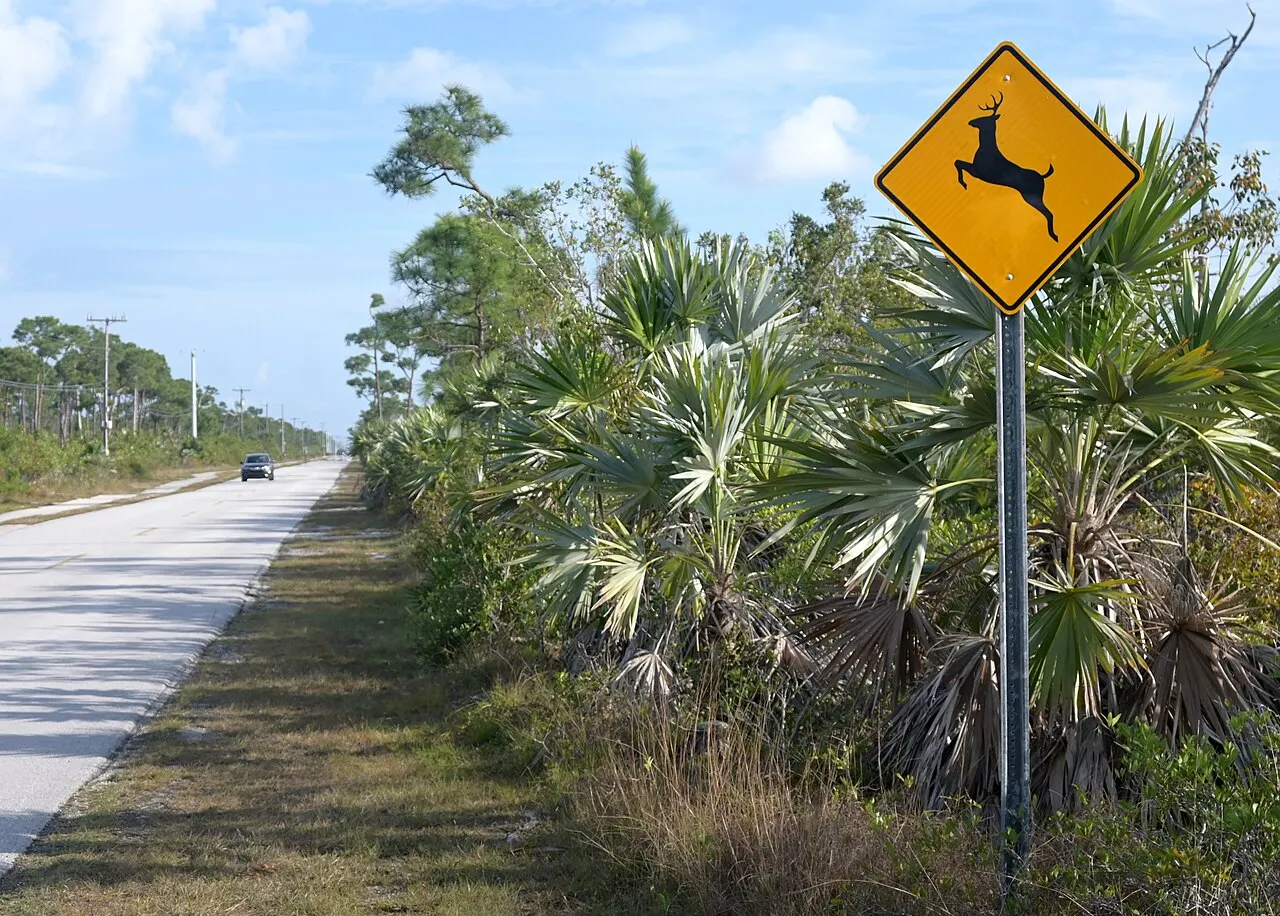
The AHEAD or distance plaque that paragraph 03 recommends is written for pedestrian, snowmobile, and equestrian crossings. The diagonal-arrow rule in paragraph 04 names W11-2, W11-6, W11-7, and W11-9. Neither names W11-3, and paragraph 12 names only W11-2 and W11-9 for fluorescent yellow-green. The Big Pine Key photograph is the ordinary yellow diamond. An agency may still add a plaque such as NEXT XX MILES under any warning sign (Sections 2C.57 and 2C.61), which tells you how long the stretch runs.
What do you actually do in the next few seconds?
- 1Ease off before you see an animal
The sign is not a report that a deer is in the lane now. It marks a stretch where animals may enter the road. Trees at the edge can hide them until you are close.
- 2Scan the shoulders
An animal at the edge is already a reason to slow. Florida Statutes 316.185 says being under the posted limit does not relieve you of the duty to slow when special hazards exist or may exist.
- 3Brake in your lane
No rule cited here tells you to leave the lane, and a swerve into the oncoming lane can trade a deer strike for a head-on crash.
- 4Look again after the first animal clears
Check the shoulder it came from before you go back to the limit. The sign marks a route, not one animal.
What does Camille Ortiz do at dusk on a 45 mph road?
Posted 45, a deer on the shoulder at 300 feet
- 1At 7:40 p.m. on September 18, 2026, Camille Ortiz is westbound on a two-lane county road in Florida posted 45 mph, driving at 45. A yellow deer diamond is on the right, the kind in the photograph: leaping deer, no arrow, no plaque.
- 2A deer stands on the right shoulder about 300 feet ahead, facing the pavement. At 45 mph that is about 4.5 seconds. Table 2C-3's potential-stop distance at 45 mph is 360 feet, but the note under the table leaves a deer sign's position to engineering judgment, so the sign told her nothing about distance.
- 3She brakes in her lane and is down to about 20 mph as she reaches it. The deer bolts across. A second deer is still on the shoulder. She stays slow until both are off the pavement and the shoulder.
Outcome. No advisory speed was printed on the sign, so she did not invent one, and she did not swing into the eastbound lane. The duty to slow came from 316.185, not from the diamond.
Which animal statutes do not belong to this sign?
Florida Statutes 316.0825 requires reasonable care when you approach or pass a person riding or leading an animal on the road or shoulder, and bans intentionally startling or injuring that animal. It is not about a wild deer, and it sets no passing gap and no night speed. California Vehicle Code 22350 forbids a speed faster than is reasonable or prudent for the weather, visibility, traffic, and the road, and any speed that endangers people or property. It does not mention deer and attaches no number to this diamond. No section opened here publishes a deer-sign speed, a fine unique to the sign, or hours when it switches on.
- "Slow to 25" or "drop 10 mph at dusk" invents a number. Section 2C.55, 316.185, and 22350 print none.
- "Deer have the right-of-way" is not in any statute cited here. The duty those statutes do state is about your speed: 316.185 for special hazards, and 22350 for a speed that does not endanger people or property.
- The 3-foot bicycle gap and 316.0825 are the wrong rules. 316.0825 is about a person riding or leading an animal.
What is the Deer Crossing sign often mistaken for?
The other large-animal signs in the same family, W11-4, W11-16 through W11-22, which use cattle, moose, elk, sheep and other silhouettes. The tested action is identical for all of them.
What does the permit test ask about the Deer Crossing sign?
This question is from the practice bank, with the answer marked.
This sign means:
- A.A wildlife refuge is nearby
- B.Animals cross here and you should expect more than one(correct answer)
- C.Hunting is permitted alongside the road
- D.Livestock are fenced off the roadway
Source: MUTCD W11-3
Questions drivers ask about the Deer Crossing sign
Is there a night speed limit that comes with the deer sign?
Not from the sign. Section 2C.55 and the note under Table 2C-3 give W11-3 no speed and no time of day. Florida Statutes 316.185 says being under the posted limit does not relieve you of the duty to slow when special hazards exist with respect to other traffic or roadway conditions. It does not name animals. California Vehicle Code 22350 requires a speed that is reasonable or prudent and that does not endanger people or property. Neither statute prints a deer-zone number.
The deer is on the shoulder, not in the lane. Do I still slow?
Yes, if it may step out. Florida 316.185 applies when special hazards exist or may exist, and California 22350 bars any speed that endangers people or property. A deer facing the pavement 300 feet ahead can be in your lane inside the 4.5 seconds you have at 45 mph. Waiting for it to reach the white line leaves no time to slow.
Why does this sign not show a distance or a downward arrow?
The arrow requirement and the AHEAD or distance plaque in Section 2C.55 are written for pedestrian, snowmobile, and equestrian crossings, not for W11-3. Table 2C-3's note uses Deer Crossing as an example of a warning that is not tied to one point, so the agency places it by engineering judgment. An agency may add a NEXT XX MILES plaque under any warning sign (Section 2C.61) to show how long the stretch runs.
Does Florida's law about passing an animal set a gap for deer?
No. Section 316.0825 applies when a person is riding or leading an animal on the roadway or the shoulder. You use reasonable care and you do not intentionally startle or injure that animal. A wild deer has no rider and no lead. The closer fit is 316.185, the general duty to slow for special hazards, which sets no passing gap.
Sources
- MUTCD 11th Edition, Chapter 2C, Table 2C-1
- MUTCD 11th Edition (December 2023), Section 2C.55, Non-Vehicular Warning signs including W11-3
- MUTCD 11th Edition, Section 2C.04 and Table 2C-3, including the note on Deer Crossing placement
- MUTCD 11th Edition, Sections 2C.57 and 2C.61, supplemental and distance plaques
- Florida Statutes 316.185, special hazards (2026)
- Florida Statutes 316.0825, vehicle approaching an animal (2026)
- California Vehicle Code 22350, basic speed law
What are the other warning signs?
All 55 warning signs on one page, or every US road sign by shape and color.
Test yourself on this sign and the rest of the set with a road signs practice test for Florida, Texas, California or New York.
The artwork is the federal design itself, which the manual dedicates to the public domain in MUTCD 11th Edition, Part 1, Section 1D.06, checked 2026-09-09. The Interstate Shield, the 511 pictograph and the National Scenic Byway graphic are named exceptions and are not reproduced anywhere on this site.
Source: Manual on Uniform Traffic Control Devices, 11th Edition. Not affiliated with or endorsed by the Federal Highway Administration or any state agency.