What does the Emergency Vehicle sign mean?
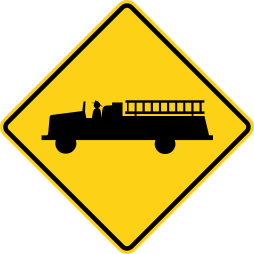
The Emergency Vehicle sign (MUTCD W11-8) is a warning sign under the federal Manual on Uniform Traffic Control Devices, the national standard the states build from. Fire, ambulance or other emergency vehicles enter the roadway at this point.
Source: MUTCD 11th Edition, Chapter 2C, Table 2C-1, checked 2026-09-09.
What shape and color is the Emergency Vehicle sign?
| MUTCD code | W11-8 |
|---|---|
| Group | Warning signs |
| Shape | Diamond |
| Color | Yellow background, black symbol and border |
What a diamond means. A warning. It tells you what the road does next and obliges you to do nothing in particular, which is the distinction test writers probe most often.
What yellow means. General warning of a permanent condition ahead.
Warning signs. A diamond reports a condition and orders nothing. What you do about it is left to you, and that gap between a report and an order is what test writers keep probing.
Where is this diamond required, and when does a second plaque have to go with it?
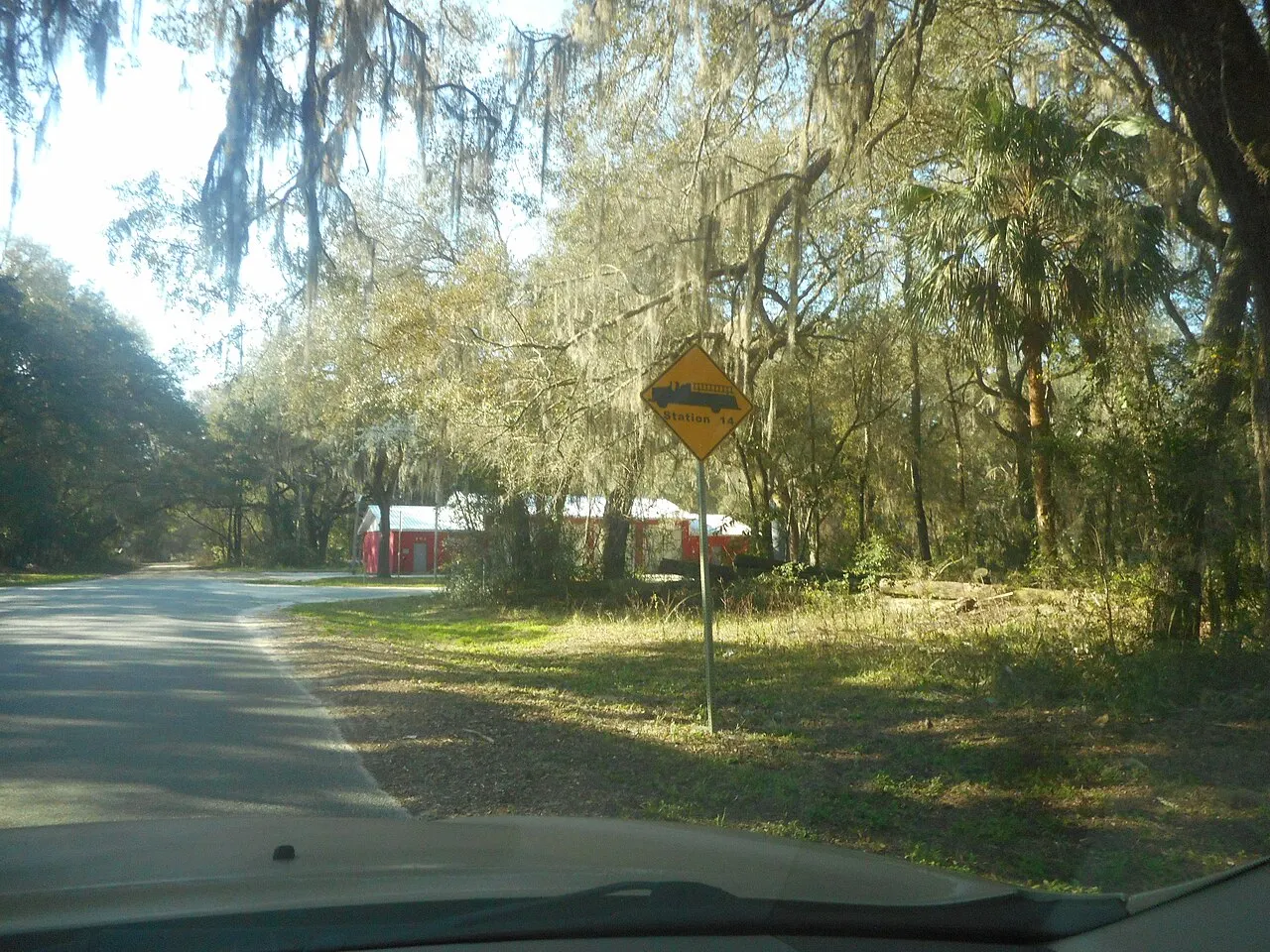
W11-8 is a vehicular warning in Section 2C.54. Paragraph 03 says use it only where sight distance is restricted or the entering traffic would be unexpected. A station drive hidden by trees is that case. The Florahome photograph adds the words Station 14. Paragraph 15 allows the diamond, or a word message for the type of vehicle, with "rescue squad" as the example, in advance of a station that has no emergency-vehicle signal. A station number is a local label. It is not a different rule.
Paragraph 14 is a standard: W11-8 with the EMERGENCY SIGNAL AHEAD plaque (W11-12P) shall stand in advance of every emergency-vehicle traffic control signal. Without that plaque, the diamond is the station warning paragraph 15 allows where no such signal exists. If the activity is seasonal or temporary, paragraph 04 says remove or cover the sign. Paragraphs 16 and 17 allow a warning beacon with a WHEN FLASHING plaque to mark the periods when the activity is present or likely.
Table 2C-1 lists W11-8 at 30 by 30 inches for a single-lane conventional road and 36 by 36 for a multi-lane one. Section 2C.03 paragraph 03 makes 36 by 36 the minimum for a diamond facing traffic on a multi-lane conventional road posted above 35 mph. A smaller sign does not change the duty.
What do you do when the bay doors are shut?
- 1Find the driveway
With no signal plaque, the hazard is a vehicle entering from the station. Watch the apron. Keep your lane.
- 2A truck with no lights and no siren
The diamond does not give it priority. Florida 316.125(1) has a driver leaving a driveway yield to vehicles on the highway close enough to be an immediate hazard. In a business or residence district, 316.125(2) adds a stop before the sidewalk and a yield to pedestrians.
- 3Lights or a siren
That duty is no longer the sign's. Florida and California do not use the same trigger. Do not pull over for a light bar you have not seen.
- 4A parked emergency vehicle is a third case
Florida 316.126(1)(b) applies when an authorized emergency vehicle displaying any visual signals is parked on the roadside, not when the shoulder is empty. On a two-lane road, slow to 20 mph under the posted limit if the limit is 25 or greater, or travel at 5 mph if the limit is 20 or less.
A station driveway with no lights and no siren
The driver leaving the station driveway yields.
The warning diamond does not change ordinary right-of-way. Florida 316.125 has the vehicle leaving the driveway yield to traffic on the highway close enough to be an immediate hazard.
What does Nate Brennan do past Station 14?
Posted 45, no lights, trees at the driveway
- 1At 1:10 p.m. on June 18, 2026, Nate Brennan is at 40 mph on a two-lane Florida road posted 45, with trees close along both sides as in the Florahome photograph. The diamond shows a fire truck and Station 14. No EMERGENCY SIGNAL AHEAD plaque, no beacon, no siren.
- 2The station driveway is on his right, partly behind trees, the restricted sight distance Section 2C.54 paragraph 03 describes. He eases off and watches it. A fire engine sits in the bay, lights off. He does not pull over, because nothing in 316.126(1)(a) has started.
- 3Half a mile later an ambulance comes up behind him with red lights and a siren. Section 316.126(1)(a) now applies. He pulls as close as reasonable to the right edge, clear of the next intersection, and stops until it passes.
Outcome. The diamond made him look at the driveway early. The lights and the siren, not the sign, started the pull-over.
When do Florida and California actually make you pull over?
| Florida 316.126(1)(a) | California 21806 | |
|---|---|---|
| What starts the duty | A siren or other adequate audible device, or blue or red lights. Either one. | A siren and a red lamp visible from 1,000 feet to the front. Both. |
| What you do | Pull as close as reasonable to the curb edge, clear of any intersection, and stop until it passes. | Drive to the right-hand edge or curb, clear of any intersection, and stop until it passes. |
| What the diamond adds | Nothing in this subsection. | Nothing in this section. A diamond is not a siren or a red lamp. |
California 21806 also says a driver in an exclusive or preferential lane shall leave it once the exit can be made with reasonable safety. Florida 316.126(1)(a) has no separate lane rule. An officer's direction overrides either statute.
A station number does not mean a truck is leaving and does not mean you move over. Wait for the lights or the siren the statute names. Where a WHEN FLASHING beacon is used, it marks the periods when station traffic is present or likely.
What is the Emergency Vehicle sign often mistaken for?
The Emergency Signal Ahead plaque (W11-12P), which warns of a signal that turns red for emergency vehicles rather than an entrance.
What does the permit test ask about the Emergency Vehicle sign?
This question is from the practice bank, with the answer marked.
An emergency vehicle approaches with lights and siren. You should:
- A.Speed up to clear the intersection
- B.Pull over to the right and stop until it passes(correct answer)
- C.Stop immediately wherever you are
- D.Move to the left lane
Why: Work your way over to the right-hand curb or shoulder, then hold still until it has gone by. Freezing in a live lane, or halfway through an intersection, leaves the crew nowhere to get around you.
Source: Uniform Vehicle Code, operation on approach of emergency vehicles
Questions drivers ask about the Emergency Vehicle sign
Do I pull over as soon as I see the emergency vehicle diamond?
No. Section 2C.54 uses W11-8 to warn that emergency vehicles may enter, or, with the EMERGENCY SIGNAL AHEAD plaque, that a signal for them is ahead. Florida Statutes 316.126(1)(a) starts when an authorized emergency vehicle is on immediate approach and is using a siren or showing blue or red lights. California Vehicle Code 21806 starts when it is sounding a siren and showing a red lamp visible from 1,000 feet. The diamond meets neither test.
The sign says Station 14. Does a named station change what I do?
No. The Florahome photograph shows those words with a fire truck symbol. Section 2C.54, paragraph 15, allows the diamond, or a word message for the type of vehicle such as rescue squad, in advance of a station that has no emergency-vehicle signal. A station number identifies which building. It does not set a speed, and it does not order you to the shoulder. Watch that driveway, and keep going if nothing is entering.
I hear a siren but I do not see lights. In Florida, do I yield?
Yes. Section 316.126(1)(a) is written with "or": an audible signal by siren, exhaust whistle, or other adequate device, or visible blue or red lights. Either one, on an authorized emergency vehicle en route to an emergency, starts the duty to pull to the curb edge, clear of an intersection, and stop until it passes. California 21806 is stricter. It requires the siren and a red lamp visible from 1,000 feet, both of them, before that state's pull-over duty begins.
There is a plaque that says EMERGENCY SIGNAL AHEAD. What is different?
Section 2C.54, paragraph 14, requires that plaque with the W11-8 in advance of every emergency-vehicle traffic control signal, so one of those signals is ahead. Without the plaque, the diamond is the station warning in paragraph 15. Either way, you do not pull over until the vehicle itself meets the state's lights-or-siren test.
Sources
- MUTCD 11th Edition, Chapter 2C, Table 2C-1
- MUTCD 11th Edition (December 2023), Section 2C.54, Vehicular Traffic Warning signs including W11-8 and the W11-12P plaque
- MUTCD 11th Edition, Table 2C-1 and Section 2C.03, warning sign sizes and the multi-lane minimum
- Florida Statutes 316.126, approach of an authorized emergency vehicle (2026)
- Florida Statutes 316.125, vehicle entering a highway from a driveway (2026)
- California Vehicle Code 21806, approach of an authorized emergency vehicle
What are the other warning signs?
All 55 warning signs on one page, or every US road sign by shape and color.
Test yourself on this sign and the rest of the set with a road signs practice test for Florida, Texas, California or New York.
The artwork is the federal design itself, which the manual dedicates to the public domain in MUTCD 11th Edition, Part 1, Section 1D.06, checked 2026-09-09. The Interstate Shield, the 511 pictograph and the National Scenic Byway graphic are named exceptions and are not reproduced anywhere on this site.
Source: Manual on Uniform Traffic Control Devices, 11th Edition. Not affiliated with or endorsed by the Federal Highway Administration or any state agency.