What does the Hill sign mean?
The Hill sign (MUTCD W7-1) is a warning sign under the federal Manual on Uniform Traffic Control Devices, the national standard the states build from. The grade falls away steeply enough to build speed on its own. Choose the lower gear at the top, because brakes held on all the way down will fade.
Source: MUTCD 11th Edition, Chapter 2C, Table 2C-1, checked 2026-09-09.
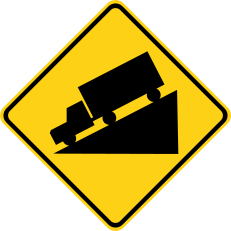
What shape and color is the Hill sign?
| MUTCD code | W7-1 |
|---|---|
| Group | Warning signs |
| Shape | Diamond |
| Color | Yellow background, black symbol and border |
What a diamond means. A warning. It tells you what the road does next and obliges you to do nothing in particular, which is the distinction test writers probe most often.
What yellow means. General warning of a permanent condition ahead.
Warning signs. A diamond reports a condition and orders nothing. What you do about it is left to you, and that gap between a report and an order is what test writers keep probing.
Which downgrades are supposed to get this sign?
Section 2C.14 says the Hill sign should be used ahead of a downgrade where the length, the percent of grade, the horizontal curvature, or other physical features require special precautions. The Hill sign with a grade plaque, or the W7-1a sign used alone, should go up for five listed cases. Paragraph 03 adds that the signs should also be used for steeper grades, and where crash experience and field observations show a need.
On a longer grade, paragraph 04 and Section 2C.64 say agencies should consider a distance plaque, or a combined distance and grade plaque, at intervals of about 1 mile. An optional plaque may read USE LOW GEAR or TRUCKS USE LOWER GEAR, which paragraph 05 ties to a grade where downshifting as well as braking might be advisable. Those words are not on the plain Hill sign.
What do you do at the top?
- 1Choose the gear while you are still on the flat or the crest
Where a gear plaque is posted, the manual is marking a descent where downshifting as well as braking might be advisable. Pick the gear before the grade is pulling the vehicle, not after speed has built.
- 2Do not read the percent as a speed
A 6% plaque is a slope: 6 feet of drop for every 100 feet of horizontal distance. Section 2C.14 does not convert that percent into an mph figure. Only an advisory speed plaque would add a speed, and only after a study.
- 3Keep room around heavy vehicles
A loaded truck can gain speed on a long descent. Following closely on the way down leaves no gap if the vehicle ahead speeds up or has to brake hard.
- 4Treat a runaway-truck ramp as a different sign series
Where an escape ramp exists, Section 2C.15 says the ramp warnings should sit about 1 mile and about 1/2 mile ahead of the grade and of the ramp, with another sign at the gore. The Hill sign does not point at the ramp.
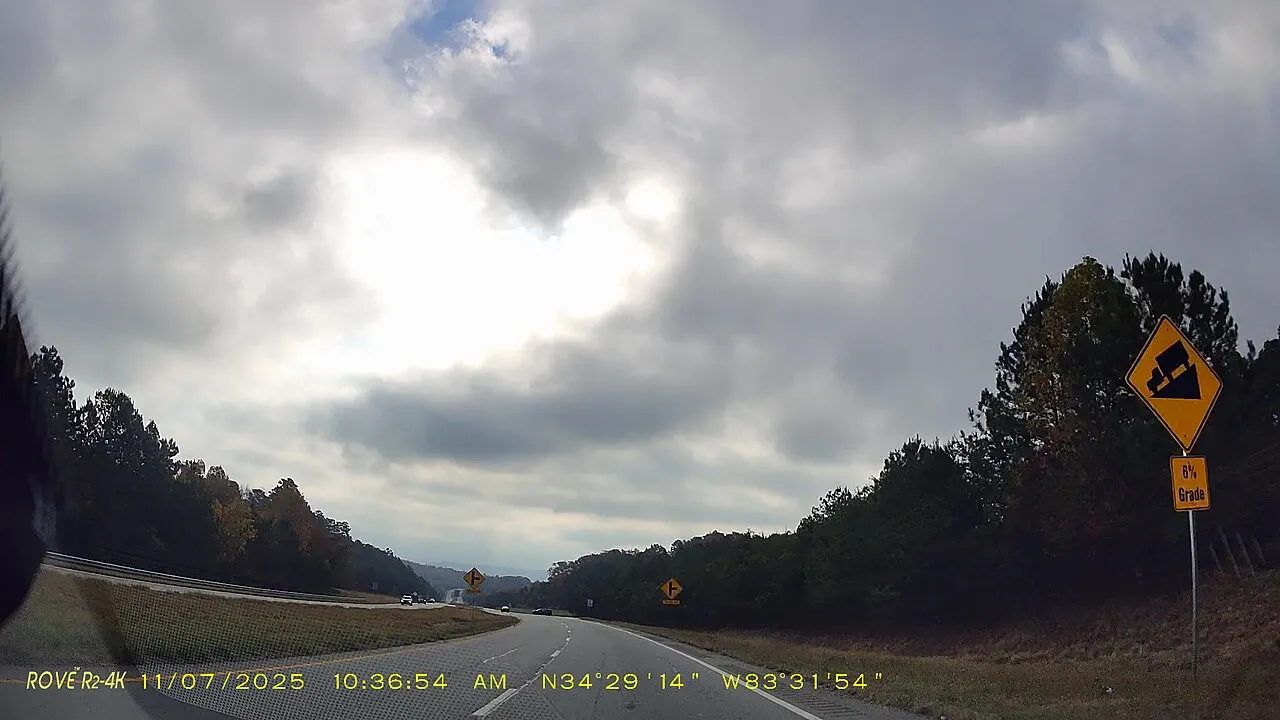
Denise, southbound U.S. 441, Banks County, May 21, 2026
- 1She passes the Hill sign with a 6% Grade plaque, the assembly in the photograph.
- 2Paragraph 02 says that pairing, or the W7-1a sign, should be used for a 6% downgrade longer than 2,000 feet. Paragraph 03 also allows signing where crash experience and field observations show a need. The photo does not establish the length.
- 3The assembly carries no gear plaque and no advisory speed plaque, so the sign sets no gear and no new number. The posted speed limit still applies.
- 4She stays in the same gear she used on the flat and rides the brake pedal from the top to the bottom.
Outcome. She used the brakes as the only control for the whole descent. The sign warned of a grade that calls for special precautions, and those precautions start before the slope, not halfway down it.
What about the crest, where you cannot see over?
A blind crest has its own sign: HILL BLOCKS VIEW, Section 2C.16, which may be used where a crest leaves too little stopping sight distance at the posted speed limit. That sign should carry an advisory speed based on the available sight distance. If a specific hazard past the crest has its own warning sign, that sign should be used instead. The truck-on-a-slope symbol is the downgrade, not the hidden crest.
| Duty | California Vehicle Code 21662 | New York VAT 1215 |
|---|---|---|
| Keep the vehicle under control | Yes, in defiles, canyons, or on mountain highways | Yes, in defiles, canyons, or on mountain highways |
| Position on the road | As near the right-hand edge as reasonably possible, only if there is no marked centerline | As near the right-hand edge as reasonably possible, with no centerline condition |
| Horn | Only if the road is too narrow to stay entirely right of center: sound the horn approaching a curve whose view is blocked within 200 feet | Sound the horn approaching any curve whose view is blocked within 200 feet |
Neither statute names W7-1 or a percent of grade. Florida section 316.183(4)(c) is a different duty: drive at an appropriately reduced speed approaching a hill crest. It sets no gear and no percent.
New York section 1125(a)(1) bars driving on the left side of the roadway when approaching the crest of a grade, or on a curve, where the view is obstructed enough to create a hazard if another vehicle approaches from the opposite direction. The Hill sign does not say that. The passing statute does, and it applies at the crest whatever sign you remember.
What is the Hill sign often mistaken for?
The Hill with Grade version (W7-1a) and the truck-specific plaques. On CDL tests the required action, not the symbol, is what is being examined.
What does the permit test ask about the Hill sign?
This question is from the practice bank, with the answer marked.
A sign showing a truck on a downward slope warns of:
- A.A truck route
- B.A steep descent where heavy vehicles need care(correct answer)
- C.A weigh station ahead
- D.A truck stop
Why: This warns of a steep grade. Descend in a lower gear so the engine helps hold your speed, rather than riding the brakes until they fade.
Source: Federal MUTCD, 11th Edition (FHWA)
Questions drivers ask about the Hill sign
Does 6% mean I have to drive 6 mph slower?
No. The plaque is rise over run, expressed as a percent. Section 2C.14 never turns a percent into a speed cut. A 6% grade longer than 2,000 feet is one of the downgrades that should be signed. The speed you carry is still the posted limit, or slower if the grade, traffic, and your brakes require it. An advisory speed, if one is posted, would be a separate yellow plaque.
The sign shows a truck. Does it apply to my car?
Yes. Paragraph 01 speaks of precautions on the part of road users, not trucks alone. The optional plaque can aim a gear instruction at trucks (TRUCKS USE LOWER GEAR) or leave it general (USE LOW GEAR). Without either plaque, you still have the downgrade warning, and the sign itself gives no gear instruction.
How long can the hill be before they sign it again?
For a longer grade, Sections 2C.14 and 2C.64 say agencies should consider a distance plaque, or a combined distance and grade plaque, at intervals of about 1 mile. That is something to consider, not a fixed requirement, and the manual does not treat an unsigned mile as a safe one.
I am at the top and cannot see oncoming traffic. Is that what this sign means?
Not by itself. HILL BLOCKS VIEW, Section 2C.16, is the crest sign for inadequate stopping sight distance, and it should carry an advisory speed based on that sight distance. If a specific hazard beyond the crest has its own sign, the manual prefers that sign. New York section 1125 separately bars driving left of center when the crest hides oncoming traffic. The slope symbol is about the descent.
Sources
- MUTCD 11th Edition, Chapter 2C, Table 2C-1
- MUTCD 11th Edition, December 2023, Sections 2C.14, 2C.15, 2C.16, and 2C.64
- New York Vehicle and Traffic Law section 1215, Driving on mountain highways
- New York Vehicle and Traffic Law section 1125
- California Vehicle Code section 21662
- Florida Statutes section 316.183 (2025), reduced speed approaching a hill crest
What are the other warning signs?
All 55 warning signs on one page, or every US road sign by shape and color.
Test yourself on this sign and the rest of the set with a road signs practice test for Florida, Texas, California or New York.
The artwork is the federal design itself, which the manual dedicates to the public domain in MUTCD 11th Edition, Part 1, Section 1D.06, checked 2026-09-09. The Interstate Shield, the 511 pictograph and the National Scenic Byway graphic are named exceptions and are not reproduced anywhere on this site.
Source: Manual on Uniform Traffic Control Devices, 11th Edition. Not affiliated with or endorsed by the Federal Highway Administration or any state agency.