What does the Two-Way Traffic sign mean?
The Two-Way Traffic sign (MUTCD W6-3) is a warning sign under the federal Manual on Uniform Traffic Control Devices, the national standard the states build from. Oncoming vehicles use the next lane over from here, with nothing but paint between the two streams.
Source: MUTCD 11th Edition, Chapter 2C, Table 2C-1, checked 2026-09-09.
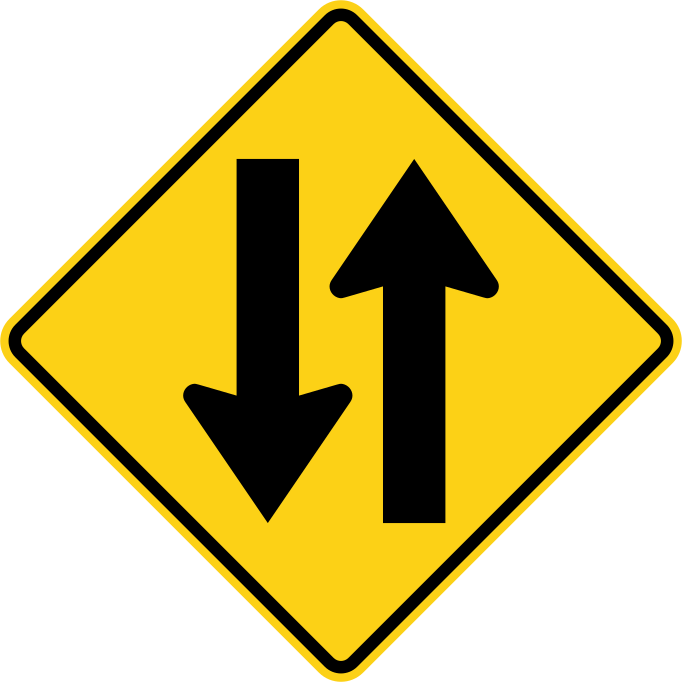
What shape and color is the Two-Way Traffic sign?
| MUTCD code | W6-3 |
|---|---|
| Group | Warning signs |
| Shape | Diamond |
| Color | Yellow background, black double arrow symbol and border |
What a diamond means. A warning. It tells you what the road does next and obliges you to do nothing in particular, which is the distinction test writers probe most often.
What yellow means. General warning of a permanent condition ahead.
Warning signs. A diamond reports a condition and orders nothing. What you do about it is left to you, and that gap between a report and an order is what test writers keep probing.
Which change in the road is this diamond for?
Section 2C.51 gives the diamond three uses. It should warn of a change from a multi-lane divided road to a two-lane, two-way road. With an AHEAD plaque (W16-9P), it should warn that a one-way street is about to become a two-lane, two-way road, the layout in Figure 2B-18. It may also be repeated at intervals along a two-lane, two-way road, or used to back up the Divided Highway Ends sign. No interval is printed.
Section 2C.52 covers a different pair, W6-5 and W6-5a, for three-lane roads with two lanes one way and one the other. Work zones have their own rules in Part 6. Section 6H.16 says W6-3 should be used where one roadway of a divided highway is closed and both directions share the other, at the start of that section and at intervals. The orange Narrow Two-Way Traffic sign, W6-4 in Section 6H.17, is mounted on flexible supports in a series along the center line.
How far ahead of the change is it placed?
Section 2C.04 offers Table 2C-3 as an aid for placing warning signs and says to apply its distances with engineering judgment. The table's columns cover speed reduction and lane changing in heavy traffic, a possible stop, and slowing to an advisory speed. None is written for W6-3, and Section 2C.51 prints no distance, so the manual gives no footage for this sign.
What do you do when the one-way stretch is ending?
- 1Read the plaque before you assume you are already in two-way traffic
With AHEAD, the two-way section is in front of you. Without it, Section 2C.51 is describing the change off a divided multi-lane road, or a reminder along a two-lane road.
- 2Move to the right and expect a vehicle in the next lane
Florida statute 316.088 lets the state or a local authority designate a highway, roadway, part of a roadway, or specific lanes as one-way, shown by official traffic control devices, and you drive only in the designated direction. Once that designation ends, the next lane over carries opposing traffic.
- 3Do not pass on the left out of habit
The blocks behind you may have had parked cars and no oncoming headlights. After the change, the left side of the center line belongs to the other direction. A pass that was ordinary on the one-way street is a head-on conflict here.
Jonah Ellison leaving a one-way street, March 21, 2026
- 1At 11:05 am Jonah has driven six blocks on a downtown Florida street posted 30 mph. One Way signs designate it one-way. Parked cars line both curbs, and he has seen no opposing traffic.
- 2At the last intersection a Two-Way Traffic sign stands with an AHEAD plaque. Section 2C.51 says that pair should warn of a change from a one-way street to a two-lane, two-way road.
- 3The two-way section starts about 200 feet past the sign. He keeps to the right-hand lane. Statute 316.088 bound him to one direction only where the devices designated it.
- 4A delivery van is stopped in his lane at the first driveway, and a car is coming toward him in the lane on his left. He waits behind the van and does not swing left to pass.
Outcome. The plaque told him the change was ahead, not behind him. Once the one-way designation ended, the left lane carried opposing traffic, and passing the van on the left was no longer open to him.
You can drive a two-lane road for miles and see this diamond once, or several times. Section 2C.51 allows it at intervals and does not number them. A long gap between signs is not evidence that the road went back to one-way.
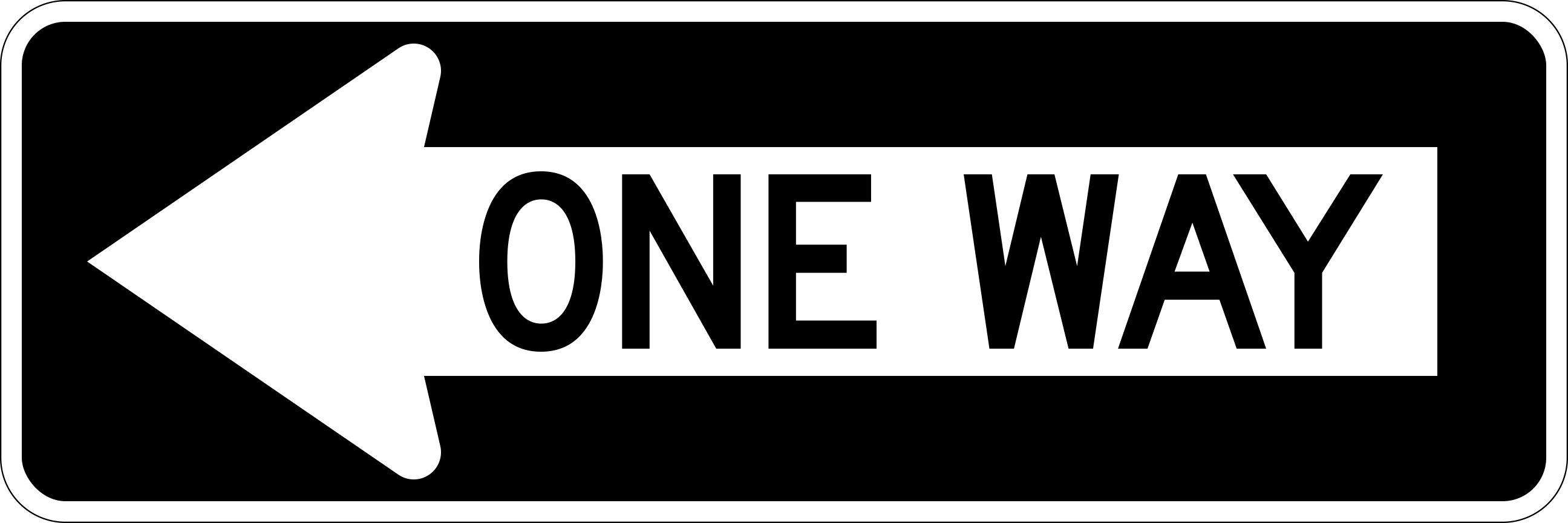
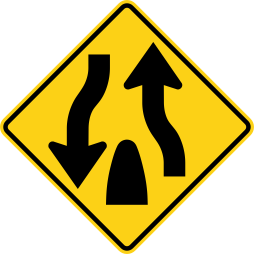
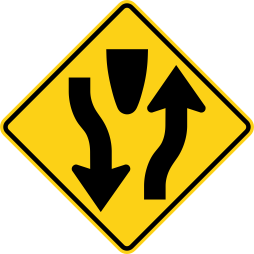
One Way is the regulatory sign behind the one-way order you were under. Divided Highway Ends is the warning Section 2C.51 says this sign may back up. Divided Highway begins is the opposite change, where a median is about to separate the two directions.
What is the Two-Way Traffic sign often mistaken for?
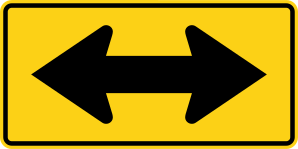
One Way (R6-1) reversed in the mind, and the Two-Direction Large Arrow (W1-7). W6-3 warns of oncoming traffic in the next lane.
| |  |
|---|---|---|
| GroupWarning signs | GroupRegulatory signs | GroupWarning signs |
| ShapeDiamond | ShapeHorizontal rectangle | ShapeHorizontal rectangle |
| ColorYellow background, black double arrow symbol and border | ColorBlack background, white legend and arrow | ColorYellow background, black double arrow and border |
| What it meansOncoming vehicles use the next lane over from here, with nothing but paint between the two streams. | What it meansOne direction of travel is permitted, the one the arrow points. | What it meansThe road you are approaching runs both left and right from here. |
Which signs get mistaken for the Two-Way Traffic sign?
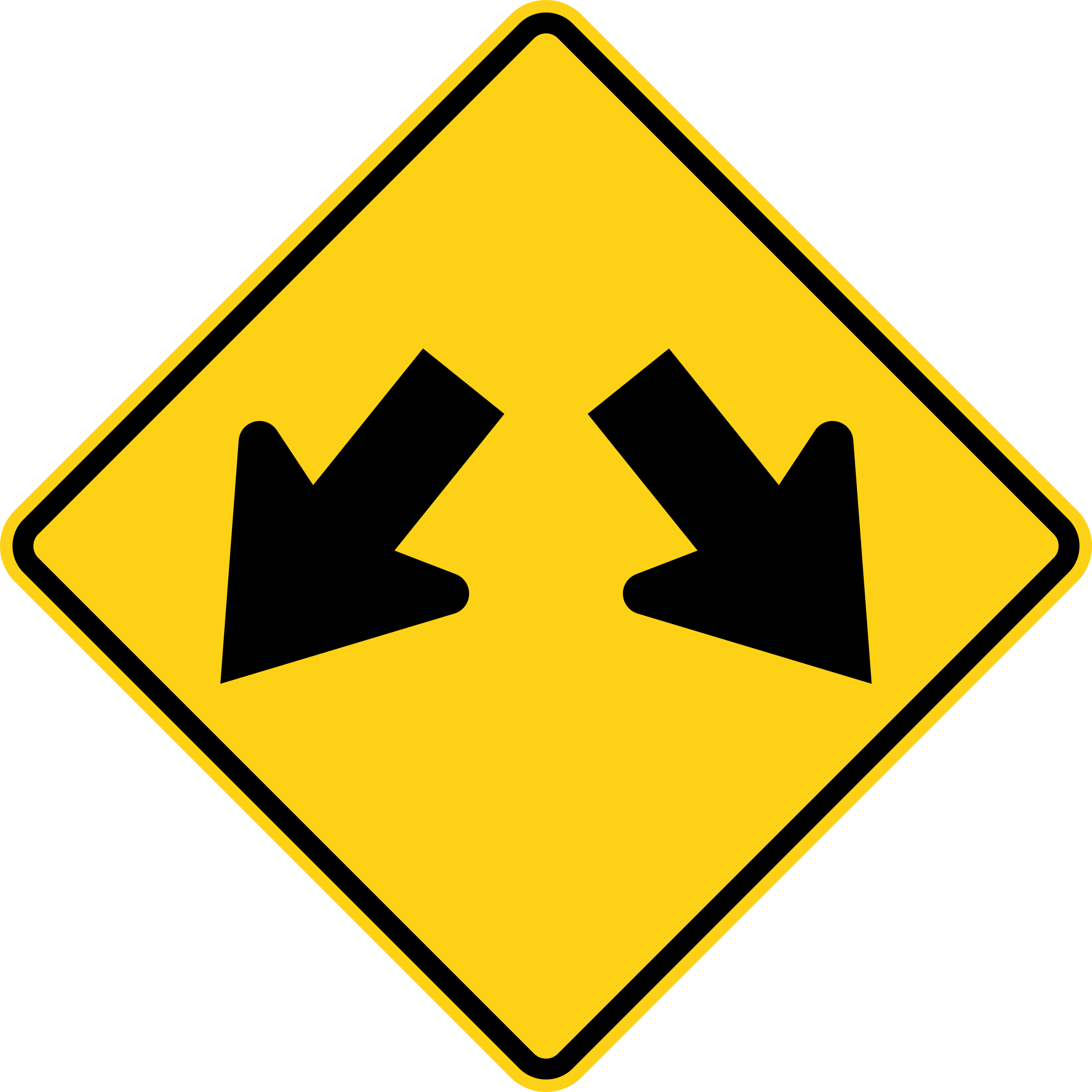 Double ArrowW12-1
Two-Way Traffic (W6-3) and the Two-Direction Large Arrow (W1-7). W12-1 is about a physical obstruction directly in front of you.
What does the permit test ask about the Two-Way Traffic sign?
This question is from the practice bank, with the answer marked.
This sign means:
- A.A one way road is ahead
- B.The roadway ahead carries traffic in both directions(correct answer)
- C.Two lanes merge ahead
- D.A passing lane begins ahead
Source: MUTCD W6-3
Questions drivers ask about the Two-Way Traffic sign
If I do not see this sign, is the road still one-way?
Not because of the missing sign. Section 2C.51 does not require the diamond at every change, and Florida statute 316.088 ties one-way travel to the devices that designate it, such as One Way signs, not to this warning. Read those devices. A missing diamond neither keeps a one-way order in force nor ends one.
Does the sign set a new speed?
Section 2C.51 attaches no speed to W6-3 and calls for no advisory plaque. Table 2C-3 is about where warning signs stand, not a limit you must drop to. The posted limit stays until a speed limit sign changes it. What changes is lane position: expect an oncoming vehicle in the next lane.
How far before the two-way pavement should the sign stand?
No distance is printed for W6-3. Section 2C.04 offers Table 2C-3 as an aid to apply with judgment, but its columns are written for lane changing in heavy traffic, possible stops, and slowing to an advisory speed, and Section 2C.51 assigns none of them to this sign. With an AHEAD plaque, the two-way section is still in front of you.
Is the work-zone version the same sign?
Sometimes. Section 6H.16 uses the same W6-3 where one roadway of a divided highway is closed and two-way traffic runs on the other, at the start and at intervals. The Narrow Two-Way Traffic sign, W6-4 in Section 6H.17, is different: an orange sign at least 12 by 18 inches, mounted on flexible supports in a series along the center line to separate the two directions.
Sources
- MUTCD 11th Edition, Chapter 2C, Table 2C-1
- MUTCD 11th Edition (December 2023), Sections 2C.04, 2C.51, and 2C.52, Table 2C-3
- MUTCD 11th Edition (December 2023), Sections 6H.16 and 6H.17
- Florida Statutes section 316.088 (2025), One-way roadways and rotary traffic islands
What are the other warning signs?
All 55 warning signs on one page, or every US road sign by shape and color.
Test yourself on this sign and the rest of the set with a road signs practice test for Florida, Texas, California or New York.
The artwork is the federal design itself, which the manual dedicates to the public domain in MUTCD 11th Edition, Part 1, Section 1D.06, checked 2026-09-09. The Interstate Shield, the 511 pictograph and the National Scenic Byway graphic are named exceptions and are not reproduced anywhere on this site.
Source: Manual on Uniform Traffic Control Devices, 11th Edition. Not affiliated with or endorsed by the Federal Highway Administration or any state agency.