What does the Cross Road sign mean?
The Cross Road sign (MUTCD W2-1) is a warning sign under the federal Manual on Uniform Traffic Control Devices, the national standard the states build from. Another road cuts straight across yours just ahead, so traffic can arrive from the left and the right at once.
Source: MUTCD 11th Edition, Chapter 2C, Table 2C-1, checked 2026-09-09.

What shape and color is the Cross Road sign?
| MUTCD code | W2-1 |
|---|---|
| Group | Warning signs |
| Shape | Diamond |
| Color | Yellow background, black symbol and border |
What a diamond means. A warning. It tells you what the road does next and obliges you to do nothing in particular, which is the distinction test writers probe most often.
What yellow means. General warning of a permanent condition ahead.
Warning signs. A diamond reports a condition and orders nothing. What you do about it is left to you, and that gap between a report and an order is what test writers keep probing.
On which approach is a cross-road sign allowed?
MUTCD 11th Edition, Section 2C.41 allows a Cross Road (W2-1) sign ahead of an intersection to show that one is there and that traffic may turn or enter. The symbol should match the real layout. If the side roads are not opposite each other, the section says to use Offset Side Roads (W2-7) instead, and two closely spaced side roads on the same side take Double Side Roads (W2-8). A W2-7 or W2-8 should show no more than two side roads on one side and no more than three in all.
Paragraph 07 is the limit that surprises people. Intersection warning signs, other than the Circular Intersection (W2-6), the T-Intersection (W2-4) and certain grade crossing advance warning signs, should not be used on an approach already controlled by a STOP sign, a YIELD sign or a signal. So W2-1 normally faces the driver who is not being stopped, warning that traffic can arrive from both sides.
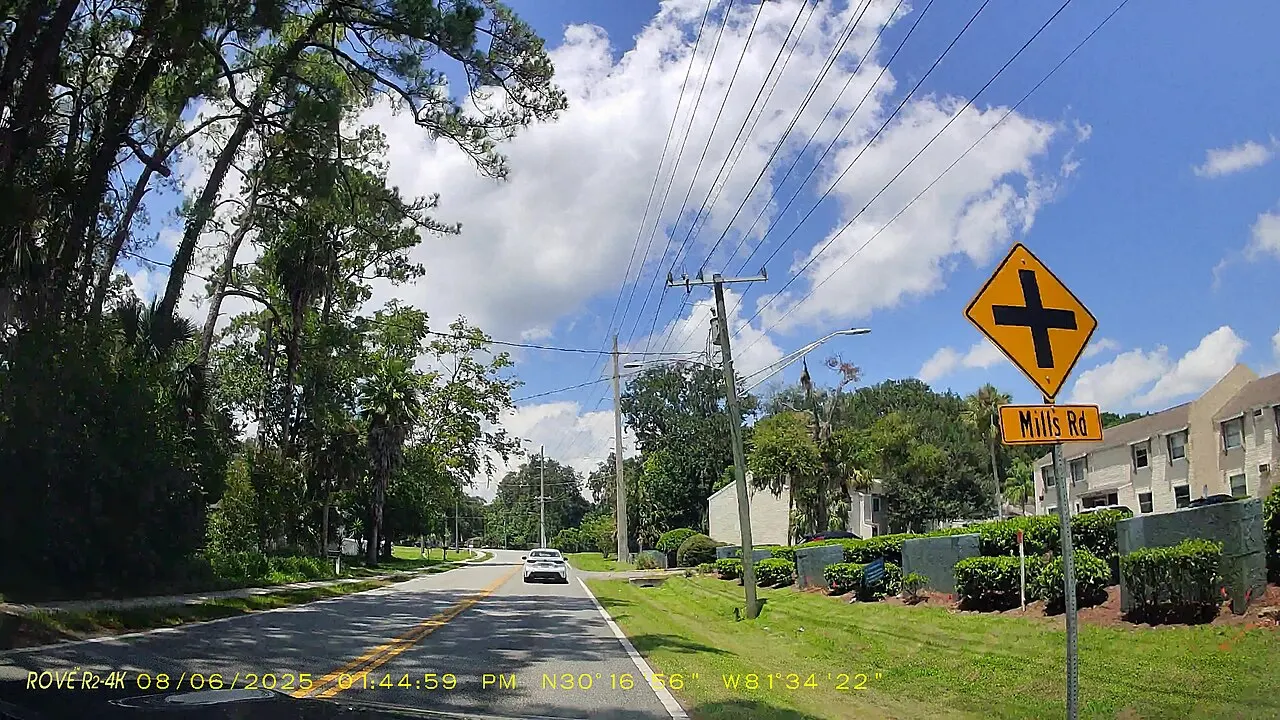
The Jacksonville photo shows a Mills Rd name plaque under the cross-road symbol on westbound Hogan Road. Section 2C.65 allows an Advance Street Name plaque (W16-8P or W16-8aP) under any W2-series sign to name the intersecting street. The plaque names the road. It does not change who yields.
You do not stop at W2-1. If your approach needed a stop, paragraph 07 of Section 2C.41 says this symbol should generally not be the sign on that approach. The stop, the yield, or the signal, if any, is at the intersection.
What do you do between the sign and the crossing?
- 1Look both ways for entering traffic
The symbol is a through road with another road crossing it. Vehicles can come from the left and the right at the same crossing, which is the difference from a single side road.
- 2Do not treat the warning as a control
Keep moving unless a regulatory sign, a signal, or the traffic itself requires something else. The warning only says the crossing exists.
- 3Apply the uncontrolled rule only if nothing else controls you
Florida Statutes s. 316.121(1) and (2): yield to a vehicle that has already entered the intersection from a different highway, and if two vehicles enter from different highways at the same time, the driver on the left yields to the driver on the right. Subsection (5) says these rules are modified at through highways and elsewhere in the chapter.
Uncontrolled crossing after a W2-1
The driver on the left, if both enter together yields.
Florida Statutes s. 316.121 gives the crossing to whoever has already entered from the other road, and to the driver on the right when two enter together. A signal or a stop or yield sign on your approach replaces that rule. The warning sign does not.
What does Andre do on Hogan Road at 40 mph?
Andre, westbound, Mills Rd named on the plaque
- 1Andre is westbound on Hogan Road at 40 mph and sees the W2-1 with the Mills Rd plaque from the Jacksonville photo. The 40 mph is there for the arithmetic. It is not a claim about the posted limit on Hogan Road.
- 2If he may have to stop, Table 2C-3 Condition B, deceleration to 0 mph, is 305 feet at 40 mph. Note 3 of the table names Intersection Warning signs among the typical signs for that potential-stop column.
- 3The example assumes no sign or signal controls either road at the crossing and that both are paved city streets, so s. 316.121(1) and (2) decide it. It is not a description of the real junction. A car from Mills Rd has already entered the intersection, and Andre yields to it.
- 4A second car on Mills Rd, coming from his left, reaches the crossing at the same moment he does. He is the driver on the right, so that driver yields to him. He still keeps his speed low enough to stop if the other driver does not.
Outcome. He never stops at the yellow diamond. He uses the plaque to know where to look, then yields only to the vehicle the statute favors.
What trap answers show up for this symbol?
| Layout ahead | Sign Section 2C.41 names | Wrong pick |
|---|---|---|
| One road crosses yours, roughly square | Cross Road, W2-1 | A side-road symbol, which has one arm |
| Side roads are staggered | Offset Side Roads, W2-7 | W2-1, which draws them opposite |
| You are already at a stop, yield, or signal | Usually none of these diamonds | W2-1 on the stopped approach |
Paragraph 07 still allows the T-Intersection and Circular Intersection symbols, and certain grade crossing advance warning signs, on a controlled approach.
Other traps: calling W2-1 a railroad warning because both have a crossing shape (the Grade Crossing Advance Warning sign, W10-1, is a round yellow sign with an X), answering that cross traffic must stop, and answering that you stop at the warning. When no device controls your approach, the right-of-way rule in Florida is s. 316.121.


Count the arms. One side, both sides, or a road that stops.
What is the Cross Road sign often mistaken for?
The railroad advance warning sign (W10-1), which is a yellow circle with an X, not a cross-shaped symbol in a diamond. Also Side Road (W2-2), where the road joins from one side only.
|  | |
|---|---|---|
| GroupWarning signs | GroupRailroad crossing signs | GroupWarning signs |
| ShapeDiamond | ShapeCircle, 36 inches diameter | ShapeDiamond |
| ColorYellow background, black symbol and border | ColorYellow background, black X and RR legend and border | ColorYellow background, black symbol and border |
| What it meansAnother road cuts straight across yours just ahead, so traffic can arrive from the left and the right at once. | What it meansTracks cross the pavement somewhere past this sign. | What it meansA single arm meets your road from one side only, and drivers waiting on it often have a poor view of you. |
What does the permit test ask about the Cross Road sign?
This question is from the practice bank, with the answer marked.
This sign warns of:
- A.A four way intersection ahead(correct answer)
- B.A road joining from one side only
- C.A T intersection where your road ends
- D.A railroad crossing ahead
Source: MUTCD W2-1
Questions drivers ask about the Cross Road sign
Do I stop at the cross-road sign?
No. W2-1 warns that a crossing is ahead and that traffic may turn or enter. Section 2C.41 says this kind of intersection warning should not be used on an approach that is already controlled by a STOP sign, a YIELD sign, or a signal. Any stop you owe is at the intersection control, not at the diamond.
Does the street name under the sign change who goes first?
No. Section 2C.65 allows an Advance Street Name plaque under a W2-series sign so you know which road is crossing. In the Jacksonville photo that plaque reads Mills Rd under the symbol on westbound Hogan Road. Yielding still comes from a signal, a stop or yield sign, or, if none of those face you, Florida Statutes s. 316.121.
What if the two side roads are not directly across from each other?
Section 2C.41 says to use Offset Side Roads (W2-7) instead of the Cross Road sign. If two closely spaced side roads are on the same side, use Double Side Roads (W2-8). Either sign should show no more than two side roads on one side and no more than three in all.
Who yields if nobody has a sign at the crossing?
Florida Statutes s. 316.121 says you yield to a vehicle that has already entered the intersection from a different highway, and if two vehicles enter from different highways at the same time, the driver on the left yields to the driver on the right. Where no official traffic control device controls the approach, subsection (3) also makes a driver entering or crossing a state-maintained road yield to all traffic approaching on it, and subsection (4) does the same for a driver coming off an unpaved road onto a paved county or city road.
Sources
- MUTCD 11th Edition, Chapter 2C, Table 2C-1
- MUTCD 11th Edition (December 2023), Chapter 2C, Sections 2C.41 and 2C.65, and Table 2C-3 with its note 3
- MUTCD 11th Edition (December 2023), Part 8, Section 8B.06 and Figure 8B-4, Grade Crossing Advance Warning (W10-1) sign
- Florida Statutes s. 316.121, vehicles approaching or entering intersections (2026)
What are the other warning signs?



All 55 warning signs on one page, or every US road sign by shape and color.
Test yourself on this sign and the rest of the set with a road signs practice test for Florida, Texas, California or New York.
The artwork is the federal design itself, which the manual dedicates to the public domain in MUTCD 11th Edition, Part 1, Section 1D.06, checked 2026-09-09. The Interstate Shield, the 511 pictograph and the National Scenic Byway graphic are named exceptions and are not reproduced anywhere on this site.
Source: Manual on Uniform Traffic Control Devices, 11th Edition. Not affiliated with or endorsed by the Federal Highway Administration or any state agency.