What does the Grade Crossing Advance Warning sign mean?
The Grade Crossing Advance Warning sign (MUTCD W10-1) is a railroad crossing sign under the federal Manual on Uniform Traffic Control Devices, the national standard the states build from. Tracks cross the pavement somewhere past this sign. Come down to a speed you could stop from, and check the rails both ways rather than waiting for something to tell you a train is coming.
Source: MUTCD 11th Edition, Part 8, Table 8B-1, checked 2026-09-09.

What shape and color is the Grade Crossing Advance Warning sign?
| MUTCD code | W10-1 |
|---|---|
| Group | Railroad crossing signs |
| Shape | Circle, 36 inches diameter |
| Color | Yellow background, black X and RR legend and border |
What a circle means. A railroad crossing ahead. Round signs are used for one purpose in the federal system, which makes this an easy question and an easy mark to lose.
What yellow means. General warning of a permanent condition ahead.
Railroad crossing signs. Advance warning, crossbuck and the passive versus active distinction. Rare on the road, common on the test, and the questions turn on who has right of way.
How far before the rails does this sign stand, and when is it left out?
Section 8B.06 requires a W10-1 on each road approaching a grade crossing, with listed exceptions. If the nearest rail is less than 100 feet from the edge of a parallel road, W10-2, W10-3, or W10-4 goes on that parallel road and no round sign is required in the short gap. At 100 feet or more the guidance reverses: use the round sign and not those diamonds. The round sign can also be left out on a low-volume, low-speed road crossing a rarely used spur where a person on the ground holds traffic for every train, in a business or commercial area with active crossing devices, and where the roadside cannot display it at all.
Section 8B.06 places it by Section 2C.04 and Table 2C-3, and Section 2C.04 calls those distances an aid that can be adjusted for the site. The manual does not say which column of the table applies to W10-1. The potential-stop column, the one used for Stop Ahead and Signal Ahead, gives 250 feet at 35 mph, 360 at 45, 495 at 55, and 645 at 65. If Yield Ahead or Stop Ahead is also warranted under Section 2C.35, the round sign goes upstream of it.
Section 8C.02 adds markings on paved approaches: a white retroreflective X, the letters RR, a no-passing marking on a two-lane, two-way road with a center line, and transverse lines. They are required where the crossing has signals or gates, and at any other crossing where the posted or statutory speed is 40 mph or higher. The Diagnostic Team can drop them below 40 mph, or in an urban area, if other devices already give enough warning. Part of the X should sit directly opposite this sign, and any extra X closer to the rails should end at least 50 feet before the stop or yield line. In Florida, Section 316.171 says the railroad does not have to install pavement markings or advance warning signs; those belong to the government that runs the road.
What do you do between this sign and the rails?
- 1Change speed here
Whatever distance the agency took from Table 2C-3 is your room to slow. Waiting for the crossbuck spends it.
- 2Read the device at the rails
Lights, a gate, YIELD on the crossbuck, or STOP on the crossbuck each ask for something different. This sign does not choose.
- 3Measure a required stop from the rail
Florida Section 316.1575 puts it within 50 feet but not less than 15 feet from the nearest rail. It applies when a signal warns of a train, a gate is down or a flagger signals, a train sounds a warning or is an immediate hazard, or a train is plainly visible and in hazardous proximity.
- 4Do not invent a full stop
With no STOP sign, no signal, no gate, and no train, keep a speed you can still stop from and cross when the rails are clear. Section 8B.04 notes that certain commercial vehicles and school buses must stop at every crossing under a federal rule.
Marcus at 55 mph on a rural Florida highway
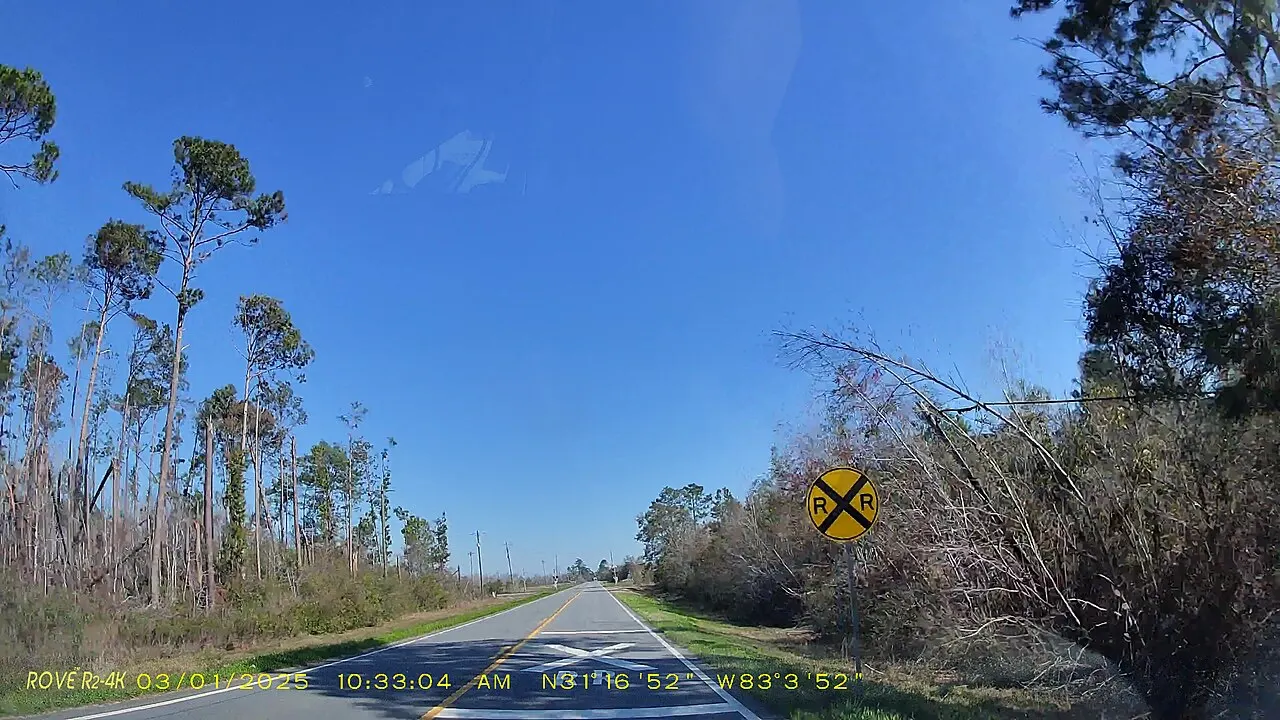
- 1On January 14, 2026 at 7:05 a.m. Marcus is at 55 mph on a two-lane Florida highway. A round sign and a white pavement X stand together, like the pair in the Berrien County photo. Placed by the potential-stop column, that sign is about 495 feet before the stop line.
- 2He holds 55 until the crossbuck is close. A freight train is now plainly visible and near, so Section 316.1575 requires a stop 15 to 50 feet from the nearest rail, and at 55 mph he no longer has the room to make it.
Outcome. He should have lifted off at the round sign, while all 495 feet were still his. If he fails to stop at the rails, a first violation of Section 316.1575 is a $500 fine or 25 hours of community service, plus 6 points on his license.
- Stopping beside the round sign. Placed by the potential-stop column at 55 mph, it is about 495 feet early.
- Reading it as "a train is coming now." It marks a crossing ahead.
- Expecting one at every downtown crossing. A business or commercial area with active devices is an exception.
- Treating the pavement X as a later warning. Part of the X belongs opposite the sign.
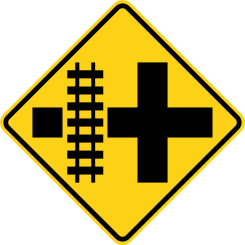
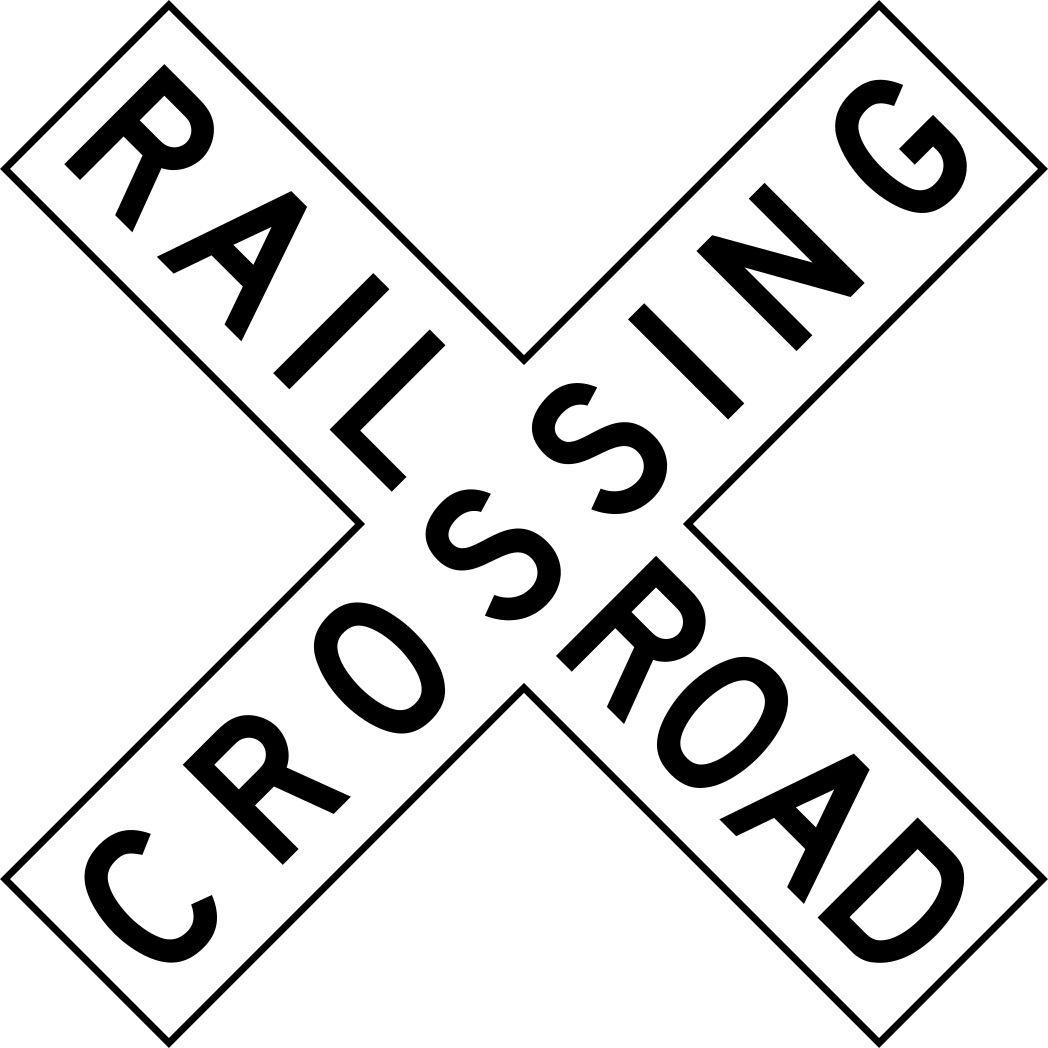
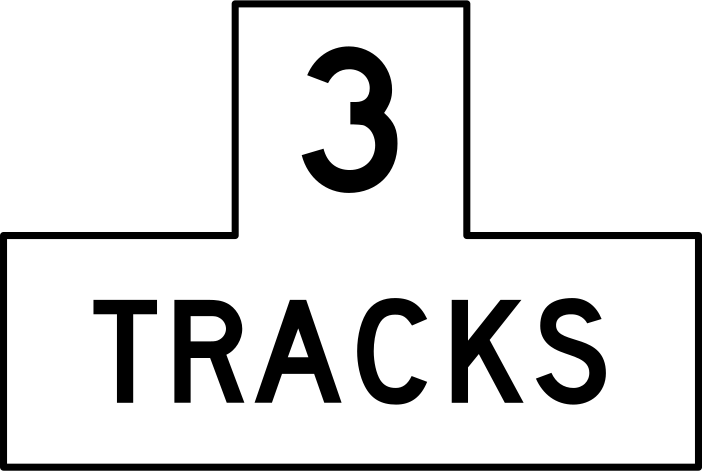
The diamonds are for a crossing tight against a side road. The crossbuck is at the rails.
What is the Grade Crossing Advance Warning sign often mistaken for?
The crossbuck (R15-1) at the crossing itself. W10-1 is the only round warning sign in the manual and is the one exception to the orange rule inside work zones, where it stays yellow.
| |
|---|---|
| GroupRailroad crossing signs | GroupRailroad crossing signs |
| ShapeCircle, 36 inches diameter | ShapeTwo crossed blades forming an X |
| ColorYellow background, black X and RR legend and border | ColorRetroreflective white with the words RAILROAD CROSSING in black |
| What it meansTracks cross the pavement somewhere past this sign. | What it meansYou are at the tracks, not approaching them. |
Which signs get mistaken for the Grade Crossing Advance Warning sign?
 Cross RoadW2-1
The railroad advance warning sign (W10-1), which is a yellow circle with an X, not a cross-shaped symbol in a diamond. Also Side Road (W2-2), where the road joins from one side only.
- Grade Crossing and Intersection Advance WarningW10-2, W10-3, W10-4
The plain W10-1 round sign. These show the geometry of the tracks relative to the side road.
What does the permit test ask about the Grade Crossing Advance Warning sign?
These 2 questions are from the practice bank, with the answer marked.
A round yellow sign is used for exactly one thing. It warns of:
- A.A curve ahead
- B.A railroad crossing ahead(correct answer)
- C.A roundabout ahead
- D.A school zone ahead
Source: MUTCD W10-1
A round sign warns of:
- A.A roundabout
- B.A railroad crossing ahead(correct answer)
- C.A dead end
- D.A rest area
Why: The circular yellow sign carrying a large X and two Rs is the advance warning for a railroad crossing. Look, listen and be ready to stop.
Source: Federal MUTCD, 11th Edition (FHWA)
Questions drivers ask about the Grade Crossing Advance Warning sign
Do I stop at the round railroad sign itself?
No. Section 8B.06 puts it in advance of the crossing, at a Table 2C-3 distance, not at the rails. When Florida Section 316.1575 requires a stop, that stop is within 50 feet but not less than 15 feet from the nearest rail. Stopping out at the round sign leaves you far short of the point the statute names.
The crossing has lights and gates. Why is the round sign sometimes missing downtown?
Section 8B.06 does not require W10-1 in a business or commercial area where active crossing devices are in use. The lights and the gate do the warning at the rails. That exception covers the advance sign only, not the lights. Section 8C.02 still requires the white pavement X on paved approaches to a crossing with signals or gates, unless the Diagnostic Team finds, on a road under 40 mph or in an urban area, that the other devices already give enough warning.
I turned off a parallel road and never saw the round sign. Was it missing?
Not always. When the nearest rail is less than 100 feet from the parallel road, Section 8B.06 uses W10-2, W10-3, or W10-4 on that road and does not require a W10-1 in the gap. At 100 feet or more the guidance flips: install the round sign and skip those diamonds. The sign you missed may have been a diamond back at the turn.
Sources
- MUTCD 11th Edition, Part 8, Table 8B-1
- MUTCD 11th Edition (December 2023), Part 8, Sections 8B.04, 8B.06, and 8C.02 and Figure 8C-1
- MUTCD 11th Edition (December 2023), Chapter 2C, Section 2C.04 and Table 2C-3
- Florida Statutes section 316.1575 (2025), obedience at railroad-highway grade crossings
- Florida Statutes section 316.171 (2025), who erects crossing devices
What are the other railroad crossing signs?


All 8 railroad crossing signs on one page, or every US road sign by shape and color.
Test yourself on this sign and the rest of the set with a road signs practice test for Florida, Texas, California or New York.
The artwork is the federal design itself, which the manual dedicates to the public domain in MUTCD 11th Edition, Part 1, Section 1D.06, checked 2026-09-09. The Interstate Shield, the 511 pictograph and the National Scenic Byway graphic are named exceptions and are not reproduced anywhere on this site.
Source: Manual on Uniform Traffic Control Devices, 11th Edition. Not affiliated with or endorsed by the Federal Highway Administration or any state agency.