What does the Turn sign mean?
The Turn sign (MUTCD W1-1) is a warning sign under the federal Manual on Uniform Traffic Control Devices, the national standard the states build from. The alignment breaks sharply, close to a right angle. Do the braking on the straight, because there is no room to lose speed once you are into it.
Source: MUTCD 11th Edition, Chapter 2C, Table 2C-1, checked 2026-09-09.
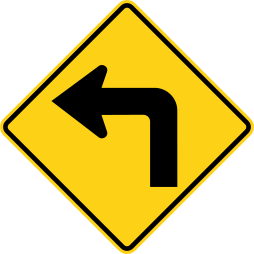
What shape and color is the Turn sign?
| MUTCD code | W1-1 |
|---|---|
| Group | Warning signs |
| Shape | Diamond |
| Color | Yellow background, black symbol and border |
What a diamond means. A warning. It tells you what the road does next and obliges you to do nothing in particular, which is the distinction test writers probe most often.
What yellow means. General warning of a permanent condition ahead.
Warning signs. A diamond reports a condition and orders nothing. What you do about it is left to you, and that gap between a report and an order is what test writers keep probing.
What advisory speed earns the right-angle arrow?
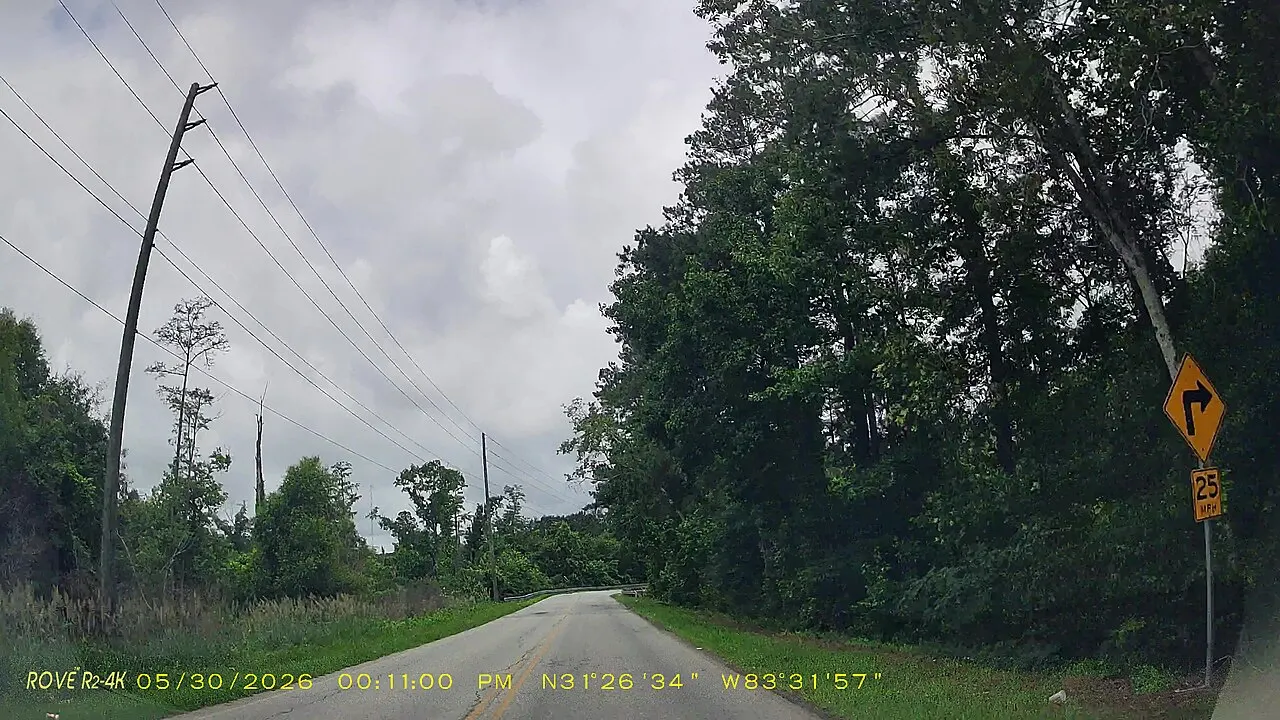
Section 2C.07 starts from the curve arrow. The Turn sign is the replacement it recommends when the horizontal curve has an advisory speed of 30 mph or less. The Tift County photo shows the case that guidance is written for: a right-angle arrow and a 25 MPH plaque. Twenty-five is under the cutoff, so the sharp arrow is the sign the section points to, not a stylistic choice.
| What the road does | Sign |
|---|---|
| One bend, advisory above 30 mph | Curve arrow, when Table 2C-4 calls for an alignment sign |
| One bend, advisory 30 mph or less | Turn arrow |
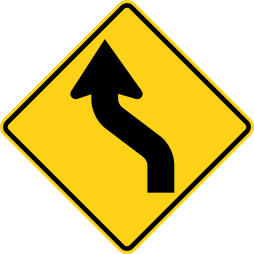
| Two bends in opposite directions, tangent shorter than 600 feet | One Reverse Turn or one Reverse Curve, not two single signs |
| Three or more alignment changes, each tangent shorter than 600 feet | A Winding Road sign may replace the series |
MUTCD 11th Edition, December 2023, Section 2C.07, paragraphs 01 through 05. The 600-foot test is the tangent between the bends, not the length of the bend itself.
How close to the corner can the sign be?
Sharp advisories land in the shortest cells of Table 2C-3. On a 40 mph approach the table lists 100 feet to slow to 10 or 20 mph and prints N/A for 30 mph. On a 45 mph approach it lists 125 feet to slow to 10 mph and 100 feet to slow to 20 or 30 mph. Footnote 6 explains that 100 feet is a minimum listed to keep signs spaced apart. Where a cell reads N/A, footnote 5 says the alignment sign may go anywhere from the point of curvature up to 100 feet before the curve, though it should still stand ahead of the curve and at least 100 feet from any other sign. Every Condition B figure already deducts 250 feet of reading distance. The table has no 25 mph column, so a 25 advisory falls between the 20 and 30 columns. Section 2C.04 lets an agency adjust the distances for roadway features, other signs, and visibility.
What do you do on the short approach?
- 1Brake to the plaque speed before the roadway breaks
At 40 mph the table may leave 100 feet or less from the sign to the turn, plus the distance from which you could already read it. There is no second straight section inside a right-angle bend.
- 2Commit to the advisory you were given
A 25 MPH plaque is the study speed for that turn in free-flow conditions. It is a multiple of 5, as Section 2C.59 requires. It is not a hint to try 35 because the bend "looks fine."
- 3Look for a second bend close by
If the next change turns the other way and the tangent is under 600 feet, Section 2C.07 says a Reverse Turn sign should be used instead of two Turn signs. Two separate Turn signs that close together are a layout to question, not two independent corners.
- 4Expect an outside arrow when chevrons will not fit
At a differential of 15 mph, Chart B of Table 2C-4 calls for delineators plus the advance sign. At 20 mph or more it calls for chevrons. A One-Direction Large Arrow may replace or supplement those when the site cannot hold the full set, and Section 2C.10 also lets it back up a Turn sign to emphasize a sharp bend.
Sam, a Texas two-lane posted 40, advisory 25, August 7, 2026
- 1The road is a collector with a center line carrying 3,200 vehicles a day, which Chart A of Table 2C-4 lists as recommended for devices.
- 2The differential is 15 mph. Chart B pairs delineators with the advance alignment sign, and Table 2C-6 requires the plaque.
- 3Twenty-five is under 30, so the advance sign is a Turn sign, the same right-angle arrow as in the Tift County photograph.
- 4On a 40 mph approach, Table 2C-3 lists 100 feet from the sign to a 20 mph condition and prints no distance for 30 mph, leaving the sign anywhere from the point of curvature up to 100 feet ahead. A 25 mph advisory sits between those columns.
- 5Sam passes the sign still at 40 and tries to shed 15 mph after the front wheels have turned.
- 6Section 545.351(c)(2) requires an appropriately reduced speed when approaching and going around a curve, consistent with the reasonable-speed rule in subsections (a) and (b).
Outcome. The legal maximum on that road was still 40. The Turn sign and the plaque were the warning that 40 does not fit the corner, and with 100 feet or less between sign and turn, holding 40 past the sign left almost no straight road to slow on.
Which test answers swap this sign for its neighbors?
- Calling every bent arrow a curve. The manual splits them at an advisory of 30 mph. A 25 plaque with a gentle curve arrow, or a 45 plaque with a right-angle arrow, does not follow Section 2C.07.
- Treating two close opposite bends as two Turn signs. Under 600 feet of tangent, the section recommends one Reverse Turn sign.
- Reading the plaque as the new speed limit for the next mile. The number applies to the turn the arrow describes. The white speed limit sign, if there is one, is unchanged.
- Assuming a missing sign means the corner is gentle. Devices may be omitted at an approach limit of 20 mph or less, and Chart A leaves some roads optional. A missing sign is not a finding that the advisory is high.
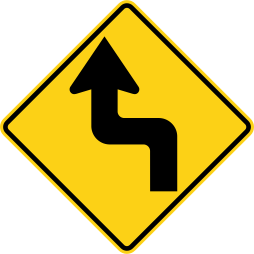
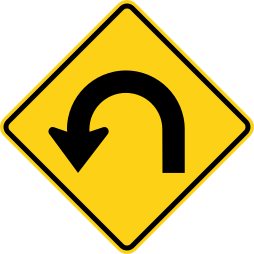
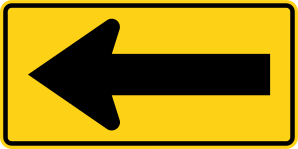
Reverse Turn covers two opposite sharp bends with a short tangent. Hairpin Curve may replace a Turn sign where the road changes direction by 135 degrees or more. The large arrow can stand on the outside of the turn when chevrons or delineators will not fit.
What is the Turn sign often mistaken for?
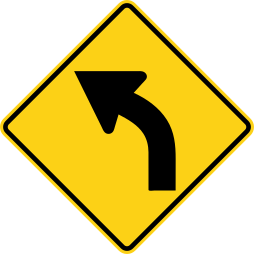
Curve (W1-2). Turn shows an arrow bending at roughly a right angle and means a sharp turn; Curve shows a gentle bend. The advisory speed plaque under it is the practical tell.
|  |
|---|---|
| GroupWarning signs | GroupWarning signs |
| ShapeDiamond | ShapeDiamond |
| ColorYellow background, black symbol and border | ColorYellow background, black symbol and border |
| What it meansThe alignment breaks sharply, close to a right angle. | What it meansA gradual bend rather than a corner. |
Which signs get mistaken for the Turn sign?
What does the permit test ask about the Turn sign?
This question is from the practice bank, with the answer marked.
A yellow sign showing a curved arrow with a posted number means:
- A.A mandatory maximum speed limit
- B.An advisory safe speed for the curve(correct answer)
- C.A distance to the next exit
- D.A weight limit for the bridge
Why: The number on a warning sign is advisory: the recommended speed to take the feature safely in good conditions. The legal limit remains the posted regulatory limit.
Source: Federal MUTCD, 11th Edition (FHWA)
Questions drivers ask about the Turn sign
I am in a 45 mph zone and the plaque says 20. How far before the corner is the sign supposed to be?
Table 2C-3, on a 45 mph approach, lists 100 feet to slow to 20 mph and 125 feet to slow to 10 mph. Those are sign-to-curve distances, already cut by a 250-foot allowance for reading the symbol. The table has no separate column for 15 or 25. A site can adjust the distance, and 100 feet is the minimum the table lists so signs stay spaced apart.
Does a turn sign mean the road actually corners at 90 degrees?
The manual does not define the Turn sign by a surveyed angle. Section 2C.07 ties it to an advisory speed of 30 mph or less, and saves the Hairpin Curve sign for a change of 135 degrees or more. A bend can look gentler than a square corner and still fall in that speed range because of superelevation, pavement, or sight distance. The plaque, not the artwork, carries the study speed.
Two Turn signs appear a few seconds apart, bending opposite ways. Is that the layout the manual wants?
Usually not. If the tangent between two opposite alignment changes is shorter than 600 feet, Section 2C.07 says a Reverse Turn sign should be used rather than successive Turn signs. The 600 feet is the straight piece between the bends.
Is 25 mph on the plaque a Texas speed limit?
No. Section 545.352 lists the speeds that are prima facie evidence of an unlawful speed when exceeded, and a yellow advisory is not among them. Section 545.351(c)(2) still requires a reduced speed going around a curve. The plaque is the study speed for that turn, and neither section sets a fine tied to it.
Sources
- MUTCD 11th Edition, Chapter 2C, Table 2C-1
- MUTCD 11th Edition, December 2023, Sections 2C.04, 2C.06, 2C.07, 2C.10, and 2C.59, Tables 2C-3, 2C-4, and 2C-6
- Texas Transportation Code section 545.351
- Texas Transportation Code section 545.352
What are the other warning signs?
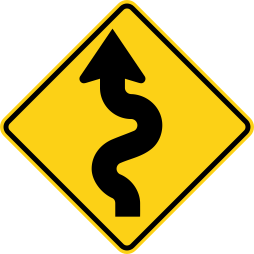



All 55 warning signs on one page, or every US road sign by shape and color.
Test yourself on this sign and the rest of the set with a road signs practice test for Florida, Texas, California or New York.
The artwork is the federal design itself, which the manual dedicates to the public domain in MUTCD 11th Edition, Part 1, Section 1D.06, checked 2026-09-09. The Interstate Shield, the 511 pictograph and the National Scenic Byway graphic are named exceptions and are not reproduced anywhere on this site.
Source: Manual on Uniform Traffic Control Devices, 11th Edition. Not affiliated with or endorsed by the Federal Highway Administration or any state agency.