What does the Left Turn Yield On Green sign mean?
The Left Turn Yield On Green sign (MUTCD R10-12) is a regulatory sign under the federal Manual on Uniform Traffic Control Devices, the national standard the states build from. The round green permits the left turn without protecting it. Judging the gap in oncoming traffic is your job, and anyone walking across the road you are turning into goes ahead of you.
Source: MUTCD 11th Edition, Chapter 2B, Table 2B-1, checked 2026-09-09.
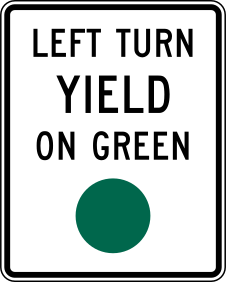
What shape and color is the Left Turn Yield On Green sign?
| MUTCD code | R10-12 |
|---|---|
| Group | Regulatory signs |
| Shape | Vertical rectangle |
| Color | White background, black legend, green circle symbol |
What a vertical rectangle means. Usually regulatory: a law you must obey. Speed limits, turn restrictions and parking rules take this shape.
What white means. Regulatory. A black legend on a white background is a law, not advice.
Regulatory signs. Every sign in this group has a statute behind it, so disobeying one is a citable offense on its own. Permit tests tend to word them as a duty you owe rather than show you the face.
Where is this sign mounted, and is it required?
R10-12 is optional. Section 2B.59 lists LEFT TURN YIELD ON GREEN, with the circular green symbol, among signs that may clarify a signal. If it is used, it should stand adjacent to the left-turn signal face. If more emphasis is needed, a second copy with an AT SIGNAL plaque (R10-31P) may be posted in advance of the intersection. Table 2B-1 sizes it at 30 by 36 inches on a conventional road, single lane or multi-lane. The other size columns are blank.
Section 4F.07 covers a protected/permissive left turn that shares a face with through traffic. A supplementary sign shall not be required. If one is used, it shall be R10-12. Section 4F.08 covers a separate left-turn face run in protected/permissive mode, and it says a circular green shall not be used in that face. For a flashing yellow arrow, Section 2B.59 lists a different legend, R10-12a, LEFT TURN YIELD ON FLASHING YELLOW ARROW.
What must you do when the green ball is lit?
- 1You may turn left on the circular green
Florida Statutes 316.075(1)(a)1 says traffic facing a circular green may proceed cautiously straight or turn right or left unless a sign prohibits the turn. California Vehicle Code 21451(a) is built the same way and also names a U-turn unless a sign prohibits it.
- 2Yield to oncoming vehicles that are a hazard
California Vehicle Code 21801 says a driver turning left shall yield to all vehicles approaching from the opposite direction that are close enough to be a hazard at any time during the turn, and shall keep yielding until the turn can be made with reasonable safety. Florida Statutes 316.122 uses "within the intersection or so close thereto as to constitute an immediate hazard," and it also covers vehicles lawfully passing on your left. Neither statute prints a minimum gap in seconds or feet.
- 3Yield to people already in the crosswalk
Both Florida 316.075(1)(a)1 and California 21451(a) require the turning driver to yield to pedestrians lawfully in the intersection or an adjacent crosswalk. A gap in the cars does not erase a person who is already crossing the street you are turning into.
| What you see | What the opened law says | What the MUTCD adds |
|---|---|---|
| Circular green, with or without R10-12 | You may turn left, and you yield to oncoming traffic that is a hazard and to pedestrians in the crosswalk | If a supplementary sign is used on a shared protected/permissive face, it shall be R10-12. The sign is not required. |
| Green arrow | Enter only for the movement the arrow shows, and still yield to a pedestrian lawfully in an adjacent crosswalk and to other traffic lawfully using the intersection | The arrow is a different indication. R10-12 is the circular-green sign, not the arrow sign. |
| Flashing yellow arrow | Not addressed in Florida 316.075(1)(a) or California 21451 | Section 2B.59 lists a separate legend for it, R10-12a, Left Turn Yield on Flashing Yellow Arrow, not R10-12. |
Left turn on a circular green
The driver turning left yields.
California Vehicle Code 21801 and Florida Statutes 316.122 put the yield on the turning driver, not on the oncoming driver who also has a green ball.
Luis, a circular green, a car 150 feet away
- 1Luis is in the left-turn lane at a Florida intersection on a circular green, with R10-12 beside that signal face, the position Section 2B.59 says should be used.
- 2An oncoming car is 150 feet away at 35 mph, about 51 feet per second, so about 3 seconds out. A pedestrian is already in the crosswalk on the street he would enter.
- 3He waits. Florida Statutes 316.075(1)(a)1 requires the yield to that pedestrian, and 316.122 requires the yield to an oncoming car close enough to be an immediate hazard. A car about 3 seconds out would reach him while he is still across its lane, so he treats it as one. He does not wait for an arrow this signal is not showing.
Outcome. When the crosswalk is empty and the next oncoming vehicle is far enough that he can finish the turn with reasonable safety, he turns. The sign did not add a duty the statutes lack. Neither statute publishes a gap, in feet or seconds, that counts as safe.
Florida Statutes 316.075(1)(a)2 and California Vehicle Code 21451(b) still make a green-arrow driver yield to a pedestrian lawfully in an adjacent crosswalk and to other traffic lawfully in the intersection. The arrow means your movement is the protected one. It does not erase a person already crossing.
Trap answers on this sign
- Treating R10-12 as a ban on the left turn until an arrow appears. Both state sections allow the turn on the circular green.
- Treating the circular green as protected because the sign is white and regulatory. The legend is the yield, and the symbol is a green circle, not an arrow.
- Using this sign to explain a flashing yellow arrow. That indication has R10-12a if a sign is used.
- Turning through a pedestrian because the oncoming lane is empty. The pedestrian yield is its own sentence in both 316.075 and 21451.
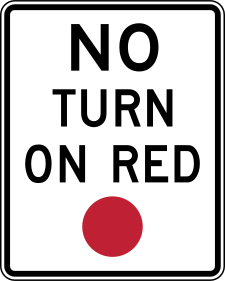
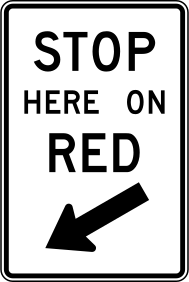
No Turn on Red limits a red light. Stop Here on Red moves where you stop.
What is the Left Turn Yield On Green sign often mistaken for?
A green arrow, which is a protected turn. The circular green is permissive; the arrow is not.
What does the permit test ask about the Left Turn Yield On Green sign?
This question is from the practice bank, with the answer marked.
You are turning left at a green light with no arrow. You must:
- A.Turn immediately, the green gives you priority
- B.Yield to oncoming traffic and pedestrians(correct answer)
- C.Wait for the light to turn yellow
- D.Sound the horn and proceed
Why: A circular green releases you into the intersection without handing you any claim on the gap. Wait out the oncoming line, let anyone in the crosswalk finish, and turn only when the whole maneuver fits.
Source: Uniform Vehicle Code, vehicle turning left
Questions drivers ask about the Left Turn Yield On Green sign
Can I turn left on a green ball if this sign is posted?
Yes. The sign is how Section 2B.59 clarifies that the circular green allows the turn and that you yield. Florida Statutes 316.075(1)(a)1 says traffic facing a circular green may turn left unless a sign prohibits the turn, and shall yield to vehicles and pedestrians lawfully in the intersection or an adjacent crosswalk. California Vehicle Code 21451(a) is the same structure, and adds a U-turn unless a sign prohibits it. R10-12 does not prohibit the turn. It states the yield.
Does a green arrow mean I can ignore oncoming cars and the crosswalk?
No. A green arrow is a different display from the circular green this sign describes, and it still carries duties. Florida Statutes 316.075(1)(a)2 lets a driver facing a green arrow enter only to make the movement the arrow shows, and requires a yield to pedestrians lawfully within an adjacent crosswalk and to other traffic lawfully using the intersection. California Vehicle Code 21451(b) requires a yield to other traffic and to a pedestrian lawfully within the intersection or an adjacent crosswalk. R10-12 is not the arrow sign.
Where should I look for the sign?
Section 2B.59 says that if R10-12 is used, it should be located adjacent to the left-turn signal face. A second copy, with an AT SIGNAL plaque, may be installed in advance when more emphasis is needed. The sign is 30 by 36 inches on a conventional road. Section 4F.07 says that on a shared signal face for a protected/permissive left turn, a supplementary sign is not required, and if one is used it shall be this one.
How big a gap do I need before I turn?
Neither California Vehicle Code 21801 nor Florida Statutes 316.122 publishes a distance or a number of seconds. California says yield to opposing vehicles close enough to be a hazard at any time during the turn, until the turn is reasonably safe. Florida says yield to an opposing vehicle in the intersection or so close as to be an immediate hazard, and to a vehicle lawfully passing on your left. The gap is that judgment, not a printed number.
Is this the same sign as a flashing yellow arrow?
No. Section 2B.59 lists them as two legends. R10-12 is Left Turn Yield on Green with a circular green symbol. R10-12a is Left Turn Yield on Flashing Yellow Arrow. Section 4F.08 says a separate left-turn face in protected/permissive mode shall not display a circular green. Treating a flashing yellow arrow as this sign's green ball is the mix-up.
Sources
- MUTCD 11th Edition, Chapter 2B, Table 2B-1
- MUTCD 11th Edition (December 2023), Section 2B.59 and Table 2B-1
- MUTCD 11th Edition (December 2023), Sections 4F.07 and 4F.08
- Florida Statutes 316.075 (2026)
- Florida Statutes 316.122 (2026)
- California Vehicle Code 21451
- California Vehicle Code 21801
What are the other regulatory signs?
All 39 regulatory signs on one page, or every US road sign by shape and color.
Test yourself on this sign and the rest of the set with a road signs practice test for Florida, Texas, California or New York.
The artwork is the federal design itself, which the manual dedicates to the public domain in MUTCD 11th Edition, Part 1, Section 1D.06, checked 2026-09-09. The Interstate Shield, the 511 pictograph and the National Scenic Byway graphic are named exceptions and are not reproduced anywhere on this site.
Source: Manual on Uniform Traffic Control Devices, 11th Edition. Not affiliated with or endorsed by the Federal Highway Administration or any state agency.