What does the No Turn On Red sign mean?
The No Turn On Red sign (MUTCD R10-11) is a regulatory sign under the federal Manual on Uniform Traffic Control Devices, the national standard the states build from. Stopping does not buy the turn here. Where the default rule would let you go right on red after a full stop, or left on red from one one-way street onto another, this sign cancels the permission until the light turns green.
Source: MUTCD 11th Edition, Chapter 2B, Table 2B-1, checked 2026-09-09.
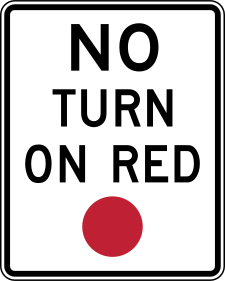
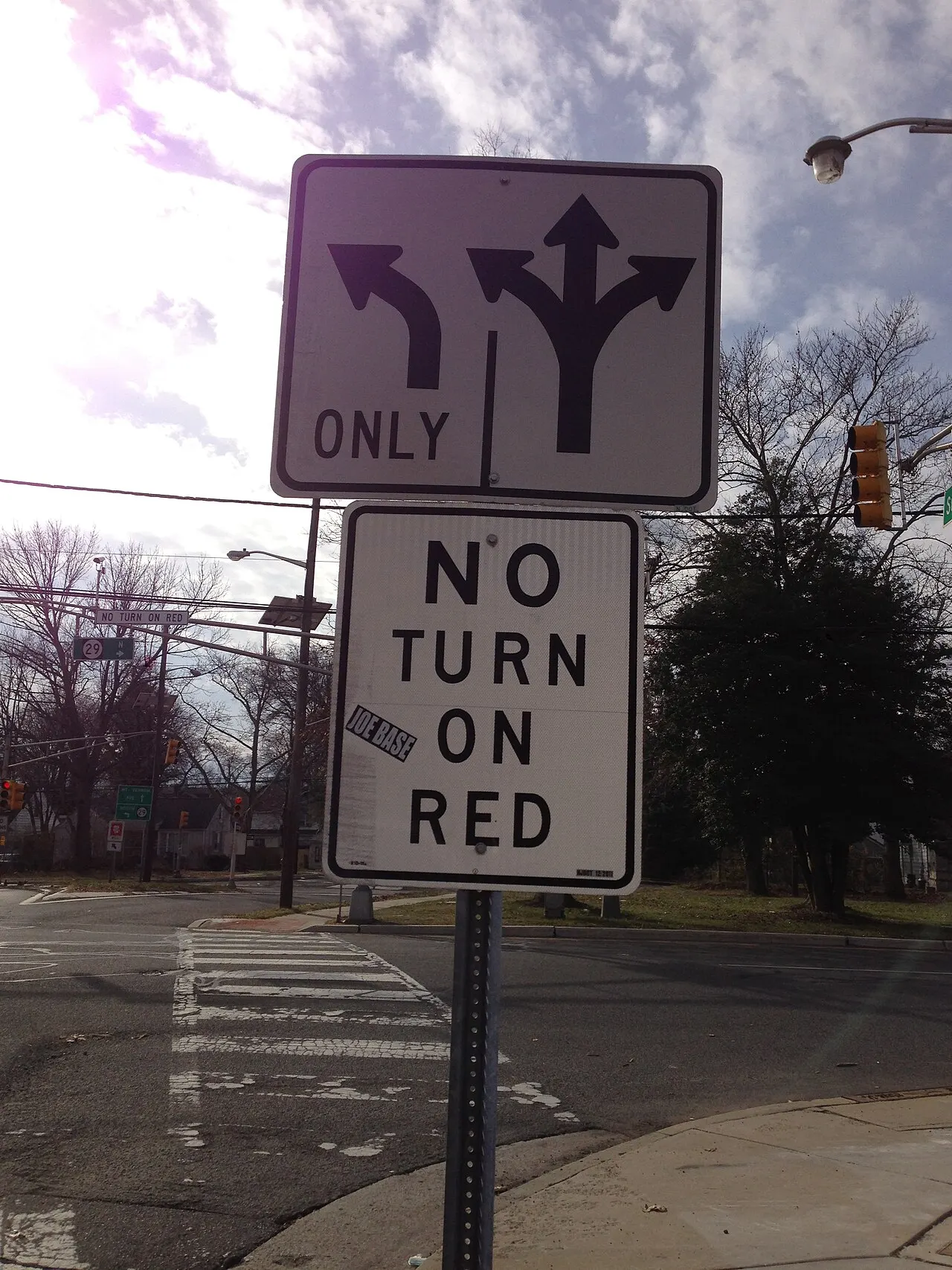
What shape and color is the No Turn On Red sign?
| MUTCD code | R10-11 |
|---|---|
| Group | Regulatory signs |
| Shape | Vertical rectangle |
| Color | White background, black legend and border, or with a red circle and slash over a signal symbol |
What a vertical rectangle means. Usually regulatory: a law you must obey. Speed limits, turn restrictions and parking rules take this shape.
What white means. Regulatory. A black legend on a white background is a law, not advice.
What red means. Stop, yield, or a prohibition. Red never advises, it always forbids or commands.
Regulatory signs. Every sign in this group has a statute behind it, so disobeying one is a citable offense on its own. Permit tests tend to word them as a duty you owe rather than show you the face.
Which design does the manual require, the words or the symbol?
Section 2B.60 draws a line. Where a right turn on a circular red is prohibited, or a left on a circular red from a one-way street onto a one-way street, the word sign R10-11 or R10-11b shall be used. The symbolic R10-11a shall be used when the approach is controlled by both circular red and red arrow indications. The symbol is not the Standard for a circular-red-only approach.
| Code | When Section 2B.60 uses it | What you may do |
|---|---|---|
| R10-11 or R10-11b | Circular red only, turn on red prohibited | Stay stopped until a green that allows your turn |
| R10-11a | Approach has both circular red and red arrow indications | Stay stopped. The symbol version is the one required here |
| R10-11c or R10-11d | More than one right-turn lane, and the ban is not for every lane | Turn on red only from a lane the sign leaves open |
| R10-17a | Turns on red are permitted and the indication is a steady red arrow | Stop, then turn. This sign permits, it does not ban |
Table 2B-1: R10-11 and R10-11a are 24 by 30 inches on a conventional road, 36 by 48 oversized. R10-11b is 24 by 24, oversized 36 by 36. Expressway and freeway cells are blank.
Guidance puts the sign near the appropriate signal head. A conventional-size R10-11, R10-11a, R10-11b, or R10-17a on the far side of the intersection, more than 120 feet from the stop line, shall have a duplicate on the near side. A part-time ban may use a blank-out sign, or a static sign with an hours legend or an R10-20aP hours plaque. Whether to ban the turn is Guidance after an engineering study. The listed conditions include poor sight distance, geometry that could cause unexpected conflicts, an exclusive pedestrian or bicycle phase, too many conflicts with pedestrians, more than three right-turn-on-red crashes in 12 months on that approach, and a skew that makes cross traffic hard to see.
The light is red and the sign is up. What do you do?
- 1Stop at the stop line and stay stopped
The sign removes the turn that a full stop would otherwise allow. Creeping into the cross street to "see better" is the turn.
- 2Do not borrow permission from another signal head
Read the head that faces your lane. A green arrow for a different movement does not release yours.
- 3On green, the turn can be legal again
R10-11 cancels the red permission. It is not R3-1. On a green that allows your movement, the turn is back, and you still yield to people in the crosswalk.
- 4A steady red arrow is a separate order
California Vehicle Code section 21453(c) and New York Vehicle and Traffic Law section 1111(d)(3) bar entering on a steady red arrow to make the arrow's movement. Where turns on red are permitted at a steady red arrow, Section 2B.60 says an R10-17a sign should be installed next to that arrow.
Priya Menon at a wide crossing
- 1On May 7, 2026, Priya is stopped at a circular red in California. The far-side NO TURN ON RED is 140 feet from her stop line, so Section 2B.60 requires the near-side duplicate she also sees. Both are conventional 24 by 30 inch word signs.
- 2Vehicle Code section 21453(b) would let her turn right after the stop in 21453(a), except when a sign prohibits the turn. The sign is there. A pedestrian is also in the crosswalk her turn would cross.
- 3She does not edge up. She waits for a green that allows the movement, then yields to anyone still in that crosswalk.
Outcome. Two signs are posted because 140 feet is past the 120-foot line in paragraph 4. Her stop did not revive the turn.
The conflict a legal right on red still has to yield
A driver who is allowed to turn on red yields to the person in the crosswalk yields.
California 21453(b), Florida 316.075(1)(c), and Texas 544.007(d) attach that yield to a turn on red the law allows. R10-11 takes the turn away, so you do not start across the crosswalk on red at all.
How do the four states word the permission this sign cancels?
California 21453(b) allows the right turn, or a left from one one-way street onto another, after the stop, except where a sign prohibits it, and requires a yield to pedestrians in the adjacent crosswalk and to a vehicle close enough to be an immediate hazard. Florida 316.075(1)(c) allows that right turn after the stop and the yield, and lets a city or county ban it with a sign visible to approaching traffic. A ban on the one-way-to-one-way left turn has to be a sign attached to the signal. Texas 544.007(d) allows the same two turns after the stop and the yield. Subsection (f) lets the Texas Transportation Commission, a city, or a county commissioners court prohibit the turn by posting notice at the intersection.
New York Vehicle and Traffic Law section 1111(d)(2) allows a right turn on a circular red, and a left from one one-way roadway onto another, after the stop and the yield, unless a sign prohibits it. That permission does not apply in a city of one million or more unless the city adopts a local law making it apply. The New York driver's manual gives the result for New York City: no turn on red there unless a sign permitting it is posted.
What is the No Turn On Red sign often mistaken for?
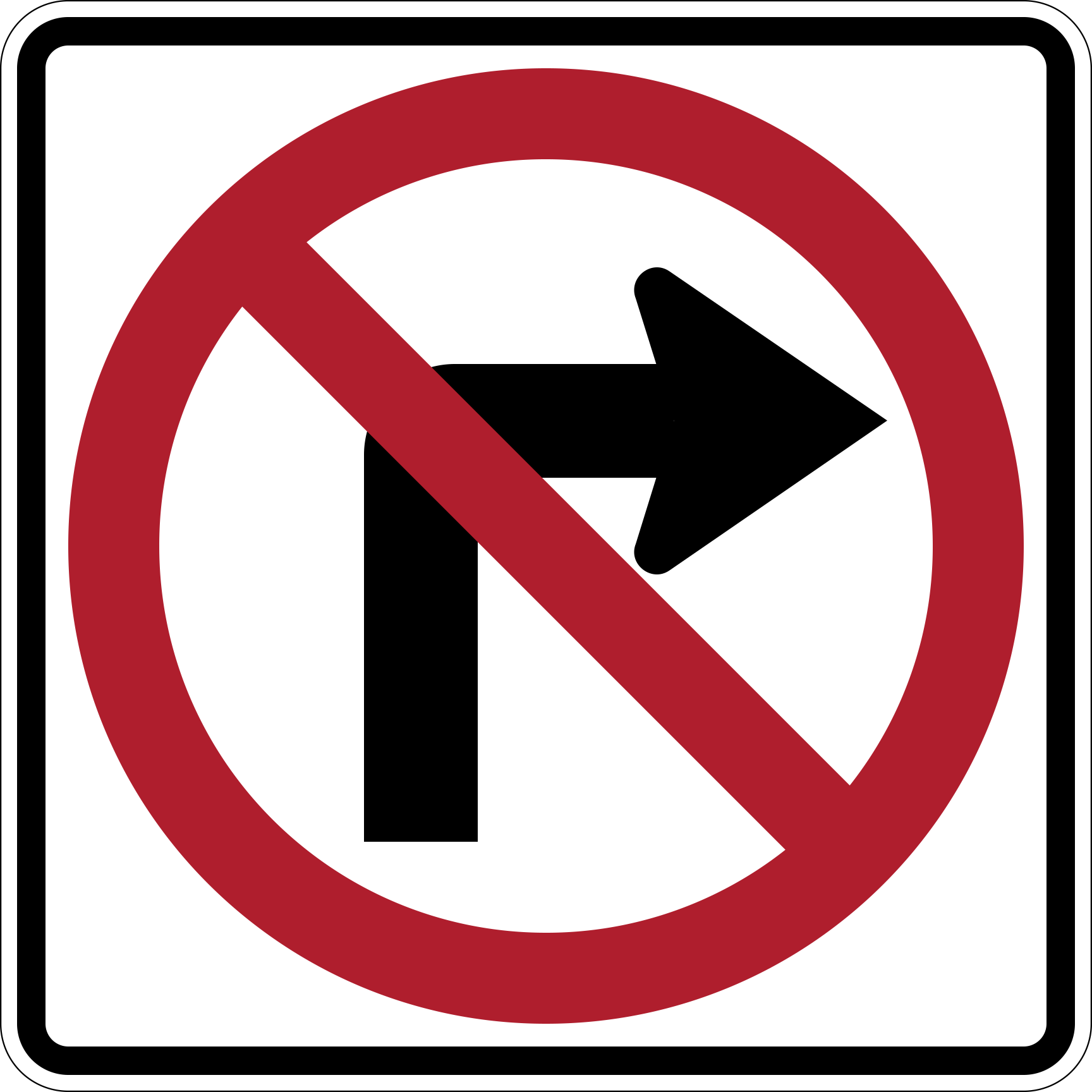
The default rule, which in most states permits a right turn on red after a full stop. Also confused with No Right Turn (R3-1), which bans the turn at all times, not just on red.
|  |
|---|---|
| GroupRegulatory signs | GroupRegulatory signs |
| ShapeVertical rectangle | ShapeSquare |
| ColorWhite background, black legend and border, or with a red circle and slash over a signal symbol | ColorWhite background, red circle and slash, black arrow |
| What it meansStopping does not buy the turn here. | What it meansA right turn out of this approach is prohibited. |
What does the permit test ask about the No Turn On Red sign?
This question is from the practice bank, with the answer marked.
Where this sign is posted:
- A.You may turn on red after a complete stop
- B.You must wait for a green signal before turning(correct answer)
- C.Turns are banned at all times
- D.Only left turns are banned on red
Source: MUTCD R10-11
Questions drivers ask about the No Turn On Red sign
Does this sign also ban the turn when the light is green?
No. Section 2B.60 is about prohibiting a turn on a circular red, or telling you which sign to use when both a circular red and a red arrow are present. The all-the-time ban is the movement prohibition sign R3-1. On a green that allows your movement, R10-11 is no longer the restriction, and you still yield to people lawfully in the crosswalk.
There is a red arrow and no sign at all. May I turn after stopping?
Not in California or New York. California Vehicle Code section 21453(c) says a driver facing a steady red arrow shall not enter the intersection to make that movement, and New York section 1111(d)(3) says the same. Where a turn on a steady red arrow is permitted, Section 2B.60 says the R10-17a sign, Right on Red Arrow After Stop, should be installed next to that arrow. Without a law and a sign granting it, treat the red arrow as a stop.
Why are there two No Turn on Red signs on one approach?
Paragraph 4 of Section 2B.60 requires a near-side duplicate when a conventional-size sign is on the far side and the stop line is more than 120 feet from it. A second sign can also be one of the lane versions, R10-11c or R10-11d, where there is more than one right-turn lane and the ban does not cover every lane. Read each legend. They are not always copies.
Is right on red the default in New York City?
No. Vehicle and Traffic Law section 1111(d)(2) withholds the usual right-on-red and one-way-to-one-way left-on-red from a city of one million or more unless the city adopts a local law, and the New York driver's manual says turning on red in New York City is not allowed unless a sign permitting it is posted. Elsewhere in the state, the turn is allowed after the stop and the yield unless a sign prohibits it.
Sources
- MUTCD 11th Edition, Chapter 2B, Table 2B-1
- MUTCD 11th Edition (December 2023), Chapter 2B, Section 2B.60 and Table 2B-1
- California Vehicle Code section 21453
- Florida Statutes section 316.075 (2026)
- Texas Transportation Code section 544.007
- New York Vehicle and Traffic Law section 1111
- New York DMV, Driver's Manual, Chapter 4: Traffic Control
What are the other regulatory signs?
All 39 regulatory signs on one page, or every US road sign by shape and color.
Test yourself on this sign and the rest of the set with a road signs practice test for Florida, Texas, California or New York.
The artwork is the federal design itself, which the manual dedicates to the public domain in MUTCD 11th Edition, Part 1, Section 1D.06, checked 2026-09-09. The Interstate Shield, the 511 pictograph and the National Scenic Byway graphic are named exceptions and are not reproduced anywhere on this site.
Source: Manual on Uniform Traffic Control Devices, 11th Edition. Not affiliated with or endorsed by the Federal Highway Administration or any state agency.