What does the Roundabout Directional sign mean?
The Roundabout Directional sign (MUTCD R6-4, R6-4a, R6-4b) is a regulatory sign under the federal Manual on Uniform Traffic Control Devices, the national standard the states build from. Circulate around the central island in the direction the chevrons point.
Source: MUTCD 11th Edition, Chapter 2B, Table 2B-1, checked 2026-09-09.
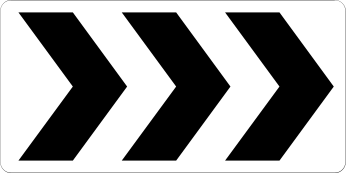
What shape and color is the Roundabout Directional sign?
| MUTCD code | R6-4, R6-4a, R6-4b |
|---|---|
| Group | Regulatory signs |
| Shape | Horizontal rectangle |
| Color | Black background, white chevrons and border |
What a horizontal rectangle means. Usually guidance: direction, distance and destination. Also used for some regulatory plaques mounted under another sign. Rectangles are the loosely assigned outline in the system, though, so on this sign the shape alone does not tell you its family; the color and the legend do.
What black means. Used with white for regulatory signs where the legend needs to dominate, such as ONE WAY.
Regulatory signs. Every sign in this group has a statute behind it, so disobeying one is a citable offense on its own. Permit tests tend to word them as a duty you owe rather than show you the face.
Where does the chevron panel stand, and what does the manual use now?
Chapter 2B of the December 2023 MUTCD no longer lists R6-4, R6-4a, or R6-4b. The 2009 edition covered them in Section 2B.43: white rectangles with two, three, or four black chevrons pointing right, mounted on the central island. Sections 2B.49 and 2B.51 of the 11th Edition, which now cover signing on and around the island, set no date for taking old panels down. A panel still on an island is an older installation. Follow the direction it points.
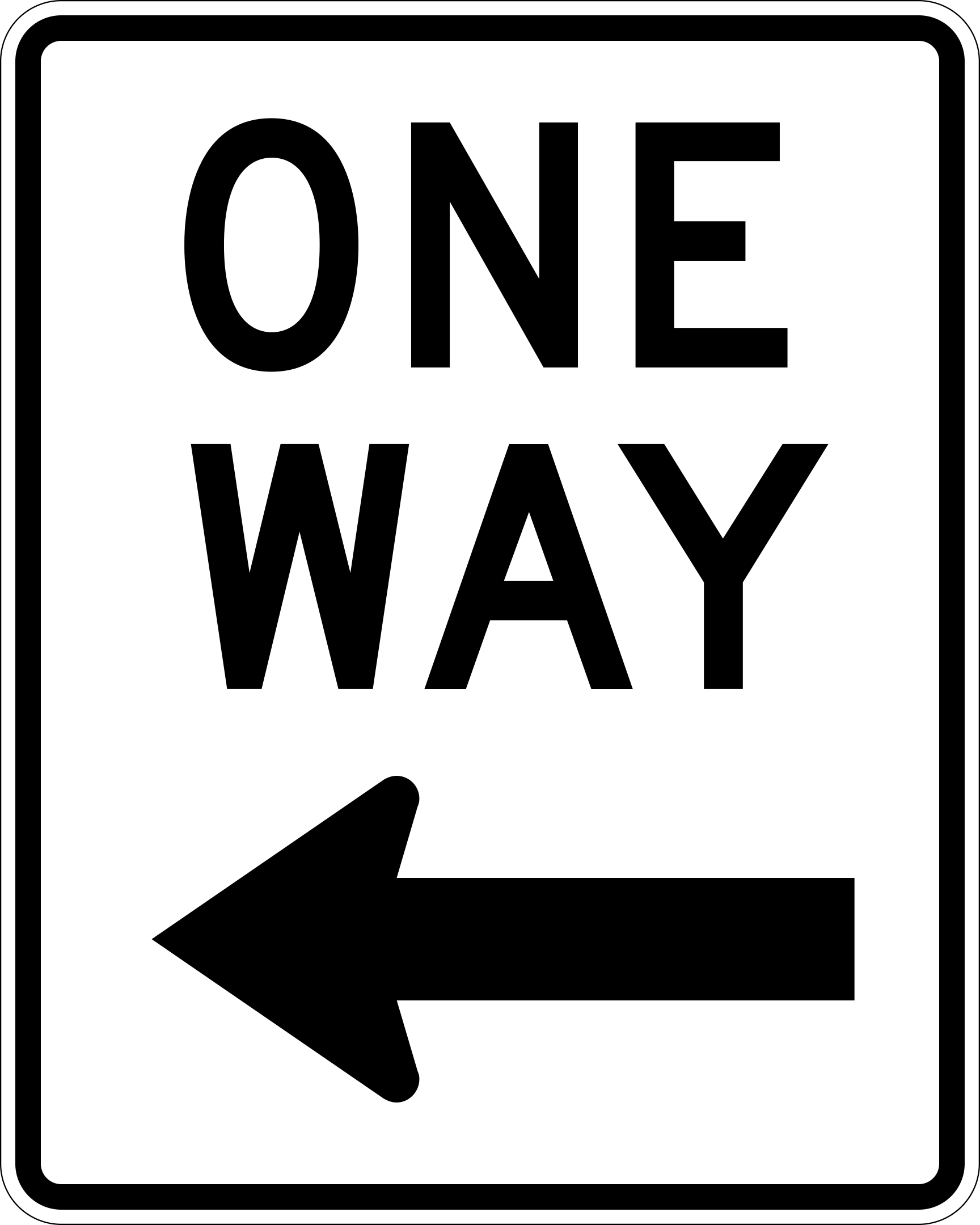
Where the island has room, Section 2B.49 paragraph 12 allows a ONE WAY sign to send traffic counter-clockwise. Paragraph 13 says the bottom of that sign should be at least 4 feet above the near edge of the traveled way. Where the island cannot hold a sign, Section 2B.51 says a Roundabout Circulation plaque (R6-5P) should go under the YIELD on each approach. The plaque may also be added when the island already has ONE WAY signs.
| Device | Where it is | What you do with it |
|---|---|---|
| YIELD (R1-2) | Each entrance, never on the circle (Section 2B.10). | Slow, stop if you need to, yield to traffic already in the circle. |
| ONE WAY | Central island, if it can hold a sign. | Counter-clockwise only. |
| R6-5P plaque | Under each YIELD if the island cannot hold a sign. | Same direction, read before you enter. |
| Older R6-4 panel | Some islands. Not in the 11th Edition. | Follow the chevrons. A missing panel is not a choice of sides. |
Section 2B.10 allows a YIELD on every approach at a roundabout. That is the exception to the usual ban on yielding every leg.
Section 2C.08 paragraph 11 forbids Chevron Alignment signs that direct traffic to the right in the central island. Paragraph 04 puts those yellow chevrons on the outside of a curve. On a multi-lane approach with a raised splitter island, Section 2B.18 paragraph 15 says a second YIELD should stand on the left. On a single-lane approach, paragraph 16 makes that left-side YIELD optional. Section 2B.19 paragraph 07 says Yield Here to Pedestrians signs should not be used ahead of a crosswalk entering or leaving a roundabout.
What do you do from the entrance to your exit?
- 1Deal with the YIELD before the island
It controls the approach, not the circle. If you must stop, Florida Statutes 316.123(3) puts the stop before the near-side crosswalk or, with no crosswalk, at the point nearest the circle where you can see approaching traffic.
- 2Look left and take a real gap
Counter-clockwise traffic comes from your left. Stop when the gap is too short. A yield sign does not require a stop when the way is clear. If you drive past the yield without stopping and collide with a vehicle in the intersection or a pedestrian in the crosswalk, 316.123(3) makes the collision prima facie evidence that you failed to yield.
- 3Keep the island on your left
Florida 316.088(3) says a vehicle passing around a rotary traffic island is driven only to the right of it. New York Vehicle and Traffic Law 1127(b) says the same for a circular intersection unless a device indicates otherwise. New York 1145 says you yield to any vehicle already traveling on the circle unless a device directs otherwise.
- 4Do not stop beside the panel
Once you are on the circulatory roadway, the next entrance yields to you. Stopping at the chevrons traps the drivers behind you.
Entering while a car is already in the circle
The driver at the entrance yields.
Section 2B.10 puts the YIELD on the approach, so the car already on the circulatory roadway keeps moving.
What does Priya Kapoor do with a van 60 feet to her left?
A 35 mph approach at 2:15 p.m.
- 1At 2:15 p.m. on March 12, 2026, Priya Kapoor is northbound in Florida on a two-lane road posted 35 mph, heading into a single-lane roundabout with four legs. A YIELD is on her right. An older chevron panel on the island points to her right. This leg has no crosswalk.
- 2She slows from 30 mph to about 15. A white van is already on the circle, about 60 feet to her left. Entering now would make the van brake, so she stops. With no crosswalk, 316.123(3) puts that stop at the point nearest the circle where she can see traffic coming.
- 3The van passes. She enters to the right of the island, keeps moving past the panel, and leaves at the third exit, the road to her left.
Outcome. She reached the road on her left by going counter-clockwise past two exits, not by turning left at the entrance. The panel was not a four-way stop.
Which choices sound plausible and are wrong?
- "Stop at the island and take turns." Traffic already in the circle has the right-of-way. Arrival order is not the rule.
- "Pass the island on either side." The chevrons point one way. Florida 316.088(3) requires the right side, and New York 1127(b) does too unless a device says otherwise.
- "Yields on every leg are a mistake." Section 2B.10 paragraph 06 allows that at a roundabout.
- "The panel sets the circle's speed." It has no number, and none of the sections cited here sets a national roundabout speed. Where an agency posts an advisory speed, Section 2C.59 puts it on a W13-1P plaque under an advance warning sign.
An island that looks empty can hide a car behind the splitter. The chevrons, or the ONE WAY sign, only show direction after you have yielded.
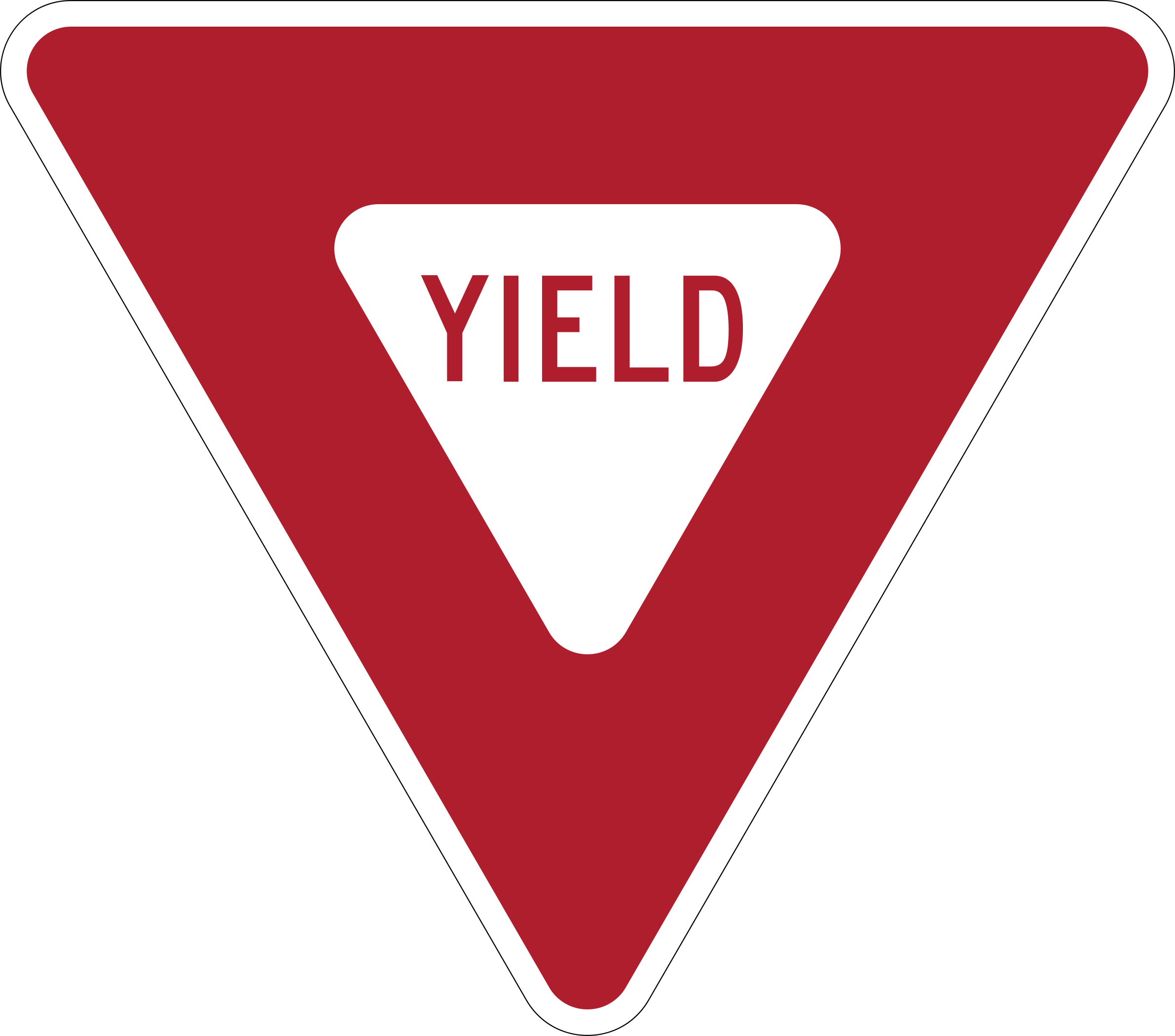
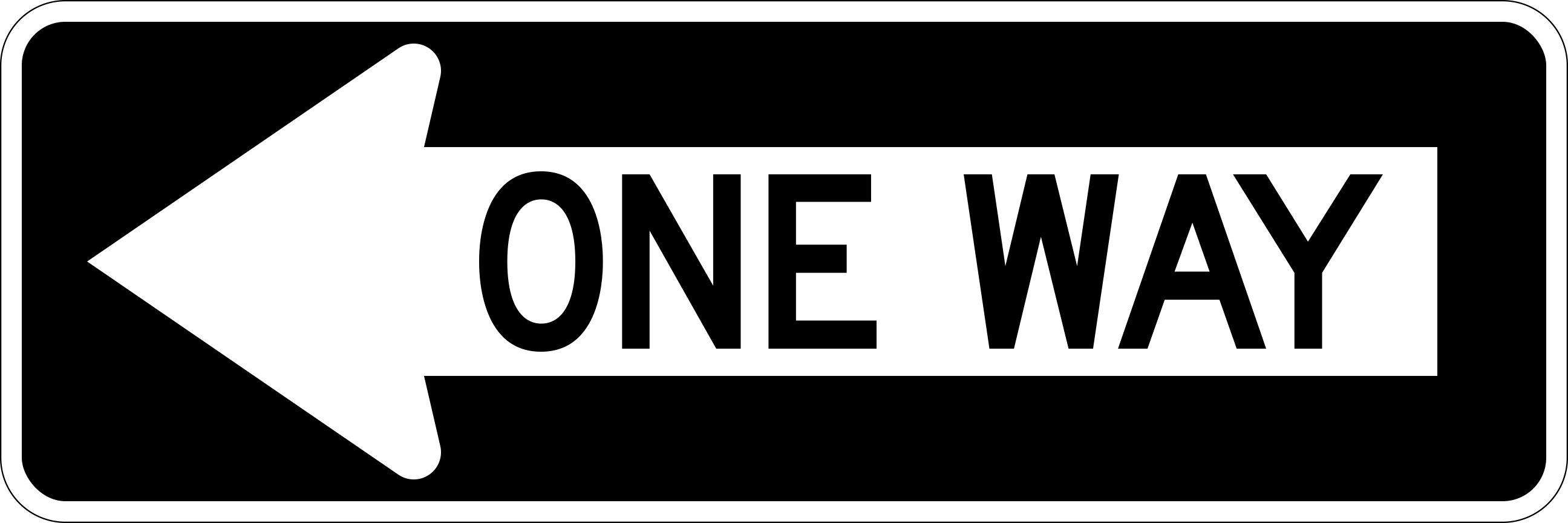
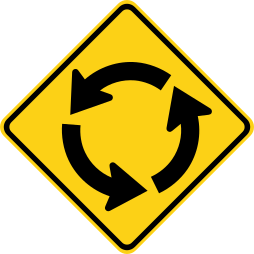

YIELD controls the entrance. ONE WAY is the island sign Section 2B.49 allows. The diamond warns on the approach. The yellow chevron marks a curve, and Section 2C.08 bars right-pointing ones from the central island.
What is the Roundabout Directional sign often mistaken for?
The Chevron Alignment sign (W1-8), which is yellow with a single black chevron and marks a curve. Black-and-white chevrons at a roundabout are regulatory.
| |
|---|---|
| GroupRegulatory signs | GroupWarning signs |
| ShapeHorizontal rectangle | ShapeVertical rectangle |
| ColorBlack background, white chevrons and border | ColorYellow background, black chevron and border |
| What it meansCirculate around the central island in the direction the chevrons point. | What it meansMarks the direction of the curve; several are placed through the bend so one is always in view. |
Which signs get mistaken for the Roundabout Directional sign?
- Circular Intersection (Roundabout Ahead)W2-6
The black-and-white roundabout directional sign (R6-4) at the island itself, and the ROUNDABOUT plaque (W16-12aP) which is text, not a symbol.
What does the permit test ask about the Roundabout Directional sign?
This question is from the practice bank, with the answer marked.
When entering a roundabout in the United States you yield to:
- A.Traffic waiting to enter
- B.Traffic already circulating, approaching from your left(correct answer)
- C.Traffic approaching from your right
- D.Nobody, roundabouts are uncontrolled
Why: US roundabouts run counterclockwise, so circulating traffic reaches you from the left. Yield to it, enter in a gap, and signal right as you leave.
Source: Federal MUTCD, 11th Edition (FHWA)
Questions drivers ask about the Roundabout Directional sign
Do I have to stop at every roundabout?
No. Section 2B.10 requires a YIELD at each entrance, not a STOP. Florida Statutes 316.123(3) spells out what a yield asks: slow to a speed reasonable for the conditions, stop only if safety requires it, and yield to any vehicle in the intersection or approaching so closely as to be an immediate hazard. An empty circle does not require a full stop.
The road I want is to the left. Do I turn left at the entrance?
No. You enter to the right of the island and go counter-clockwise until that exit comes around. Florida Statutes 316.088(3) says a vehicle passing around a rotary traffic island is driven only to the right of it. A left turn at the entrance would put you against traffic already in the circle. The chevron panel, or the ONE WAY sign used on newer islands, points that same direction.
Two of us reach different entrances at the same moment. Who goes?
Look at the circle, not at the other entrance. New York Vehicle and Traffic Law 1145 says that, unless a traffic control device directs otherwise, the driver about to enter yields to any vehicle already traveling on the circle. If neither of you is in the circle yet, each of you yields to traffic that is, and you take the gap that does not conflict with the other entrance.
If the new manual uses a ONE WAY sign, is an old chevron panel something I can ignore?
No. The 11th Edition no longer lists R6-4, R6-4a, and R6-4b, and Sections 2B.49 and 2B.51 set no removal deadline. A panel that is still mounted is telling you the direction around that island. The legal duties sit in the YIELD at the entrance and in the state rule that you pass the island on the right.
Sources
- MUTCD 11th Edition, Chapter 2B, Table 2B-1
- MUTCD 11th Edition (December 2023), Section 2B.10, YIELD signs at roundabout entrances
- MUTCD 11th Edition, Section 2B.18, extra YIELD on a splitter island
- MUTCD 11th Edition, Section 2B.19, Yield Here to Pedestrians signs not used on roundabout approaches
- MUTCD 11th Edition, Section 2B.49, ONE WAY signs on the central island
- MUTCD 11th Edition, Section 2B.51, Roundabout Circulation plaque (R6-5P)
- MUTCD 11th Edition, Sections 2C.08 and 2C.59, Chevron Alignment signs barred from the central island, and the Advisory Speed plaque
- MUTCD 2009 Edition, Section 2B.43, Roundabout Directional Arrow signs (R6-4 series)
- Florida Statutes 316.088, one-way roadways and rotary traffic islands (2026)
- Florida Statutes 316.123, vehicle entering a stop or yield intersection (2026)
- New York Vehicle and Traffic Law 1145, vehicle approaching a rotary traffic circle
- New York Vehicle and Traffic Law 1127, one-way roadways and circular intersections
What are the other regulatory signs?
All 39 regulatory signs on one page, or every US road sign by shape and color.
Test yourself on this sign and the rest of the set with a road signs practice test for Florida, Texas, California or New York.
The artwork is the federal design itself, which the manual dedicates to the public domain in MUTCD 11th Edition, Part 1, Section 1D.06, checked 2026-09-09. The Interstate Shield, the 511 pictograph and the National Scenic Byway graphic are named exceptions and are not reproduced anywhere on this site.
Source: Manual on Uniform Traffic Control Devices, 11th Edition. Not affiliated with or endorsed by the Federal Highway Administration or any state agency.