What does the No Right Turn sign mean?
The No Right Turn sign (MUTCD R3-1) is a regulatory sign under the federal Manual on Uniform Traffic Control Devices, the national standard the states build from. A right turn out of this approach is prohibited. Stopping first does not earn it, the way it would at a plain red light.
Source: MUTCD 11th Edition, Chapter 2B, Table 2B-1, checked 2026-09-09.
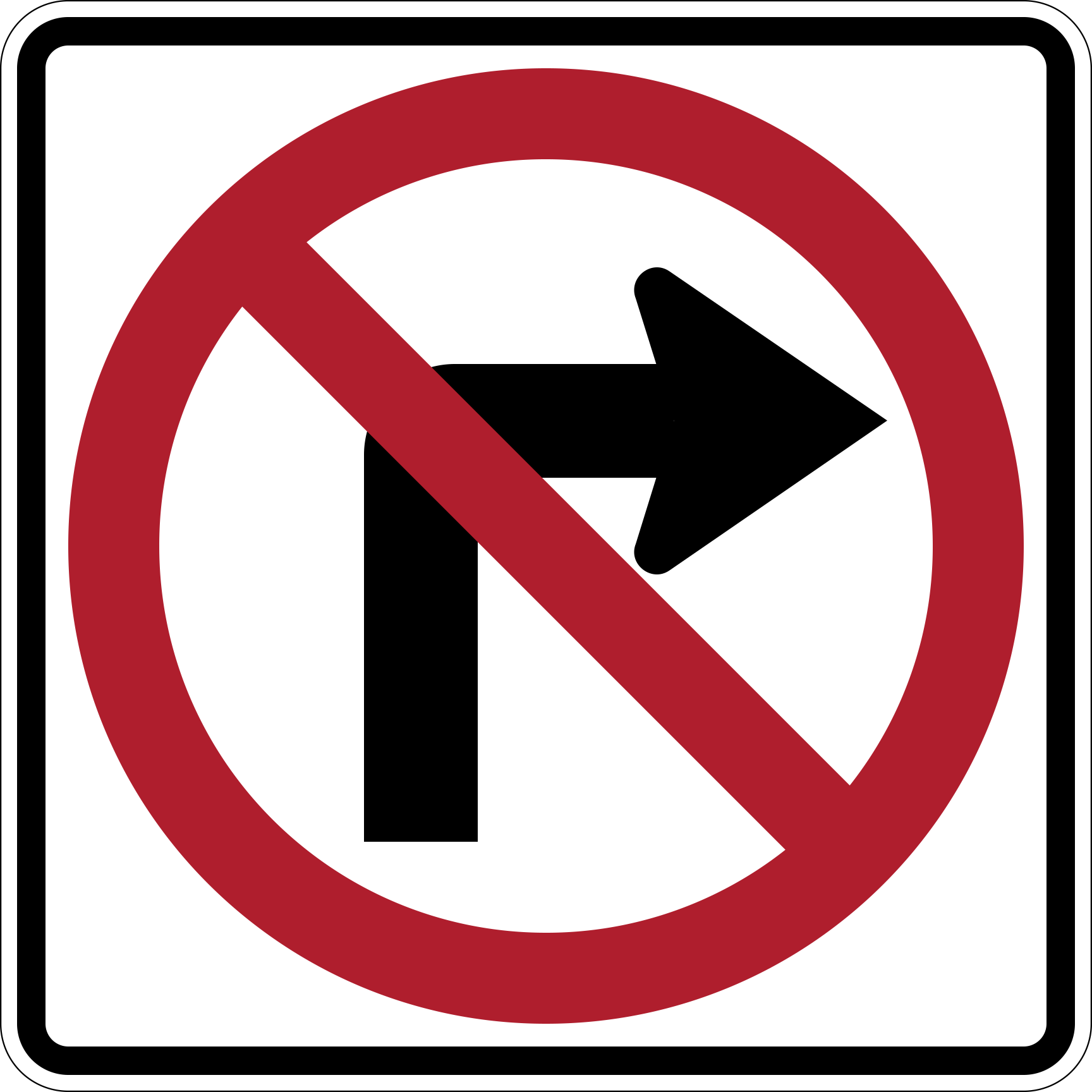
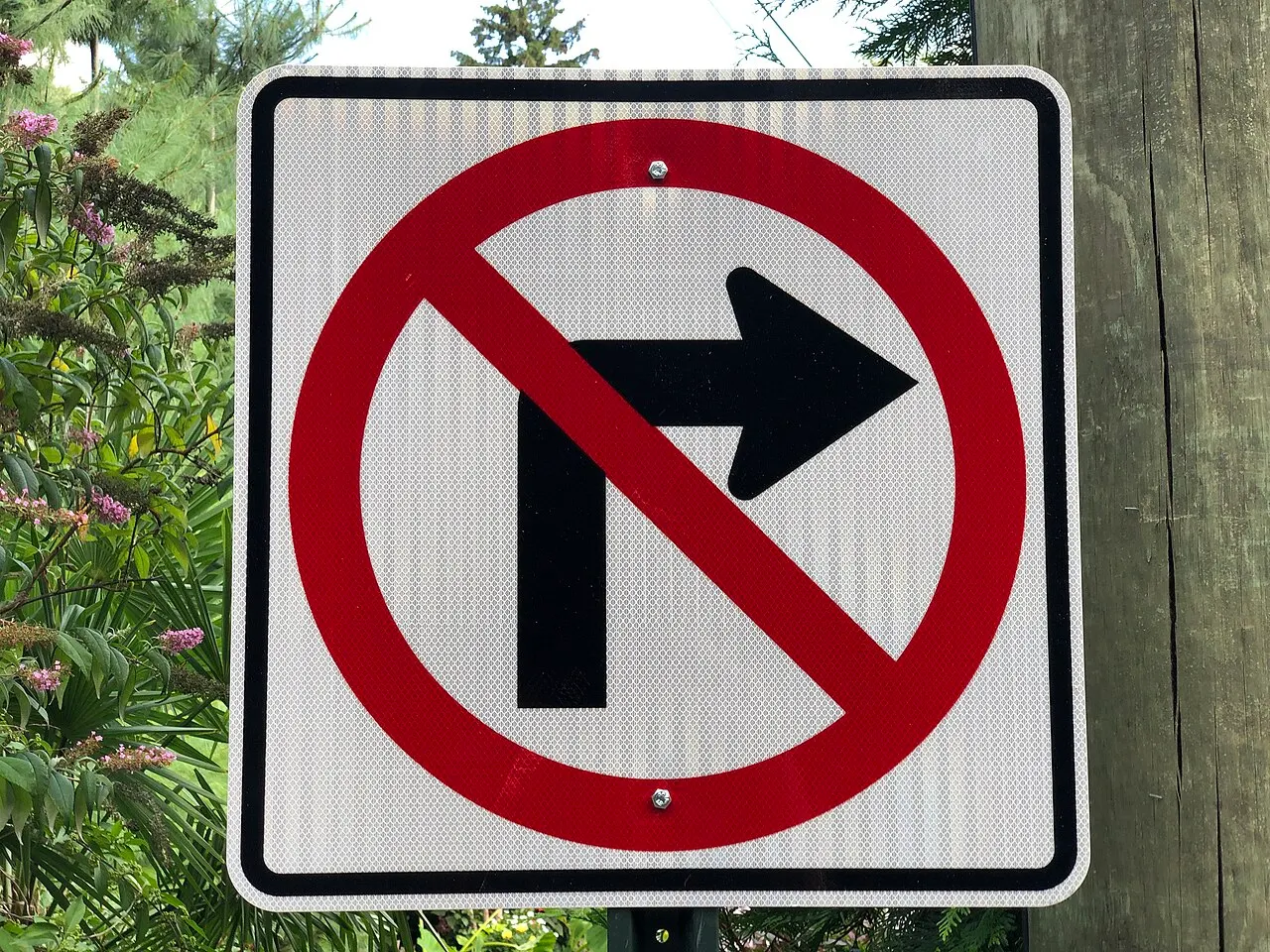
What shape and color is the No Right Turn sign?
| MUTCD code | R3-1 |
|---|---|
| Group | Regulatory signs |
| Shape | Square |
| Color | White background, red circle and slash, black arrow |
What white means. Regulatory. A black legend on a white background is a law, not advice.
What red means. Stop, yield, or a prohibition. Red never advises, it always forbids or commands.
Regulatory signs. Every sign in this group has a statute behind it, so disobeying one is a citable offense on its own. Permit tests tend to word them as a duty you owe rather than show you the face.
Does R3-1 close one lane, or the whole approach?
Section 2B.26, paragraph 2, is Guidance that answers the lane question. Movement prohibition signs should be used to prohibit a turn from an entire approach. They should not be used to say what one lane of a multi-lane approach must do. Lane-by-lane orders belong to the lane control signs in Sections 2B.27 through 2B.30. If you are in the middle lane, the right-turn ban still includes you.
Placement follows the drivers who want the turn. At least one R3-1 should be over the roadway or at a right-hand corner. At a signal, it should sit next to a signal face that right-lane drivers see, and a post-mounted sign may be added to supplement an overhead one. Where One Way signs are used, paragraph 13 allows No Right Turn and No Left Turn signs to be omitted. A missing R3-1 next to a One Way is not proof the turn is open. The One Way may be doing that work.
A ban that lasts only part of the day has a preference order in paragraph 14. First choice is a blank-out or changeable message sign that shows the prohibited movement only while it applies, especially at signals. Second is a permanent sign with hours and days on it (R3-1g or R3-1h). Last is a portable sign, off the roadway at each corner, used only while the ban applies. A symbol with no hours is not a part-time ban.
The light is green and the right turn is the one you need. Then what?
- 1Drop the right turn on this approach
Stopping, a green light, or a gap in cross traffic does not buy the movement. The sign is the prohibition. The signal does not outrank it.
- 2Do not change lanes to "get past" the sign
The Guidance is an entire-approach ban. Sliding from the through lane into the right lane still points you at the prohibited movement.
- 3Go straight, or turn where the approach allows it
The legal right turn is a later junction that does not have this sign, or a different approach the agency has left open.
- 4Read any supplementary legend before you decide you are exempt
Versions R3-1b through R3-1d limit the ban to a vehicle class, and R3-1e and R3-1f state an exception. Without such a legend, the sign applies to the whole approach, not only to trucks.
Luis Ortega in the middle lane
- 1On January 22, 2026, Luis is driving in Florida and approaches a signal at 25 mph on a 30 mph street. He is in the middle of three lanes, about 60 feet from the stop line. The circular signal is green.
- 2An R3-1 stands at the right-hand corner, and another is beside the signal face aimed at the right lane. That pair matches the placement Guidance in Section 2B.26.
- 3Florida Statutes section 316.075(1)(a)1. would otherwise let him turn right on a circular green. The same sentence withholds that permission where a sign prohibits the turn. He stays in the middle lane and goes straight.
Outcome. Changing lanes to turn would still have been the prohibited movement. The sign covers the approach, not only the car sitting in the right lane.
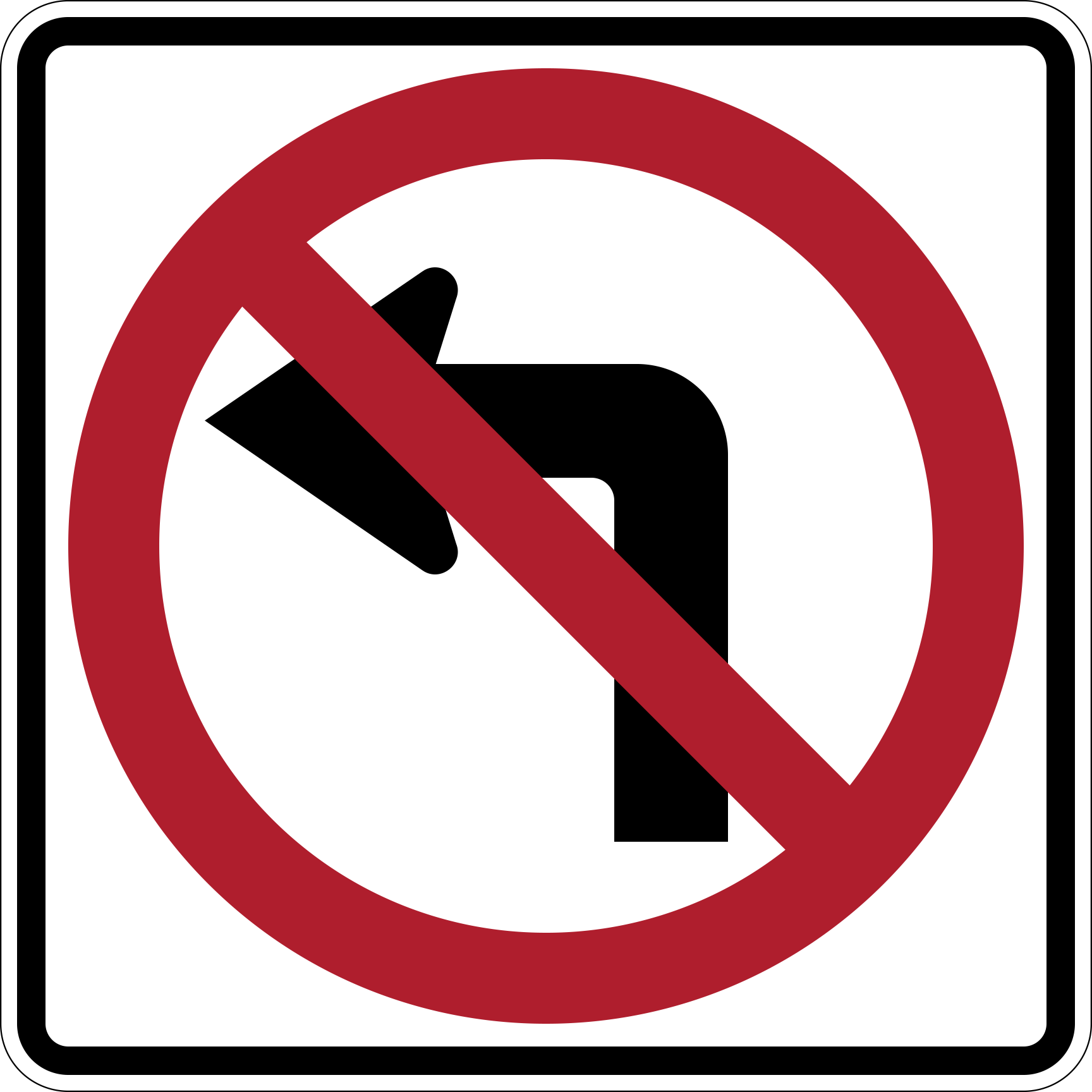
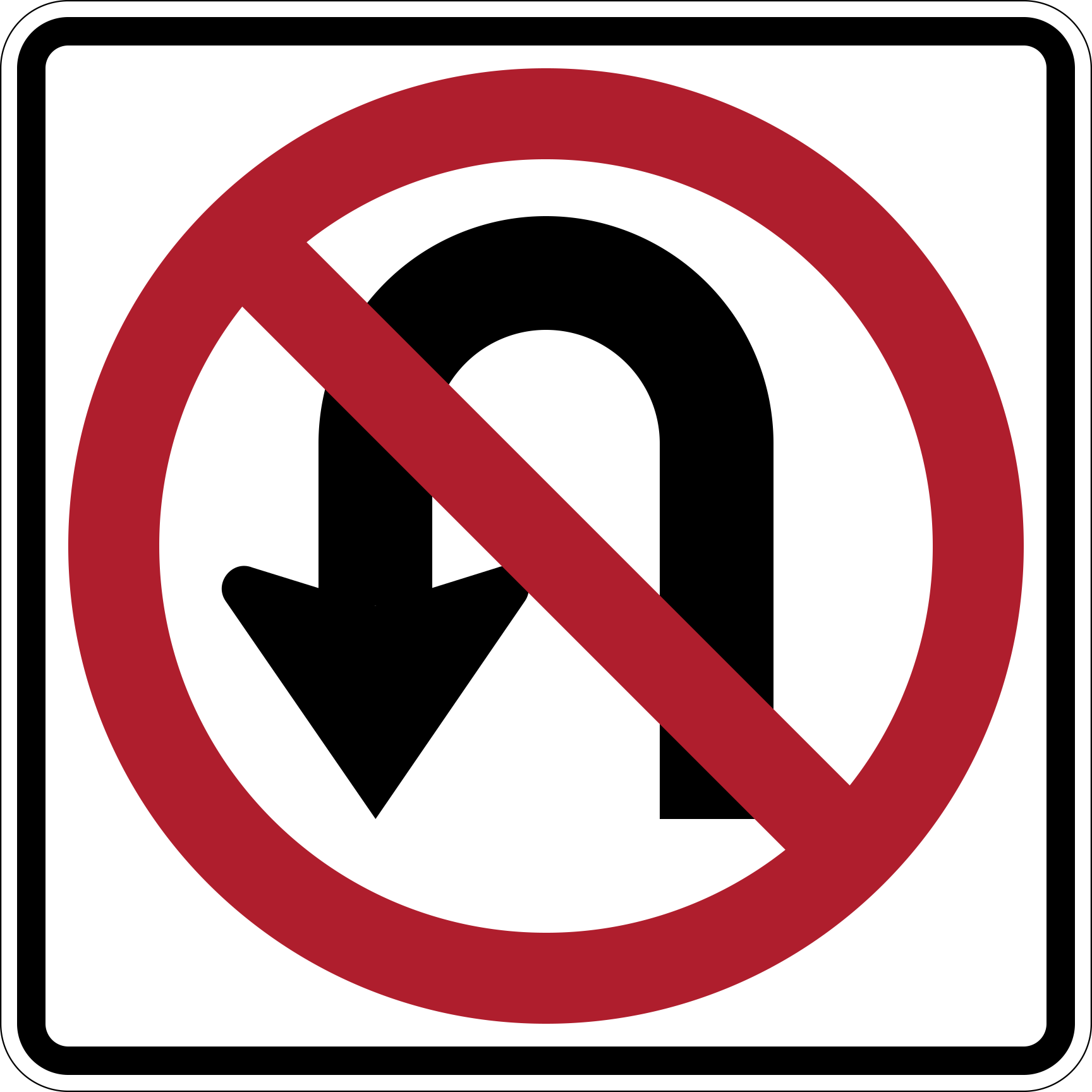
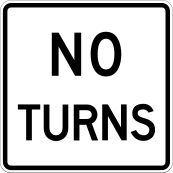
Each of these is a movement prohibition sign under Section 2B.26. The arrow is the whole of the difference. No Turns closes left and right. A right-arrow slash does not close the left.
Which statutes say a sign beats the usual turn?
Florida Statutes section 316.075(1)(a)1. says vehicular traffic facing a circular green may proceed straight or turn right or left unless a sign at that place prohibits the turn. Turning traffic still yields to other vehicles and to pedestrians lawfully in the intersection or an adjacent crosswalk. Texas Transportation Code section 544.007(b) has the same structure: a circular green allows straight, right, or left unless a sign prohibits the turn, and the operator yields to other vehicles lawfully in the intersection and stops and yields to pedestrians lawfully in it or in an adjacent crosswalk.
California Vehicle Code section 21461(a) makes it unlawful to fail to obey a sign the federal MUTCD defines as regulatory, including one erected to carry out the code or a local traffic ordinance. New York Vehicle and Traffic Law section 1160(d) says that where markers or signs require a different course from the usual turn path, no driver shall turn other than as those signs direct. New York section 1110(a) adds the general duty to obey an official traffic-control device. None of these sections prints a fine.
Table 2B-1 sizes for R3-1 match the rest of the movement prohibition row: 24 by 24 inches on a single-lane conventional road, 36 by 36 on multi-lane and expressway, 48 by 48 oversized. Freeway and minimum are not given for that row.
What is the No Right Turn sign often mistaken for?
No U-Turn (R3-4) and No Left Turn (R3-2). All three are the same square with a different black arrow inside the red circle, and the U-turn arrow curls back on itself.
| | |
|---|---|---|
| GroupRegulatory signs | GroupRegulatory signs | GroupRegulatory signs |
| ShapeSquare | ShapeSquare | ShapeSquare |
| ColorWhite background, red circle and slash, black arrow | ColorWhite background, red circle and slash, black U-shaped arrow | ColorWhite background, red circle and slash, black arrow |
| What it meansA right turn out of this approach is prohibited. | What it meansTurning back on yourself is prohibited at this opening, so carry on and find a legal place to reverse direction. | What it meansA left turn out of this approach is prohibited, so the movement has to be made at another intersection. |
Which signs get mistaken for the No Right Turn sign?
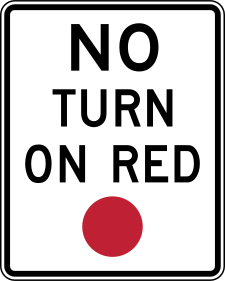 No Turn On RedR10-11
The default rule, which in most states permits a right turn on red after a full stop. Also confused with No Right Turn (R3-1), which bans the turn at all times, not just on red.
What does the permit test ask about the No Right Turn sign?
This question is from the practice bank, with the answer marked.
A red circle with a diagonal slash over a symbol means:
- A.A warning about the symbol
- B.The action shown is prohibited(correct answer)
- C.The action shown is required
- D.Services related to the symbol
Why: Red with a slash always prohibits. The symbol tells you what is banned, such as a U-turn, a right turn or trucks.
Source: Federal MUTCD, 11th Edition (FHWA)
Questions drivers ask about the No Right Turn sign
I stopped for the red light. May I turn right once it is clear?
Not if R3-1 is the sign facing you. That sign prohibits the right turn from the approach, on red and on green. The sign that cancels only the red-light permission is a different design, the No Turn on Red series in Section 2B.60. Stopping and waiting does not satisfy R3-1.
I am in the through lane, not the right lane. Does the sign skip me?
No. Section 2B.26 says these signs should prohibit the movement from the entire approach and should not be used as lane control. Lane control has its own signs. Being one lane left of the curb does not take you out of the ban.
The sign has no clock on it. Is the ban only in rush hour?
A part-time ban is supposed to show its hours, either on a blank-out sign, on an R3-1g or R3-1h legend, or on a portable sign used only during the ban. A plain symbol with no hours is the full prohibition. Do not guess a time window the sign does not print.
One Way signs are up and this sign is missing. Is the right turn open?
Not necessarily. Paragraph 13 of Section 2B.26 allows No Right Turn and No Left Turn signs to be omitted where One Way signs are used. The One Way face is then what tells you the cross street's direction. Turn only if that direction matches the way you want to go.
Sources
- MUTCD 11th Edition, Chapter 2B, Table 2B-1
- MUTCD 11th Edition (December 2023), Chapter 2B, Section 2B.26 and Table 2B-1
- Florida Statutes section 316.075 (2026)
- Texas Transportation Code section 544.007
- California Vehicle Code section 21461
- New York Vehicle and Traffic Law section 1110
- New York Vehicle and Traffic Law section 1160
What are the other regulatory signs?
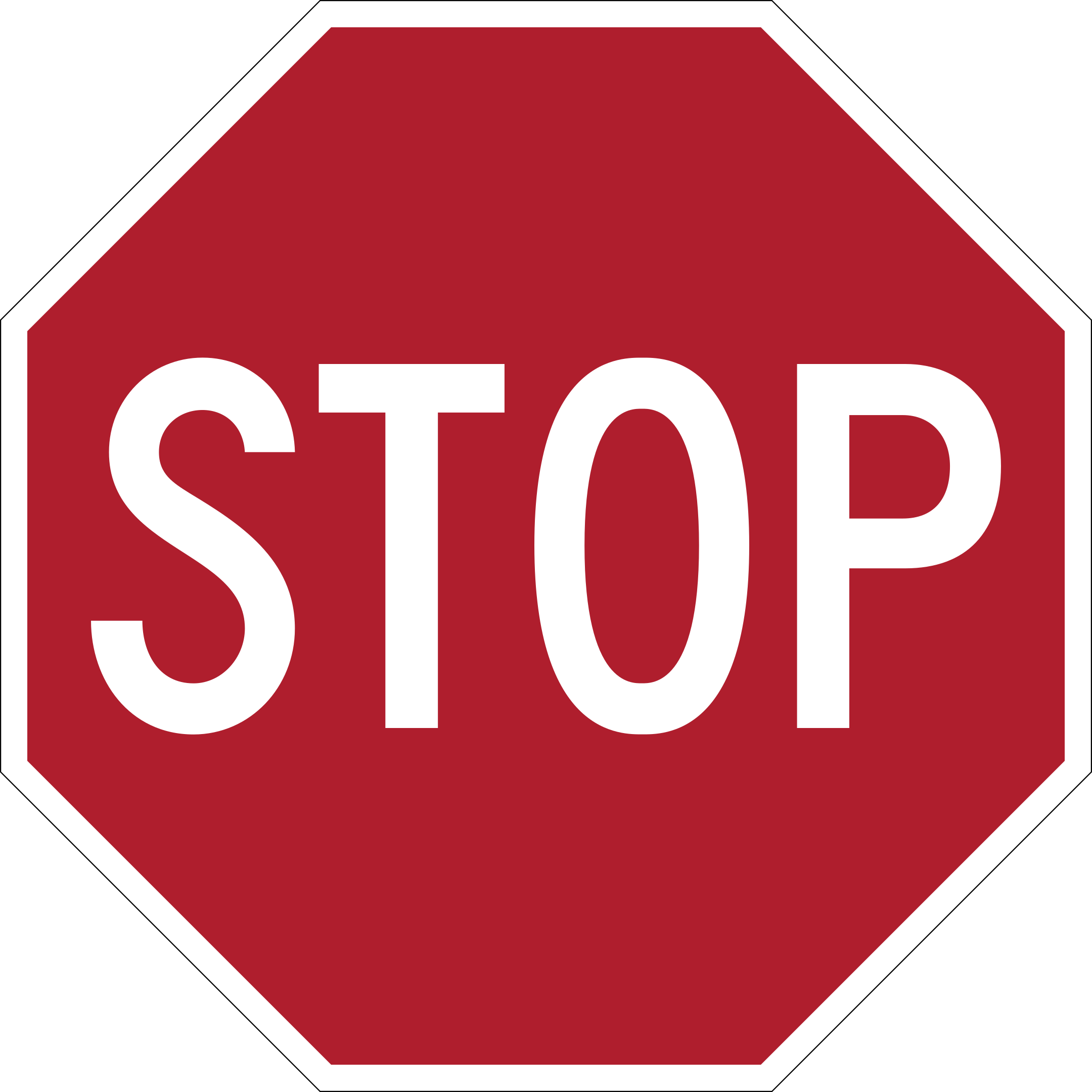
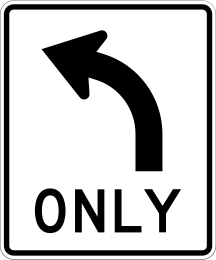
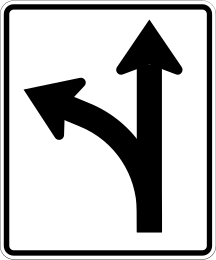
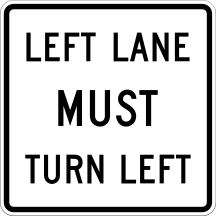
All 39 regulatory signs on one page, or every US road sign by shape and color.
Test yourself on this sign and the rest of the set with a road signs practice test for Florida, Texas, California or New York.
The artwork is the federal design itself, which the manual dedicates to the public domain in MUTCD 11th Edition, Part 1, Section 1D.06, checked 2026-09-09. The Interstate Shield, the 511 pictograph and the National Scenic Byway graphic are named exceptions and are not reproduced anywhere on this site.
Source: Manual on Uniform Traffic Control Devices, 11th Edition. Not affiliated with or endorsed by the Federal Highway Administration or any state agency.