What does the All Way plaque mean?
The All Way plaque (MUTCD R1-3P) is a regulatory sign under the federal Manual on Uniform Traffic Control Devices, the national standard the states build from. Every approach to this intersection is stop-controlled, so all drivers must stop.
Source: MUTCD 11th Edition, Chapter 2B, Table 2B-1, checked 2026-09-09.
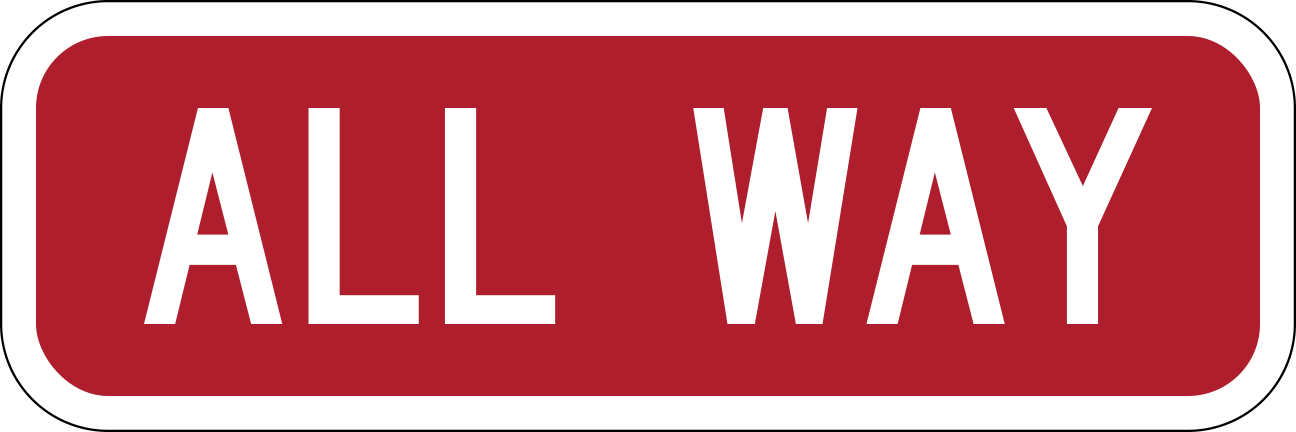
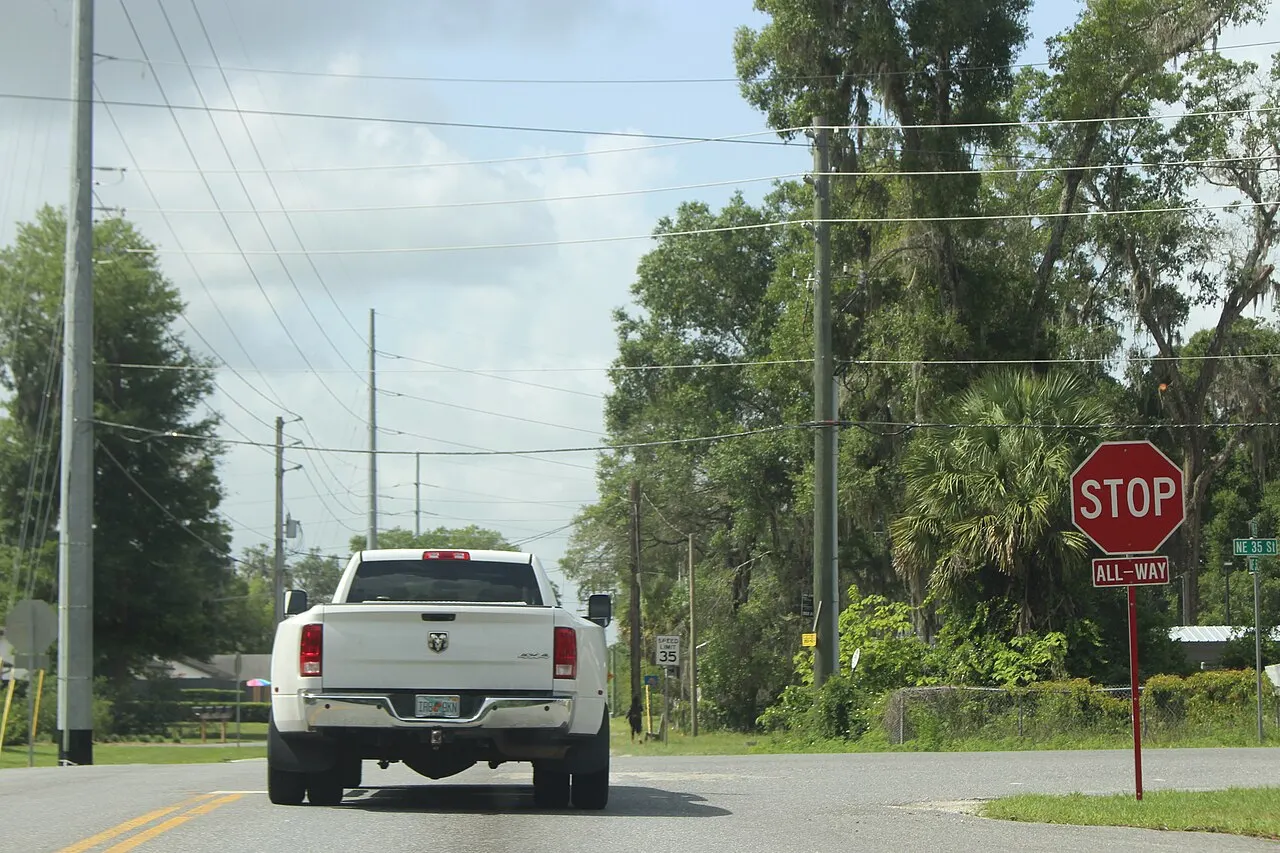
What shape and color is the All Way plaque?
| MUTCD code | R1-3P |
|---|---|
| Group | Regulatory signs |
| Shape | Horizontal rectangle mounted below the stop sign |
| Color | Red background, white legend and border |
What a horizontal rectangle means. Usually guidance: direction, distance and destination. Also used for some regulatory plaques mounted under another sign.
What red means. Stop, yield, or a prohibition. Red never advises, it always forbids or commands.
Regulatory signs. Every sign in this group has a statute behind it, so disobeying one is a citable offense on its own. Permit tests tend to word them as a duty you owe rather than show you the face.
When is the plaque required, and what may not be used instead?
Section 2B.04 is a standard, not a suggestion. At an intersection where every approach is controlled by STOP signs, an ALL-WAY plaque (R1-3P) shall be mounted below each STOP sign. The plaque is a white legend and border on a red background. The next paragraph bans the substitutes people still remember: supplemental plaques reading 2-WAY, 3-WAY, 4-WAY, or any other number of ways shall not be used with STOP signs.
Table 2B-1 gives the plaque as 18 by 6 inches on a conventional road, single lane or multi-lane. Expressway, freeway, and minimum columns are blank. The oversized plaque is 30 by 12 inches. The plaque is not a sign you stand alone. It hangs under R1-1, and only in the all-way case. If stop signs control every approach but one, the ALL-WAY plaque is the wrong device. Guidance in the same section says a TRAFFIC FROM LEFT (RIGHT) DOES NOT STOP plaque, or an ONCOMING TRAFFIC DOES NOT STOP plaque, should be used instead, unless the only approach that does not stop is a one-way street.
Who goes after everyone has stopped?
The plaque tells you that every driver has a stop. It does not, by itself, rank those drivers. The ranking is in the state statutes, and the two opened here do not use the same verb.
| Situation | Florida Statutes 316.123(2)(b) | California Vehicle Code 21800 |
|---|---|---|
| One driver stopped earlier | The first vehicle to stop shall be the first to proceed | A vehicle that has entered the intersection from another highway is yielded to. The section does not say "first to stop." |
| Two vehicles at the same moment | If they reach the four-way stop at the same time, the driver on the left yields to the driver on the right | If they enter from different highways at the same time, the driver on the left yields to the driver on the immediate right (subdivision (c)) |
| Ordinary stop-sign yield rule | The stop-then-yield rule in 316.123(2)(a) has no all-way exception. The four-way order is added in (2)(b). | Vehicle Code 21802, the usual "immediate hazard" rule after a stop, does not apply where stop signs are on all approaches (subdivision (c)) |
Florida still says "four-way stop intersection" in the statute. The MUTCD forbids a 4-WAY plaque. The statute wording and the plaque legend differ, but they describe the same control.
Two vehicles reach an all-way stop together
The driver who has a vehicle on the right yields.
Florida Statutes 316.123(2)(b) and California Vehicle Code 21800(c) both send the tie to the driver on the right. In the drawing, the northbound driver yields to the vehicle approaching from the east.
Rosa at 8:12 a.m., then a tie with Malik
- 1Rosa and Malik meet at a four-leg intersection in Florida where every approach has a STOP sign and an ALL-WAY plaque. Rosa stops at 8:12:00 a.m. Malik stops at his stop line at 8:12:04.
- 2Florida Statutes 316.123(2)(b) lets the first vehicle to stop proceed first. Rosa goes. Malik waits.
- 3On the drive home that evening, they reach the same intersection at the same moment. Rosa's approach is on Malik's right, so Malik yields and Rosa proceeds.
Outcome. Same plaque, two different sentences of the Florida statute. Arrival order decides the first pair. Left-yields-to-right decides the tie. California would describe the tie as two vehicles entering at the same time, and would not use the words "first to stop."
Does a bad crash record force the plaque to go up?
No. Section 2B.12 says the decision should rest on an engineering study, and meeting a warrant shall not in itself require the installation. Warrant A (Section 2B.13) is an option: on a four-leg intersection, five or more correctable crashes in 12 months or six or more in 36 months. A three-leg intersection uses four and five. Warrant D (Section 2B.16) is also an option: at least 300 combined vehicle, bicycle, and pedestrian units per hour from the major street for each of any 8 hours, and 200 from the minor street in those same hours. Above a 40 mph 85th percentile on the major street, those volumes may drop to 70 percent, 210 and 140.
Section 2B.04 requires the ALL-WAY plaque wherever every approach stops, so a STOP sign without one tells you that at least one other approach does not stop, and it may be the cross traffic. Where drivers could mistake the intersection for an all-way stop, Section 2C.66 lets the agency mount a yellow CROSS TRAFFIC DOES NOT STOP plaque below the STOP sign. That is a warning plaque, not the red ALL-WAY plaque.
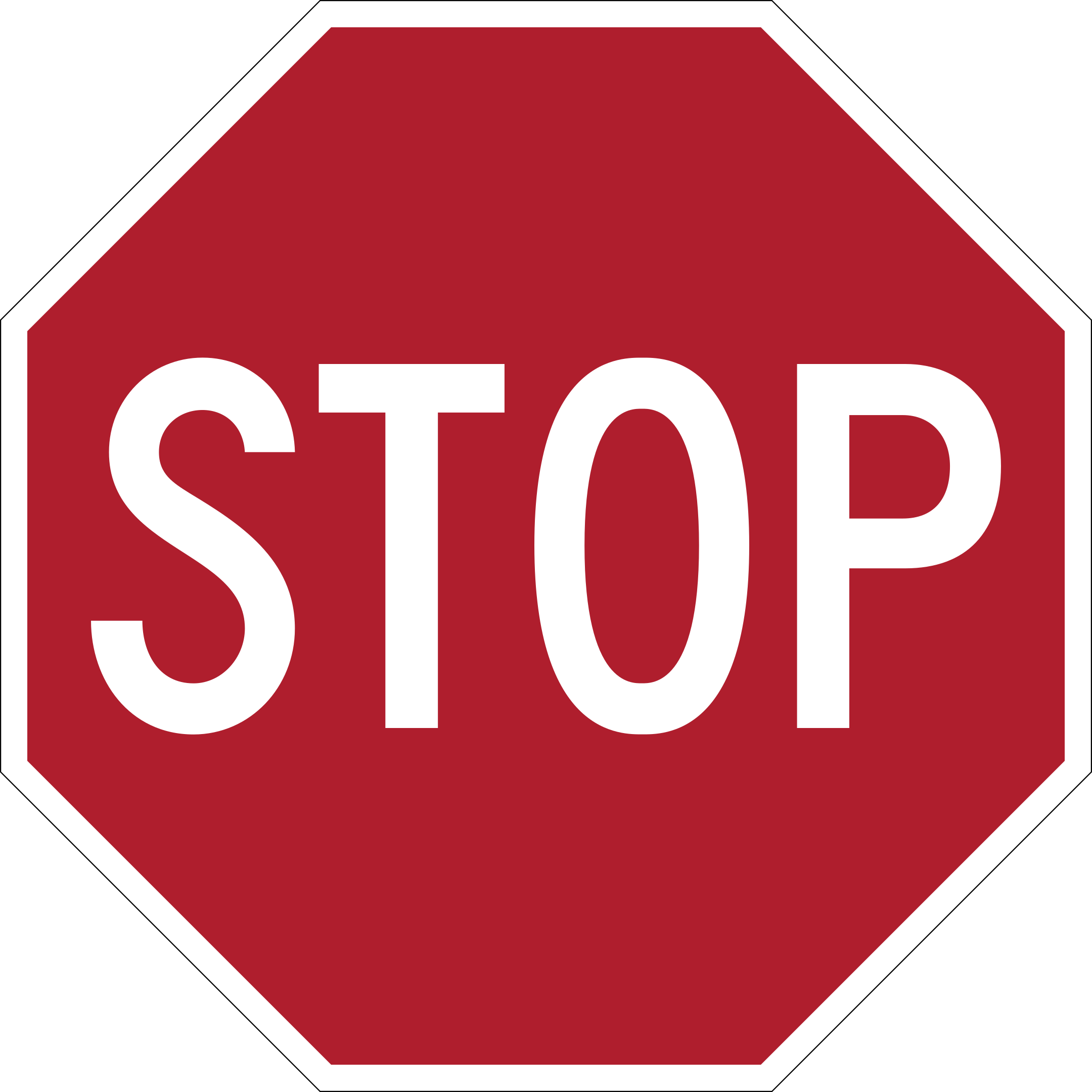
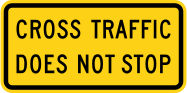
The octagon is the regulatory sign. The red plaque is added only when every approach has one. The yellow plaque is the warning used when cross traffic does not stop.
What is the All Way plaque often mistaken for?
Its absence is the point most learners miss: a stop sign with no ALL WAY plaque means cross traffic does not stop. The CROSS TRAFFIC DOES NOT STOP plaque (W4-4P) exists precisely because drivers assume otherwise.
| |
|---|---|
| GroupRegulatory signs | GroupWarning signs |
| ShapeHorizontal rectangle mounted below the stop sign | ShapeHorizontal rectangle plaque below a stop sign |
| ColorRed background, white legend and border | ColorYellow background, black legend and border |
| What it meansEvery approach to this intersection is stop-controlled, so all drivers must stop. | What it meansYou are stopping but the road you are crossing is not controlled, so wait for a full gap. |
What does the permit test ask about the All Way plaque?
This question is from the practice bank, with the answer marked.
At a four-way stop, who has priority?
- A.Whoever arrives first(correct answer)
- B.Whoever is turning right
- C.The largest vehicle
- D.Whoever signals first
Why: First to arrive is first to go. If two arrive together, the vehicle on the right proceeds first, and drivers going straight take precedence over turning traffic.
Source: Uniform Vehicle Code, stop intersections
Questions drivers ask about the All Way plaque
If there is no ALL-WAY plaque, do the other drivers stop?
Do not assume they do. Section 2B.04 requires the ALL-WAY plaque under each STOP sign only when every approach stops, and it forbids a 2-WAY, 3-WAY, or 4-WAY plaque. With no plaque, you stop and the cross street may not. If every approach but one stops, Section 2B.04 guidance says to use TRAFFIC FROM LEFT (RIGHT) DOES NOT STOP, or ONCOMING TRAFFIC DOES NOT STOP, unless that free approach is a one-way street.
Two cars stop at the same time. Who goes?
Florida Statutes 316.123(2)(b): if two vehicles reach a four-way stop together, the driver on the left yields to the one on the right. If they did not arrive together, the first to stop goes first. California Vehicle Code 21800(c) decides the tie the same way, but it says "enter," not "stop," and it never says the first driver to stop goes first.
Is an old 4-WAY plaque still the correct sign?
Not under the 11th Edition. Section 2B.04 says supplemental plaques with legends such as 2-WAY, 3-WAY, 4-WAY, or other numbers of ways shall not be used with STOP signs. The required legend, when every approach stops, is ALL-WAY, white on red, under each STOP sign. Florida law still describes the intersection as a "four-way stop" in section 316.123. That is the rule of who proceeds. It is not permission to post a 4-WAY plaque.
Do five crashes in a year mean the city must install all-way stops?
No. Section 2B.13 says all-way stop control may be installed where a four-leg intersection has five or more correctable crashes in 12 months, or six or more in 36 months. A three-leg intersection uses four and five. Section 2B.12 then says, as a standard, that meeting a warrant shall not in itself require the installation. The engineering study is the decision. Volume warrant D, 300 and 200 units per hour over the same 8 hours, is also a "may."
Sources
- MUTCD 11th Edition, Chapter 2B, Table 2B-1
- MUTCD 11th Edition (December 2023), Sections 2B.04 and 2B.12 through 2B.16, and Table 2B-1
- MUTCD 11th Edition (December 2023), Section 2C.66
- Florida Statutes 316.123 (2026)
- California Vehicle Code 21800
- California Vehicle Code 21802
What are the other regulatory signs?
All 39 regulatory signs on one page, or every US road sign by shape and color.
Test yourself on this sign and the rest of the set with a road signs practice test for Florida, Texas, California or New York.
The artwork is the federal design itself, which the manual dedicates to the public domain in MUTCD 11th Edition, Part 1, Section 1D.06, checked 2026-09-09. The Interstate Shield, the 511 pictograph and the National Scenic Byway graphic are named exceptions and are not reproduced anywhere on this site.
Source: Manual on Uniform Traffic Control Devices, 11th Edition. Not affiliated with or endorsed by the Federal Highway Administration or any state agency.