What does the No Passing Zone sign mean?
The No Passing Zone sign (MUTCD W14-3) is a warning sign under the federal Manual on Uniform Traffic Control Devices, the national standard the states build from. From this pennant until the solid yellow line beside your lane ends, the sight distance is too short to complete a pass, so overtaking is prohibited for the whole stretch.
Source: MUTCD 11th Edition, Chapter 2C, Table 2C-1, checked 2026-09-09.
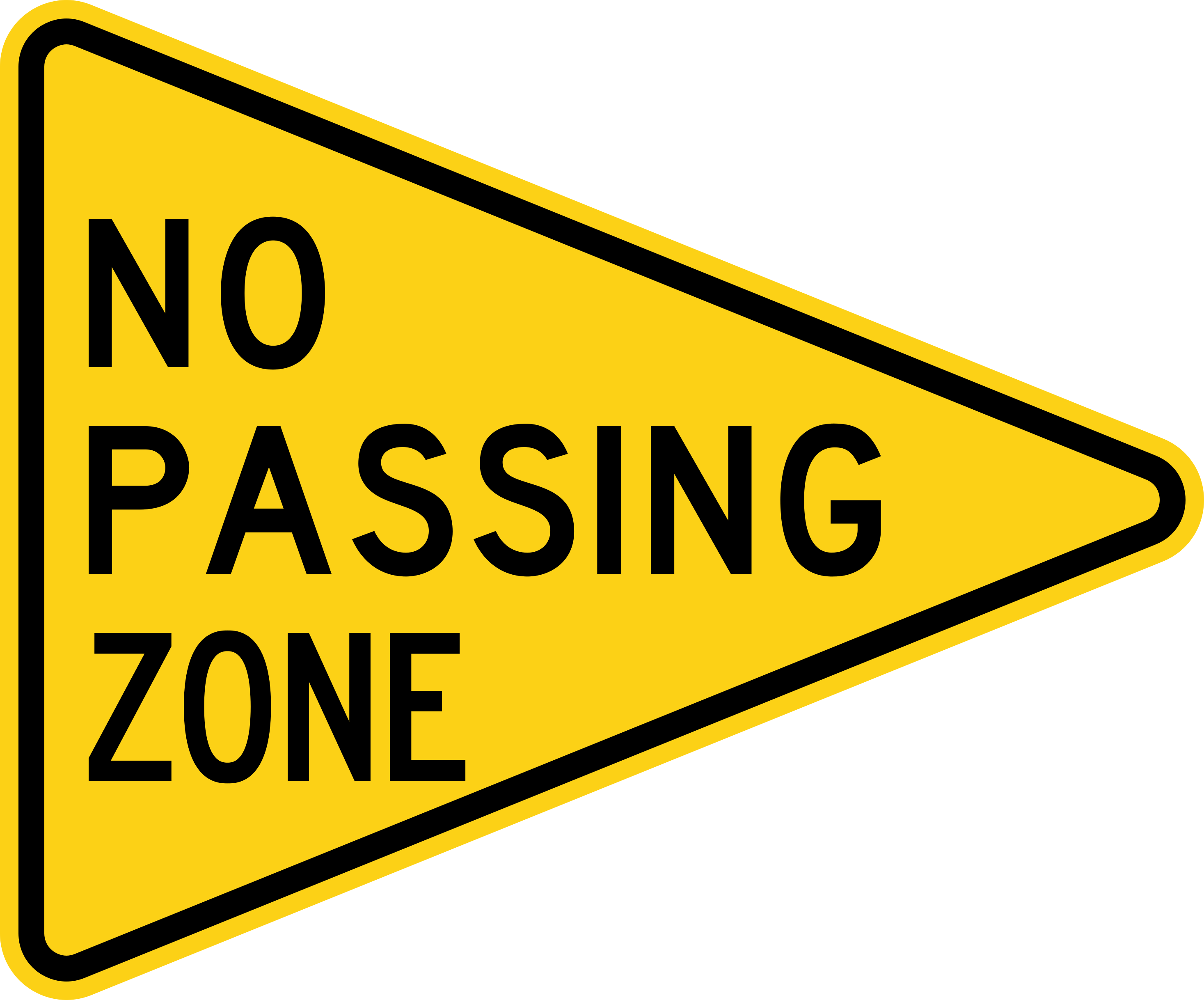
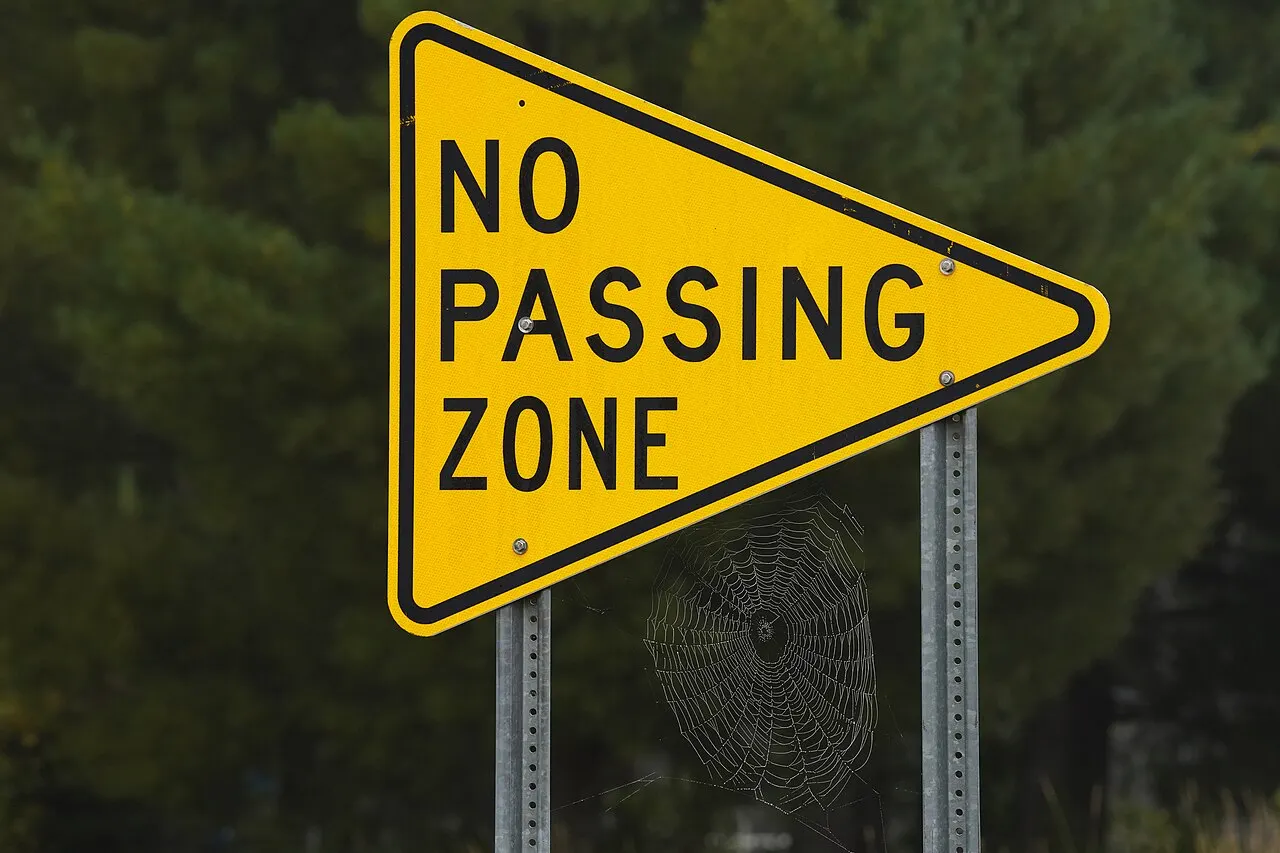
What shape and color is the No Passing Zone sign?
| MUTCD code | W14-3 |
|---|---|
| Group | Warning signs |
| Shape | Pennant, an isosceles triangle with the point to the right |
| Color | Yellow background, black legend and border |
What a pennant means. No passing zone, posted on the LEFT side of the road facing the driver whose passing is restricted. The only sign of this shape.
What yellow means. General warning of a permanent condition ahead.
Warning signs. A diamond reports a condition and orders nothing. What you do about it is left to you, and that gap between a report and an order is what test writers keep probing.
Why is the pennant at the start of the zone, on your left?
Section 2C.53 is a Standard. The sign is a pennant-shaped isosceles triangle, its long axis horizontal and pointing to the right. When it is used, it goes on the left-hand side of the road at the beginning of a no-passing zone that markings, Do Not Pass signs, or both already identify. It stands where the zone begins, not in advance of it.
Section 3B.03 sets the length: from the point where sight distance first drops below Table 3B-1, with eye and object both 3.5 feet up, to the point where it is long enough again. At 55 mph the table minimum is 900 feet. On a three-lane road where the center lane switches direction, a flush buffer island at least 50 feet long is required in the center lane.
Which yellow line still lets a driver pass?
| What you see on your side | Passing a car | Still allowed |
|---|---|---|
| Double solid yellow | Do not drive left of the lines | A left turn at an intersection or into or out of a driveway or private road, or a U-turn made under the rules for U-turns |
| Solid on your side, broken on the other | You may not cross to pass | The same turn and U-turn exceptions, plus the two-way left-turn lane rule in 21460.5 |
| Broken on your side, solid on the other | You may cross to pass other vehicles | On a two-lane highway, 21751 still requires the left side to be visible and clear far enough ahead to finish the pass |
California Vehicle Code 21460 and 21751. The pennant is posted for the direction entering its zone, which is the side whose line has turned solid.
What do you do at the post?
- 1Look left for the pennant as your line turns solid
Section 2C.53 puts it on the left at the beginning of the zone. If you watch only the right shoulder, the paint may be your first notice.
- 2Do not start a pass that a crest or a bridge will hide
California Vehicle Code 21752 bars driving left of center when approaching or on the crest of a grade or a curve where the blocked view would create a hazard, and it prints no footage for that. It does print 100 feet for a bridge, viaduct, or tunnel when the view is obstructed, and 100 feet for any railroad grade crossing or intersection. It does not apply on a one-way roadway.
- 3Finish every pass before the opposing lane is needed
Where a broken line on your side allows a pass under 21460(c), Vehicle Code 21751 still bars moving left on a two-lane highway unless the left side is clear far enough ahead to complete the pass without interfering with oncoming traffic. A pennant facing you means your side has no pass at all.
Luis Ortega at a bridge on a 55 mph road
Monday, July 13, 2026, northbound in California
- 1Luis is northbound on a two-lane road posted 55 mph, behind a motorhome doing 48 mph. At 55 mph, Table 3B-1 uses 900 feet of passing sight distance when the zones are marked.
- 2The pennant is on his left, point to the right, where his side of the center line turns solid. A bridge is 80 feet ahead, and its railing blocks his view of the far end.
- 3Vehicle Code 21752(b) applies: his view is obstructed within 100 feet of a bridge. The opposing side of the line is broken, and 21460(c) lets drivers on that side cross it. His side is solid.
- 4He stays behind the motorhome until his side of the line is broken again and the bridge no longer blocks the view.
Outcome. The pennant marked the start of the zone for his direction. The solid line on his side and the obstructed view 80 feet from a bridge each made a move left unlawful.
Texas Transportation Code 545.056 bars driving left of center within 100 feet of a bridge, viaduct, or tunnel anywhere, and within 100 feet of an intersection or railroad grade crossing in a municipality. Outside a municipality, the intersection and crossing ban applies only when a sign or marking under 545.055 shows it. It also applies while you are waiting to board a ferry run by the Texas Transportation Commission. None of it applies on a one-way roadway or to a left turn into or from an alley, private road, or driveway.
Which choices miss the side of the line you are on?
- Starting a pass just before the post and finishing it inside the zone. Once your side is solid, 21460 bars driving left of the lines, so the pass has to be complete before the zone begins.
- Passing because the other side of the line is broken. Vehicle Code 21460(c)(1) gives that pass only to the driver who has the broken line on their own side.
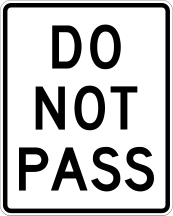
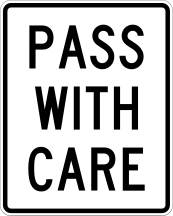
The pennant marks a zone that markings or Do Not Pass already identify. Pass With Care is the downstream sign when Do Not Pass was used at the start.
What is the No Passing Zone sign often mistaken for?
Do Not Pass (R4-1). This is the only pennant-shaped sign in the manual and the only warning sign mounted on the LEFT side of the road, so it faces the driver who would be tempted to pass.
| |
|---|---|
| GroupWarning signs | GroupRegulatory signs |
| ShapePennant, an isosceles triangle with the point to the right | ShapeVertical rectangle |
| ColorYellow background, black legend and border | ColorWhite background, black legend and border |
| What it meansFrom this pennant until the solid yellow line beside your lane ends, the sight distance is too short to complete a pass, so overtaking is prohibited for the whole stretch. | What it meansPassing is prohibited from this point until a sign or marking permits it again. |
What does the permit test ask about the No Passing Zone sign?
These 3 questions are from the practice bank, with the answer marked.
This is the only sign of its shape. It marks:
- A.The start of a no passing zone, posted on the left side of the road(correct answer)
- B.A narrow bridge ahead
- C.The end of a divided highway
- D.A merge from the right
Source: MUTCD W14-3
A yellow pennant-shaped sign on the left side of the road means:
- A.No passing zone(correct answer)
- B.School ahead
- C.Divided highway
- D.Merging traffic
Why: The pennant is the only sign posted on the left, marking the start of a no passing zone. It faces you at the beginning of the restricted stretch.
Source: Federal MUTCD, 11th Edition (FHWA)
Passing another vehicle becomes illegal when:
- A.You are on a two-lane road
- B.You are approaching a hill crest or curve where you cannot see far enough ahead(correct answer)
- C.The vehicle ahead is slower than the limit
- D.It is after dark
Why: Passing needs enough clear sight distance to complete the maneuver and return. Crests, curves, intersections and railroad crossings all remove that.
Source: Uniform Vehicle Code, limitations on overtaking
Questions drivers ask about the No Passing Zone sign
Does the pennant ban passing for both directions?
It faces the direction entering the zone, from the left side, at the beginning. A note on Figure 3B-4 says zones in opposite directions might or might not overlap, depending on alignment. Follow the line on your side. A broken line on the other side is not your pass under Vehicle Code 21460(c).
Can I pass a tractor if I am sure nothing is coming?
Not from the solid side, and not inside the 21752 limits. At 55 mph, Table 3B-1 uses 900 feet of sight to a 3.5-foot object to mark the zone. A crest or a bridge railing can hide an oncoming vehicle while the lane you can see looks empty. The pennant means your direction is already inside the zone.
Why is there sometimes no sign on the right shoulder?
Section 2B.36 makes the Do Not Pass sign optional, and Section 2C.53 sets rules for the pennant only when it is used. If the pennant is used, it goes on the left at the start. A missing right-side sign does not move the pennant or shorten the paint.
Sources
- MUTCD 11th Edition, Chapter 2C, Table 2C-1
- MUTCD 11th Edition (December 2023), Section 2C.53
- MUTCD 11th Edition (December 2023), Sections 2B.36 and 2B.37
- MUTCD 11th Edition (December 2023), Section 3B.03, Table 3B-1, and Figure 3B-4
- California Vehicle Code section 21460
- California Vehicle Code section 21751
- California Vehicle Code section 21752
- Texas Transportation Code section 545.056
What are the other warning signs?
All 55 warning signs on one page, or every US road sign by shape and color.
Test yourself on this sign and the rest of the set with a road signs practice test for Florida, Texas, California or New York.
The artwork is the federal design itself, which the manual dedicates to the public domain in MUTCD 11th Edition, Part 1, Section 1D.06, checked 2026-09-09. The Interstate Shield, the 511 pictograph and the National Scenic Byway graphic are named exceptions and are not reproduced anywhere on this site.
Source: Manual on Uniform Traffic Control Devices, 11th Edition. Not affiliated with or endorsed by the Federal Highway Administration or any state agency.