What does the Do Not Pass sign mean?
The Do Not Pass sign (MUTCD R4-1) is a regulatory sign under the federal Manual on Uniform Traffic Control Devices, the national standard the states build from. Passing is prohibited from this point until a sign or marking permits it again.
Source: MUTCD 11th Edition, Chapter 2B, Table 2B-1, checked 2026-09-09.
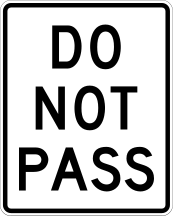

What shape and color is the Do Not Pass sign?
| MUTCD code | R4-1 |
|---|---|
| Group | Regulatory signs |
| Shape | Vertical rectangle |
| Color | White background, black legend and border |
What a vertical rectangle means. Usually regulatory: a law you must obey. Speed limits, turn restrictions and parking rules take this shape.
What white means. Regulatory. A black legend on a white background is a law, not advice.
Regulatory signs. Every sign in this group has a statute behind it, so disobeying one is a citable offense on its own. Permit tests tend to word them as a duty you owe rather than show you the face.
Where can this sign be added, and what distance sets the zone?
Section 2B.36 makes the white Do Not Pass sign optional. An agency may add it to the no-passing markings to stress the ban, at the start of a zone and again at intervals inside it, wherever sight distance is short or other conditions make passing a poor idea. No spacing for those repeat signs is printed.
The paint is what Section 3B.03 regulates. On two-way roads of two or three lanes that have a center line, a no-passing zone is required at hills and curves where passing sight distance falls short of Table 3B-1, and anywhere else an engineering study finds passing has to be banned. On a hill, sight distance is measured from an eye 3.5 feet above the pavement to an object 3.5 feet above it. The zone begins where that distance first falls below Table 3B-1 for the speed limit or 85th-percentile speed, and ends where it is long enough again.
When Do Not Pass stands at the upstream end, Section 2B.37 says Pass With Care should stand at the downstream end. That second sign marks where the zone stops. It does not tell you the opposing lane is clear.
What do you do from the sign until the markings open?
- 1Stay right of your line
Florida statute 316.0875(2) bars driving on the left side of the roadway, or left of the striping that marks the zone, at any time and for the full length of the zone.
- 2Do not trust an empty-looking lane
The zone exists because sight distance fell below Table 3B-1. Over a crest, an object 3.5 feet high can be out of view while the pavement you can see looks empty.
- 3Use only the three Florida exceptions
Section 316.0875(3) allows a brief, safe move left of center only as far as needed to avoid an obstruction, to turn left into or from an alley, private road, or driveway, or to pass a bicycle, other nonmotorized vehicle, or electric bicycle under 316.083(2) or (3). Passing a car or truck is not on the list.
- 4Wait for the downstream end
When your side of the line turns broken, the marked zone is over. If Do Not Pass opened it, Pass With Care should be posted there. You still need a clear stretch long enough to finish the pass.
Section 316.0875(4) makes a violation a noncriminal traffic infraction, punishable as a moving violation under chapter 318. The section itself prints no dollar amount. The penalty comes from chapter 318.
What does the rule do to a driver stuck behind a truck?
Andre Pell on a 45 mph Florida road, May 8, 2026
- 1At 2:10 pm Andre is eastbound on a two-lane Florida road posted 45 mph, behind a box truck doing 34 mph.
- 2Do Not Pass stands on the right as his side of the center line turns solid before a crest. At 45 mph, Table 3B-1 calls for 700 feet of sight distance to a 3.5-foot object, and the crest cuts the view below that, which is why the zone is marked.
- 3A driveway on the left is about 60 feet ahead. Section 316.0875(3)(b) would let him cross the line briefly only to turn into it. It gives him no right to pass the truck, so he stays behind it.
- 4Past the crest his side of the line turns broken and Pass With Care stands on the right, as Section 2B.37 calls for. The road ahead is straight and the opposing lane is empty, so he passes and returns to the right.
Outcome. The sign and the solid line barred the pass from the post to the end of the zone. The driveway exception covered only a turn. He passed once the zone ended and the opposing lane was clear.
Which permit-test answers sound careful and are still wrong?
- "No oncoming headlights, so I can pass." Florida 316.0875(2) bars driving left of the zone striping at any time, and Table 3B-1 has no night version.
- "Black on white is only advice." Statute 316.0875(1) says a driver must obey the signs or markings once they are in place and clearly visible.
- "The next Do Not Pass sign ends the zone." Section 2B.36 allows repeat signs at intervals inside one zone. The zone ends where the markings end.
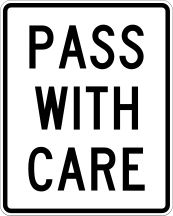
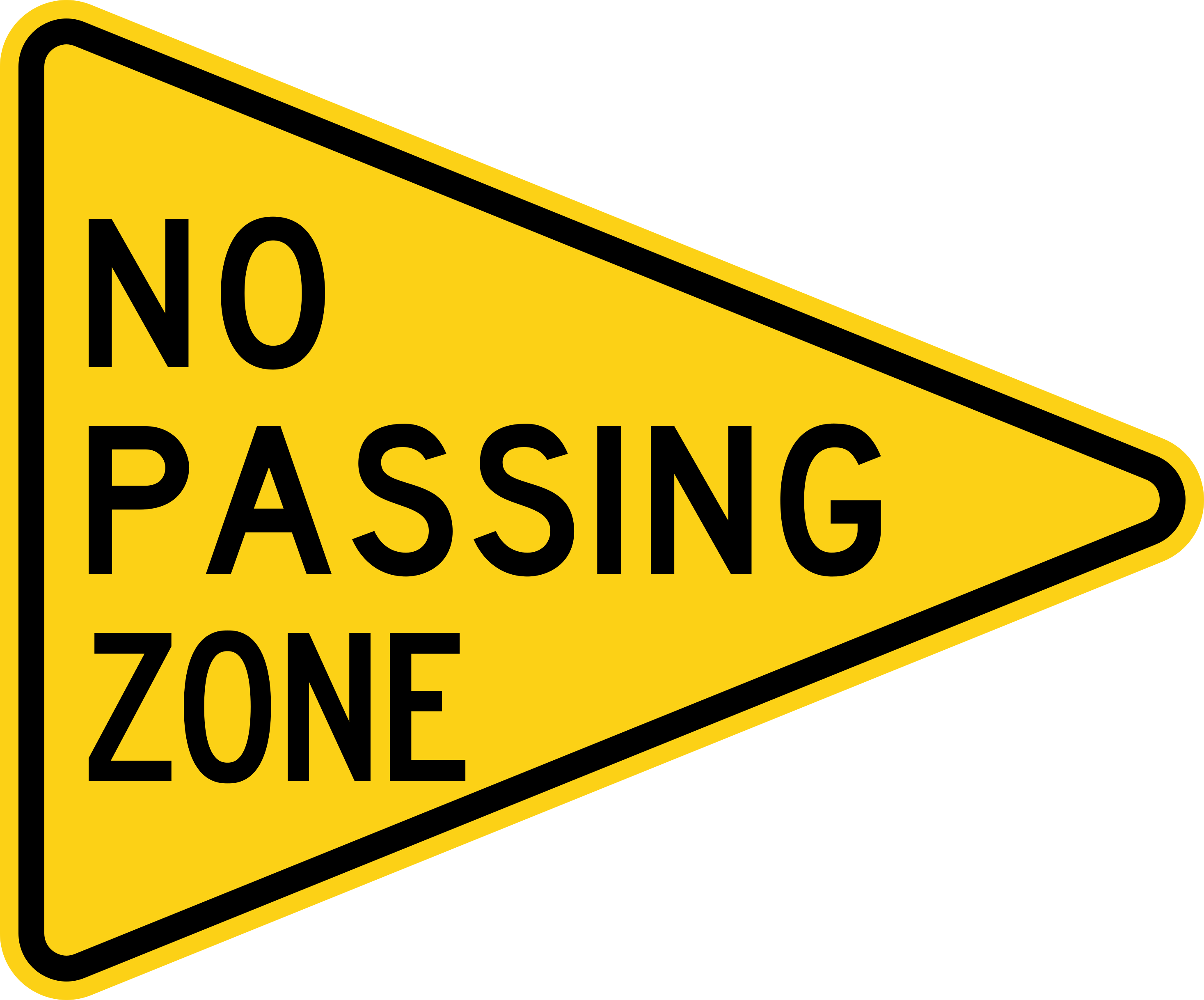

Pass With Care belongs at the downstream end when Do Not Pass opened the zone. The pennant is the left-side sign for the same zone. Stay In Lane is a multi-lane sign, used with double white lines, that holds you in your lane for any lane change, not only a pass.
What is the Do Not Pass sign often mistaken for?
The No Passing Zone pennant (W14-3), which is yellow, triangular, and posted on the left-hand side of the road. R4-1 is the regulatory version on the right; the pennant is the warning version facing you across the road.
| |
|---|---|
| GroupRegulatory signs | GroupWarning signs |
| ShapeVertical rectangle | ShapePennant, an isosceles triangle with the point to the right |
| ColorWhite background, black legend and border | ColorYellow background, black legend and border |
| What it meansPassing is prohibited from this point until a sign or marking permits it again. | What it meansFrom this pennant until the solid yellow line beside your lane ends, the sight distance is too short to complete a pass, so overtaking is prohibited for the whole stretch. |
Which signs get mistaken for the Do Not Pass sign?
- Stay In LaneR4-9
Do Not Pass (R4-1). Stay In Lane bans any lane change, including one that is not a pass.
What does the permit test ask about the Do Not Pass sign?
This question is from the practice bank, with the answer marked.
This sign means:
- A.Passing is prohibited from this point until a sign says otherwise(correct answer)
- B.Passing is allowed only on the right
- C.Slower traffic must move right
- D.The lane ahead is closed
Source: MUTCD R4-1
Questions drivers ask about the Do Not Pass sign
Can I pass a bicycle where Do Not Pass is posted in Florida?
Section 316.0875(3)(c) allows a brief, safe move left only as far as needed to pass a bicycle, another nonmotorized vehicle, or an electric bicycle, and only as 316.083(2) or (3) provides. Those subsections set the gap at not less than 3 feet, and if you cannot pass safely at that distance you stay behind. A car or truck is not covered by the exception.
Do headlights at night let me pass inside the zone?
No. Florida statute 316.0875(2) bars driving left of the zone striping at any time, which includes night. Section 2B.36 and Table 3B-1 have no night exception either. Seeing no headlights over a crest does not reopen a marked zone.
What if the sign is down but the yellow line remains?
Statute 316.0875(1) makes signs or markings enough, so visible striping still bars driving left of it inside the zone. Section 2B.36 describes the sign as used in addition to the markings. A missing post does not erase the line, and a second post inside the zone does not end it.
Sources
- MUTCD 11th Edition, Chapter 2B, Table 2B-1
- MUTCD 11th Edition (December 2023), Sections 2B.36, 2B.37, and 2B.40
- MUTCD 11th Edition (December 2023), Section 3B.03 and Table 3B-1
- Florida Statutes section 316.0875 (2025), No-passing zones
- Florida Statutes section 316.083 (2025), Overtaking and passing a vehicle
What are the other regulatory signs?
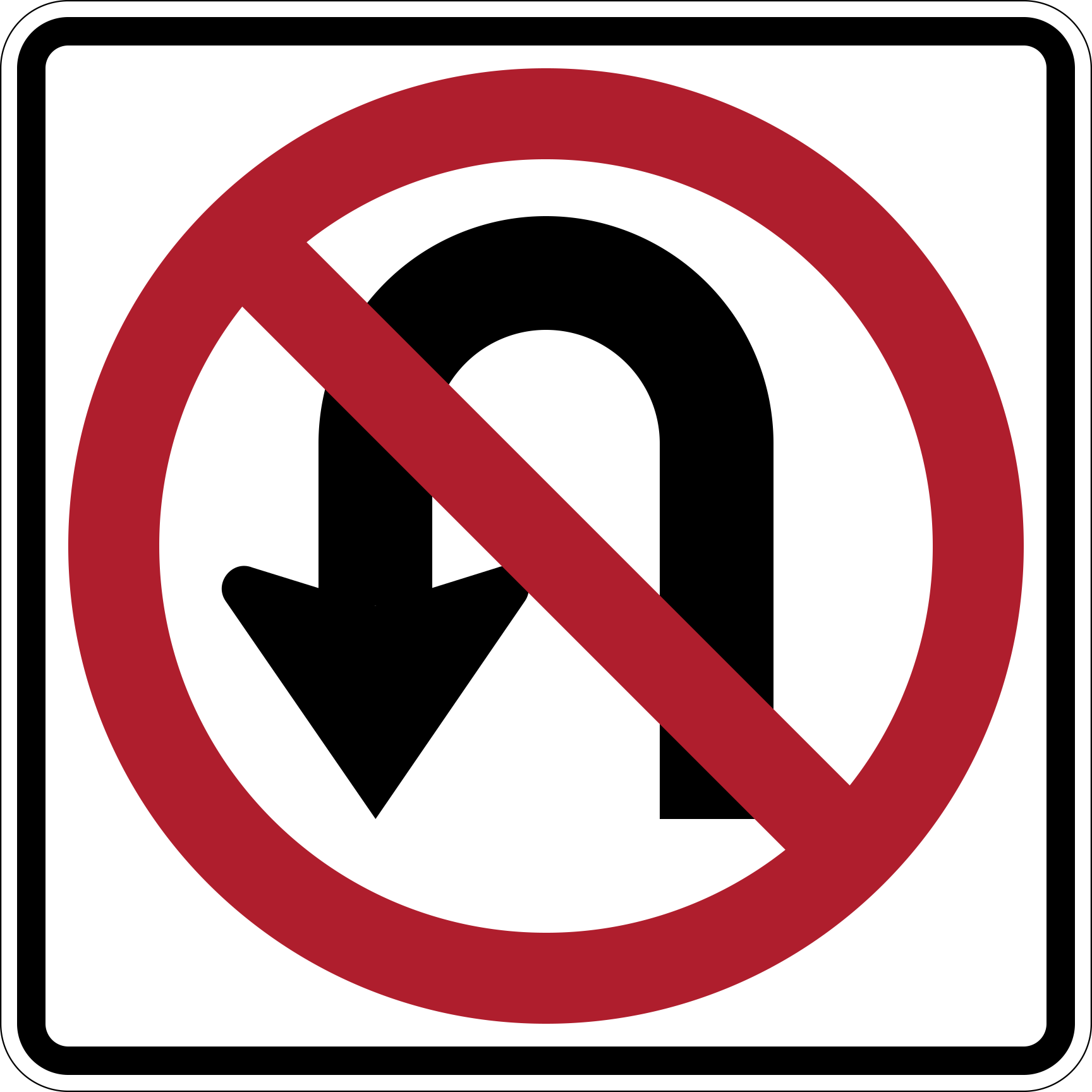
All 39 regulatory signs on one page, or every US road sign by shape and color.
Test yourself on this sign and the rest of the set with a road signs practice test for Florida, Texas, California or New York.
The artwork is the federal design itself, which the manual dedicates to the public domain in MUTCD 11th Edition, Part 1, Section 1D.06, checked 2026-09-09. The Interstate Shield, the 511 pictograph and the National Scenic Byway graphic are named exceptions and are not reproduced anywhere on this site.
Source: Manual on Uniform Traffic Control Devices, 11th Edition. Not affiliated with or endorsed by the Federal Highway Administration or any state agency.