What does the Two-Way Left Turn Only sign mean?
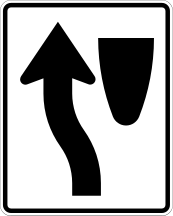
The Two-Way Left Turn Only sign (MUTCD R3-9b) is a regulatory sign under the federal Manual on Uniform Traffic Control Devices, the national standard the states build from. The center lane is reserved for left turns by traffic traveling in either direction and must not be used for through travel or passing.
Source: MUTCD 11th Edition, Chapter 2B, Table 2B-1, checked 2026-09-09.
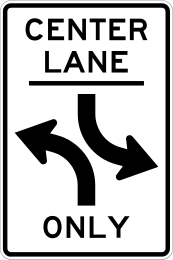
What shape and color is the Two-Way Left Turn Only sign?
| MUTCD code | R3-9b |
|---|---|
| Group | Regulatory signs |
| Shape | Vertical rectangle |
| Color | White background, black arrows and legend |
What a vertical rectangle means. Usually regulatory: a law you must obey. Speed limits, turn restrictions and parking rules take this shape.
What white means. Regulatory. A black legend on a white background is a law, not advice.
Regulatory signs. Every sign in this group has a statute behind it, so disobeying one is a citable offense on its own. Permit tests tend to word them as a duty you owe rather than show you the face.
What has to be painted before this sign means anything?
Section 2B.32 says the overhead R3-9a or post-mounted R3-9b sign should be used with the required markings where a lane that never reverses is reserved for left turns in either direction and is not used for passing, overtaking, or through travel. The post-mounted sign may replace or supplement the overhead one. BEGIN or END can be shown inside the sign border or on an R3-9cP or R3-9dP plaque mounted just above.
Section 3B.05 requires a broken yellow line toward the turn lane and a solid yellow line toward the through lanes, on each side. White two-way arrows should be placed at or just past the start of the lane, and a one-direction arrow is forbidden between those yellow lines. The markings should stop short of intersections rather than run up to them.
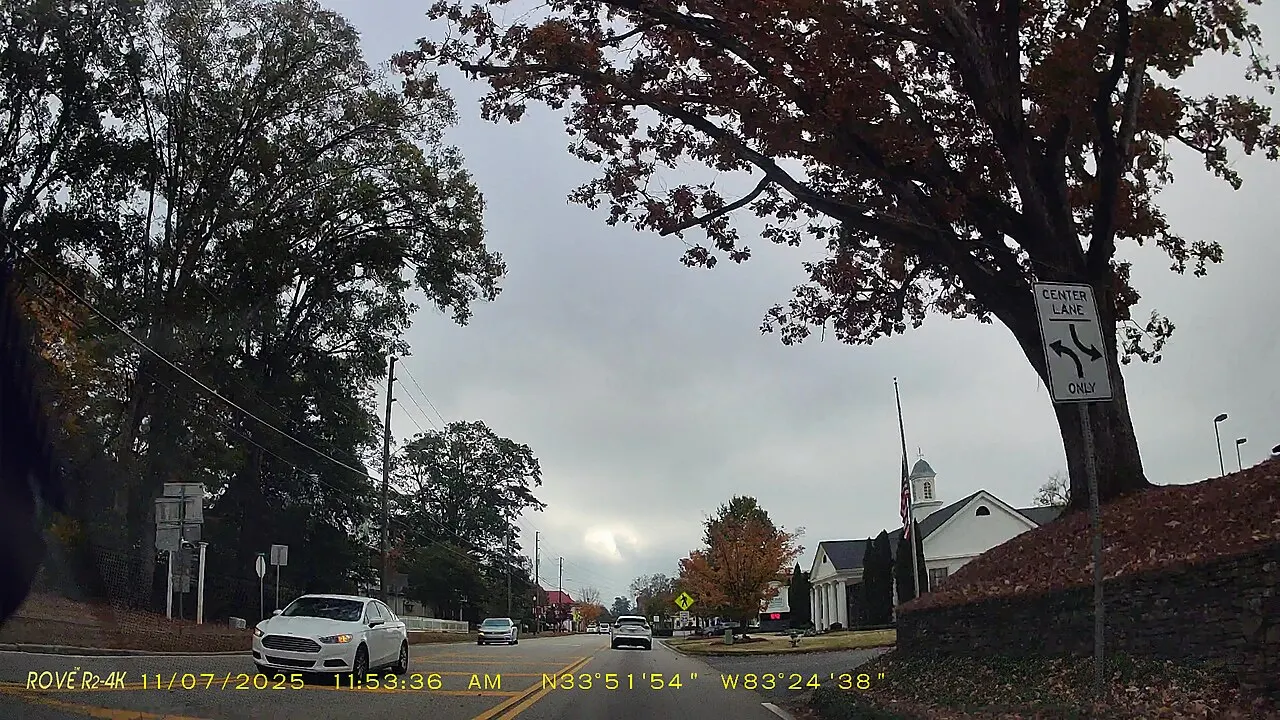
The Watkinsville sign stands beside the road and reads CENTER LANE ONLY with opposing left-turn arrows, the post-mounted design. Reversible-lane signs, R3-9e through R3-9i, must account for every time of day and day of the week under Section 2B.34. A sign with no times on it is not one of those.
How far may you drive in the lane?
| Question | California Vehicle Code 21460.5 | Florida statute 316.089 |
|---|---|---|
| How long may you stay in the lane? | Not more than 200 feet while preparing for and making the turn, or while preparing to merge into the adjacent lanes | No distance limit is printed |
| May you pass from the center lane? | No. The lane is only for a left turn from or into the highway, or a U-turn where one is otherwise allowed | On a three-lane, two-way road, 316.089(2) allows it when the center lane is clear for a safe distance. Where devices assign the lane, 316.089(3) says you obey them |
| May you turn left from another lane? | No. Where a two-way left-turn lane is designated, a left turn or U-turn shall not be made from any other lane | Section 316.089 has no matching sentence |
Do not carry the California 200-foot limit onto a Florida road. Florida has not printed that number in 316.089.
In New York, signal at least 100 feet before changing from the through lane into the signed center lane, and signal at least 100 feet before making the left turn. The New York State Driver's Manual (MV-21), Chapter 5 applies that lead time to both lane changes and turns. It measures when you warn other drivers, while the California 200-foot figure in the comparison measures how far you may travel within the center lane.
Left turn out of the center lane
The driver turning left yields.
Florida statute 316.122 says a driver turning left into a driveway yields to any vehicle approaching from the opposite direction that is within the intersection or so close as to be an immediate hazard.
What do you do once the arrows start?
- 1Enter only to prepare for your turn
Move into the center lane close to the driveway or street you are turning into. It is not a through lane or a passing lane.
- 2In California, keep it under 200 feet
Vehicle Code 21460.5(c) limits you to 200 feet in the lane while preparing for and making the turn, or while preparing to merge back. If your turn is farther away than that, stay in the through lane and enter later.
- 3Yield to oncoming traffic
California Vehicle Code 21801(a) makes a driver turning left yield to oncoming vehicles close enough to be a hazard, and keep yielding until the turn can be made with reasonable safety. Florida 316.122 puts the same duty on a driver turning into a driveway, and adds vehicles lawfully passing on the left. A driver facing you in the center lane is turning too and does not shield you from through traffic.
- 4Turn from the center lane, not beside it
In California a left turn or U-turn shall not be made from any other lane where a two-way left-turn lane is designated, so you do not turn across it from a through lane.
Carmen Briggs, Tuesday, September 1, 2026, a 40 mph California arterial
- 1Carmen is southbound at 40 mph. The driveway she wants is on the left, and the two-way left-turn arrows start about 600 feet before it.
- 2She stays in the through lane and moves into the center lane about 180 feet before the driveway, inside the 200-foot limit in Vehicle Code 21460.5(c). Entering at the first arrows would have meant about 600 feet in the lane.
- 3An oncoming sedan is close enough to be a hazard, so she stops in the center lane and waits. Vehicle Code 21801(a) keeps that duty on her until the turn can be made with reasonable safety.
- 4Once the sedan has passed and the oncoming lane is clear, she turns into the driveway.
Outcome. She used about 180 feet of the lane for one turn, yielded to oncoming traffic, and did not ride the center lane from the first arrows. In Florida, 316.089 prints no distance limit, but the sign still reserves the lane for left turns.
Florida statute 316.089(2) allows a pass in the center lane of a three-lane, two-way road when that lane is clear of traffic for a safe distance. Subsection (3) says drivers obey devices that assign lanes. With this sign and its markings in place, the passing answer is wrong.
What is the Two-Way Left Turn Only sign often mistaken for?
A normal left-turn-only lane. This lane is shared with oncoming traffic making their own left turns, which is why you may not drive along it.
What does the permit test ask about the Two-Way Left Turn Only sign?
This question is from the practice bank, with the answer marked.
A center lane marked with a solid yellow line on the outside and a broken yellow line on the inside, on both sides, is:
- A.A passing lane
- B.A two-way left turn lane(correct answer)
- C.A reversible bus lane
- D.A breakdown lane
Why: That marking identifies a shared center lane used only for left turns from either direction. It must never be used to travel along or to pass.
Source: Federal MUTCD, 11th Edition (FHWA)
Questions drivers ask about the Two-Way Left Turn Only sign
Can I drive the center lane for a quarter mile to reach my turn?
Not in California. Vehicle Code 21460.5(c) limits the lane to 200 feet while you prepare for and make the turn, or prepare to merge back, and a quarter mile is 1,320 feet. Stay in the through lane until the turn is close. Florida 316.089 prints no distance limit, but you still obey a sign that reserves the lane for left turns.
Who goes first when two drivers meet in the center lane?
Neither statute cited here sets an order between two drivers facing each other in the center lane, and the MUTCD does not either. What each statute does set is the duty to yield to oncoming vehicles close enough to be a hazard: California 21801(a) and Florida 316.122. Each driver waits for a safe gap in the through traffic.
What if the sign shows hours of the day?
That is a reversible-lane sign, R3-9e through R3-9i, not plain R3-9b. Section 2B.34 requires every time of day and day of the week to be accounted for on the sign. While it shows two-way left-turn arrows and ONLY, Table 2B-2 limits the lane to left turns in either direction. Other periods follow the other symbols: a red X closes the lane, an upward arrow opens it for through travel, and a single left-turn arrow with ONLY allows left turns in one direction.
Sources
- MUTCD 11th Edition, Chapter 2B, Table 2B-1
- MUTCD 11th Edition (December 2023), Sections 2B.32 to 2B.34 and Table 2B-2
- MUTCD 11th Edition (December 2023), Section 3B.05
- California Vehicle Code section 21460.5
- California Vehicle Code section 21801
- Florida Statutes section 316.089 (2025), Driving on roadways laned for traffic
- Florida Statutes section 316.122 (2025), Vehicle turning left
- New York State Driver's Manual (MV-21), Chapter 5, Intersections and Turns
What are the other regulatory signs?

All 39 regulatory signs on one page, or every US road sign by shape and color.
Test yourself on this sign and the rest of the set with a road signs practice test for Florida, Texas, California or New York.
The artwork is the federal design itself, which the manual dedicates to the public domain in MUTCD 11th Edition, Part 1, Section 1D.06, checked 2026-09-09. The Interstate Shield, the 511 pictograph and the National Scenic Byway graphic are named exceptions and are not reproduced anywhere on this site.
Source: Manual on Uniform Traffic Control Devices, 11th Edition. Not affiliated with or endorsed by the Federal Highway Administration or any state agency.