What does the Keep Right sign mean?
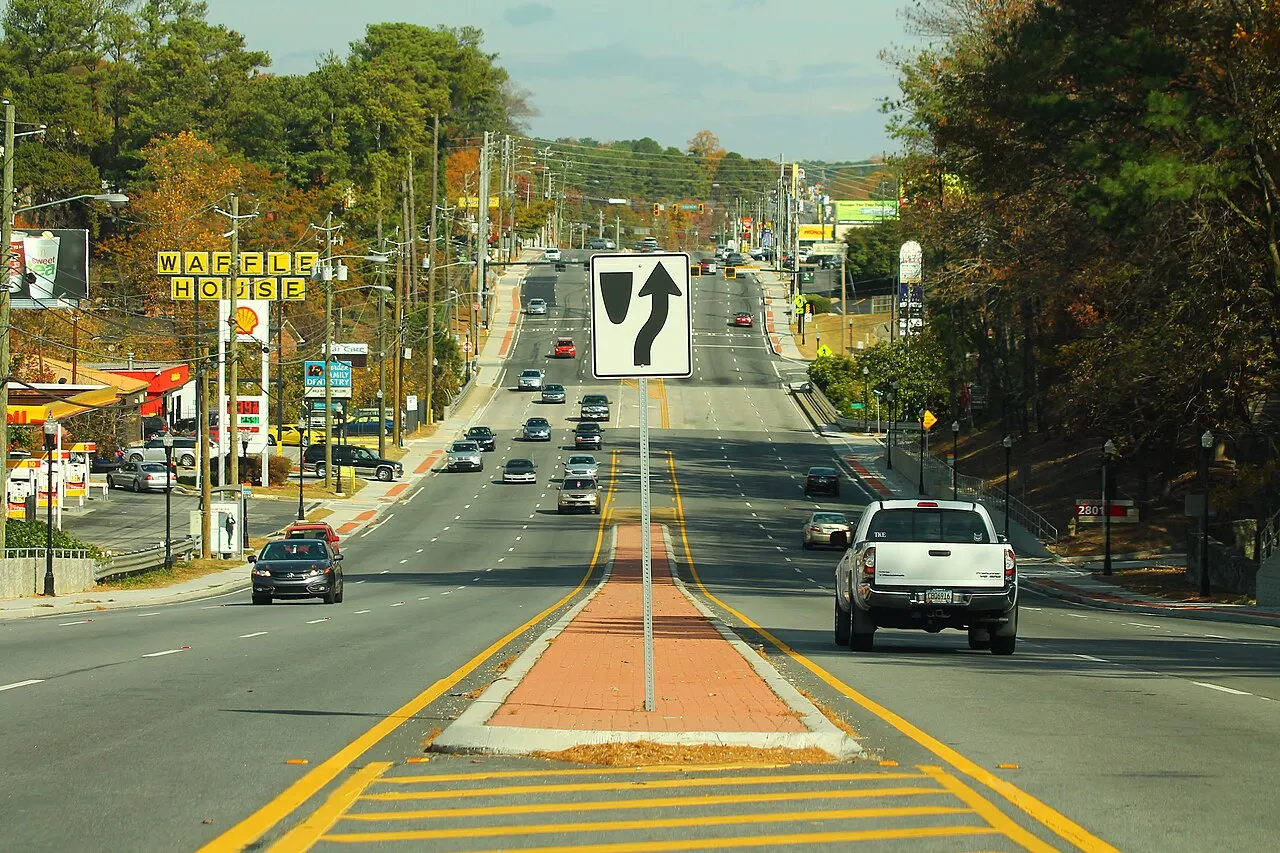
The Keep Right sign (MUTCD R4-7) is a regulatory sign under the federal Manual on Uniform Traffic Control Devices, the national standard the states build from. The divider immediately ahead has to finish up on your left. Keep to its right-hand side, and note the sign is mounted on the hazard itself, so it applies where you read it rather than further on.
Source: MUTCD 11th Edition, Chapter 2B, Table 2B-1, checked 2026-09-09.
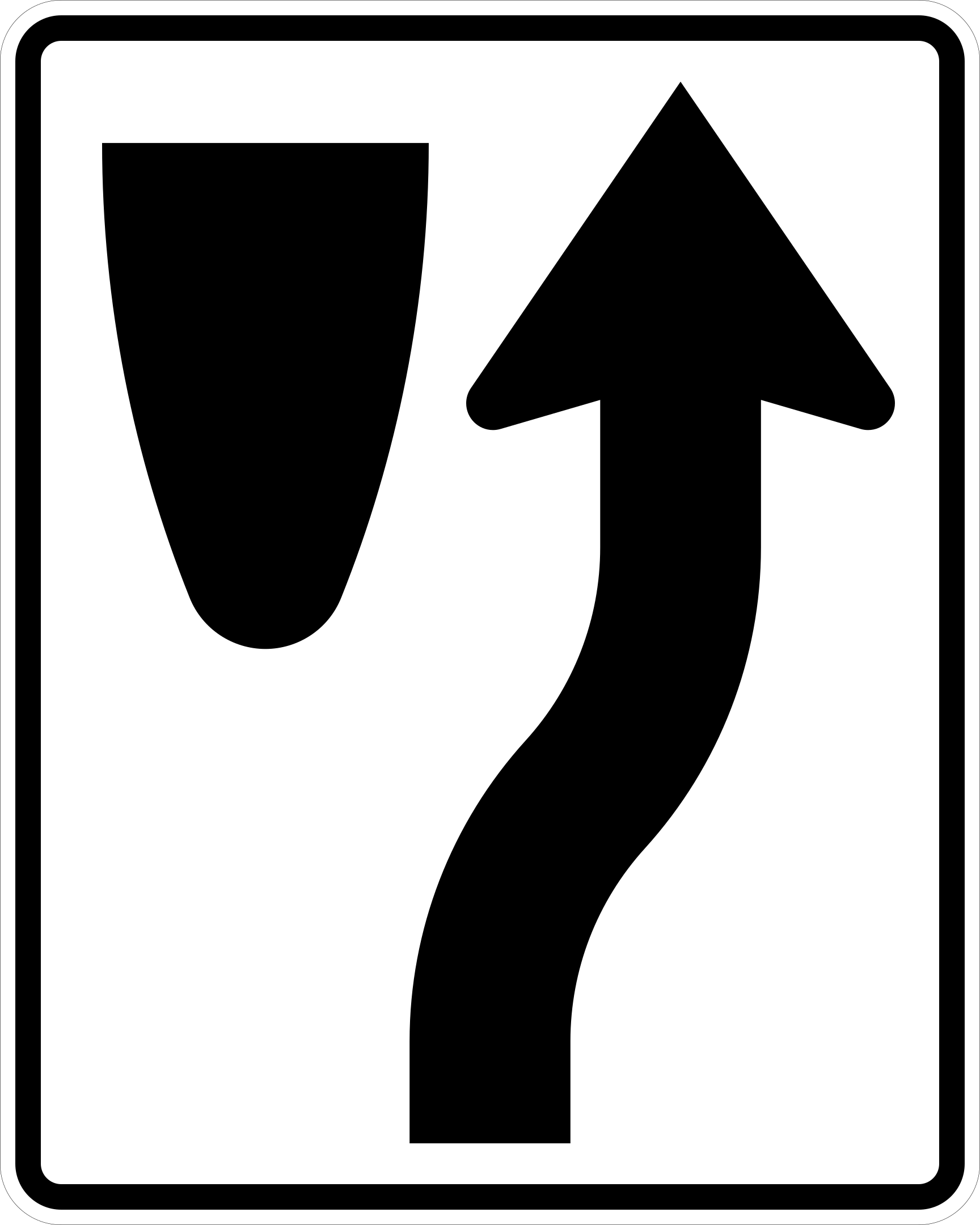
What shape and color is the Keep Right sign?
| MUTCD code | R4-7 |
|---|---|
| Group | Regulatory signs |
| Shape | Vertical rectangle |
| Color | White background, black arrow and border |
What a vertical rectangle means. Usually regulatory: a law you must obey. Speed limits, turn restrictions and parking rules take this shape.
What white means. Regulatory. A black legend on a white background is a law, not advice.
Regulatory signs. Every sign in this group has a statute behind it, so disobeying one is a citable offense on its own. Permit tests tend to word them as a duty you owe rather than show you the face.
Why is the sign on the nose of the median?
Section 2B.39 allows Keep Right wherever traffic must pass only to the right of a roadway feature or obstruction, and says it should be used where that is not readily apparent. When it is placed at the start of a median or at a median opening, it must go as close as practicable to the approach end, be visible to traffic on the divided highway, and be angled toward the crossroad approach, as Figure 2B-20 shows. The Guidance is to mount it on the face of the obstruction or just in front of it.
It shall not be installed on the right-hand side of the roadway where traffic would pass to its left. It may be left off at intermediate ends of islands and medians. Section 2C.20 bars the yellow Divided Highway (W6-1) sign from replacing it on the approach end of a median island.
Which version belongs on a narrow island?
| Sign | Use it when | Do not use it when |
|---|---|---|
| Symbol, R4-7 | Traffic must pass to the right of a roadway feature or obstruction | The island end channelizes traffic away from your approach direction. The word signs should be used there instead. |
| Word legend with arrow, R4-7a or R4-7b | The island end channelizes traffic away from your approach, or a sign in the central island of a neighborhood traffic circle directs traffic counter-clockwise, which calls for R4-7b | No bar is printed. Paragraph 09 lets the word signs stand in for the symbol sign. |
| Narrow, R4-7c | The median island is less than 4 feet wide where the sign will stand | The island is 4 feet wide or more at that point. A Standard forbids the narrow sign there. |
In a neighborhood traffic circle, R4-7b should be mounted with its bottom at least 4 feet above the near edge of the traveled way. That height is for the circle, not every nose.
What do you do when you reach the nose?
- 1Pass on the side the arrow shows
The symbol is an order about the obstruction it is mounted on. You leave that obstruction on your left.
- 2Do not cross the divider to save a left turn
California Vehicle Code 21651 covers roads split by intermittent barriers or by a dividing section at least 2 feet wide, whether unpaved or marked off by curbs, double parallel lines, or other markings. Driving over it is unlawful, and so is a left, semicircular, or U-turn except through an opening designated for vehicles or a plainly marked opening.
- 3At a crossing, keep right of the median nose
Section 2B.39 allows Keep Right in the median of a divided-highway crossing that works as a single intersection, visible to traffic on the divided highway and angled toward the crossroad approach. Turning left into the near roadway, before the nose, would put you against its traffic.
Driving on a divided highway other than to the right of the barrier or dividing section is a misdemeanor under 21651(b). A willful violation that injures or kills someone can bring imprisonment under Penal Code section 1170(h), or up to 6 months in county jail. Florida has a related circle rule in 316.088(3): a vehicle passing around a rotary traffic island is driven only to the right.
Helen Cho at a median wider than 4 feet
Wednesday, August 12, 2026, a divided arterial in California
- 1Helen is eastbound at 35 mph. At a cross street, a raised median about 6 feet wide at its nose carries a Keep Right symbol angled toward the crossroad approach.
- 2The median is 4 feet wide or more at the sign, so the narrow R4-7c is not allowed there. She is looking at the standard R4-7.
- 3The driveway she wants is on the far side of the road, 150 feet past the nose, and the raised median runs unbroken in between. She keeps right of the nose, does not cut across the median, and uses the next opening marked for vehicles.
Outcome. The arrow set the side. Vehicle Code 21651 made a shortcut across a dividing section at least 2 feet wide unlawful, even to reach a driveway 150 feet away.
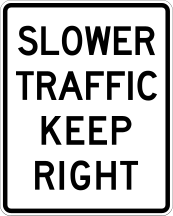
Section 2B.39 says nothing about speed. The speed sign is Slower Traffic Keep Right (R4-3) in Section 2B.38, used on multi-lane roads where slow vehicles hold the left lane. R4-7 decides only which side of an obstruction is legal.
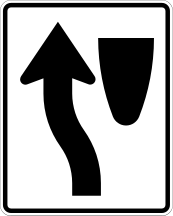
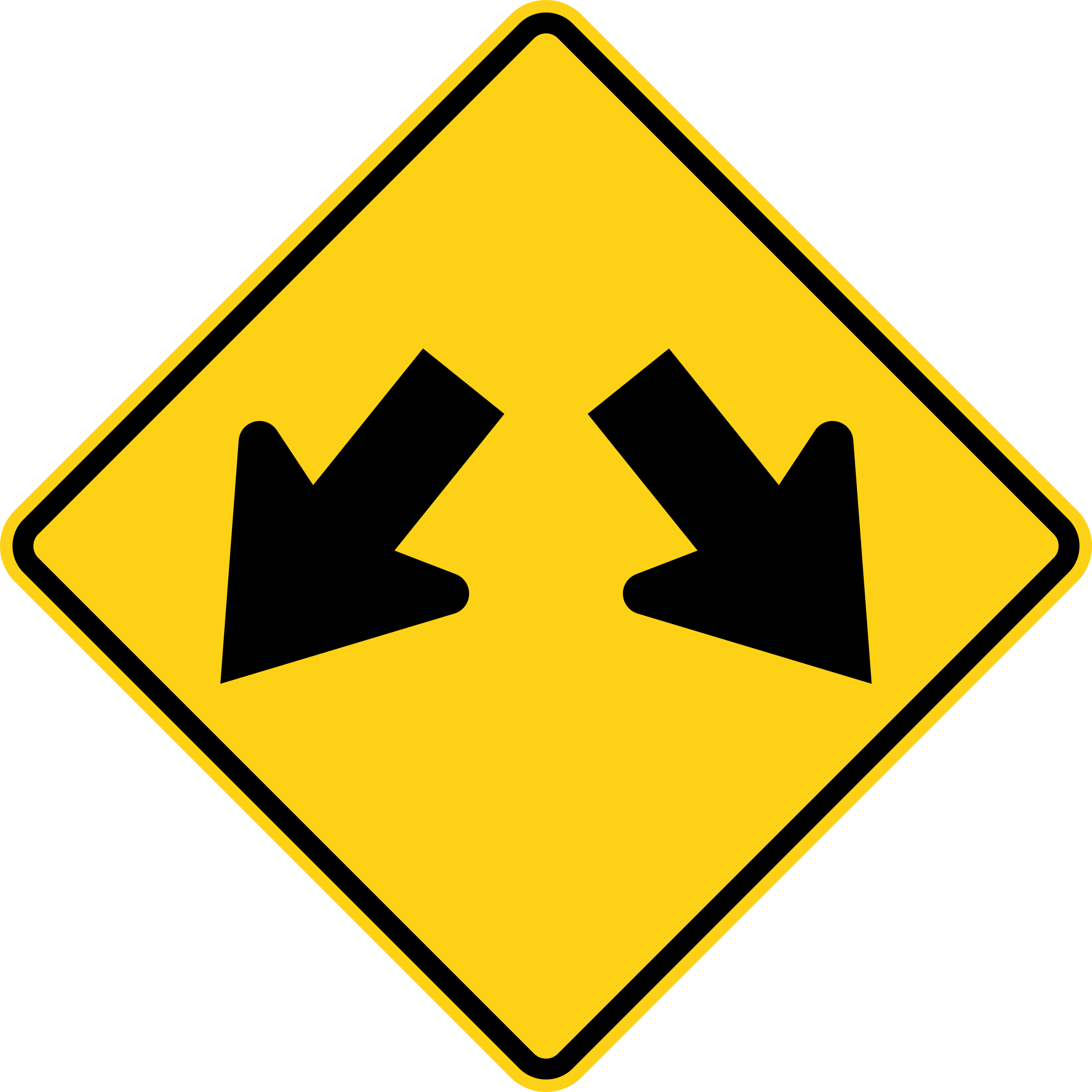
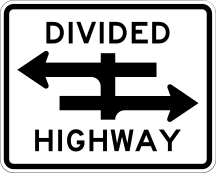
Keep Left sends you around the other side of an obstruction. Double Arrow warns that traffic may pass on either side. Divided Highway Crossing, on a side-street approach, tells you the road ahead is a divided highway.
What is the Keep Right sign often mistaken for?
Slower Traffic Keep Right (R4-3), which is about speed, not about an obstruction. Also the Keep Left version (R4-8), which is the same sign mirrored.
|  | |
|---|---|---|
| GroupRegulatory signs | GroupRegulatory signs | GroupRegulatory signs |
| ShapeVertical rectangle | ShapeVertical rectangle | ShapeVertical rectangle |
| ColorWhite background, black arrow and border | ColorWhite background, black legend and border | ColorWhite background, black arrow and border |
| What it meansThe divider immediately ahead has to finish up on your left. | What it meansVehicles moving slower than the general flow must use the right-hand lane. | What it meansThe mirrored version of R4-7: the obstruction ahead is taken on its left-hand side instead. |
What does the permit test ask about the Keep Right sign?
This question is from the practice bank, with the answer marked.
This sign tells you to:
- A.Move into the right lane
- B.Keep the obstacle it marks on your left as you go past(correct answer)
- C.Yield to traffic on the right
- D.Exit at the next ramp
Source: MUTCD R4-7
Questions drivers ask about the Keep Right sign
Can I pass left of a Keep Right sign if that side looks empty?
No. You pass to the right of the sign and the obstruction it is on, and the empty side is often the opposing roadway. California Vehicle Code 21651 makes it unlawful to drive except to the right of a dividing section at least 2 feet wide, and unlawful to drive over or across that section.
What if the median is only a stripe a foot wide?
Vehicle Code 21651 applies to intermittent barriers or a dividing section of at least 2 feet, so a 1-foot stripe falls outside it. If that stripe is double solid yellow, 21460(a) still bars driving to the left of it. Keep Right can be used wherever traffic must pass right of a feature, and the narrow R4-7c is allowed only where an island is under 4 feet wide.
Why is the sign missing at some breaks in a long median?
Section 2B.39 allows the sign to be omitted at intermediate ends of divisional islands and medians. The close placement and the angle apply when signs are put at the start of a median or at an opening. A missing sign along the grass does not let you cross it.
Sources
- MUTCD 11th Edition, Chapter 2B, Table 2B-1
- MUTCD 11th Edition (December 2023), Sections 2B.38, 2B.39, and 2B.50
- MUTCD 11th Edition (December 2023), Sections 2C.20 and 2C.23
- California Vehicle Code section 21651
- California Vehicle Code section 21460
- Florida Statutes section 316.088 (2025), One-way roadways and rotary traffic islands
What are the other regulatory signs?

All 39 regulatory signs on one page, or every US road sign by shape and color.
Test yourself on this sign and the rest of the set with a road signs practice test for Florida, Texas, California or New York.
The artwork is the federal design itself, which the manual dedicates to the public domain in MUTCD 11th Edition, Part 1, Section 1D.06, checked 2026-09-09. The Interstate Shield, the 511 pictograph and the National Scenic Byway graphic are named exceptions and are not reproduced anywhere on this site.
Source: Manual on Uniform Traffic Control Devices, 11th Edition. Not affiliated with or endorsed by the Federal Highway Administration or any state agency.