What does the Wrong Way sign mean?
The Wrong Way sign (MUTCD R5-1a) is a regulatory sign under the federal Manual on Uniform Traffic Control Devices, the national standard the states build from. Every lane around you faces the other way. Stop, then back out or turn around before you meet a vehicle head on.
Source: MUTCD 11th Edition, Chapter 2B, Table 2B-1, checked 2026-09-09.
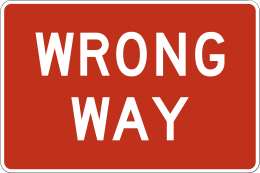
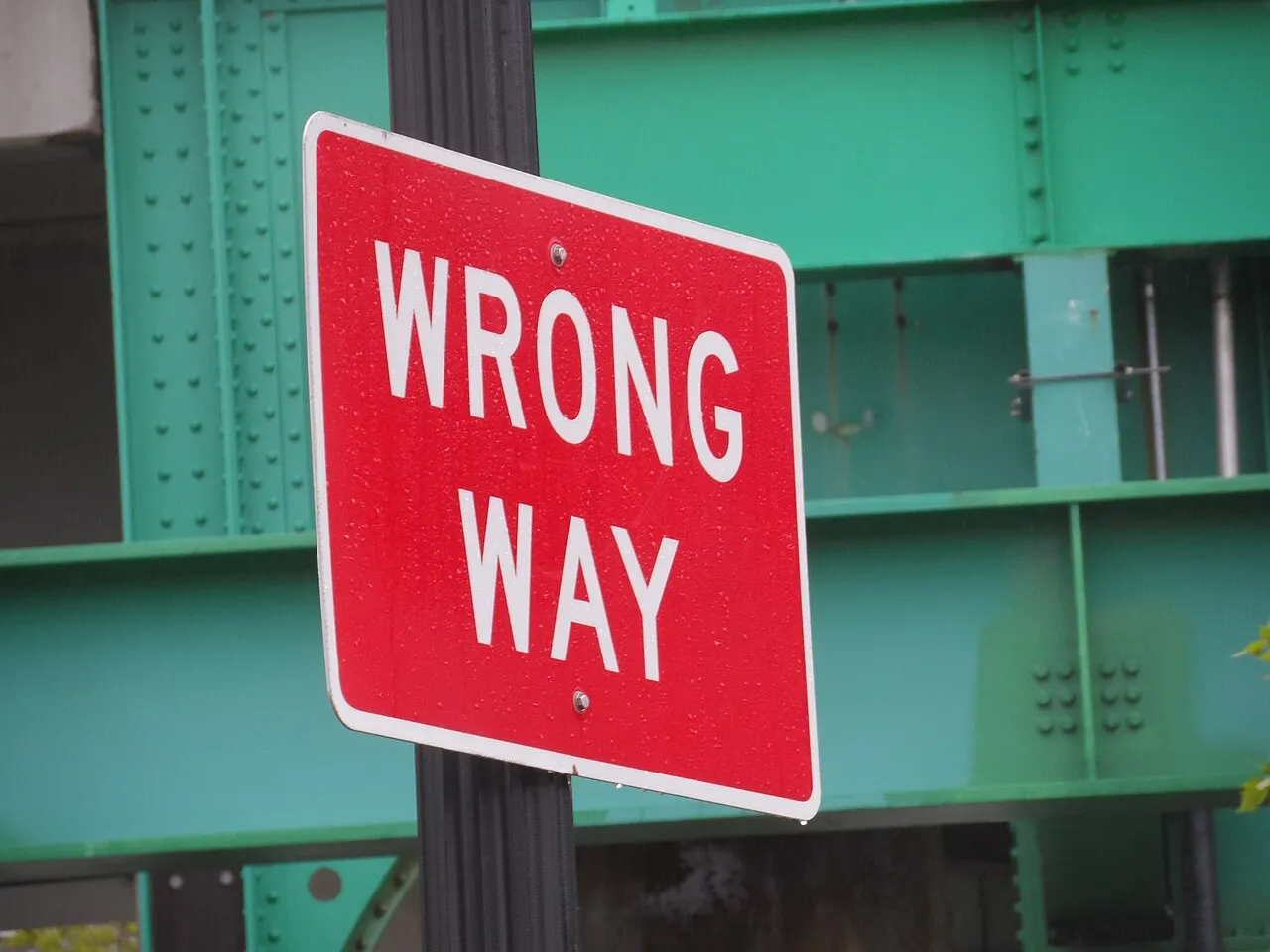
What shape and color is the Wrong Way sign?
| MUTCD code | R5-1a |
|---|---|
| Group | Regulatory signs |
| Shape | Horizontal rectangle |
| Color | Red background, white legend and border |
What a horizontal rectangle means. Usually guidance: direction, distance and destination. Also used for some regulatory plaques mounted under another sign. Rectangles are the loosely assigned outline in the system, though, so on this sign the shape alone does not tell you its family; the color and the legend do.
What red means. Stop, yield, or a prohibition. Red never advises, it always forbids or commands.
Regulatory signs. Every sign in this group has a statute behind it, so disobeying one is a citable offense on its own. Permit tests tend to word them as a duty you owe rather than show you the face.
Why is this face farther along the road than the sign at the entrance?
Section 2B.47 makes R5-1a optional. It may supplement Do Not Enter where a crossroad meets a one-way roadway in a way that does not physically discourage or prevent wrong-way entry. If it is used, Guidance puts it farther from the crossroad than the Do Not Enter sign, on the same side of the road.
Exit ramps are different: there it is a Standard. Section 2B.48 requires, where a driver could enter an exit ramp the wrong way by mistake, at least one One Way sign for each crossroad direction, at least one Do Not Enter near the downstream end of the ramp, and at least one Wrong Way on the ramp facing that driver. More Wrong Way signs may be added. Other devices add to those three signs rather than replace them: paragraph 2 says a lane-use arrow should be marked in each ramp lane near the crossroad where the layout does not make a wrong-way movement difficult, and paragraph 3 allows a Keep Right sign on the ramp median nose.
| Device | Where Section 2B.48 puts it | Force |
|---|---|---|
| One Way, each crossroad direction | Where the exit ramp meets the crossroad | Shall, at least one each way |
| Do Not Enter | Near the downstream end of the exit ramp, in full view of a driver starting in | Shall, at least one |
| Wrong Way | On the exit ramp, facing the wrong-way driver | Shall, at least one |
| Extra Wrong Way | Wherever the agency adds them | May |
MUTCD 11th Edition, December 2023, Section 2B.48, paragraph 1, and the option for additional Wrong Way signs in paragraph 3.
You are already past the crossroad. What now?
- 1Stop instead of driving farther up the ramp
The sign faces a driver who has already started the wrong way. Driving on toward the freeway to find a wider spot only closes the gap with traffic coming at you.
- 2Back out or turn around only when it is safe
That is the instruction California's driver handbook gives for these signs. Check that nothing is coming down the ramp and that the crossroad behind you is clear before you move.
- 3Re-enter the crossroad in the direction One Way shows
Section 2B.48 requires One Way signs for each crossroad direction at the ramp terminal. Match them. Do not swing onto the crossroad against those arrows.
- 4Do not treat a low mount as a smaller rule
A sign whose bottom is near headlight height is the same prohibition. The lower mount is an option for reaching wrong-way drivers, explained next.
When can the bottom of the sign be only 3 feet up?
Section 2B.48, paragraph 7, allows a minimum of 3 feet, measured from the bottom of the sign to the near edge of the pavement, for a Do Not Enter or Wrong Way sign that stands along a freeway or expressway exit ramp downstream of the crossroad and faces a wrong-way driver. It applies only where an engineering study shows the lower height would address wrong-way movements, and only where there are no parked cars, no pedestrian activity, and no obstructions such as snow or vegetation. At the crossroad itself, a Wrong Way may be mounted as low as 3 feet on the same support as a Do Not Enter that meets the height rules in Section 2A.15.
Marcus Hale on an exit ramp
- 1On June 12, 2026, at 9:40 p.m., Marcus is on a California crossroad posted 45 mph. He turns too early for the freeway entrance and starts up the exit ramp instead.
- 2He passes a Do Not Enter at the end of the ramp. About 90 feet farther along, on the same side, a Wrong Way faces him. He is at 15 mph. That is the layout Sections 2B.47 and 2B.48 describe: the red rectangle on the ramp, farther from the crossroad than Do Not Enter, facing him.
- 3He stops. He does not climb the ramp looking for a place to turn around.
- 4No headlights are coming down the ramp and the crossroad behind him is empty. He backs out to it and turns in the direction the One Way signs at the terminal show.
Outcome. He is off the ramp before meeting anyone head-on. Driving farther in would have been the movement Section 2B.48 puts this sign there to interrupt.
Expressway size is also 36 by 24. Freeway and oversized are 42 by 30. Unlike the Do Not Enter row, the Wrong Way row lists a minimum size.
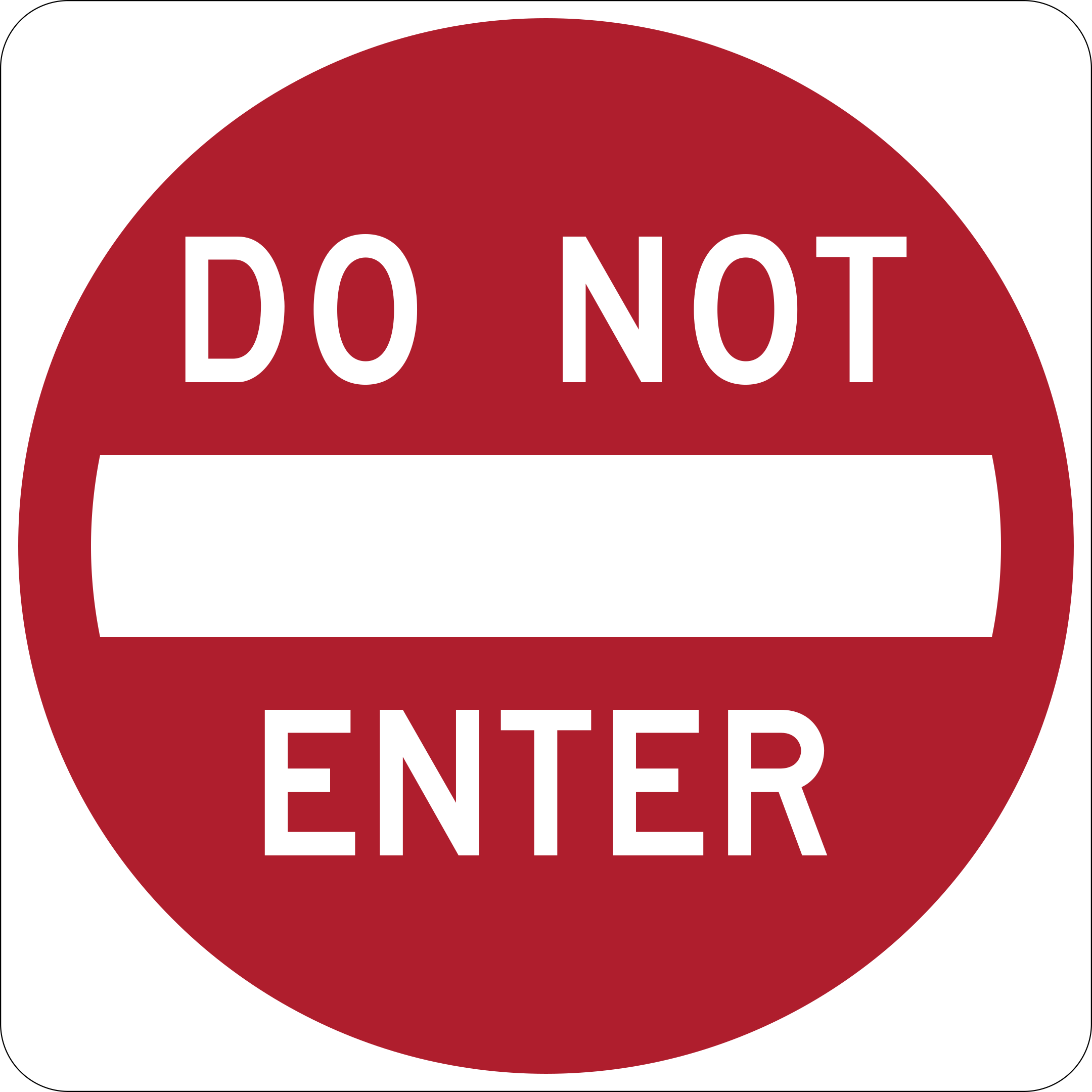
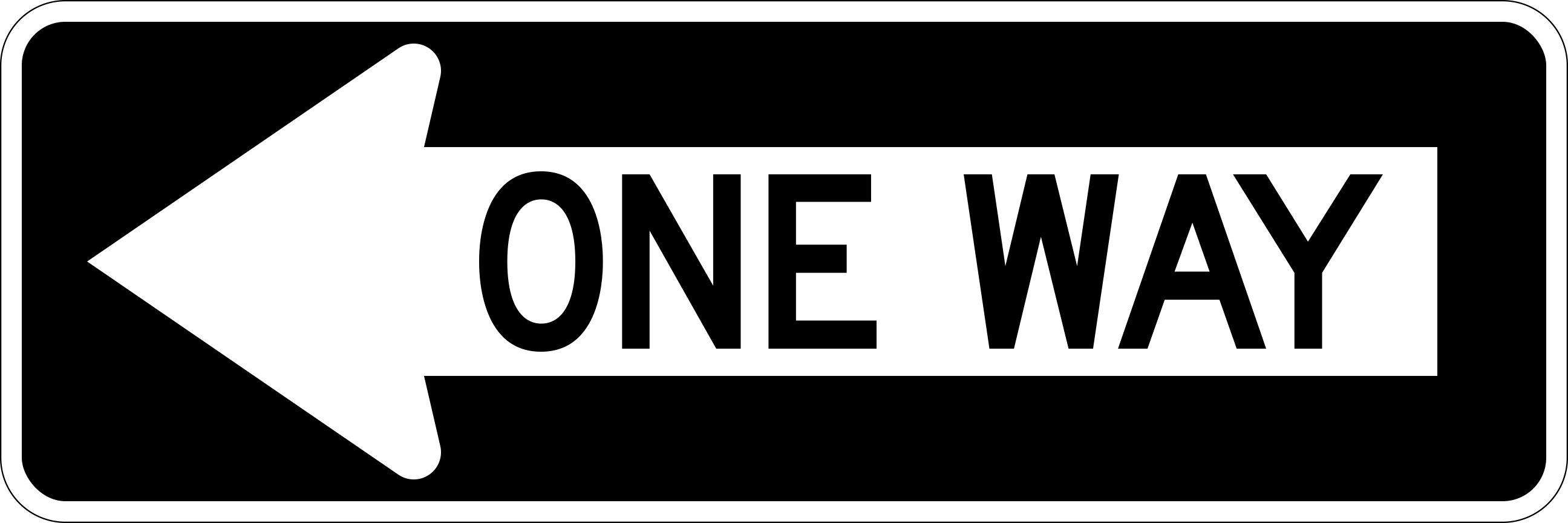
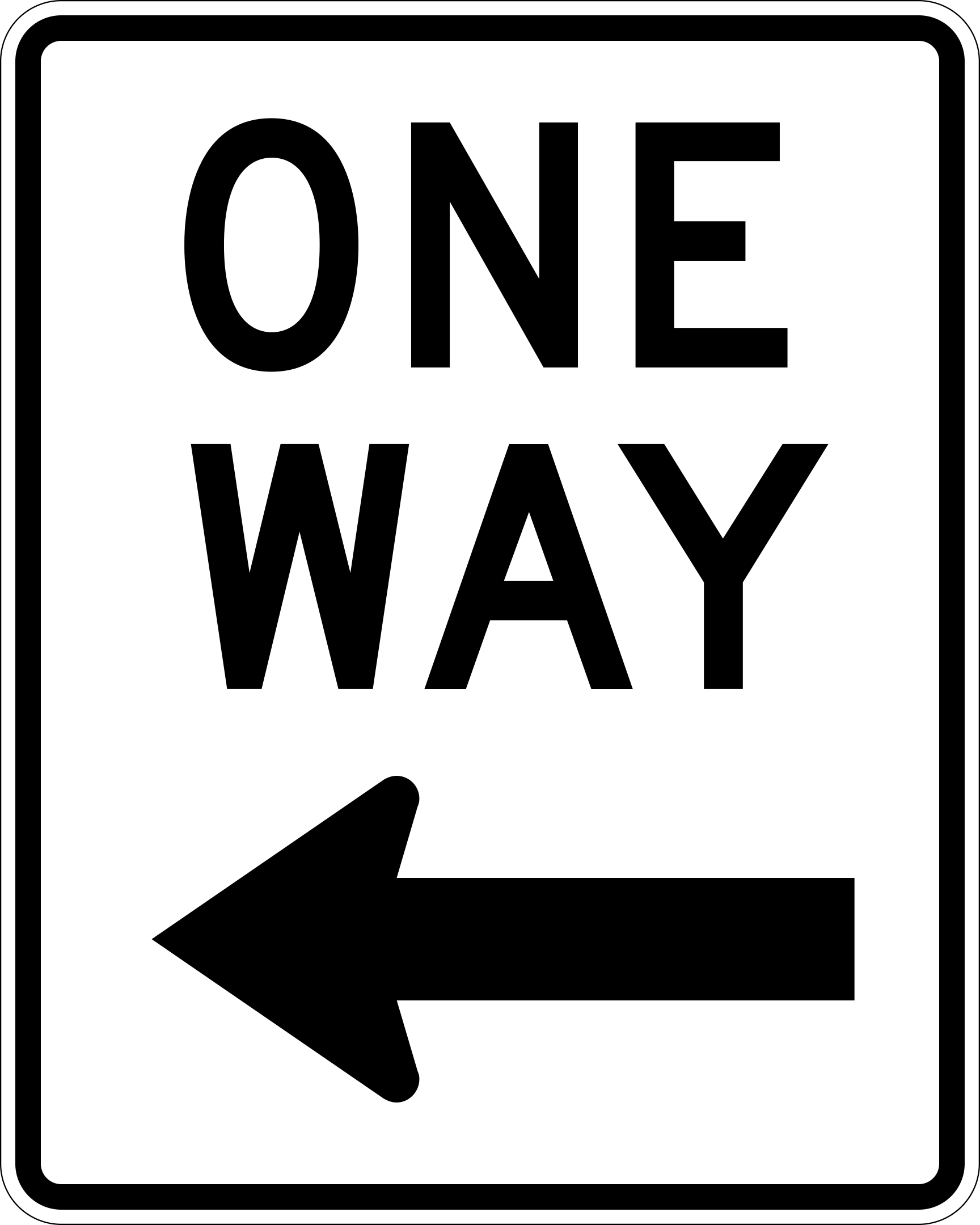
Do Not Enter is the entrance prohibition. The horizontal and vertical One Way signs tell the crossroad direction. This red sign is the one aimed at a driver already headed the wrong way.
What do Texas, California, and Florida call the driving that follows?
Texas Transportation Code section 545.063 requires the right-hand roadway where two or more roadways are separated by a space, a physical barrier, or a clearly indicated dividing section built to impede traffic, unless an official traffic-control device or a police officer directs otherwise. Crossing that divider is allowed only through an opening, or at a crossover or intersection a public authority established.
California Vehicle Code section 21651(b) makes driving anywhere but to the right of that divider a misdemeanor, and 21651(c) raises the penalty when a willful violation injures or kills someone: imprisonment under Penal Code section 1170(h), or up to 6 months in county jail. Florida Statutes section 316.088 requires driving only in the designated direction on a designated one-way roadway. None of the three sections prints a dollar fine.
What is the Wrong Way sign often mistaken for?
Do Not Enter (R5-1). Also mistaken for a warning; it is the last regulatory sign before a head-on situation.
| |
|---|---|
| GroupRegulatory signs | GroupRegulatory signs |
| ShapeHorizontal rectangle | ShapeSquare |
| ColorRed background, white legend and border | ColorWhite background, red circle containing a white horizontal bar, black legend |
| What it meansEvery lane around you faces the other way. | What it meansEntry in this direction is banned outright, because the lanes past the sign run at you rather than with you. |
What does the permit test ask about the Wrong Way sign?
This question is from the practice bank, with the answer marked.
This sign appearing in front of you means:
- A.You have missed your exit
- B.You have entered a one way road facing the wrong direction and must turn around(correct answer)
- C.The road ahead is one way in your direction
- D.A detour begins here
Source: MUTCD R5-1a
Questions drivers ask about the Wrong Way sign
I am already on the ramp. Should I keep going until I can turn around?
No. Section 2B.47 places this sign farther along the one-way roadway than Do Not Enter, and Section 2B.48 requires at least one on an exit ramp facing the wrong-way driver. Stop. California's handbook tells drivers who meet these signs to back out or turn around when it is safe. Driving farther up the ramp is how you meet traffic head-on.
Why is one of these signs mounted so low I could touch the bottom?
Section 2B.48 allows a minimum of 3 feet from the bottom of the sign to the near pavement edge, only for a sign along a freeway or expressway exit ramp downstream of the crossroad, facing wrong-way traffic, after an engineering study, and where there are no parked cars, no pedestrian activity, and no obstructions such as snow or vegetation. The lower height does not weaken the prohibition.
Does a Wrong Way sign mean the exit is closed for everybody?
No. It faces a driver traveling against the ramp. Lawful traffic leaving the freeway is moving the other way and sees the back of the sign. Section 2B.46 even tells agencies to turn away or shield a Do Not Enter that traffic it does not apply to could see.
Is there a legal smaller size?
Table 2B-1 lists a minimum of 30 by 18 inches for R5-1a. Single-lane conventional and expressway sizes are 36 by 24. Multi-lane, freeway, and oversized are 42 by 30. A smaller homemade plaque is not the sign in that table.
Sources
- MUTCD 11th Edition, Chapter 2B, Table 2B-1
- MUTCD 11th Edition (December 2023), Chapter 2B, Sections 2B.46, 2B.47, 2B.48 and Table 2B-1
- FHWA: MUTCD 11th Edition page (Revision 1, December 2025, is now the current version)
- California DMV, California Driver Handbook, Section 7: Laws and Rules of the Road
- Texas Transportation Code section 545.063
- California Vehicle Code section 21651
- Florida Statutes section 316.088 (2026)
What are the other regulatory signs?
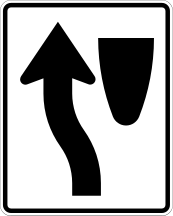

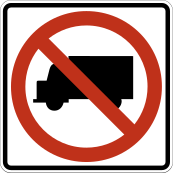
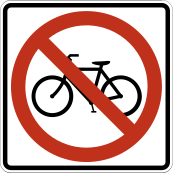
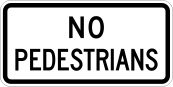
All 39 regulatory signs on one page, or every US road sign by shape and color.
Test yourself on this sign and the rest of the set with a road signs practice test for Florida, Texas, California or New York.
The artwork is the federal design itself, which the manual dedicates to the public domain in MUTCD 11th Edition, Part 1, Section 1D.06, checked 2026-09-09. The Interstate Shield, the 511 pictograph and the National Scenic Byway graphic are named exceptions and are not reproduced anywhere on this site.
Source: Manual on Uniform Traffic Control Devices, 11th Edition. Not affiliated with or endorsed by the Federal Highway Administration or any state agency.